Unit 3 Study Guide: Differentiation of Composite, Implicit, and Inverse Functions (AP Calculus AB)
The Chain Rule for Composite Functions
What a composite function is (and why it changes differentiation)
A composite function is a function built by feeding one function into another. If you start with an “inside” function %%LATEX0%% and then apply an “outside” function %%LATEX1%%, you get the composite
This matters for derivatives because the rate of change of %%LATEX3%% with respect to %%LATEX4%% happens in stages: %%LATEX5%% changes, which changes %%LATEX6%%, which then changes . Differentiating a composite is like tracking how a change “flows through” the layers.
A common misconception is to treat like a product and try to “differentiate each part separately.” Composition is not multiplication. You need a rule that accounts for the inner change.
The idea behind the chain rule (two equivalent forms)
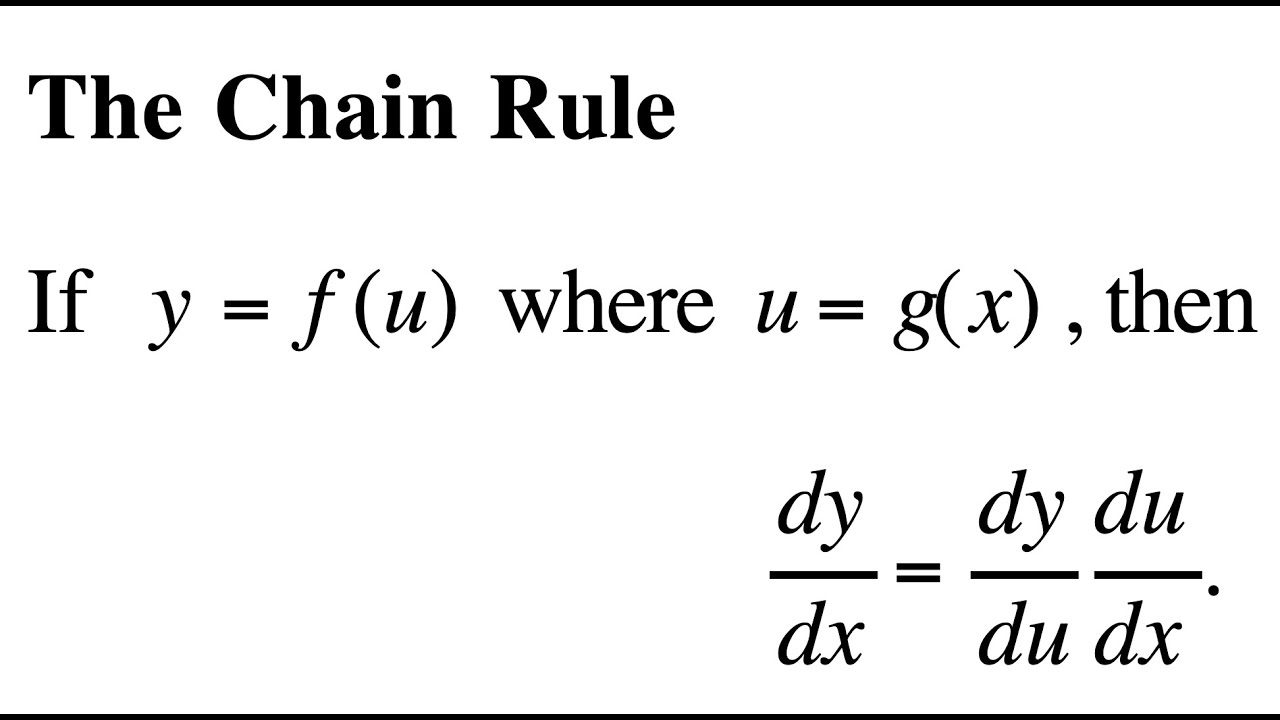
Think in terms of small changes. If %%LATEX9%% and %%LATEX10%%, then a small change in %%LATEX11%% produces a small change in %%LATEX12%%, and that produces a small change in . The chain rule formalizes “multiply the rates”:
In function notation, if , then
Interpretation: take the derivative of the outside function (treating the inside as the variable and leaving it alone), then multiply by the derivative of the inside (with respect to ).
Recognizing when you need the chain rule
You usually need the chain rule when you see “a function inside a function,” especially:
- Powers of expressions, like
- Trig of an expression, like
- Exponentials/logs of expressions, like
A quick check: if you can name an “inside” expression %%LATEX22%% so the function becomes something like %%LATEX23%%, you’re likely looking at chain rule.
Memory trick (mnemonic)
A popular way to remember the process for many chain rule problems (especially power-of-a-parenthesis forms) is:
- “douter, inner, dinner”: differentiate the outer layer, keep the inner expression, then multiply by the derivative of the inner.
Image reference from the original notes:
Worked examples
Example 1: Power of a linear function
Differentiate
- Identify inside and outside.
- Inside:
- Outside:
- Differentiate the outside with respect to .
- Multiply by .
- Substitute back:
A common mistake here is forgetting the factor of from the inner derivative.
Example 2: Trig of a polynomial
Differentiate
Outside derivative: derivative of %%LATEX34%% is %%LATEX35%%. Multiply by the inner derivative:
Notation you must be fluent with
AP problems switch notations often. These are equivalent ways to express derivatives.
Derivative of %%LATEX37%% with respect to %%LATEX38%%:
Derivative of %%LATEX41%% at input %%LATEX42%%:
Derivative of a composition:
When you see %%LATEX45%%, it’s a reminder that %%LATEX46%% depends on , which becomes crucial in implicit differentiation.
Exam Focus
- Typical question patterns:
- “Find %%LATEX48%%” where %%LATEX49%% includes nested expressions like trig, exponentials, logs, or powers.
- “Find the slope of the tangent line at ” for a composite function.
- “Differentiate and simplify” (often with multiple layers).
- Common mistakes:
- Forgetting to multiply by the derivative of the inside.
- Differentiating the inside correctly but not keeping it inside the outside derivative.
- Losing parentheses, especially with negatives and exponents.
Multiple Layers and Combining Differentiation Rules
Why “real” derivatives rarely use one rule
Most exam-level functions aren’t “just chain rule” or “just product rule.” They blend rules. The skill is not memorizing more formulas; it’s building a reliable process:
- Identify the overall structure (sum, product, quotient, composition).
- Apply the correct outer rule first.
- Inside that, apply whatever rule fits next.
A powerful mindset is: differentiate from the outside in.
Chain rule with products and quotients
If you have something like
this is a product of two composites. You must use the product rule, and inside each product term you’ll use the chain rule.
Product rule reminder:
Quotient rule reminder:
Common misconception: trying to apply chain rule to the whole expression without first acknowledging it is a product or quotient.
Chain rule with exponentials and logarithms
These appear constantly because they model growth/decay and multiplicative change.
Key base derivatives:
Then apply chain rule for inner expressions:
That last form is worth remembering: derivative of is “inner derivative over the inner.”
Worked examples
Example 1: Product + chain rule
Differentiate
Let
Then
Compute by chain rule:
Compute by chain rule:
Substitute:
You can factor to simplify:
Factoring is not always required, but it often reduces algebra errors later.
Example 2: Quotient + chain rule
Differentiate
Let %%LATEX71%% and %%LATEX72%%. Then
Compute
So
A typical mistake is differentiating %%LATEX77%% as %%LATEX78%% and forgetting the factor of .
Example 3: Log of an expression
Differentiate
Use the pattern
Here %%LATEX82%% so %%LATEX83%%:
Note the domain: %%LATEX85%% (so %%LATEX86%%). AP may ask about where the function (and derivative) is defined.
Exam Focus
- Typical question patterns:
- Differentiate expressions that require product/quotient rule and chain rule.
- Simplify or factor a derivative for later analysis (critical points, sign charts).
- Use derivatives of %%LATEX87%% or %%LATEX88%% in context.
- Common mistakes:
- Applying chain rule “across” a product instead of using product rule.
- Algebra mistakes after differentiating correctly (lost parentheses, sign errors).
- Forgetting domain restrictions for logarithms (argument must be positive).
Implicit Differentiation: Differentiating When Is Hidden
What “implicit” means
An equation is implicit when %%LATEX90%% is not isolated as a function of %%LATEX91%%. For example,
describes a circle. You can solve for as
but that splits the circle into two functions and introduces extra algebra. Implicit differentiation lets you find directly from the original relation.
This matters because many curves in geometry, physics, and economics are naturally written as relations, not neat explicit functions.
The key idea: treat %%LATEX96%% as a function of %%LATEX97%%
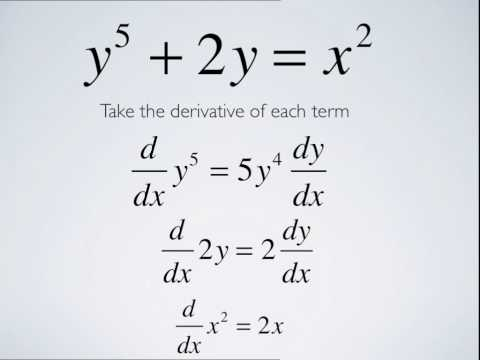
When you differentiate an implicit equation with respect to %%LATEX98%%, you assume %%LATEX99%% depends on . That means:
- The derivative of %%LATEX101%% with respect to %%LATEX102%% is not .
- When differentiating terms involving %%LATEX104%%, you must multiply by %%LATEX105%% via the chain rule.
For instance,
And if you have %%LATEX107%%, think “outside is cube, inside is %%LATEX108%%”:
A very common mistake is to write
as if were a constant. It isn’t.
A helpful rule-of-thumb description (often how students catch themselves mid-problem) is: if you differentiate something and the variable does not match the “with respect to” variable, you must follow it with the derivative of that variable with respect to %%LATEX112%%. That is why differentiating %%LATEX113%% gives a factor of .
Relating %%LATEX115%% and %%LATEX116%% (reciprocal relationship)
Sometimes a problem or a student workflow leads to finding %%LATEX117%% instead of %%LATEX118%%. When the derivative is defined and nonzero, they are reciprocals:
This reciprocal idea can also help you check work: if one is very large in magnitude, the other should be very small in magnitude.
The implicit differentiation process
For an equation involving %%LATEX120%% and %%LATEX121%%:
- Differentiate both sides with respect to .
- Every time you differentiate a term containing %%LATEX123%%, include %%LATEX124%%.
- Collect all terms with on one side.
- Factor out and solve.
You can (and often must) apply other rules like product rule or quotient rule when terms contain both %%LATEX127%% and %%LATEX128%%. The AP exam loves to do this.
Image reference from the original notes:
Worked examples
Example 1: Circle slope (and tangent line at a point)
Given
find .
Differentiate both sides:
Compute each derivative:
Solve for :
At the point %%LATEX136%%, substitute %%LATEX137%% and :
So the slope of the tangent line is %%LATEX140%%. Using point-slope form with the point %%LATEX141%%:
Example 2: Mixed powers and products
Differentiate implicitly:
Differentiate term by term. The first term is a product in %%LATEX144%% and %%LATEX145%%, so use product rule:
And
Right-hand side derivative is . Put together:
Group the terms:
Factor:
Solve:
A common mistake is forgetting product rule on %%LATEX154%% and differentiating it as %%LATEX155%% only.
Exam Focus
- Typical question patterns:
- “Find for the curve given implicitly.”
- “Find the slope of the tangent line at a given point on an implicit curve.”
- “Find an equation of the tangent line” using point-slope form after finding the slope.
- Common mistakes:
- Treating %%LATEX157%% like a constant (missing %%LATEX158%% factors).
- Forgetting product rule/quotient rule when terms involve both %%LATEX159%% and %%LATEX160%%.
- Solving for incorrectly due to algebra (especially sign errors).
Second Derivatives and Tangent/Normal Lines from Implicit Relations
Why you might need implicitly
Sometimes you’re asked about concavity or acceleration along a curve described implicitly. Concavity is controlled by the second derivative:
When %%LATEX164%% is given implicitly, you typically find %%LATEX165%% first, then differentiate that expression with respect to %%LATEX166%%, being careful that %%LATEX167%% is still a function of .
A common trap: once you have %%LATEX169%% in terms of %%LATEX170%% and %%LATEX171%%, differentiating again usually requires chain rule (because of %%LATEX172%%) and often quotient rule.
A practical tip: if you’re required to take a second derivative, simplify the first derivative before you start the second-derivative step.
Tangent lines vs normal lines
At a point on a curve:
- The tangent line has slope
- The normal line is perpendicular to the tangent, so its slope is the negative reciprocal:
(as long as ).
If the tangent slope is , the normal line is vertical. If the tangent is vertical (undefined slope), the normal is horizontal.
Worked example: implicit second derivative
Given
we found
Now compute .
Differentiate both sides of
with respect to %%LATEX181%%. The right side is a quotient of %%LATEX182%% and %%LATEX183%%, and %%LATEX184%% depends on %%LATEX185%%. Use quotient rule on %%LATEX186%%.
Let %%LATEX187%% and %%LATEX188%%. Then
Here %%LATEX190%% and %%LATEX191%%, so
Because
substitute:
Combine the numerator:
Now include the negative sign from :
On the circle, , so
At the point ,
This is negative, so the upper semicircle is concave down there.
Worked example: tangent and normal lines
For the same circle at :
Tangent slope:
Tangent line:
Normal slope:
Normal line:
A typical error is flipping the slope but forgetting the negative sign (or applying it twice).
Exam Focus
- Typical question patterns:
- “Find for an implicitly defined curve and evaluate at a point.”
- “Find the equation of the tangent line and/or normal line at a point.”
- “Determine concavity at a point on an implicit curve.”
- Common mistakes:
- Differentiating expressions containing without chain rule on the second derivative step.
- Substituting the point too early (before finishing differentiating), which can hide where should appear.
- Incorrect negative reciprocal for the normal line slope.
Inverse Functions and the Derivative of an Inverse
What an inverse function really does
An inverse function reverses the input-output relationship of a function. If , then
Graphically, %%LATEX212%% and %%LATEX213%% are reflections across the line
Not every function has an inverse that is also a function. For an inverse to be a function, %%LATEX215%% must be one-to-one (each output comes from exactly one input). A practical calculus-friendly condition is that %%LATEX216%% is strictly increasing or strictly decreasing on the interval of interest.
The inverse-derivative formula (from the chain rule)
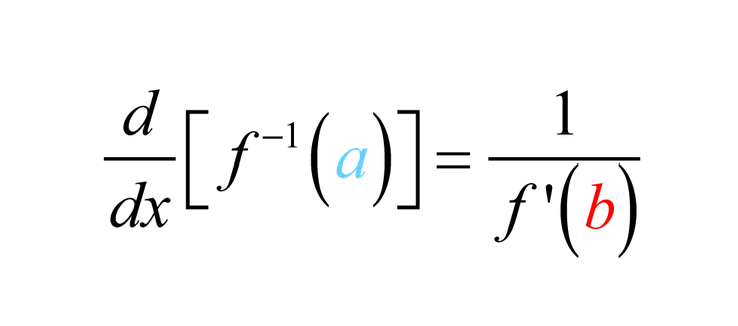
If %%LATEX217%% and %%LATEX218%% are inverses, then
Differentiate both sides with respect to :
Solve for the derivative of the inverse:
A key condition: you need %%LATEX223%% for this formula to make sense. Geometrically, if %%LATEX224%% has a horizontal tangent at some point, its inverse has a vertical tangent there, so the inverse derivative is undefined.
Image reference from the original notes:
The point-specific version (most common on AP)
If %%LATEX225%%, then %%LATEX226%% and
A very test-friendly way to think about the point matching is: points swap. If a point %%LATEX228%% lies on the graph of %%LATEX229%%, then %%LATEX230%% lies on the graph of %%LATEX231%%.
Worked examples
Example 1: Using the point-specific inverse formula
Suppose %%LATEX232%% and %%LATEX233%%. Find .
Because %%LATEX235%%, we know %%LATEX236%%. Then
A common mistake is answering %%LATEX238%%. You must evaluate %%LATEX239%% at the input that maps to %%LATEX240%%, which is %%LATEX241%%.
Example 2: Inverse derivative from an explicit function
Let
Find .
First find %%LATEX244%% such that %%LATEX245%%:
The real solution is . Now compute
So , and
This is much faster than solving for explicitly.
How to interpret “corresponding points” (the (1,2) vs (2,1) idea)
If you want the slope of the inverse at an input, you must locate the corresponding point on the original function. For instance, if a point %%LATEX254%% lies on %%LATEX255%% where %%LATEX256%%, then the corresponding point on %%LATEX257%% is . The derivative relationship matches that swap: to find the inverse’s slope at the first point, you take the reciprocal of the original function’s slope at the swapped point.
Interpreting inverse-derivative behavior
Because inverse functions reflect across %%LATEX259%%, slopes also “flip.” If %%LATEX260%% has a steep slope at a point, its inverse has a shallow slope at the corresponding reflected point.
If %%LATEX261%% is negative, then %%LATEX262%% is decreasing at %%LATEX263%%, and its inverse is also decreasing at %%LATEX264%%. The reciprocal keeps the sign:
Exam Focus
- Typical question patterns:
- Given %%LATEX266%% and %%LATEX267%%, find .
- Use a table of values for %%LATEX269%% and %%LATEX270%% to compute a specific inverse derivative.
- Use the identity and differentiate to derive or justify a result.
- Common mistakes:
- Plugging in the wrong input when evaluating .
- Forgetting that the inverse derivative may be undefined if .
- Confusing %%LATEX274%% with %%LATEX275%%.
- AP pacing note:
- The exam often includes only 1–2 inverse-derivative questions, so prioritize accuracy on the “match the point, then take the reciprocal” process.
Inverse Trigonometric Functions and Their Derivatives
What inverse trig functions mean (conceptually)
Inverse trigonometric functions undo trig functions, but you must be careful: trig functions like repeat, so they are not one-to-one on all real numbers. To define inverses, we restrict domains.
For example, arcsine is the inverse of sine on a restricted interval:
- %%LATEX277%% means %%LATEX278%% with restricted to a principal range.
The most important idea is: inverse trig functions are best understood as angles as outputs. Their derivatives come from implicit differentiation combined with trig identities.
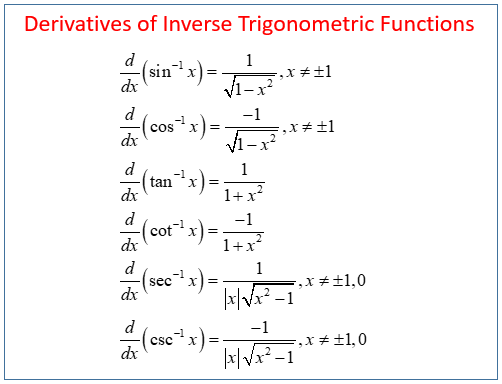
Image reference from the original notes (memorization chart):
The core derivatives (with domain notes)
These are standard AP Calculus AB derivatives:
You may also see:
\frac{d}{dx}[\arccot(x)]=-\frac{1}{1+x^2}
\frac{d}{dx}[\arcsec(x)]=\frac{1}{|x|\sqrt{x^2-1}}
\frac{d}{dx}[\arccsc(x)]=-\frac{1}{|x|\sqrt{x^2-1}}
The absolute value in the last two derivatives is required for correctness across negative values.
These derivatives only make sense where the functions are defined. For instance, %%LATEX287%% and %%LATEX288%% require %%LATEX289%%, and their derivatives blow up near %%LATEX290%% because the square root in the denominator goes to zero.
Why arcsin and arctan derivatives look the way they do (derivation idea)
Take , meaning
Differentiate implicitly:
So
But your derivative must be in terms of %%LATEX295%%, not %%LATEX296%%. Since ,
That produces
This reasoning explains where the square root comes from and why the sign is chosen to match the principal range.
Chain rule with inverse trig
Inverse trig derivatives almost always appear with an inner function. Use chain rule:
Worked examples
Example 1: Arcsin with an inner function
Differentiate
Use the pattern for %%LATEX303%% with %%LATEX304%% and :
Domain note: need %%LATEX307%%, so %%LATEX308%%.
Example 2: Arctan with a polynomial
Differentiate
Here %%LATEX310%% and %%LATEX311%%:
A common mistake is writing (confusing the formula).
Exam Focus
- Typical question patterns:
- Differentiate expressions containing %%LATEX314%%, %%LATEX315%%, or with an inner function.
- Use an inverse trig derivative as part of a larger product/quotient.
- Analyze where an inverse trig derivative is defined (domain/denominator constraints).
- Common mistakes:
- Forgetting chain rule for %%LATEX317%% or %%LATEX318%%.
- Dropping parentheses: must square the entire inner function.
- Ignoring domain restrictions, especially for %%LATEX320%% and %%LATEX321%%.
Strategy for Mixed Composite, Implicit, and Inverse Differentiation Problems
Why “strategy” matters more than memorizing more rules
Unit 3 problems often test whether you can recognize structure and choose the right tool. Many AP questions intentionally combine ideas:
- A curve is given implicitly, but contains a composite term like
- An inverse relationship is present, but you are expected to use inverse-derivative logic instead of finding the inverse.
- A derivative must be evaluated at a point that you can only find from the original relation.
A reliable decision process
When you see a differentiation task, walk through these questions:
- Is %%LATEX323%% explicitly written as a function of %%LATEX324%%?
- If no, you likely need implicit differentiation.
- Do you see “a function inside a function”?
- If yes, chain rule is involved (maybe nested many times).
- Is there an inverse function mentioned (like %%LATEX325%% or %%LATEX326%%)?
- If yes, consider inverse-derivative formulas or inverse trig derivatives.
- Is the overall structure a product or quotient?
- Apply product/quotient rule first, then chain rule inside.
You don’t have to label every step with a rule name, but you do need to respect the structure.
Worked example: implicit + chain rule
Differentiate implicitly:
Differentiate both sides:
So
Solve:
A classic mistake is differentiating %%LATEX334%% as %%LATEX335%% and stopping there.
Worked example: inverse derivative using a table/point
Suppose a function is one-to-one and differentiable, and you know
Find .
Use the point-specific inverse derivative formula:
Interpretation: the inverse is decreasing at input , and its slope is the reciprocal of the original slope.
Worked example: combining inverse trig and chain rule inside a larger expression
Differentiate
This is a product, so use product rule. Let
Then
Compute
For , use inverse trig derivative plus chain rule:
So
Common mistakes here include forgetting product rule (only differentiating one factor) or writing (squaring incorrectly).
A note on calculator-active questions
Even when the question is conceptual, the exam may provide a graph or table for %%LATEX351%% and ask about %%LATEX352%% or a composite. In those cases, you’re often expected to:
- Use the meaning of inverse: if %%LATEX353%% then %%LATEX354%%
- Use the inverse derivative rule at a point
- Read values carefully from a table (and not confuse inputs/outputs)
Accuracy in reading and matching coordinates is as important as calculus skills.
Exam Focus
- Typical question patterns:
- Differentiate an implicit equation where some terms require chain rule (like trig or exponentials in ).
- Use a table/graph to compute %%LATEX356%% from %%LATEX357%% where .
- Mixed-rule differentiation (product/quotient with inverse trig or logs inside).
- Common mistakes:
- Mixing up inputs and outputs when switching between %%LATEX359%% and %%LATEX360%%.
- Forgetting that %%LATEX361%% includes %%LATEX362%% in implicit problems.
- Algebra slips after correct differentiation (especially squaring inner functions incorrectly).
Quick Hints and Efficiency Moves (All Unit 3 Topics)
Practical hints (including when to plug in a point)
These are quick decision cues that help on multi-skill AP questions:
- When two terms are multiplied together, use the product rule unless it’s clearly easier and safer to multiply it out first.
- If you see a function within another function, you will almost certainly have to use the chain rule.
- If there are %%LATEX363%% and %%LATEX364%% terms mixed together in one equation, you will need implicit differentiation.
- If you’re finding a derivative at a point, it’s often best to find the general derivative first and then plug the point in, rather than solving to isolate .
- When evaluating derivatives at a point, look for terms that become %%LATEX366%% or %%LATEX367%% after substitution because that can dramatically simplify arithmetic.
- You can mentally take certain derivatives (for example, basic powers and the core trig/exponential/log forms) to save time, but still write enough work to avoid algebra slips.
- If you must take a second derivative, simplify the first derivative before differentiating again.
Exam Focus
- Typical question patterns:
- “Find the derivative and evaluate at %%LATEX368%%” where plugging in early may simplify arithmetic, but plugging in too early during implicit second-derivative work can cause missing %%LATEX369%% terms.
- Mixed-rule multiple-choice questions designed to trigger a wrong “single-rule” approach.
- Common mistakes:
- Choosing a rule based on what you “notice first” instead of the overall structure (for example, doing chain rule when the outermost structure is actually a product).
- Plugging in a point before the differentiation is complete in implicit second-derivative problems.
- Dropping parentheses or squaring only part of an inner expression.