Period 5: Post-Civil War Recovery and Rights (1865–1877)
Competing Visions for Reconstruction
Reconstruction refers to the period immediately following the Civil War (1865–1877) focused on reintegrating the former Confederate states into the Union and defining the legal status of African Americans. It was characterized by a fierce political struggle between the Executive branch and the Legislative branch over how to rebuild the South.
Presidential Reconstruction (1863–1866)
Led initially by Abraham Lincoln and continued by Andrew Johnson, this approach favored leniency and a quick restoration of the Union.
- Lincoln’s 10% Plan: Lincoln believed the South had never legally left the Union. His Proclamation of Amnesty and Reconstruction offered pardons to Southerners who swore allegiance to the Union. Once 10% of the 1860 voting population took the oath, the state could form a new government.
- The Wade-Davis Bill (1864): Radical Republicans in Congress countered Lincoln with this bill, requiring a majority (50%) of white males to swear loyalty. Lincoln pocket-vetoed it, signaling early tension between the White House and Congress.
- Johnson’s Plan: After Lincoln’s assassination, Andrew Johnson (a Southern Democrat who stayed loyal to the Union) took over. He offered amnesty to most Confederates but required wealthy planters to ask him personally for a pardon. He allowed Southern states to pass Black Codes, laws that restricted the rights of freedmen (e.g., prohibiting them from borrowing money to buy land or testifying against whites).
Radical (Congressional) Reconstruction (1867–1877)
Horrified by Southern resistance and Johnson’s leniency, the Radical Republicans in Congress took control. They viewed the South as conquered territory and aimed to fundamentally transform Southern society.
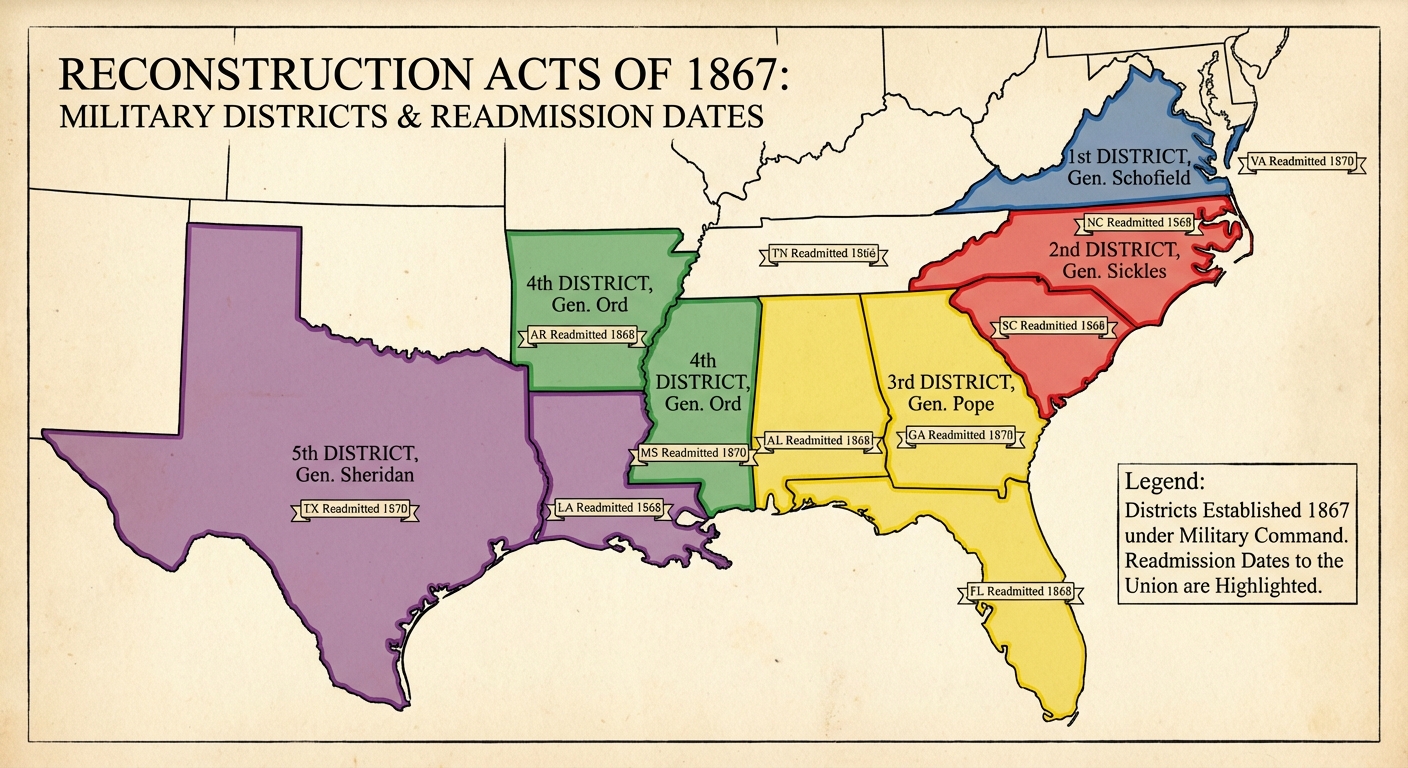
- Reconstruction Acts of 1867: Congress divided the South into five military districts, each commanded by a Union general. States had to ratify the 14th Amendment and guarantee black suffrage to be readmitted.
- Impeachment of Andrew Johnson: To stop Johnson from obstructing their plans, Congress passed the Tenure of Office Act. When Johnson fired Secretary of War Edwin Stanton, Congress impeached him. He survived removal by one single vote in the Senate, but his political power was shattered.
| Feature | Presidential Reconstruction | Radical (Congressional) Reconstruction |
|---|---|---|
| Primary Goal | Quick reunification; ending the war spirit. | Transforming Southern society; punishing rebels; protecting rights. |
| Treatment of Confederates | Lenient; widespread pardons. | Harsh; disenfranchised leaders; military occupation. |
| Rights for Freedmen | Very limited; allowed Black Codes. | Extensive; enforced Constitutional amendments; Freedmen's Bureau. |
Constitutional Amendments & Federal Legislation
The most enduring legacy of this era is the trio of "Reconstruction Amendments."
The Reconstruction Amendments
A useful mnemonic to remember the order and content is "Free Citizens Vote".
- 13th Amendment (1865): Free. Abolished slavery and involuntary servitude, except as punishment for a crime.
- 14th Amendment (1868): Citizens. Granted citizenship to all persons born or naturalized in the U.S. (overturning the Dred Scott decision). It included the Equal Protection Clause and the Due Process Clause, which became the foundation for future civil rights cases.
- 15th Amendment (1870): Vote. Prohibited denying the right to vote based on "race, color, or previous condition of servitude."
- Note: It did not grant women the right to vote, leading to a split in the women’s rights movement (e.g., Elizabeth Cady Stanton and Susan B. Anthony opposed the amendment because it excluded women).
The Freedmen’s Bureau
Established in 1865, the Freedmen’s Bureau was an early welfare agency providing food, shelter, and medical aid to those made destitute by the war.
- Major Success: Education. The Bureau established nearly 3,000 schools for freed blacks, including colleges like Howard University and Fisk University.
- Limitations: It failed to redistribute land ("40 acres and a mule" never happened on a large scale), leaving former slaves economically vulnerable.
Social and Economic Changes in the South
The New Southern Economy
With the slave system destroyed, the Southern economy collapsed. A new system emerged to replace slave labor.
- Sharecropping: Without land or capital, freedmen worked a portion of a planter’s land in exchange for a share of the crop (usually half). Landowners provided seed and tools on credit.
- Crop-Lien System: Storekeepers granted credit to local farmers in exchange for a lien on their future crops. High interest rates often created a cycle of debt, trapping sharecroppers (both black and poor white) to the land in a state largely indistinguishable from peonage.

Political Realignment in the South
For a brief period, African American men voted and held office. Two Black Senators (Hiram Revels and Blanche K. Bruce) were elected from Mississippi.
- Scalawags: A derogatory term for Southern Republicans. They were often former Whigs interested in economic development.
- Carpetbaggers: A derogatory term for Northerners who moved South. While some were corrupt opportunists, many were teachers, ministers, or investors helping to rebuild.
The Failure of Reconstruction
Despite legislative gains, Reconstruction ultimately collapsed due to Southern resistance and Northern exhaustion.
1. Southern Resistance
- Ku Klux Klan (KKK): Founded in 1867 by ex-Confederate Nathaniel Bedford Forrest, the KKK used domestic terrorism (burning buildings, lynchings) to intimidate black voters and Republicans.
- Force Acts (1870–1871): Congress passed these to give federal power to stop KKK violence, but enforcement was difficult and waning.
- "Redeemers": Southern Democrats who slowly regained control of state governments. They sought to oust the Radical Republicans and restore white supremacy.
2. Waning Northern Resolve
- The Panic of 1873: A massive economic depression shifted Northern attention away from civil rights toward the economy.
- Corruption: Scandals in the Grant administration (e.g., Crédit Mobilier, Whiskey Ring) disillusioned voters and weakened the Republican party.
3. The Compromise of 1877
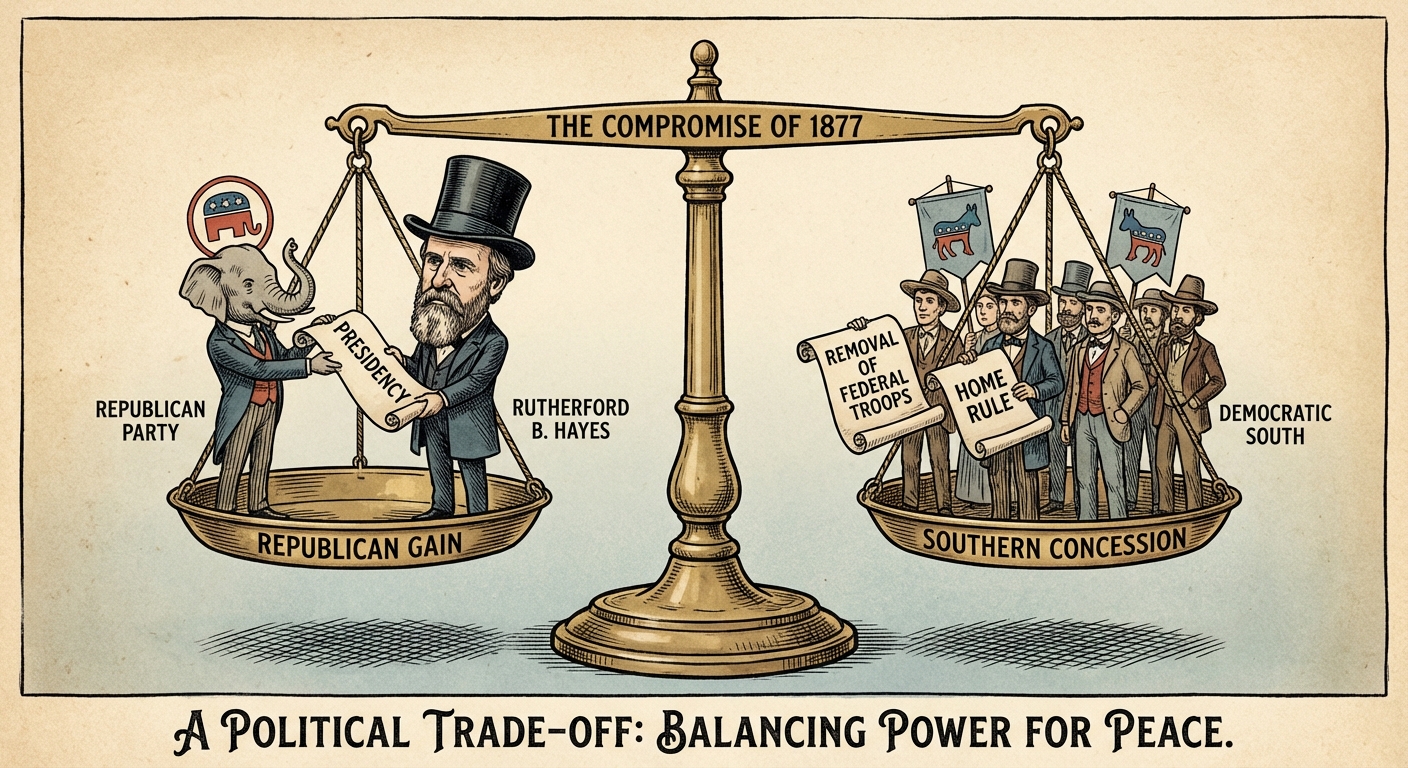
The end of Reconstruction came with the disputed election of 1876 between Rutherford B. Hayes (Republican) and Samuel Tilden (Democrat).
- The Deal: A special electoral commission gave the disputed votes to Hayes.
- The Condition: In return, Hayes agreed to withdraw the last federal troops from the South (SC, FL, LA).
- Result: The South was "Redeemed," leading to the establishment of Jim Crow laws, disenfranchisement (poll taxes, literacy tests), and segregation that would last nearly a century.
Common Mistakes & Pitfalls
- Confusing the Amendments: Students often mix up what the 14th and 15th amendments did. Remember: 13=Freedom, 14=Citizenship, 15=Vote.
- "Sharecropping was only for Black people": Incorrect. By 1880, a significant percentage of white farmers in the South were also sharecroppers. It was a class issue as well as a race issue.
- Emancipation Proclamation vs. 13th Amendment: The Emancipation Proclamation (1863) only freed slaves in rebelling territories. The 13th Amendment (1865) freed all slaves, including those in border states like Kentucky and Delaware.
- Assuming Reconstruction was a total failure: While it failed to secure long-term civil rights enforcement, the 14th and 15th Amendments remained in the Constitution. They laid the necessary legal groundwork for the Civil Rights Movement of the 1950s and 1960s.