Comprehensive Guide to Pliny's Selected Epistles (Unit 3)
Epistulae VII.27: Ghosts and the Supernatural
Unlike the factual reportage of the Eruption of Vesuvius (VI.16), Letter VII.27 addresses the universal human fascination with the supernatural. Pliny writes to his friend Licinius Sura, a learned man, asking for his opinion on whether ghosts (idola) have a real existence or if they are merely figments of our fears.
The Narrative Structure
Pliny uses a tripartite structure, presenting three anecdotes to support the existence of ghosts. The most famous is the central story of Athenodorus.
The Haunted House in Athens
Use this summary to verify your translation of lines 5–11:
- The Setting: A large, spacious house in Athens gained a bad reputation (infamis) and became deserted due to terrifying night noises.
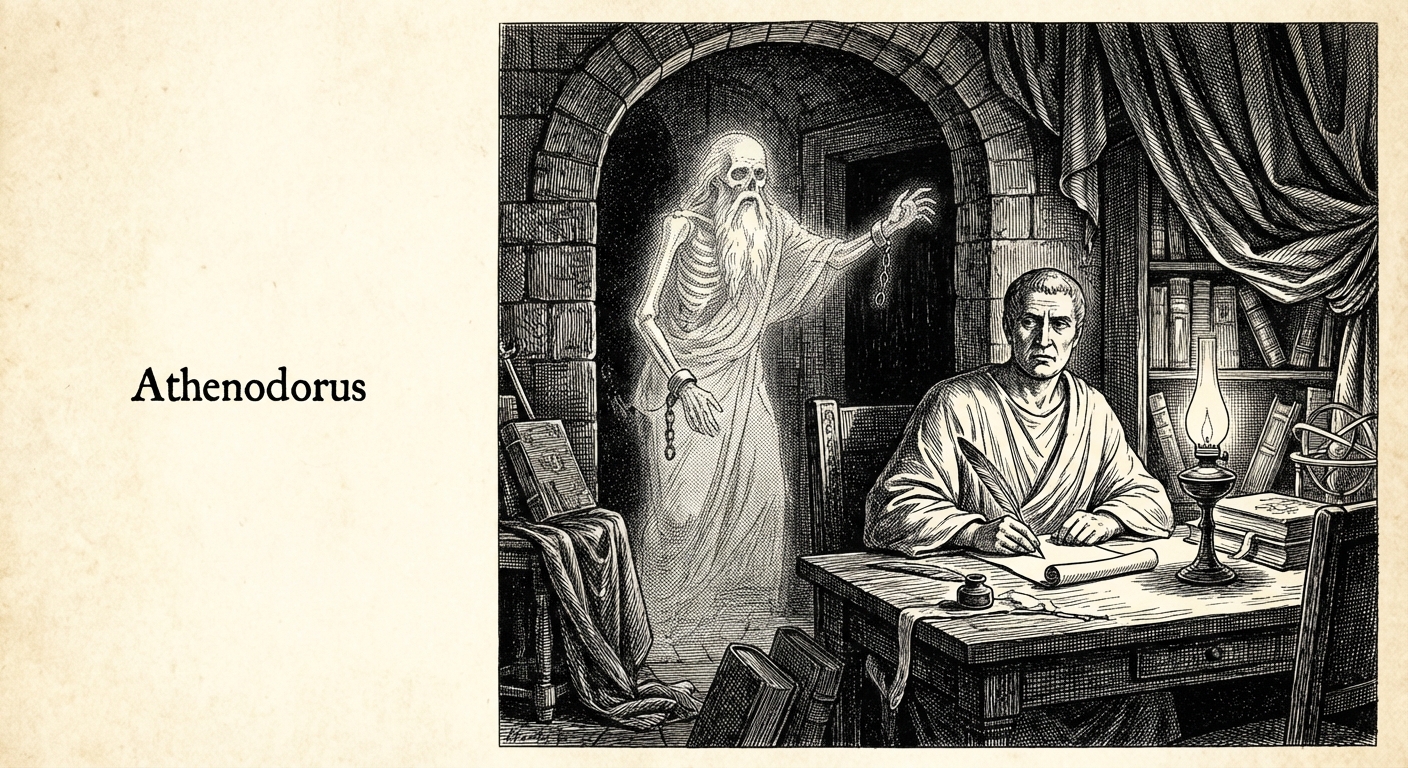
- The Phenomenon: Sounds of iron clashing and chains rattling (strepitus vinculorum) preceded the appearance of a terrifying old man—emaciated, dirty, with long hair and beard, shaking chains on his hands and feet.
- The Intervention: The philosopher Athenodorus rents the house cheap. He sets up his workspace at night to keep his mind busy so his imagination doesn't conjure fears.
- ** The Climax:** The ghost appears. Athenodorus calmly gestures for it to wait while he finishes his writing (a display of Stoic calm). The ghost beckons; Athenodorus follows it to the courtyard, where the ghost vanishes.
- The Resolution: Magistrates dig up the spot the next day. They find bones bound in chains. Once the bones are given a proper burial (rite conditis), the haunting ceases.
Key Concept: This letter underscores the Roman religious necessity of proper burial rites. A soul cannot rest if its body is unburied or dishonored.
Important Vocabulary & Grammar
- Idolum: A Greek loan word used for "specter" or "apparition."
- Silentium vs. Strepitus: Pliny juxtaposes the silence of the night with the clashing noise of chains to build tension.
- Capax, capacissima: Used to describe the house; note the use of the superlative adjectives.
Letters to Trajan (X.96, X.97): Administration & Christians
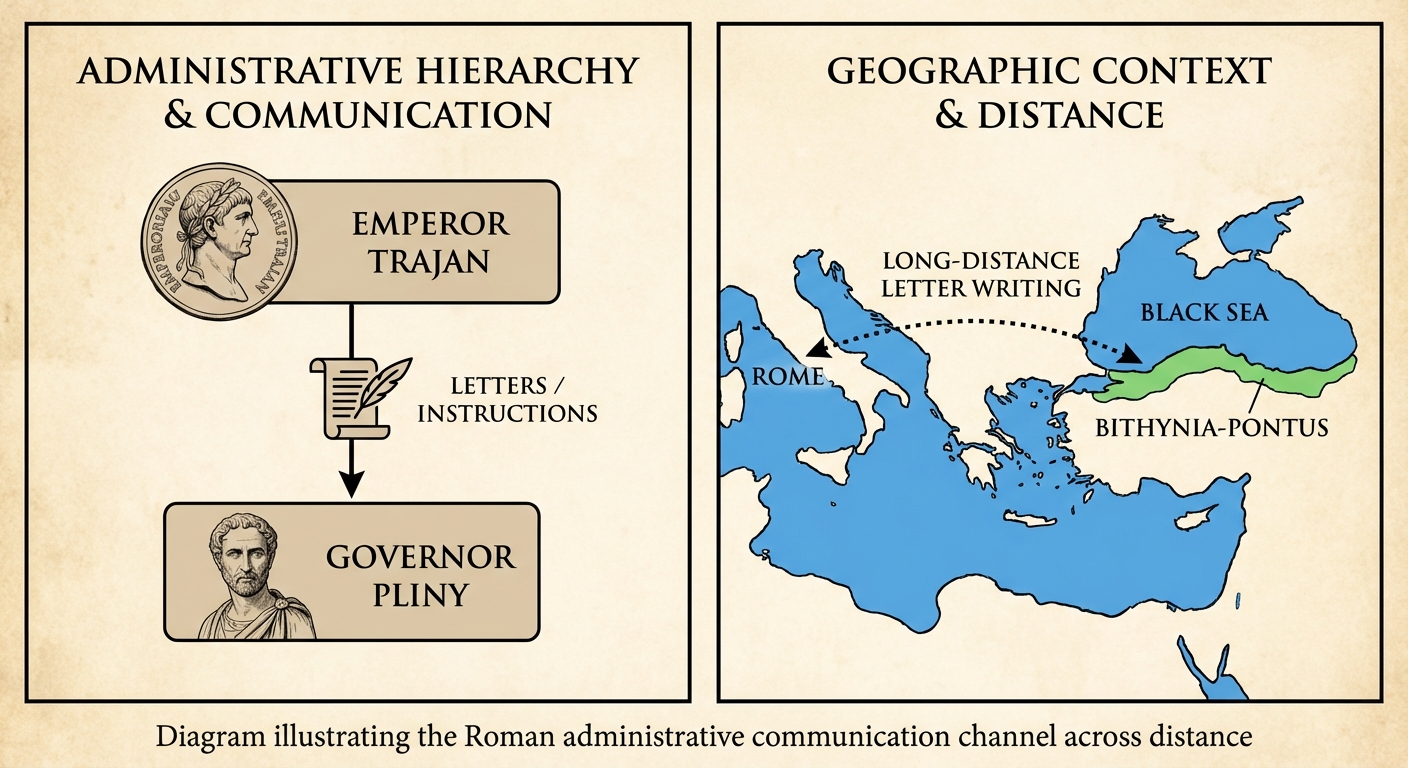
These letters are historically vital as the earliest non-Christian account of early Christian worship practices and the Roman legal response to them. They illustrate the provincial administration system in Bithynia-Pontus (modern Turkey), c. 112 CE.
Epistula X.96: Pliny's Inquiry
Pliny writes to Emperor Trajan because he is unsure how to handle trials (cognitio) of Christians. He admits he has never been present at such trials.
Pliny's Three Questions
- Age Distinction: Should the young be treated differently from adults?
- recantation: If one ceases to be a Christian, should they be pardoned?
- The Crime: Is the mere "name" of Christian (nomen ipsum) punishable, or only the crimes associated with the name (flagitia cohaerentia)?
Pliny's Procedure
Pliny describes his current method for those accused:
- He asks them, "Are you a Christian?" three times, threatening death.
- If they persist (obstinatio), he executes them. He rationalizes this not on religious grounds, but because stubbornness against a Roman governor's order is a capital offense.
- Roman Citizens: Those who are citizens are sent to Rome for trial.
Results of Investigation
Pliny tortured two female slaves (deaconesses) to find the truth but found only "depraved, excessive superstition" (superstitionem pravam, immodicam). He notes that Christians met before dawn, sang hymns to Christ "as to a god," and swore oaths—not to commit crimes, but to abstain from theft, adultery, and fraud.
Epistula X.97: Trajan's Rescript
Trajan’s reply is a masterpiece of Roman administrative brevity. It sets a legal precedent that lasted for nearly two centuries.
- No General Rule: Trajan states that no fixed rule (certam formam) can be applied universally.
- Conquirendi non sunt: "They are not to be sought out." (i.e., do not launch a witch hunt).
- Libellus sine auctore: Anonymous accusations must be ignored. Trajan calls them "a very bad precedent" and not fitting for "our age" (nec nostri saeculi est).
Letters to Calpurnia: Personal Relationships
Pliny's letters to his third wife, Calpurnia (specifically IV.19, VI.7, or VII.5), contrast sharply with his political correspondence. They humanize him and offer a glimpse into the Roman domestic ideal among the elite.
Epistula IV.19 (To Calpurnia Hispulla)
Pliny writes to his wife's aunt (Hispulla) to thank her for Calpurnia's upbringing. He praises Calpurnia not for her beauty, but for her:
- Acument: Sharpness/intelligence.
- Frugalitas: Frugality/modesty.
- Literary Devotion: She reads and memorizes his books. She sits behind a curtain during his recitations to listen to the audience's praise.
Key Themes
- Companionate Marriage: Unlike the strategic political marriages of the Republic, Pliny depicts a marriage based on mutual affection (amor) and intellectual compatibility.
- The Age Gap: Pliny was significantly older than Calpurnia. He frames her affection for him as affection for his gloria (literary fame).
Prose Composition and Epistolary Style
Pliny belongs to the "Silver Age" of Latin literature (approx. 14–117 CE). His style differs significantly from the "Golden Age" prose of Cicero.
Characteristics of Pliny's Style
- Conciseness (Brevitas): While Cicero used long, rolling periodic sentences, Pliny prefers shorter, punchier clauses.
- Varietas (Variety): He avoids repeating the same sentence structure to keep the reader engaged.
- Tricolon: He frequently uses lists of three items, often growing in length or intensity (tricolon crescens).
- Asyndeton: Omission of conjunctions to speed up the narrative (e.g., in the Ghost story).
- Litotes: Using a double negative to express a strong positive (e.g., non dubito - "I do not doubt" = I am sure).
- Hendiadys: Expressing a single idea using two words connected by "and" (e.g., vincula et auris - "chains and ears" for "sound of chains").
Grammar Watch: Indirect Statement
Pliny’s letters rely heavily on Indirect Statement (Oratio Obliqua) because he is often reporting what people said, heard, or thought.
Example from VII.27:
- Narrat… venisse ("He tells that… [the ghost] came").
- Watch for the Reflexive Pronoun (se): In indirect statement, se usually refers back to the main subject of the sentence.
Common Mistakes & Pitfalls
- Misinterpreting Pliny's Tone in X.96: Students often think Pliny hates Christians. In reality, he is indifferent to the religion but concerned about social order and legal procedure. He describes the religion merely as a "superstition," which to a Roman meant "improper/excessive worship," not necessarily "fake."
- Translating Conquirendi non sunt: In Trajan's reply (X.97), this is a passive periphrastic. It means "They must not be searched for." It is a prohibition against police action, not a statement of fact.
- Confusing the "Ghost" Vocabulary: Ensure you distinguish between simulacrum (image/likeness), effigies (statue/image), and idolum (specter/ghost). In VII.27, idolum is the specific spooky term.
- Gender of Calpurnia contexts: When translating letters about Calpurnia, pay attention to adjectives. Pliny praises her intellect (acumen - neuter) and her morals, not just her physical self.