Unit 3: The Path to Independence (1754–1776)
The Seven Years' War (The French and Indian War)
To understand the American Revolution, you must understand the war that preceded it. The Seven Years' War (1754–1763) was a global conflict, but the North American theater (known as the French and Indian War) fundamentally altered the relationship between Britain and its colonies.
Causes and The Albany Plan
The conflict began over territorial disputes in the Ohio River Valley, a region claimed by both the British (via the colonies) and the French. The French sought to link their holdings in Canada with the lower Mississippi, while British colonists sought to expand westward.
At the onset of the war, Benjamin Franklin proposed the Albany Plan of Union (1754). This was an early attempt to unite the colonies for common defense under a centralized government.
- Outcome: The plan was rejected by both the colonies (who feared losing autonomy) and the British Crown (who feared a powerful colonial bloc).
- Significance: It set a precedent for future colonial unity.
The Treaty of Paris (1763) and Its Consequences
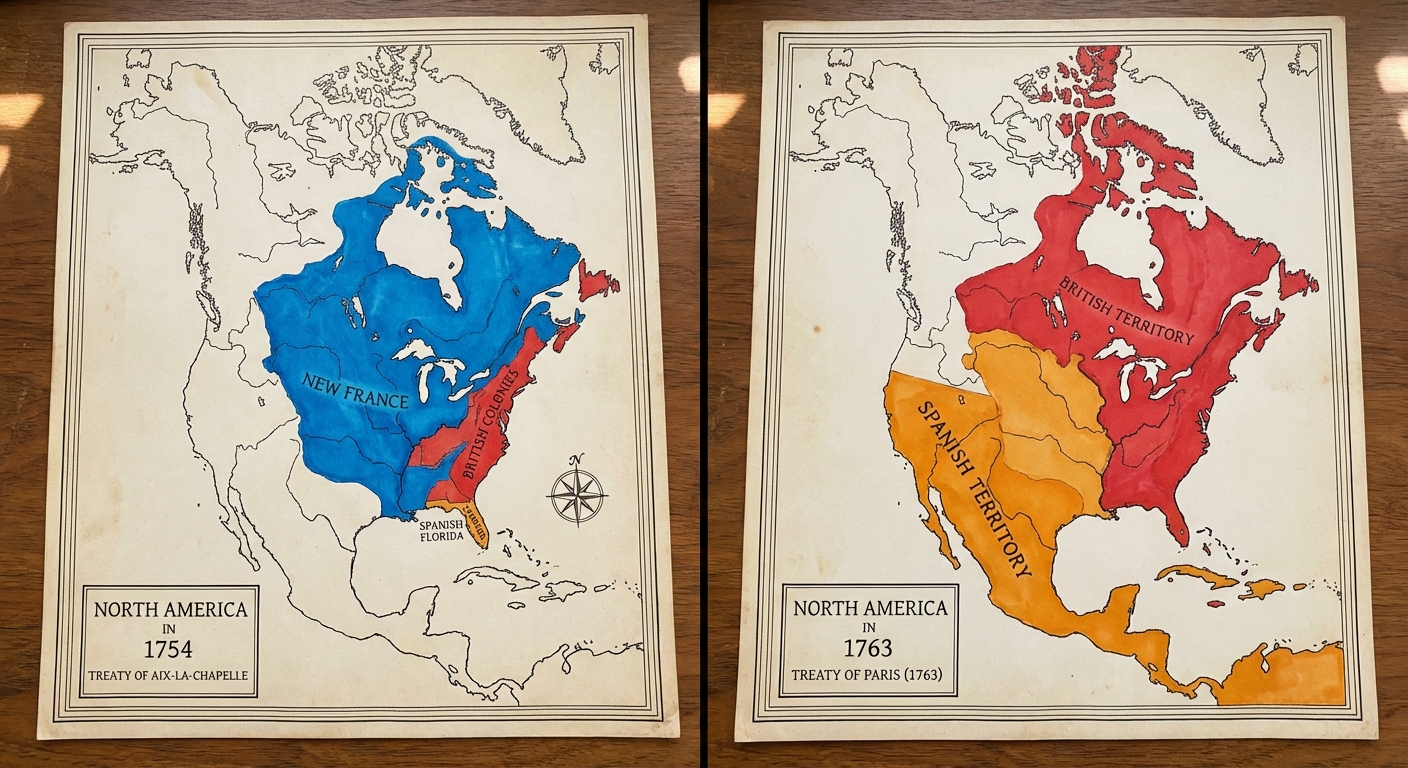
The British victory was total, but it came at a staggering cost. The Treaty of Paris (1763) reshaped the map:
- France lost nearly all its North American possessions.
- Britain gained Canada and Florida.
- Spain gained the Louisiana Territory.
The most immediate result of the war was the end of Salutary Neglect. This was the unofficial policy where Britain loosely enforced trade laws (like the Navigation Acts) to ensure colonial loyalty. Post-1763, Britain needed to reorganize its empire and pay off massive war debts.
Pontiac’s Rebellion and the Proclamation of 1763
Following the French defeat, Native American alliances in the Ohio Valley (led by Ottawa Chief Pontiac) attacked British forts in Pontiac's Rebellion, fearing British expansion.
To prevent further conflict and save money on defense, King George III issued the Proclamation of 1763. This drew a line down the Appalachian Mountains, forbidding colonial settlement to the west.
- Colonial Reaction: Anger and resentment. Colonists felt they had fought the war specifically to gain access to that land. Many ignored the line and settled anyway.
Taxation Without Representation
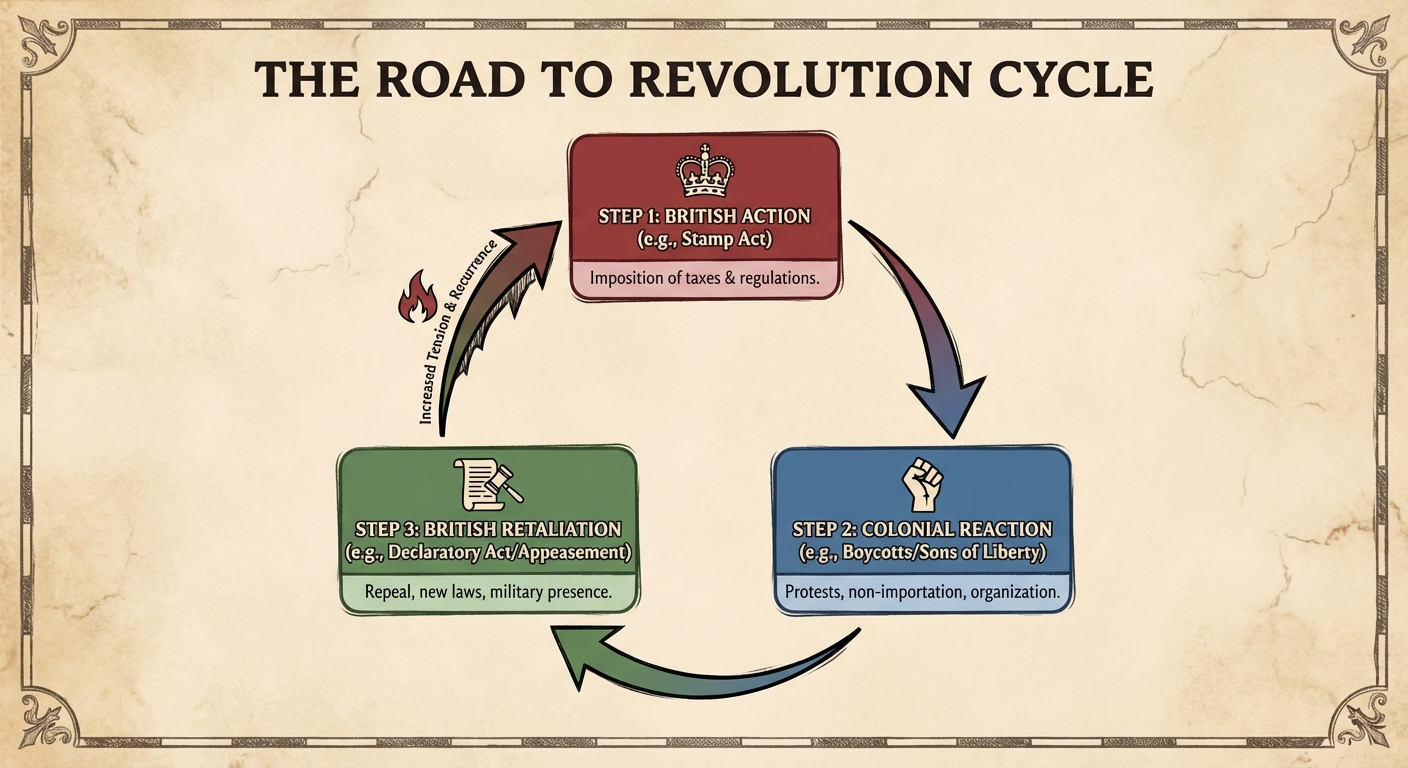
The period from 1763 to 1776 is defined by a cycle: Britain imposes a policy to raise revenue or assert control, colonists resist, and tensions escalate.
The Economic Shift: From Regulation to Revenue
Previously, acts like the Navigation Acts were designed to regulate trade (mercantilism). Newer acts were designed specifically to generate revenue to pay off British debt.
| Act | Description | Colonial Reaction |
|---|---|---|
| Sugar Act (1764) | Lowered tax on molasses but increased enforcement against smuggling. | Protests against "taxation without representation," though limited to New England merchants. |
| Stamp Act (1765) | Direct tax on all printed materials (newspapers, legal docs, playing cards). Affects everyone, not just merchants. | Massive Resistance. Formation of the Sons of Liberty; The Stamp Act Congress; Boycotts (Non-importation agreements). |
| Declaratory Act (1766) | Repealed the Stamp Act but asserted Parliament's right to tax the colonies "in all cases whatsoever." | Celebrated the repeal but overlooked the implications of the declaration. |
| Townshend Acts (1767) | Tax on imported goods (paper, tea, glass). Revenue paid royal officials, removing colonial power of the purse. | Renewed boycotts; Circular Letters (Mass. and VA); Increase in British troops in cities. |
The Crisis Escalates
Tensions boiled over in Boston, the center of resistance.
- Boston Massacre (1770): British soldiers fired into a crowd, killing five colonists. Propagandized by Paul Revere to fuel anti-British sentiment.
- The Tea Act (1773): Designed to bail out the British East India Company. It actually lowered the price of tea but maintained the tax. Colonists saw it as a trick to accept the principle of taxation.
- Boston Tea Party (1773): The Sons of Liberty dumped tea into Boston Harbor.
The Coercive (Intolerable) Acts (1774)
In direct response to the Tea Party, Parliament passed the Coercive Acts to punish Massachusetts:
- Closed Boston Harbor until tea was paid for.
- Reduced the power of the Massachusetts legislature.
- Expanded the Quartering Act.
Result: These acts backfired. Instead of isolating Massachusetts, they united the colonies. The First Continental Congress convened in 1774 to organize a unified colonial response.
Philosophical Foundations of the American Revolution
The revolution was not just about money; it was an ideological struggle rooted in the Enlightenment.
John Locke and Natural Rights
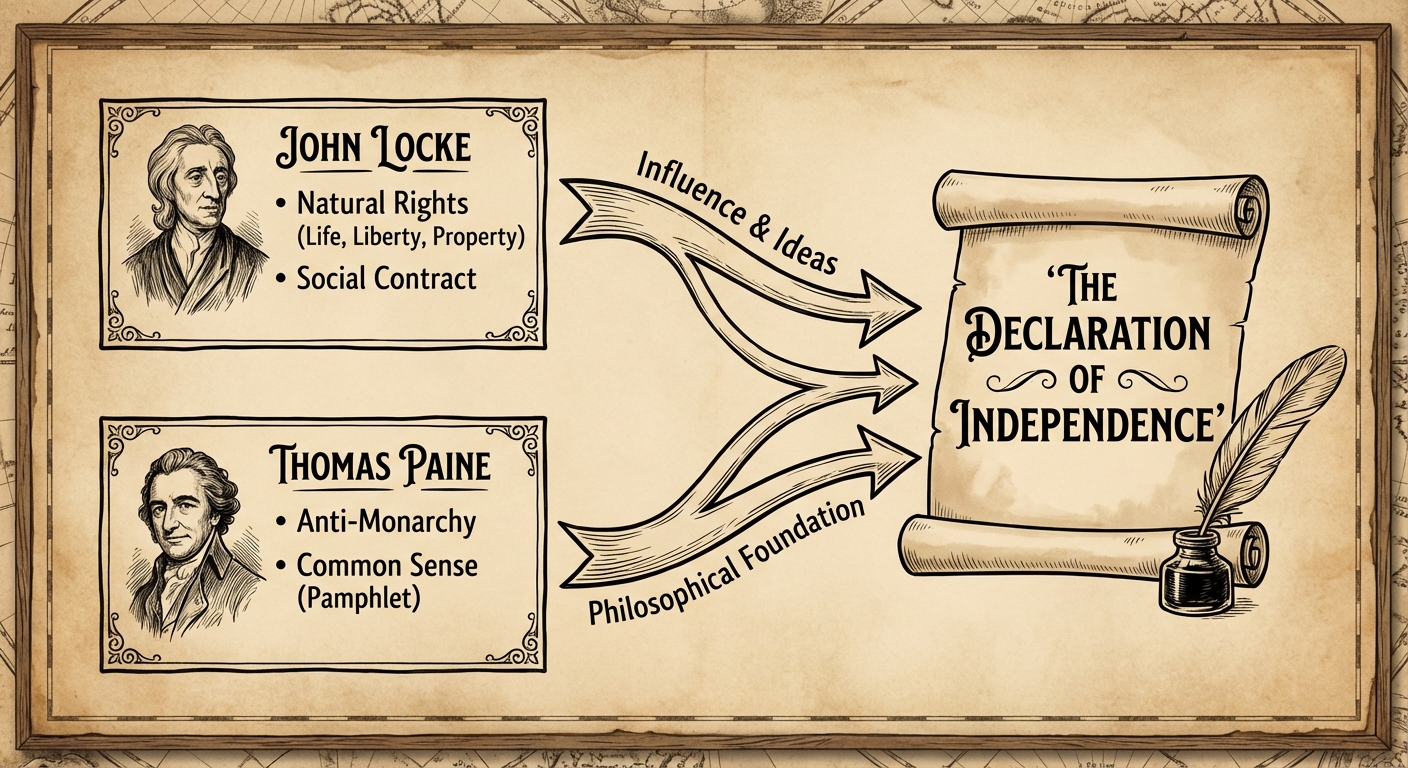
The framers of the revolution were heavily influenced by British philosopher John Locke. His key concepts included:
- Natural Rights: Life, Liberty, and Property (Jefferson changed this to "Pursuit of Happiness").
- Social Contract: Government derives its power from the "consent of the governed." If a government fails to protect natural rights, the people have a right to alter or abolish it.
Republicanism
This was a political ideology (not a party) that emphasized:
- Liberty and individual rights.
- Civic Virtue: Citizens must sacrifice personal interest for the public good.
- Fear of centralized power and corruption.
Thomas Paine’s Common Sense (1776)
While elites debated philosophy, Thomas Paine wrote a pamphlet that radicalized the masses. Written in plain language, Common Sense argued:
- It is contrary to common sense for a small island (Britain) to rule a vast continent (America).
- Kings are not chosen by God; monarchies are corrupt.
- Reconciliation is impossible; independence is the only inevitable outcome.
Impact: Paine shifted the colonial goal from restoring rights within the British Empire to declaring total independence.
The Declaration of Independence (1776)
Drafted primarily by Thomas Jefferson, the Declaration served three purposes:
- Philosophical: Stated the theory of government (Locke's influence).
- Grievances: Listed 27 specific crimes of King George III (tyranny, taxation, quartering troops).
- Declaration: Formally severed ties.
Common Mistakes & Pitfalls
- Virtual vs. Actual Representation: Students often misuse these terms. Actual Representation means an elected official comes from your district and represents you. Virtual Representation was the British argument that Parliament members represented the interests of the entire empire, regardless of who elected them. The colonists rejected Virtual Representation.
- The Proclamation Line: Do not confuse the Proclamation of 1763 with a border between colonies. It was a border between the colonies and Native American territory.
- Support for Independence: It is a mistake to think all colonists wanted independence. At the start of the war, the country was roughly split into thirds: Patriots (independence), Loyalists/Tories (loyal to Britain), and those who were Neutral.
- Timeline Confusion: The Seven Years' War creates the debt; the debt creates the taxes; the taxes create the resistance. Ensure you know the cause-and-effect relationship, not just the dates.