Comprehensive Guide to Mechanics: Work, Energy, and Power
3.1 Definition of Work
The Physics Definition of Work
In casual conversation, "work" implies effort (mental or physical). In physics, Work ($W$) is rigorously defined as the process of transferring energy to or from a system by applying a force over a displacement.
For work to be done, three conditions must be met:
- A Force must be applied.
- The object must undergo a Displacement.
- The force must have a component parallel to the displacement.
The Formula
For a constant force, the work done is defined as:
Where:
- $F$ is the magnitude of the force applied.
- $d$ (or $\Delta x$) is the magnitude of displacement.
- $\theta$ is the angle between the force vector and the displacement vector.
Sign Conventions:
- Positive Work ($+W$): The force aids motion ($0^\circ \le \theta < 90^\circ$). Energy is added to the system.
- Negative Work ($-W$): The force opposes motion ($90^\circ < \theta \le 180^\circ$). Energy is removed from the system.
- Zero Work ($0$): The force is perpendicular to motion ($\cos 90^\circ = 0$), or there is no displacement.
Example: The Normal Force on a block sliding partly horizontally usually does zero work because the force is vertical ($90^\circ$ to displacement).
Variable Force: Graphic Representation
Often, forces are not constant (e.g., stretching a spring). To find the work done by a variable force, you must analyze the graph of Force vs. Position (or Displacement).
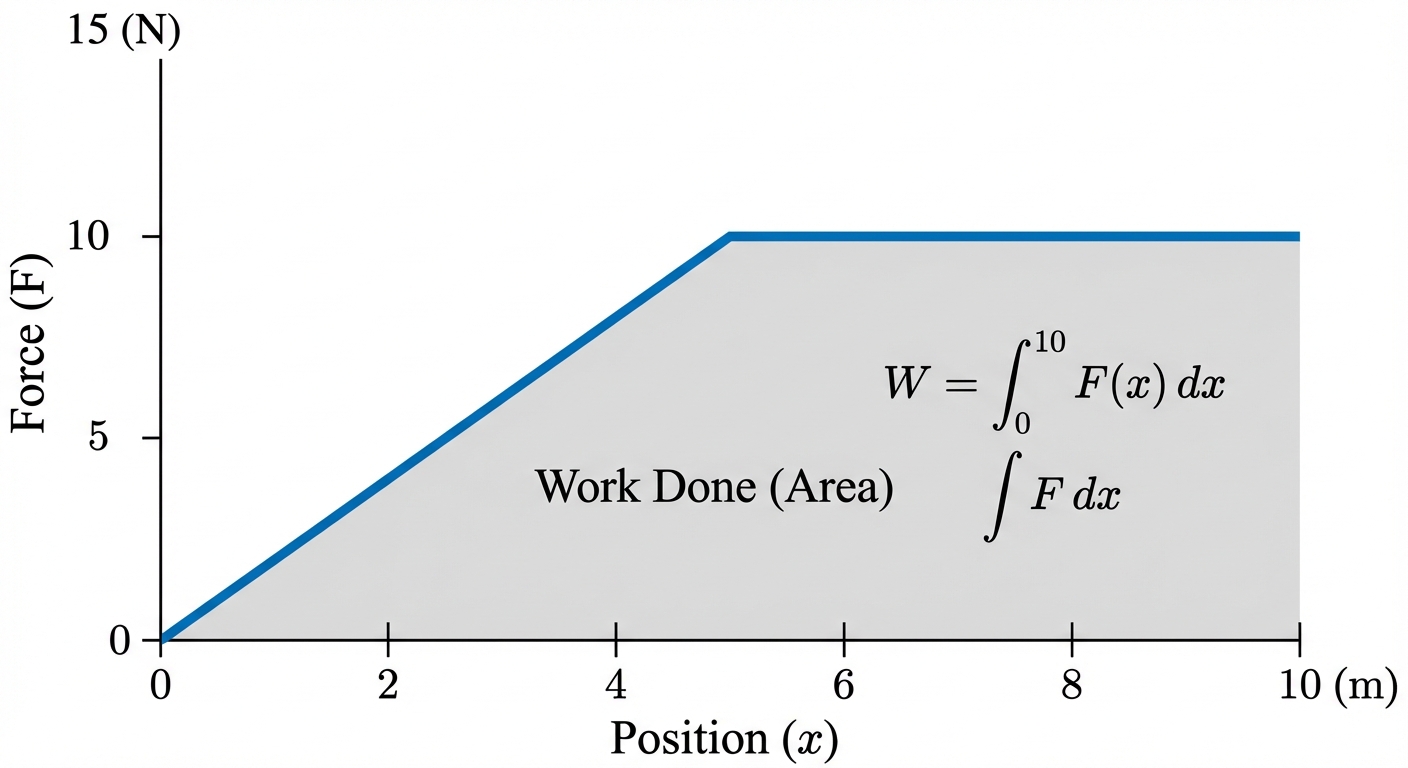
- The Area Under the Curve (between the force line and the x-axis) represents the Work done.
- If the area is below the x-axis, the work is negative.
3.2 Kinetic Energy and the Work-Energy Theorem
Kinetic Energy ($K$)
Kinetic Energy is the energy an object possesses due to its motion. It is a scalar quantity, meaning it has magnitude but no direction, and it can never be negative.
Where:
- $m$ is mass (kg)
- $v$ is velocity (m/s)
The Work-Energy Theorem
The most powerful tool in this unit connects net force to generic motion. The Work-Energy Theorem states that the net work done on an object equals the change in its kinetic energy.
It is crucial to remember that $W_{net}$ is the sum of work done by all forces acting on the object.
Analogy: Think of Kinetic Energy as the balance in a bank account. Positive work is a deposit; negative work is a withdrawal.
3.3 Potential Energy and Conservative Forces
Potential Energy ($U$) is energy stored in a system due to the arrangement or position of objects within that system. It connects to the concept of Conservative Forces.
Conservative vs. Non-Conservative Forces
- Conservative Forces: The work done is path-independent. Energy helps stored and can be fully recovered. (Examples: Gravity, Spring Force, Electrostatic Force).
- Non-Conservative Forces: The work done depends on the path. Energy is dissipated (usually as heat) and cannot be easily recovered back into mechanical energy. (Examples: Friction, Air Resistance, Applied pushes/pulls).
Gravitational Potential Energy ($U_g$)
For objects near Earth's surface (where $g$ is constant), the energy stored due to height is:
Where:
- $h$ is the vertical height relative to a chosen reference level (where $U_g=0$).
Note: You get to choose where $h=0$ is! Always pick the lowest point in the problem to simplify your math.
Elastic (Spring) Potential Energy ($U_s$)
Based on Hooke's Law ($F_s = -kx$), the energy stored in a compressed or stretched spring is:
Where:
- $k$ is the spring constant (stiffness, N/m).
- $x$ is the distance stretched or compressed from the equilibrium position.
3.4 Conservation of Energy
This is the centerpiece of Unit 3. The way you apply conservation laws depends entirely on how you define your system.
System Definitions
Open System: Energy can enter or leave the system via external work ($W{ext}$).
Closed (Isolated) System: No energy enters or leaves. The total energy remains constant.
Mechanical Energy ($ME$)
Total Mechanical Energy is the sum of kinetic and potential energies:
If a system contains only conservative forces (no friction/air resistance) and is closed:
Including Non-Conservative Forces
If friction is present within a closed system, it converts mechanical energy into Internal Energy ($\,\Delta E_{int}$ or $Q$, often felt as heat).
where $\Delta E{int} = |F{friction} d|$.
Energy Bar Charts (LOL Diagrams)
To track energy flow, we use bar charts. This helps avoid calculation errors.
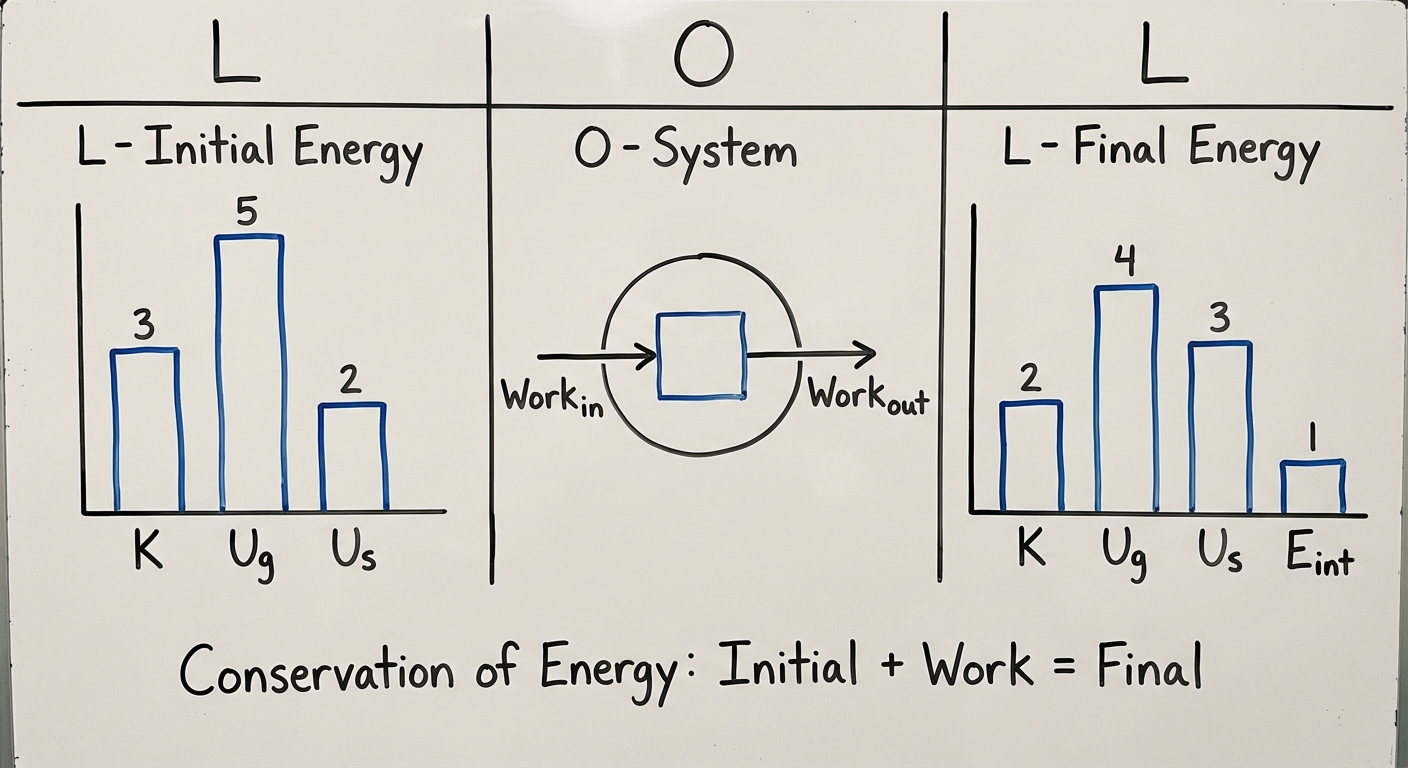
- L (Initial State): Bars represent initial $K$, $Ug$, $Us$.
- O (Flow): Represents external work ($W_{ext}$) entering or leaving.
- L (Final State): Bars represent final energies.
The equation is then built directly from reading the bars left to right.
Example Scenario: The Roller Coaster
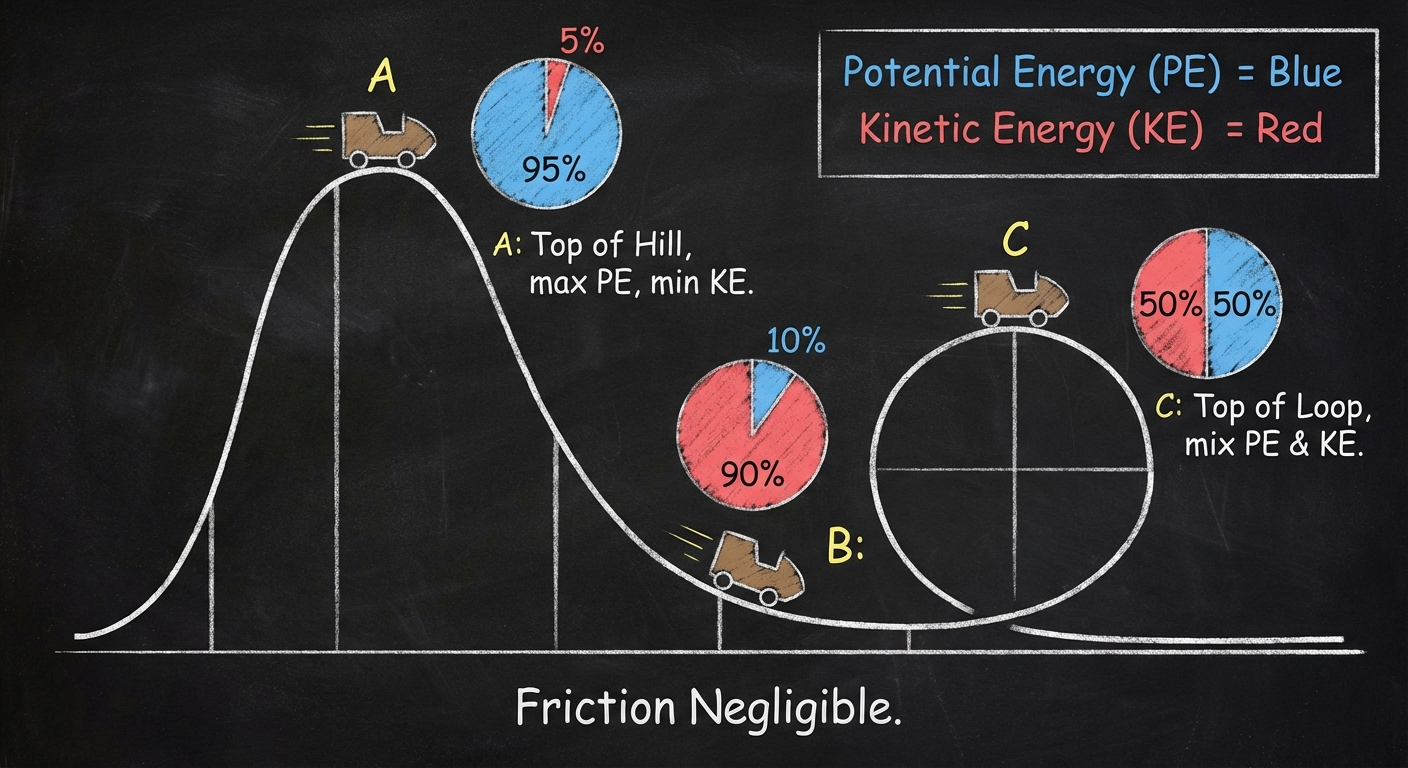
Imagine a cart at the top of a hill (A) rolling down to a valley (B).
- At A: High $U_g$, Low $K$.
- At B: Low $U_g$, High $K$.
- If friction exists, the Total Mechanical Energy at B is slightly less than at A, because some energy turned into heat.
3.5 Power
Power refers to how fast work is done or energy is transferred. Two cars might travel up the same hill (same Work done), but the sports car does it faster (higher Power).
Average Power:
Instantaneous Power:
If an object is moving at constant velocity $v$ while a force $F$ acts on it:
- Unit: Watt (W). $1 \text{ W} = 1 \text{ J/s}$.
Common Mistakes & Pitfalls
1. The "System" Trap (Earth Included vs. Excluded)
This is the #1 AP exam trick.
- System = Cart + Earth: Gravity is an internal force. You calculate changes in Potential Energy ($U_g$). You do NOT calculate work done by gravity.
- System = Cart only: Gravity is an external force. The Earth is outside the system. You calculate Work done by gravity. Potential Energy ($U_g$) does NOT exist.
2. Signs of Work
Students often confuse negative work with negative direction.
- Friction always does negative work because the force opposes the displacement vector ($180^\circ$).
- Centripetal force (perpendicular to motion) does zero work.
3. Mixing up Spring variables
In $U_s = \frac{1}{2}kx^2$, $x$ is not the length of the spring. It is the displacement from equilibrium. If a 10cm spring is stretched to 12cm, $x = 0.02m$, not $0.12m$.
4. Forgetting to Square
In both $K = \frac{1}{2}mv^2$ and $U_s = \frac{1}{2}kx^2$, the position/velocity terms are squared. If you double the speed, Kinetic Energy quadruples ($2^2=4$), it doesn't just double.
5. Height References
Forgetting to define where $h=0$. While the physics works regardless of where zero is, the math is much harder if you don't set $h=0$ at the lowest point the object reaches.