Comprehensive Guide to Unit 4: Transoceanic Interconnections (c. 1450–1750)
Technological Innovations (1450–1750)
Before European nations could dominate the oceans, they needed the tools to survive them. This period is defined by cross-cultural interactions—Europeans adopted and adapted Asian and Islamic technologies to facilitate open-ocean navigation.
Origins and Diffusion of Technology
Most "European" navigation tools actually originated elsewhere:
- The Compass: Originated in China; traveled west via the Silk Roads and Indian Ocean trade. It allowed sailors to determine direction without relying on the stars.
- The Astrolabe: Improved by Muslim navigators in the 12th century. It allowed sailors to determine how far north or south they were from the equator (latitude).
- Cartography: Knowledge of wind patterns (like the volta do mar) and currents improved maps.
Ship Design Innovations
European shipbuilders combined Mediterranean, Islamic, and Northern European designs to create vessels capable of long-distance travel.
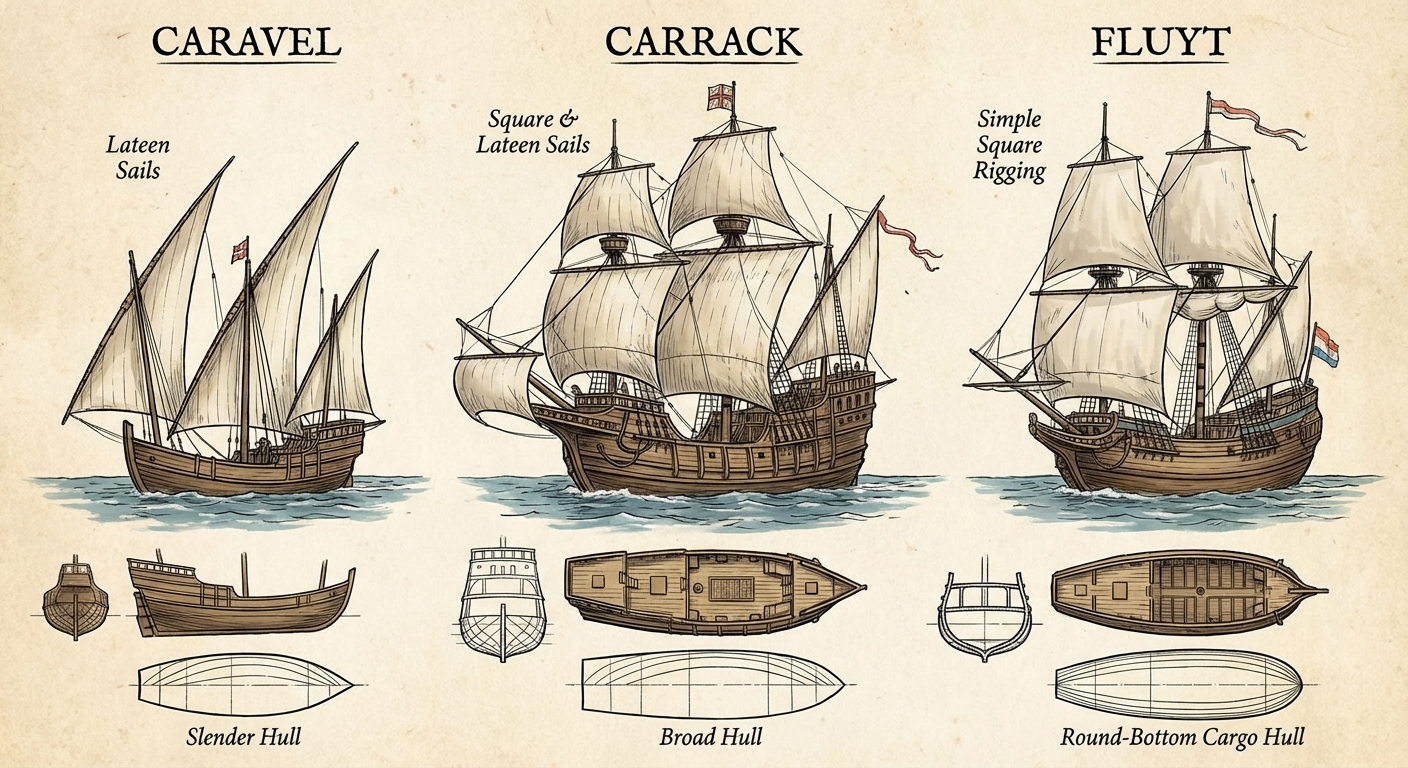
| Ship Type | Origin | Key Features | Primary Use |
|---|---|---|---|
| Caravel | Portugal | Small, highly maneuverable; used Lateen Sails (triangular sails from the Arab world) to sail against the wind. | Exploration (rivers & shallow coasts) |
| Carrack | Portugal/Spain | Larger than a caravel; square and lateen sails mixed. | Trade & Warfare (e.g., Santa Maria) |
| Fluyt | Dutch | Designed strictly for trade; large cargo hold, small crew needed. Cheaper to build. | Carrying bulk goods in the established empires |
Key Concept: The Lateen Sail was revolutionary because it allowed ships to tack (sail against the wind), breaking the reliance on monsoon wind cycles.
Exploration: Causes and Events
Why did Europeans risk death to sail into the unknown? Historians often summarize the motivation as the Three Gs.
The Three Gs
- Gold: The primary economic driver. Europeans wanted direct access to Asian spice markets (pepper, nutmeg) to bypass Muslim intermediaries and Italian merchants (like Venetians) who controlled prices.
- God: The desire to spread Christianity (specifically Catholicism for Spain/Portugal) and compete with the spread of Islam.
- Glory: National pride and personal fame for explorers (and the monarchs sponsoring them).
Key Explorers and Routes
Exploration was heavily grounded in State Sponsorship. Monarchs paid the bills hoping for tax revenue and new territory.
1. Portugal (The Pioneers)
- Prince Henry the Navigator: Established a navigation school; sponsored voyages down the West African coast.
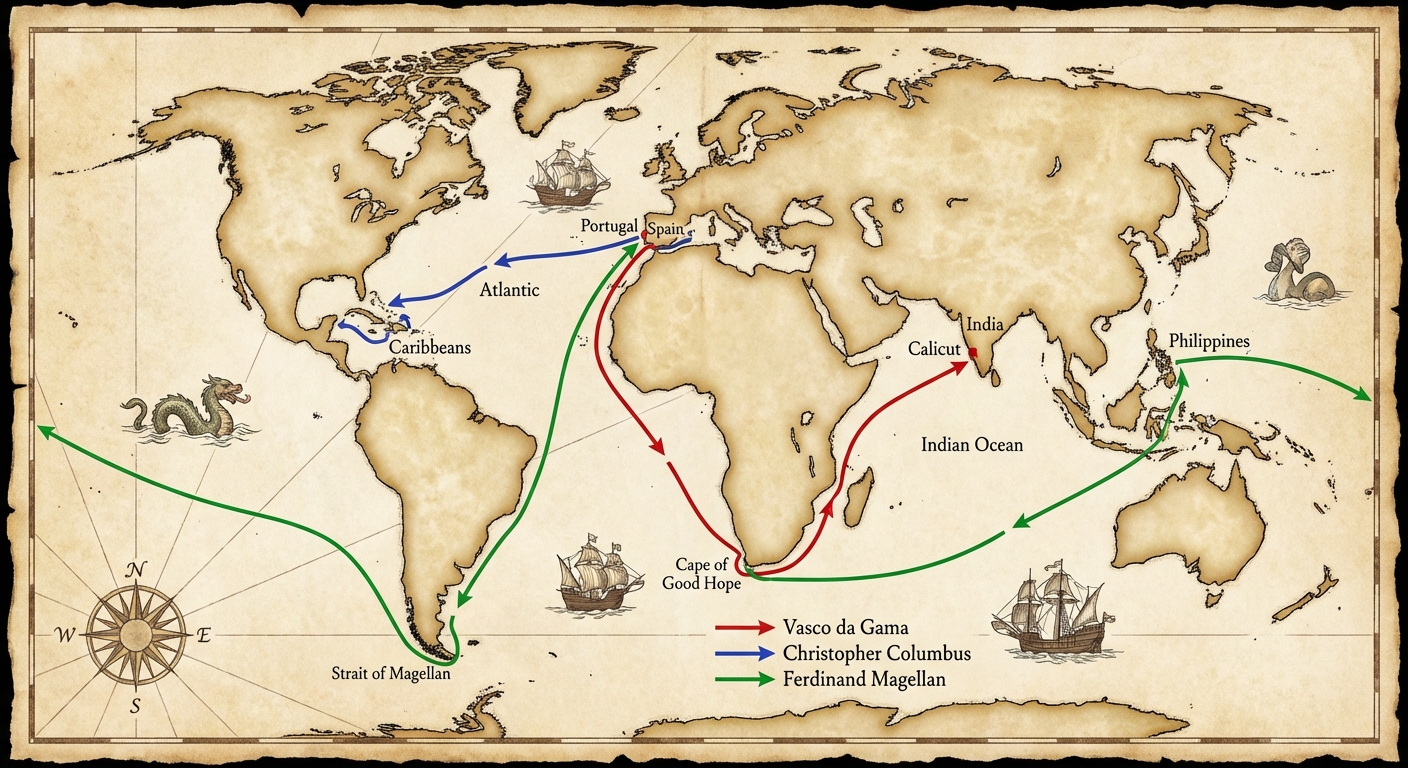
- Vasco da Gama (1498): First to sail around distinct Africa (Cape of Good Hope) and reach India. He claimed territory for Portugal, launching a Trading Post Empire.
2. Spain (The Westward Expansion)
- Christopher Columbus (1492): Sponsored by Ferdinand and Isabella. Sought India by sailing West; found the Caribbean/Americas. This contact catalyzed the Columbian Exchange.
- Ferdinand Magellan: His crew became the first to circumnavigate the globe (though Magellan died in the Philippines).
3. The Northern Passage Seekers
English, French, and Dutch explorers looked for a "Northwest Passage" to Asia through North America.
- Jacques Cartier (France): Claimed Canada.
- John Cabot (England): Explored the NE coast of North America.
- Henry Hudson (Dutch/English): Explored the Hudson River/Bay.
The Columbian Exchange
The Columbian Exchange is defined as the global diffusion of crops, other plants, human beings, animals, and disease that took place after the European exploring voyages of the New World.
Note: This was NOT a trade network (like the Silk Road). It was a biological exchange.
1. Diseases (The "Great Dying")
Indigenous Americans had no immunity to Afro-Eurasian diseases.
- Smallpox, measles, and influenza killed roughly 50–90% of the native population in the Americas.
- Result: Severe demographic collapse, which eventually led Europeans to seek labor sources from Africa.
2. Food and Animals
The exchange radically altered diets worldwide.
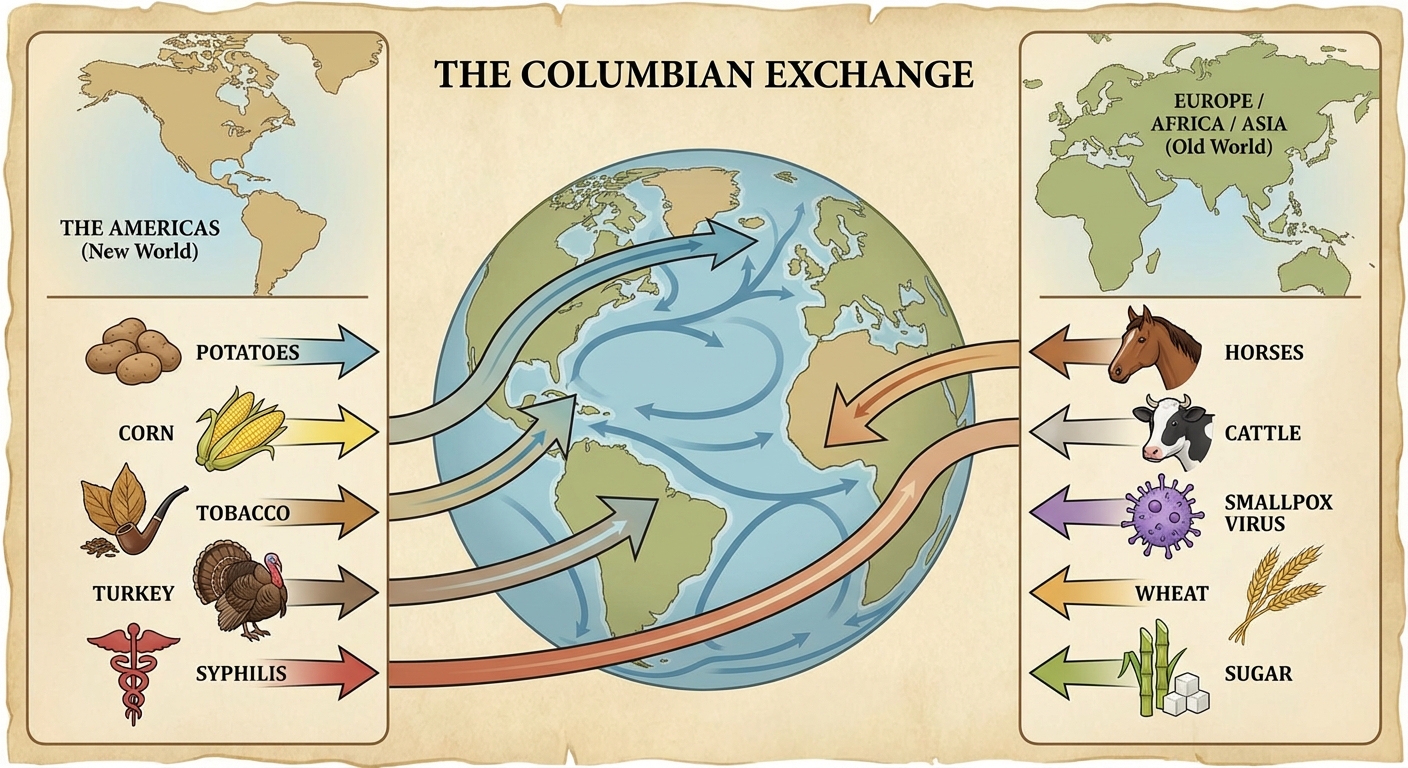
| Category | From Eastern Hemisphere (Old World) → To West | From Western Hemisphere (New World) → To East |
|---|---|---|
| Animals | Horses, Pigs, Cattle, Chickens | Turkeys, Llamas, Alpacas |
| Foods | Wheat, Sugar, Rice, Coffee, Grapes | Potatoes, Maize (Corn), Cacao, Tobacco, Tomatoes |
| Impact | Horses changed Native American hunting/warfare; Sugar drove the slave trade. | High-calorie crops (potatoes/corn) caused a population boom in Europe, Africa, and China. |
Maritime Empires Established
Once contact was established, European powers created maritime empires based on different economic and labor systems.
Economic Strategies
Mercantilism
The dominant economic theory of the time. It dictated that:
- Wealth is measured in gold and silver.
- A nation must have a favorable balance of trade (exports > imports).
- Colonies exist strictly to serve the mother country (providing raw materials and buying manufactured goods).
Joint-Stock Companies
To reduce risk, investors pooled money to fund exploration and trade.
- Examples: British East India Company (EIC) and Dutch East India Company (VOC).
- These companies were powerful; they could raise armies, mint money, and make treaties.
Colonial Labor Systems in the Americas
The "Great Dying" of indigenous people led to a labor shortage. Europeans devised several systems to exploit the land.
- Encomienda System: Spanish crown granted settlers the right to force natives to work in exchange for "protection" and Christian instruction (a form of coerced labor akin to feudalism).
- Hacienda System: Large agricultural estates run by Spanish landowners using native workers (debt peonage).
- Mit'a System (Adapted): The Spanish adapted the Incan mandatory public service system into a forced labor system for the dangerous silver mines (like Potosí).
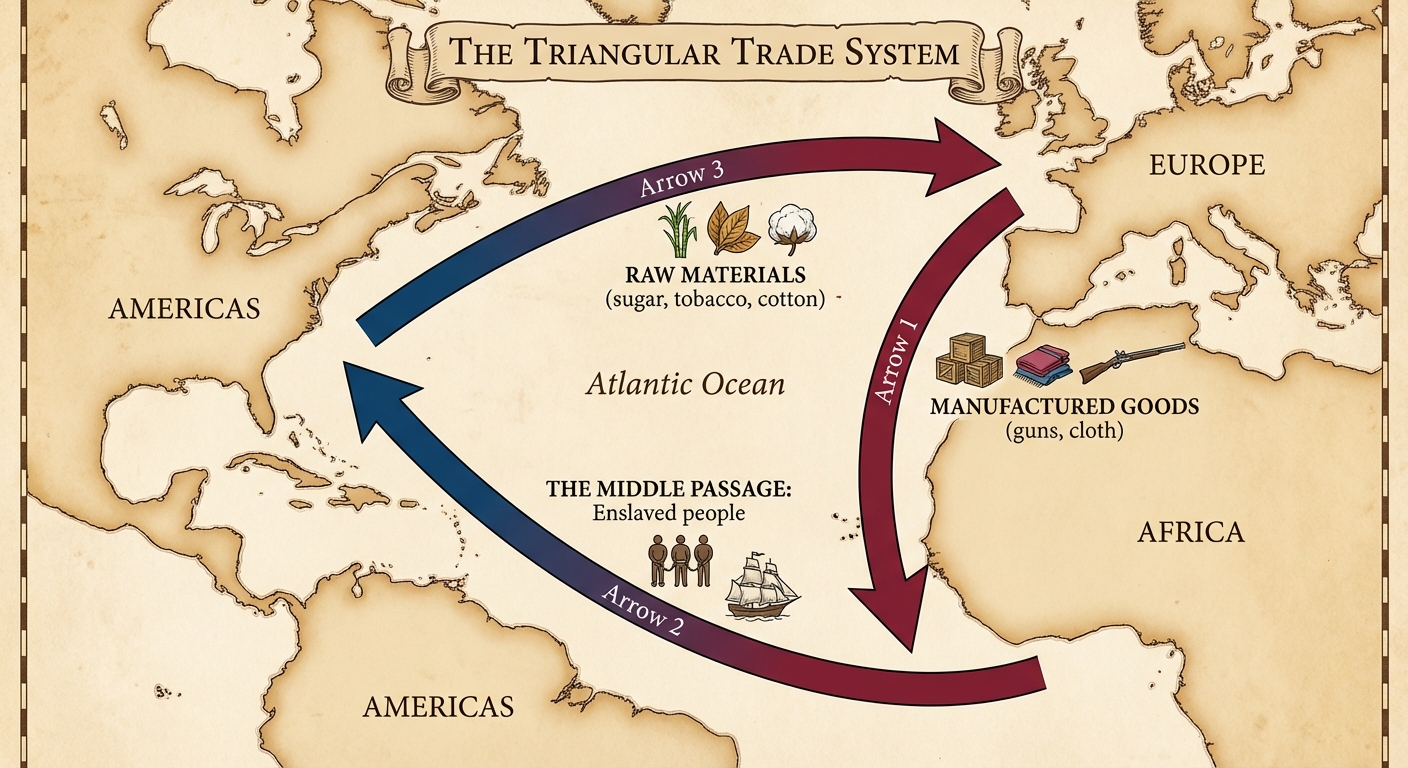
- Chattel Slavery: As native populations plummeted and the demand for labor-intensive crops (sugar, tobacco) rose, the Atlantic Slave Trade exploded. Africans were treated as property with no rights.
Social Hierarchies (The Casta System)
Specifically in Latin America, a race-based hierarchy emerged:
- Peninsulares: Born in Spain.
- Creoles: Spaniards born in the Americas.
- Mestizos: Mixed European and Indigenous ancestry.
- Mulattoes: Mixed European and African ancestry.
Common Mistakes & Pitfalls
- Exchange Direction: Students often confuse which items came from where. Remember: Potatoes and Corn (Maize) are from the Americas (Pre-Columbian). Horses and Smallpox are from Europe.
- Slavery vs. Serfdom: Do not confuse Indentured Servitude (temporary work for passage) with Chattel Slavery (lifetime, hereditary ownership of humans). Both existed, but they are legally distinct.
- Tech Invention: Europeans did not invent the compass or gunpowder; they adopted them from China. Avoid writing that "Europeans invented the tools to sail."
- Mercantilism vs. Capitalism: While related, Mercantilism is state-controlled trade for national power. Capitalism (later) focuses on private ownership and free markets. In this era, the state heavily regulated trade.
- The "Discovery": Avoid saying Columbus "discovered" America. Millions of people already lived there. Use terms like "encountered" or "connected the hemispheres."