Inverse Function Derivatives (AP Calculus AB Unit 3): General Inverses + Inverse Trig
Differentiating General Inverse Functions
What an inverse function really is
An inverse function “undoes” what the original function does. If a function takes an input and produces an output, then its inverse takes that output and returns the original input.
Formally, if a function has an inverse, the undoing relationships are:
Not every function has an inverse that is itself a function. To have an inverse function, the original function must be one-to-one on the domain you are using (it must pass the horizontal line test). In AP Calculus, it’s common to restrict the domain of a function (like a quadratic) so that it becomes one-to-one and therefore invertible.
Why inverse derivatives matter
On many AP problems you’re given information about a function and its derivative, but you’re asked about the inverse function’s slope. This comes up because:
- You might be asked for the slope of the inverse at a particular point.
- Inverse trig derivatives (like the derivative of arcsine) are special cases of inverse-function differentiation.
- Many exam questions provide a table or graph of a function and ask for the value of the inverse derivative at a point, without ever giving (or requiring) a formula for the inverse.
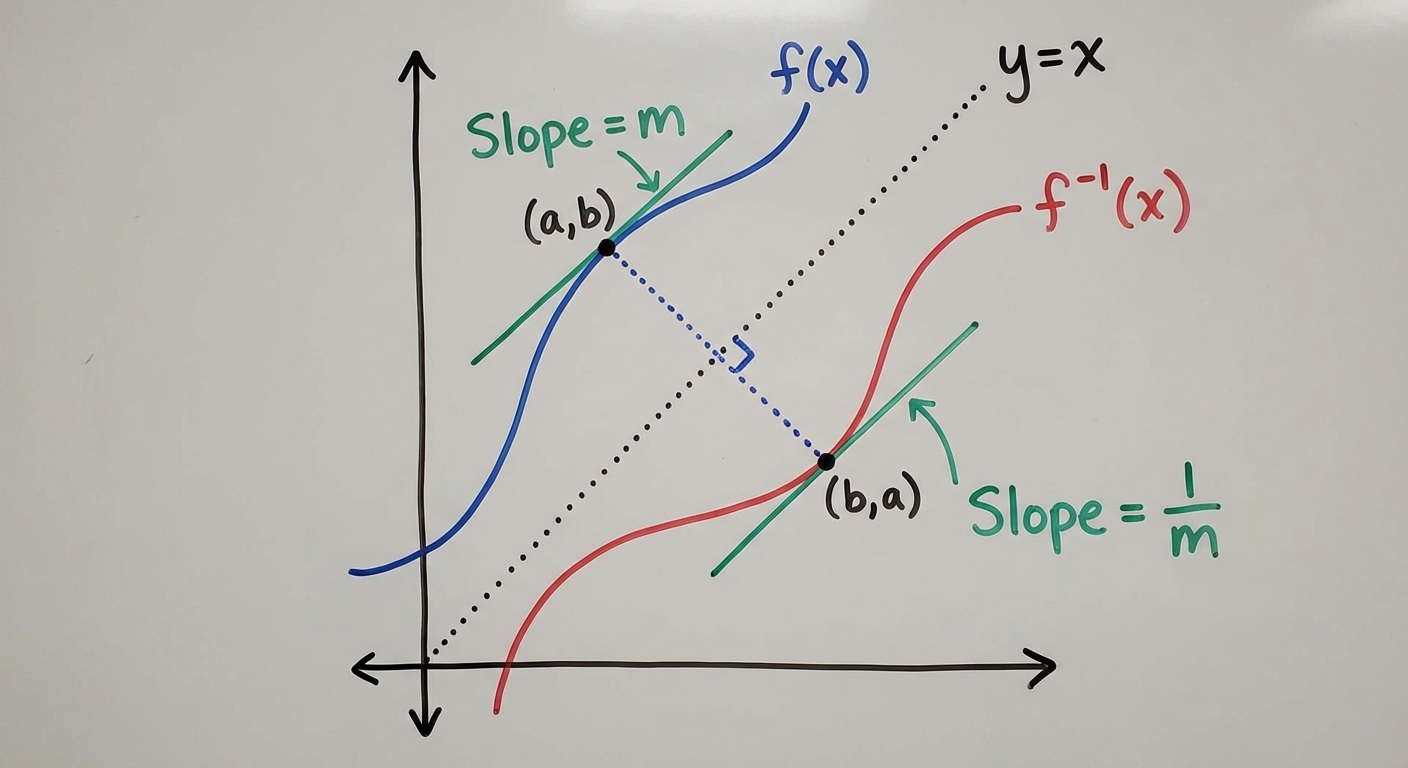
The key conceptual idea is that inverse functions swap inputs and outputs, and their tangent line slopes become reciprocals (as long as the original slope is not zero).
The geometric picture: reflection across the line
Geometrically, the graph of an inverse function is the reflection of the original function across the line:
If a point lies on the original function, then the swapped point lies on the inverse. That same “swap” happens to tangent lines: reflecting a line across changes its slope to its reciprocal (when defined).
The core derivative relationship (Inverse Function Derivative Theorem)
Suppose is differentiable and one-to-one, and let its inverse be:
Because they undo each other:
Differentiate both sides with respect to . The left side uses the Chain Rule:
Solve for the inverse derivative:
Written directly in inverse-function notation:
Key interpretation (what the formula is saying): to find the derivative of the inverse at an input value (which was an output of the original function), you first find the corresponding input on the original function, evaluate the original derivative there, then take the reciprocal.
The most practical point-swap version
A very AP-friendly version of the theorem is the “matching point” form. If:
then the inverse satisfies:
and the slopes satisfy:
This is exactly why tables and graphs are so useful: you often don’t need an explicit formula for the inverse.
Conditions and “when things break”
This reciprocal slope idea works cleanly only when the original derivative is not zero at the corresponding point.
- If:
then the inverse is differentiable at and the reciprocal formula applies.
- If:
then the original function has a horizontal tangent at %%LATEX18%%, and the inverse would have a vertical tangent at %%LATEX19%%. In that case, the inverse derivative is undefined there.
Also remember: if %%LATEX20%% is not one-to-one on the domain you’re using, then %%LATEX21%% is not a function unless you restrict the domain of .
Two reliable methods on AP problems
There are two standard approaches you’ll use repeatedly.
Method A: Use the inverse derivative formula
Use either form:
This is best when you can identify %%LATEX25%%, either because you can compute the inverse explicitly or because you can solve %%LATEX26%%.
Method B: Use implicit differentiation after swapping %%LATEX27%% and %%LATEX28%%
If:
then by definition:
Differentiate implicitly with respect to and solve for:
This is especially useful when an explicit inverse is messy or impossible to find.
Step-by-step problem solving strategy (4-step process)
When asked to find:
use this reliable routine:
- Identify the goal: you need the slope of the inverse at input .
- Find the corresponding coordinate: solve or look up the value %%LATEX35%% such that %%LATEX36%%.
- Find the derivative of the original at that input: compute or look up .
- Reciprocate:
Worked Example 1: Derivative of an inverse at a point (typical AP style)
Let:
and let:
Find:
First, find the matching input on by solving:
So:
Differentiate the original function:
Evaluate at the matching input:
Take the reciprocal:
Interpretation: at the matching point on the original function the slope is large, so the slope on the inverse is small.
Worked Example 2: Using a table/graph idea (reciprocal slopes)
Suppose you are told:
Let:
Find:
Because , the inverse satisfies:
Then the reciprocal slope rule gives:
Worked Example 3: Using a table (additional AP-style practice)
Let be differentiable and suppose:
Find:
Since %%LATEX62%%, the corresponding inverse point uses input %%LATEX63%% and matches original input . Therefore:
Worked Example 4: Implicit differentiation approach (no explicit inverse needed)
Find:
if:
Express your answer in terms of:
Let:
Then:
Differentiate with respect to :
Factor out :
Solve:
Replace %%LATEX76%% with %%LATEX77%%:
Common misconceptions to watch for
A lot of errors come from confusing similar-looking notations or evaluating at the wrong point.
- Confusing the inverse function with the reciprocal. The notation can be misleading, but:
- Forgetting to find the matching input. If you want:
you must find the value such that:
and then use .
- Trying to “invert the derivative” directly. In general:
because the derivative must be evaluated at the corresponding swapped point.
Exam Focus
Typical question patterns include (1) being given values like %%LATEX85%% and %%LATEX86%% from a table/graph and being asked for %%LATEX87%%, (2) being given a formula for %%LATEX88%% and a value %%LATEX89%% and being asked to compute %%LATEX90%% by first solving %%LATEX91%%, and (3) deriving a general expression for %%LATEX92%% in terms of using implicit differentiation.
Common mistakes include using %%LATEX94%% instead of %%LATEX95%%, solving the matching equation %%LATEX96%% incorrectly and therefore using the wrong point, ignoring the requirement that %%LATEX97%% (so you report a number where the inverse actually has a vertical tangent), and evaluating the derivative at the wrong value (for example, computing %%LATEX98%% when asked for %%LATEX99%% instead of first finding the input that produces output 5).
Differentiating Inverse Trigonometric Functions
What inverse trig functions are (and why they need special care)
An inverse trigonometric function answers questions like “what angle has this trig value?” For example, arcsine returns the angle whose sine is a given number.
A subtle but crucial point is that trig functions like sine and cosine are not one-to-one over all real numbers, so they do not have inverses on their full domains. To make inverse trig functions into true functions, we use principal-value definitions by restricting the original trig functions to intervals where they are one-to-one.
The standard principal-value restrictions you’re expected to know are:
These restrictions matter in derivative derivations because they determine signs (for example, on the arcsine interval, cosine is nonnegative).
Also, the derivatives of inverse trigonometric functions are algebraic expressions (often fractions and square roots, not trig functions), and they are frequently tested on the AP exam.
Notation you must interpret correctly
Many textbooks and calculators write inverse trig using “negative one” notation. In calculus, that notation means the inverse function, not the reciprocal trig function.
Here are equivalent notations you might see:
| Inverse trig function | Common alternate notation | Meaning |
|---|---|---|
| angle whose sine is | ||
| angle whose cosine is | ||
| angle whose tangent is |
Why these derivatives show up so often
You’ll use inverse trig derivatives directly in differentiation problems, but they also appear indirectly in:
- related rates and motion problems involving angles,
- derivatives from implicit relationships,
- later units (especially integration), because patterns like the following match inverse trig derivatives:
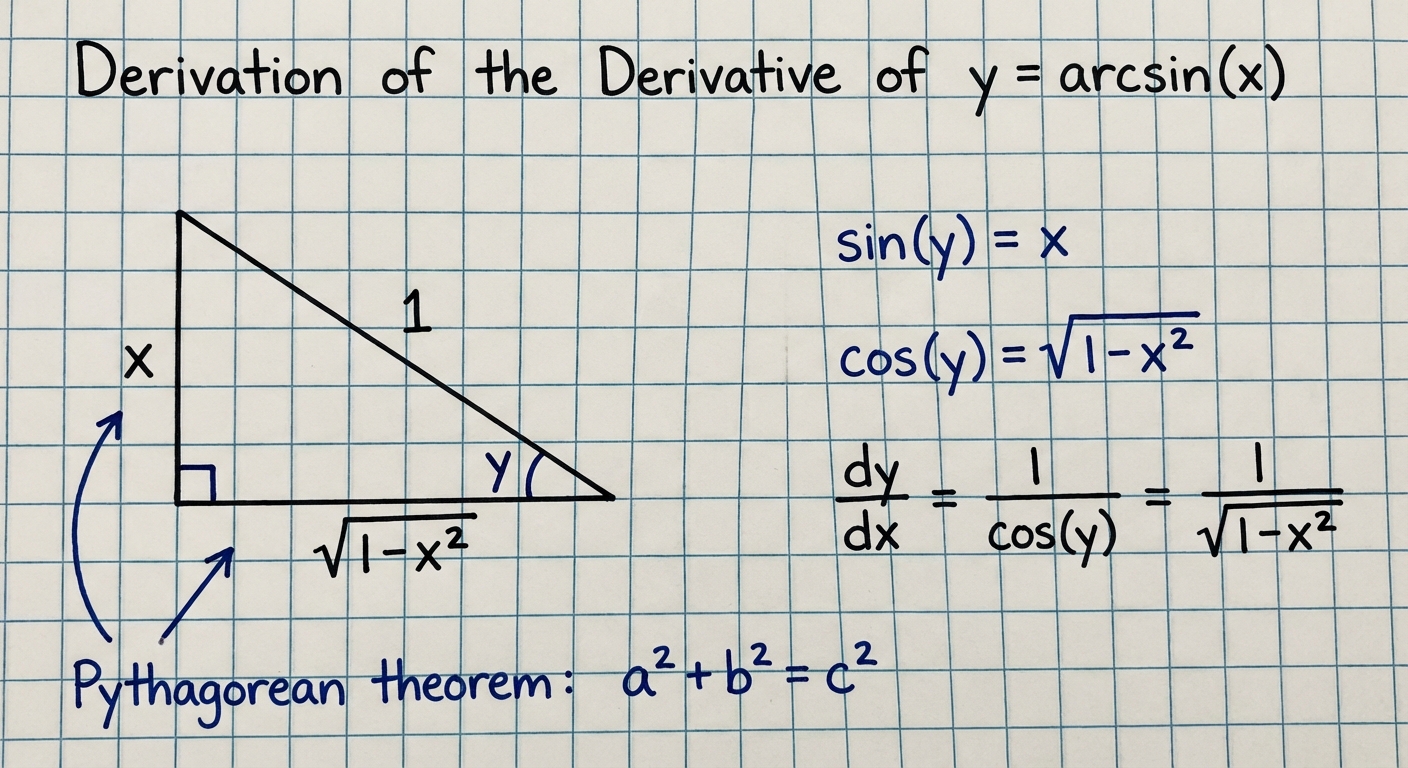
Deriving the derivative of arcsine (model derivation)
Start by letting:
Then:
Differentiate both sides with respect to :
So:
Now rewrite in terms of . Using:
and , we get:
Because arcsine outputs angles in:
we know on that interval, so:
Substitute back:
Domain note: this derivative is defined for:
At , the denominator becomes zero, matching the vertical tangents of arcsine at the endpoints.
The essential inverse trig derivative formulas
On the AP Calculus AB exam, arcsine, arccosine, and arctangent are by far the most common, but the others are still part of the broader curriculum.
It helps to remember the “inner function” version (so you automatically use the Chain Rule). Let %%LATEX130%% be a function of %%LATEX131%%.
| Function | Derivative |
|---|---|
Sign intuition (especially important for arcsine vs arccosine): arcsine is increasing on its principal domain, so its derivative is positive, while arccosine is decreasing on its principal domain, so its derivative is negative.
Memory aids & mnemonics that reflect the math
These are useful because they connect back to identities and sign behavior.
- The “Co Rule”: any inverse trig function starting with “Co” has a negative derivative:
\arccos,\ \arccot,\ \arccsc
Tan has no root: tangent and cotangent are the only ones without a square root in the denominator. (A mnemonic some students like is “Tan is tough” because it holds up the fraction without a root.)
Radical patterns come from identities: arcsin and arccos share:
because they come from:
Meanwhile arctan involves:
because of:
- Sine/Cosine vs. Secant/Cosecant:
- Sine/Cosine forms start with 1:
- Secant/Cosecant forms start with the variable:
- Sign check reminder: arcsin is increasing so its derivative is positive; arccos is decreasing so its derivative is negative.
Chain Rule with inverse trig (where most errors happen)
Most exam problems won’t be exactly arcsin of . They’ll be arcsin of something, arctan of something, etc. The steps are consistent:
- Identify the outside inverse trig function.
- Multiply by the derivative of the inside function.
For example, if:
then:
Similarly:
Worked Example 1: Differentiating an inverse trig composition
Differentiate:
Let:
so:
Then:
A common algebra slip is forgetting to square the entire inside expression and writing %%LATEX160%% instead of %%LATEX161%%.
Worked Example 2: Differentiating a more complex inside function
Differentiate:
Let:
Then:
So:
You can expand if asked, but many AP questions accept a clean unexpanded form.
Worked Example 3: Implicit differentiation with nested inside functions
Differentiate:
Let:
so:
Using the arccos rule:
Domain awareness matters here: %%LATEX170%% requires %%LATEX171%%, and arccos inputs must satisfy , so here you must have:
Worked Example 4: Applying the Chain Rule (arctan)
Find the derivative if:
Let:
Then:
Apply the arctan rule:
Connecting inverse trig derivatives back to inverse functions
Inverse trig derivatives are not “random formulas.” They come from the same inverse-function derivative idea.
For example, if:
then:
Conceptually, the inverse relationship implies:
and since:
you get:
Then you rewrite %%LATEX183%% in terms of %%LATEX184%% using identities and the principal-domain sign information.
Common misconceptions and errors
- Mixing up inverse trig with reciprocal trig. The notation:
means arcsine, not cosecant, and it is not the same as:
- Forgetting the Chain Rule. If the input is not exactly , you must multiply by the derivative of the inside. For example, the incorrect work:
is missing the factor of 5. The correct derivative is:
Dropping the negative sign for arccos. The derivative of arccos has a leading negative.
Ignoring domain restrictions when simplifying. Principal-value intervals justify choices like:
instead of:
- Algebra slips in the “inside squared” step. In expressions like:
the square applies to the entire inside expression .
- Forgetting absolute values for arcsec and arccsc. For example, the derivative of arcsec requires absolute value:
A common mistake is writing the denominator without the absolute value.
Exam Focus
Typical question patterns include differentiating expressions like %%LATEX195%%, %%LATEX196%%, and using the Chain Rule; combining inverse trig derivatives with product/quotient rules (for example a product like a variable times arctan of that variable); and evaluating slopes at specific values in a related-rates or slope-at-a-point setting.
Common mistakes include writing %%LATEX198%% instead of %%LATEX199%% for arcsin/arccos, dropping the negative sign for arccos, failing to multiply by when differentiating an inverse trig function of a nontrivial inside expression, and (when arcsec/arccsc appear) forgetting that the correct formulas require absolute value in the denominator.