AP Calculus BC Unit 2: Derivatives as Limits, Rates of Change, and Core Differentiation Rules
Secant Lines, Tangent Lines, and Rates of Change
Before you ever compute a derivative with rules, you need to understand the problem derivatives were invented to solve: how to describe instantaneous change.
Average rate of change (secant slope)
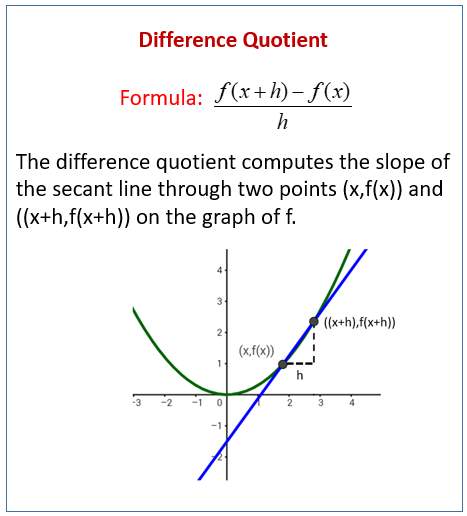
If you have a function and you look at it over an interval from one input to another, the average rate of change is the slope of the line connecting the two points on the graph. That line is called a secant line. You can think of this as “rise over run,” but using function values.
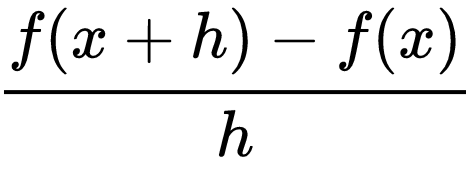
The slope of the secant line (difference quotient over an interval) is
A simpler way to say the same thing (using two points) is
This number tells you “how much the output changes per unit change in the input” on average across the whole interval. If the function is position, this is average velocity. If the function is cost, this is average cost increase per extra item.
Instantaneous rate of change (tangent slope)
The other way of finding the rate of change is at a specific point in time. This is called the instantaneous rate of change, and it’s what derivatives measure.
A tangent line captures the direction the curve is heading at a single point, and its slope represents the instantaneous rate of change. Conceptually, you get the tangent line by taking a secant line and sliding one point closer and closer to the other until the two points “merge.” As the points get close, the secant slope can settle toward a limiting value.
So the big idea is: a derivative is a limit of slopes of secant lines.
These pictures from the original notes show the secant-line idea and the tangent-line idea:
Why this matters
Almost every application of derivatives (velocity, acceleration, marginal cost, sensitivity, optimization) depends on interpreting the derivative as an instantaneous rate of change. If you only memorize rules, you might still be able to compute derivatives, but you will struggle when the AP question gives you a graph or table and asks for meaning, sign, or units.
Example 1: Average rate of change from two points
Suppose
The average rate of change from the first input to the second is
Interpretation: for each 1-unit increase in the input over that interval, the output increases by about 3 units on average.
Example 2: Secant slopes approaching a tangent slope (idea-only computation)
If you want the tangent slope at the input 1, you look at secant slopes between the inputs 1 and 1 plus a small step:
As the step shrinks toward 0, the secant slope may approach a fixed value. That limit, if it exists, is the derivative at that point.
What commonly goes wrong
A big misconception is thinking the tangent line “touches the curve at one point and never crosses.” Some notes phrase tangent lines as lines that touch the curve at exactly one point, but in calculus tangency is about matching slope locally, not about “staying on one side.” Tangent lines can cross the curve, especially near inflection points.
Exam Focus
- Typical question patterns:
- Given two points (or a table), compute an average rate of change and interpret it with units.
- Describe how a tangent slope is the limit of secant slopes as points get closer.
- Match positive/negative/zero slope to increasing/decreasing/flat behavior on a graph.
- Common mistakes:
- Swapping numerator order and getting the negative of the correct slope.
- Treating “tangent” as “does not cross,” instead of “shares slope locally.”
- Confusing average rate of change over an interval with instantaneous rate at a point.
The Derivative as a Limit (Definition)
The central definition of this unit is the limit definition of the derivative. Everything else (rules, interpretations, applications) is built on it.
Difference quotient and the derivative
The difference quotient measures the slope of a secant line using a small step:
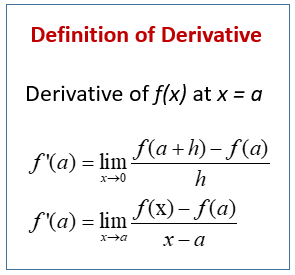
The derivative at an input is the instantaneous rate of change, defined by taking a limit as that step goes to 0:
This is the definition of the derivative.
You will also see an equivalent form, especially when a point is fixed and the other input approaches it:
Both formulas express the same idea: tangent slope is the limit of secant slopes.
Why limits are essential here
If you try to plug in a step of 0 directly, you get an undefined expression:
The derivative avoids this by asking what value the secant slopes approach as the interval length shrinks toward 0.
Worked example: derivative from the definition
Find the derivative function for
Start with the definition:
Compute the shifted value:
Substitute:
Simplify:
Factor and cancel the step (valid because the limit considers values near 0, not equal to 0):
Now take the limit:
What commonly goes wrong
Students often substitute the step as 0 too early, see the indeterminate form, and stop. The whole point is to simplify first, then take the limit. Algebra errors are also extremely common, especially when expanding the shifted expression.
Exam Focus
- Typical question patterns:
- Use the limit definition to find a derivative for a given function (often polynomial or rational).
- Write the expression for a derivative at a specific point as a limit using either form.
- Evaluate a derivative at a point after finding the derivative function.
- Common mistakes:
- Forgetting parentheses when computing the shifted expression.
- Cancelling terms incorrectly (especially with rational expressions).
- Treating the step equal to 0 as a substitution step rather than a limit process.
Derivative Notation (First and Second Derivatives)
AP Calculus expects you to recognize derivative notation flexibly, since free-response and multiple-choice questions mix notations.
Common first-derivative notations
Prime notation is compact and common for a named function, while Leibniz notation emphasizes “rate of change” and units.
- Prime notation:
- Leibniz notation:
- Operator notation:
- Value at a point:
A common misconception is to treat the Leibniz notation as an ordinary fraction you can always cancel. Later, you’ll see contexts where treating it “fraction-like” can be helpful, but in this unit you should treat it as one symbol meaning “derivative.”
Second derivative notation table (included from the original notes)
The original notes also emphasize second-derivative notation. The second derivative is the derivative of the derivative.
| Function | First Derivative | Second Derivative |
|---|---|---|
| %%LATEX29%% or %%LATEX30%% |
Derivative as a function vs. derivative at a point
The derivative at a point is a number (a single slope value), while the derivative function gives the slope for every input where it is defined.
- A derivative at a point:
- A derivative function:
Exam Focus
- Typical question patterns:
- Interpret mixed notations in the same problem (for example, switching between %%LATEX34%% and %%LATEX35%%).
- Identify whether a question is asking for a derivative function or a single derivative value.
- Recognize second-derivative notation in tables, graphs, and verbal descriptions.
- Common mistakes:
- Reporting %%LATEX36%% when the problem asked for %%LATEX37%%.
- Treating as a simple fraction in contexts where that logic is not justified.
- Confusing first- and second-derivative notation (especially primes).
Estimating Derivatives from Graphs and Tables
The AP exam often assesses whether you understand the derivative conceptually, not just algebraically. That means you need to be able to estimate derivatives when a formula is not provided.
Estimating from a graph
If you have the graph and want the derivative at a point, you estimate the slope of the tangent line at that point.
A practical method:
- Sketch (or imagine) the tangent line at the point.
- Pick two convenient points on that tangent line (not necessarily on the curve).
- Compute rise over run.
The estimate improves if you choose points far enough apart to reduce reading error, but still clearly on the tangent line.
Estimating from a table of values
From a table, you approximate the derivative by using average rates of change over small intervals near the point.
One-sided estimate:
Centered estimate (often better):
Local linearity (why tangent lines approximate functions)
If a function is differentiable at an input, then near that input the graph looks almost like a line. That line is the tangent line, and it gives the linear approximation:
Equivalently, for small changes:
Example 1: Estimating a derivative from a table
Suppose a table gives
Estimate the derivative at 2 using a centered difference with step 0.01:
Interpretation: near the input 2, the function increases by about 6 output units per 1 input unit.
Example 2: Estimating derivative sign and relative size from a graph
If the graph is increasing steeply at a point, then the derivative is positive and large. If it is decreasing gently, then the derivative is negative but closer to 0. If it is flat, the derivative is near 0.
What commonly goes wrong
A very common error is confusing the value of the function at a point (a height) with the value of the derivative at a point (a slope). Another common issue is using points on the curve instead of points on the tangent line when estimating from a graph.
Exam Focus
- Typical question patterns:
- Estimate a derivative from a graph by constructing a tangent line and computing its slope.
- Estimate a derivative from a table using one-sided or centered difference quotients.
- Compare values like derivatives at several inputs based on steepness and direction.
- Common mistakes:
- Using too-wide an interval in a table and calling it “instantaneous.”
- Mixing up left-hand and right-hand estimates and ignoring asymmetry.
- Reading slope using curve points rather than tangent-line points.
Differentiability and Continuity
Differentiability is more demanding than continuity. The AP exam frequently tests whether you understand what can prevent a derivative from existing.
What it means to be differentiable
A function is differentiable at an input if the following limit exists as a finite real number:
Geometrically, this means there is a well-defined tangent line slope at that input.
Differentiability implies continuity
A crucial theorem is:
- If a function is differentiable at a point, then it is continuous at that point.
The converse is false: a function can be continuous but not differentiable.
Common ways differentiability can fail
Even when a function is continuous, the derivative can fail to exist due to:
- Corner (left and right slopes finite but unequal)
- Cusp (slopes become infinite in opposite directions)
- Vertical tangent (slope becomes infinite)
- Discontinuity (any jump, hole, or asymptote)
- Endpoint of a domain (two-sided derivative may not exist, though a one-sided derivative can)
One-sided derivatives
Right-hand derivative:
Left-hand derivative:
The (two-sided) derivative exists only if both one-sided derivatives exist and are equal.
Example 1: A continuous function that is not differentiable
Consider
At 0 the graph has a corner. The slope from the left is negative one and from the right is positive one, so there is no single tangent slope at the point. Thus the derivative at 0 does not exist even though the function is continuous there.
Example 2: Discontinuity implies non-differentiability
If a function has a jump at 2, then it is not continuous at 2. Therefore it cannot be differentiable at 2, so the derivative at 2 does not exist.
What commonly goes wrong
Students often think “continuous” automatically means “differentiable.” Corners and cusps are the classic counterexamples. Another common mistake is thinking a vertical tangent means slope 0 because the tangent line is “straight up,” but a vertical tangent corresponds to an infinite slope, so the derivative does not exist as a finite real number.
Exam Focus
- Typical question patterns:
- Given a graph, identify where the derivative does not exist (corners, cusps, discontinuities, vertical tangents).
- Given piecewise definitions, check differentiability at a junction by matching left and right derivatives.
- Conceptual true/false: “If a function is differentiable at a point then it is continuous there.”
- Common mistakes:
- Forgetting that differentiability requires continuity first.
- Checking only function values at a point and ignoring slope behavior.
- Treating endpoints like interior points and demanding a two-sided derivative when only one side exists.
Fundamental Derivative Rules (Constant, Power, Linearity)
Using the limit definition of the derivative is powerful but tedious, so we build faster rules.
The constant rule
If a function is constant, its slope is 0 everywhere:
Example from the original notes: if
then
Constant multiple rule
If you have a constant multiplied by a function, you can “pull the constant out”:
The power rule (for integer powers)
For nonnegative integers,
A good way to remember this (from the original notes) is: “multiply down and decrease the power.”
Examples (from the original notes):
Linearity (sum and difference)
Derivatives distribute over addition and subtraction:
Example 1: Derivative of a polynomial
Let
Differentiate term-by-term:
So
Example 2: Tangent line using the derivative
If
then
At 2, the slope is
The point on the curve is
So the tangent line is
What commonly goes wrong
Two common errors are misapplying the power rule to constants (writing the derivative of 7 as 7 instead of 0) and forgetting to reduce the exponent by 1 (for example, writing the derivative of the fifth power as %%LATEX68%% instead of %%LATEX69%%).
Exam Focus
- Typical question patterns:
- Differentiate polynomials quickly and evaluate at a point.
- Find equations of tangent lines (requires a function value and a derivative value).
- Use constant multiple and linearity to differentiate sums and scaled functions.
- Common mistakes:
- Dropping terms or mishandling negative signs when differentiating term-by-term.
- Mixing up a function value with a derivative value in tangent line equations.
- Applying the power rule to expressions that are not simple powers of the input (especially once compositions appear in later units).
Product Rule and Quotient Rule
As soon as you multiply or divide functions, linearity alone is not enough. The derivative of a product is not the product of derivatives, and this is a frequent source of errors.
Product rule
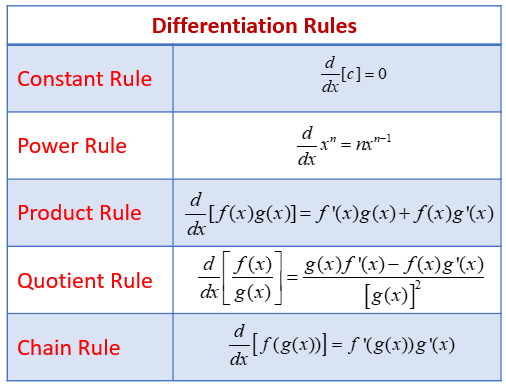
If two differentiable functions are multiplied, then
In the original notes, this is also expressed as: if
then
Mnemonic from the original notes: “1d2 + 2d1” (first times derivative of second plus second times derivative of first).
The product rule was also motivated in the original notes as a time-saver: for something like
you could multiply first and then use the power rule, but it’s often faster and less error-prone to apply the product rule directly.
Quotient rule
If a differentiable function is divided by another (nonzero) differentiable function, then
In the original notes, this is also written in numerator/denominator variables: if
then
Mnemonic from the original notes: “low d high - high d low / low squared.”
Supporting image from the original notes:
Example 1: Product rule
Differentiate
Let
Then
So
Example 2: Quotient rule
Differentiate
Let
Then
So
Simplify carefully:
Therefore
What commonly goes wrong
A classic mistake is writing the derivative of a product as the product of derivatives, which is not generally true. For the quotient rule, sign errors are common because of the subtraction in the numerator, and grouping mistakes happen when students forget parentheses.
Exam Focus
- Typical question patterns:
- Differentiate products of polynomials, or a polynomial times a trig/exponential function.
- Differentiate rational functions using quotient rule and then evaluate at a point.
- Decide whether to use product/quotient rule versus simplifying first.
- Common mistakes:
- Forgetting one term in the product rule.
- Squaring only part of the denominator instead of all of it.
- Losing parentheses in the quotient rule numerator, causing sign mistakes.
Derivatives of Exponential and Logarithmic Functions
Some derivatives are best treated as “memory derivatives” (from the original notes): they’re easier to memorize than to derive repeatedly.
Exponential derivatives
The natural exponential function has the special property that it is its own derivative:
For a general base,
If a constant scales the exponential, apply the constant multiple rule:
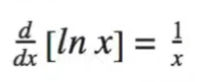
Logarithmic derivative (memory derivative)
From the original notes, you are also expected to know the derivative of the natural log:
Example 1: Differentiate an exponential and evaluate
Let
Then
At 0,
Interpretation: at 0 the instantaneous rate of change is 2 output units per 1 input unit.
Example 2: Differentiate a general base exponential
Let
Then
At 1,
What commonly goes wrong
Students often forget the factor
when differentiating a general base exponential, or they try to apply the power rule to an exponential function.
The original notes also group these as “memory derivatives,” reinforced by these images:

Exam Focus
- Typical question patterns:
- Differentiate expressions involving exponentials (and constants) using constant multiple and sum rules.
- Evaluate derivatives at specific points, often 0 or a given value.
- Interpret a derivative value as an instantaneous growth rate in an exponential model.
- Recognize and use the log derivative formula.
- Common mistakes:
- Writing an exponential derivative with power-rule structure.
- Dropping the
factor.
- Confusing
with
(which have very different derivatives).
Derivatives of Trigonometric Functions
Trigonometric functions model periodic behavior (sound waves, circular motion, seasonal patterns). In calculus, they also provide classic examples where derivatives cycle in predictable ways.
The key trig derivatives
The most important trig derivatives are
A crucial detail: these formulas assume the input is measured in radians, not degrees.
Derivatives of other trig functions
You should also know
These can be derived from sine and cosine using identities plus the product and quotient rules, but on AP they’re usually treated as standard formulas to memorize.
Example 1: Differentiate a trig expression
Differentiate
Then
So
Example 2: Product rule with trig
Differentiate
Then
What commonly goes wrong
The most common trig-derivative mistake is forgetting the negative sign in the cosine derivative. Another is mixing degree-mode intuition into a radians-based result.
Exam Focus
- Typical question patterns:
- Differentiate sums/products involving trig functions (often mixed with polynomials or exponentials).
- Evaluate a trig derivative at a specific point (commonly 0, a quarter-turn, or a half-turn in radians).
- Reason about the sign of a derivative from a trig graph.
- Common mistakes:
- Dropping the minus sign in the cosine derivative.
- Confusing the derivative of tangent with other trig identities.
- Evaluating trig values incorrectly at key angles.
Using Derivatives to Build Tangent Line Equations and Interpret Change
Unit 2 expects you to connect the derivative to geometry (tangent lines) and meaning (instantaneous rate of change).
Tangent line equation (point-slope form)
If you know the function value and derivative value at an input, the tangent line to the graph at that input is
This is just point-slope form for a line with slope
through the point
Units and interpretation
Interpreting units is one of the most testable conceptual skills.
- If input is seconds and output is meters, then derivative units are meters per second.
- If input is items and output is dollars, then derivative units are dollars per item.
This helps you check whether you computed the right quantity (function value vs. derivative, average vs. instantaneous rate).
Instantaneous change vs. average change (practical comparison)
When you approximate instantaneous change from data, you’re really using average change over a small interval:
Smaller steps often improve accuracy, but extremely small steps can amplify measurement or rounding error. On AP questions, table spacing is usually chosen to make a reasonable estimate possible.
Example 1: Tangent line and interpretation
Let
Then
At 3,
So the tangent line is
Interpretation: at the input 3, the function is increasing at 6 output units per 1 input unit.
Example 2: Using a derivative value as a rate
If a problem states
where cost is in dollars and quantity is in items, then at 50 items the cost is increasing at about 1.8 dollars per item. That is a marginal cost interpretation.
What commonly goes wrong
Students often write the tangent line using the wrong point, or they confuse a function value with a derivative value.
Exam Focus
- Typical question patterns:
- Find the tangent line equation at a given input (requires both the function value and the derivative value).
- Interpret the meaning of a derivative value in context, including correct units.
- Use a table to approximate a derivative and then write a tangent line approximation.
- Common mistakes:
- Using slope-intercept form too early and making algebra errors; point-slope is safer.
- Reporting an average rate of change when asked for instantaneous.
- Ignoring units or giving units of the function instead of units of the derivative.
Putting the Rules Together (Strategy and Mixed Examples)
Unit 2 differentiation is largely about choosing the correct rule and applying it accurately. The hard part is not memorizing formulas; it is recognizing the structure of a function and avoiding automatic but wrong moves.
A practical strategy for rule selection
When you see a function, ask yourself:
- Is it a sum or difference? Differentiate term-by-term.
- Is it a constant multiple? Pull the constant out.
- Is it a product? Use the product rule.
- Is it a quotient? Use the quotient rule.
- Are the pieces polynomials, exponentials, trig functions, or a natural log? Use the fundamental (memory) derivatives for those pieces.
In Unit 2 scope, you generally avoid the chain rule (compositions like a trig function of a polynomial) because that technique is formally developed later.
Mixed Example 1: Polynomial and exponential
Differentiate
Then
So
Mixed Example 2: Quotient with trig and polynomial
Differentiate
Let numerator and denominator be
Then
So
Mixed Example 3: Product with trig
Differentiate
Let
Then
So
Therefore
What commonly goes wrong in mixed problems
Two common issues are (1) choosing quotient rule when algebraic simplification would have made the derivative much easier (or simplifying in a way that creates extra work), and (2) confusing products with compositions. For example, a product needs product rule, while a composition needs chain rule (later unit).
Exam Focus
- Typical question patterns:
- Differentiate a function that mixes polynomials with trig, exponentials, or logs using the correct rule.
- Evaluate a derivative at a specified point after differentiating.
- Identify which rule is needed from a list of function forms.
- Common mistakes:
- Misidentifying a quotient as a product (or forgetting to square the denominator in quotient rule).
- Losing a negative sign when differentiating cosine or when distributing subtraction in the quotient rule.
- Treating a composition as if it were a product (chain rule confusion).