Foundations of Dynamics: Unit 2 Study Guide
Newton's First Law and Inertia
Newton's First Law explains what happens to an object when no net force acts upon it. It fundamentally establishes the concept of an inertial reference frame, which is a prerequisite for applying Newton's subsequent laws.
The Law of Inertia
Definition: An object at rest remains at rest, and an object in motion remains in motion with a constant velocity (same speed and straight-line direction), unless acted upon by a net external force.
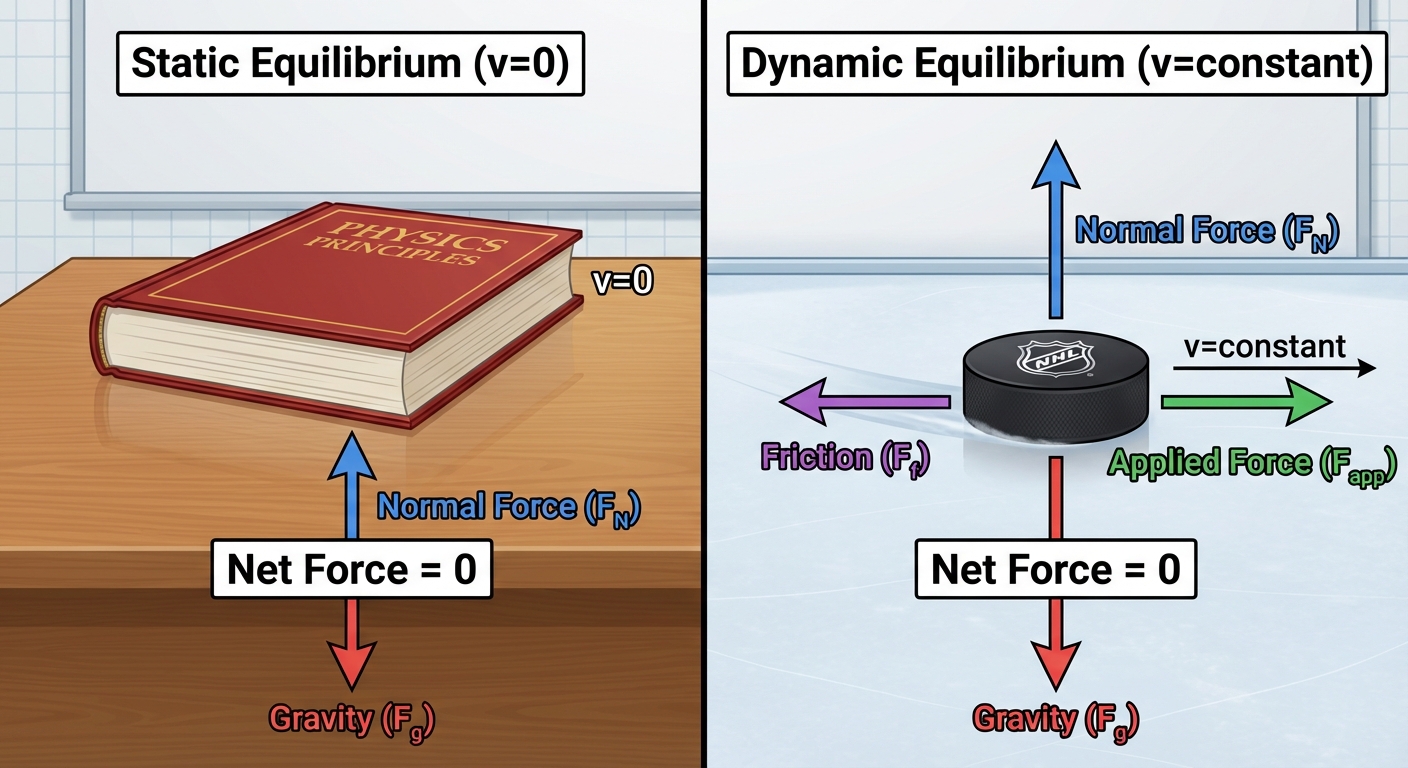
Mathematically, this describes the state of Equilibrium:
\text{If } \sum \vec{F} = 0, \text{ then } \vec{a} = 0 \text{ and } \vec{v} = \text{constant}
Key Concepts
- Inertia: This is not a force; it is an inherent property of matter. It describes an object's resistance to changes in its state of motion. Mass ($m$) is the quantitative measure of inertia. A $10\text{kg}$ rock has more inertia than a $2\text{kg}$ stone.
- Static Equilibrium: The object is at rest ($v=0, a=0$).
- Dynamic Equilibrium: The object is moving at a constant velocity ($v \neq 0, a=0$). Key words in exam problems indicating this state are "constant speed," "terminal velocity," or "no acceleration."
- Inertial Reference Frame: A frame of reference that is not accelerating. Newton's laws are only valid in inertial frames.
Free-Body Diagrams (FBDs)
In AP Physics C, drawing a correct Free-Body Diagram is widely considered the most critical skill for Unit 2. It is the bridge between the physical scenario and the mathematical equations.
Rules for Drawing FBDs
- Isolate the Object: Draw the object as a simple dot or a box. Ignore the surroundings.
- External Forces Only: Draw arrows representing distinct forces acting on the object (e.g., Gravity, Tension, Normal, Friction). Do NOT include forces the object exerts on others.
- Vector Origin: All force vectors must originate from the center of the object (the dot) and point away from it.
- Labeling: Use standard notation ($Fg$ or $mg$, $FN$ or $N$, $T$, $f_k$).
The "Example" Trap
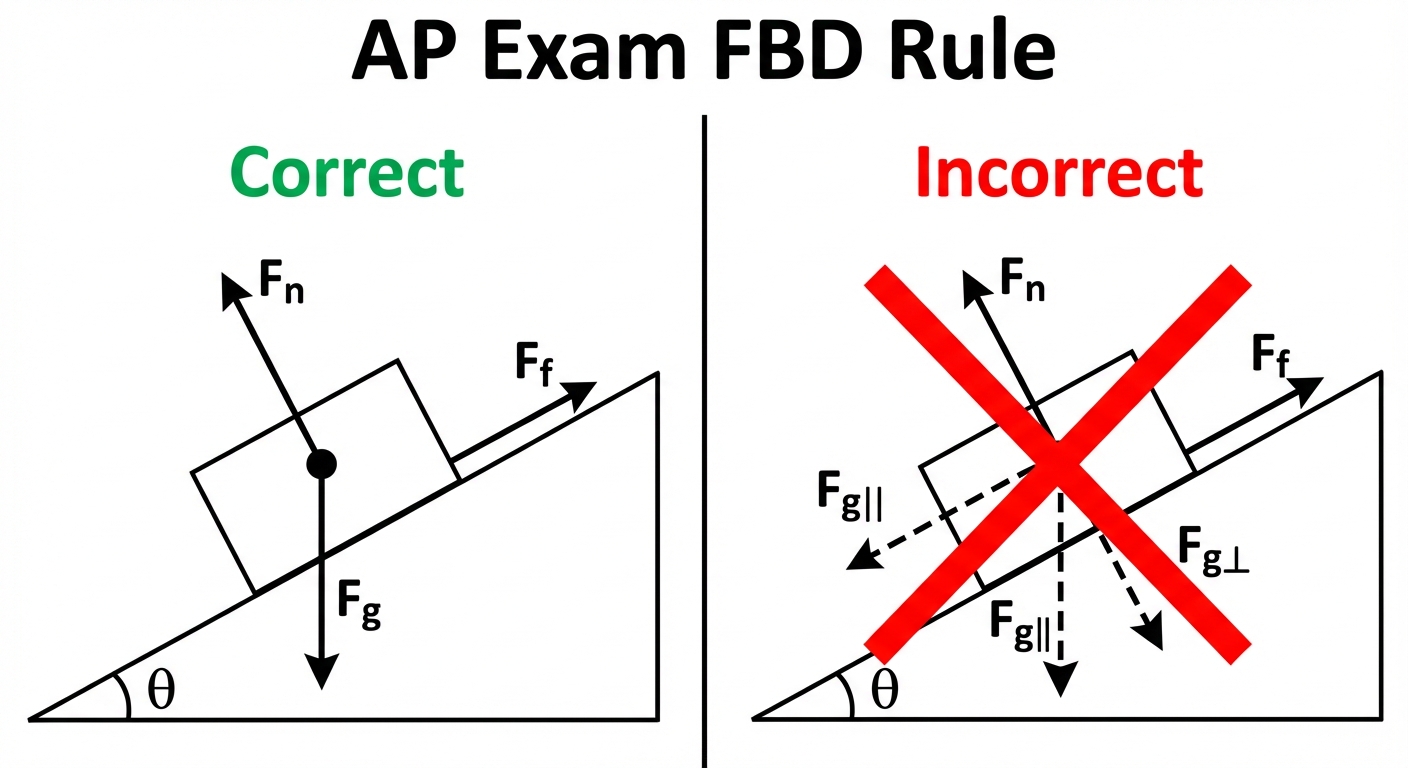
Crucial Exam Rule: When asked to draw an FBD on the AP exam, never draw vector components (like $mg\sin\theta$) on the main diagram. Components should be drawn on a separate "scratch work" diagram alongside the official one. Including components on the official diagram is often counted as "double counting" forces and will lose points.
Newton's Second Law
This is the core computational engine of mechanics. It establishes the causal link between force (cause) and acceleration (effect).
The Fundamental Equation
Definition: The acceleration of an object is directly proportional to the net force acting on it and inversely proportional to its mass.
\sum \vec{F} = m\vec{a}
However, in AP Physics C, we often look at the calculus-based definition relating force to linear momentum ($\,\vec{p}\,$, where $\vec{p} = m\vec{v}$):
\sum \vec{F} = \frac{d\vec{p}}{dt}
If mass is constant, this simplifies back to the algebra form:
\frac{d(m\vec{v})}{dt} = m \frac{d\vec{v}}{dt} = m\vec{a}
Component Analysis
Because force and acceleration are vectors, you must analyze them in perpendicular components (usually Cartesian $x$ and $y$, or Parallel $\parallel$ and Perpendicular $\perp$ for inclines).
\sum Fx = max \quad \text{and} \quad \sum Fy = may
Worked Example: Block on an Incline
Consider a block of mass $m$ sliding down a rough incline angled at $\theta$ with a coefficient of kinetic friction $\mu_k$. Find the acceleration.
- Define Axes: Let $+x$ be down the ramp, $+y$ be perpendicular to the ramp.
- Sum Forces in Y: The block does not accelerate off the ramp ($ay = 0$). \sum Fy = FN - mg\cos\theta = 0 \implies FN = mg\cos\theta
- Sum Forces in X: Gravity pulls down, friction opposes motion.
\sum Fx = mg\sin\theta - fk = ma_x - Substitute Friction: Recall $fk = \muk FN$. mg\sin\theta - \muk(mg\cos\theta) = ma_x
- Solve: Mass cancels out.
ax = g(\sin\theta - \muk\cos\theta)
Newton's Third Law
Newton's Third Law describes the nature of interactions between objects.
Interaction Pairs
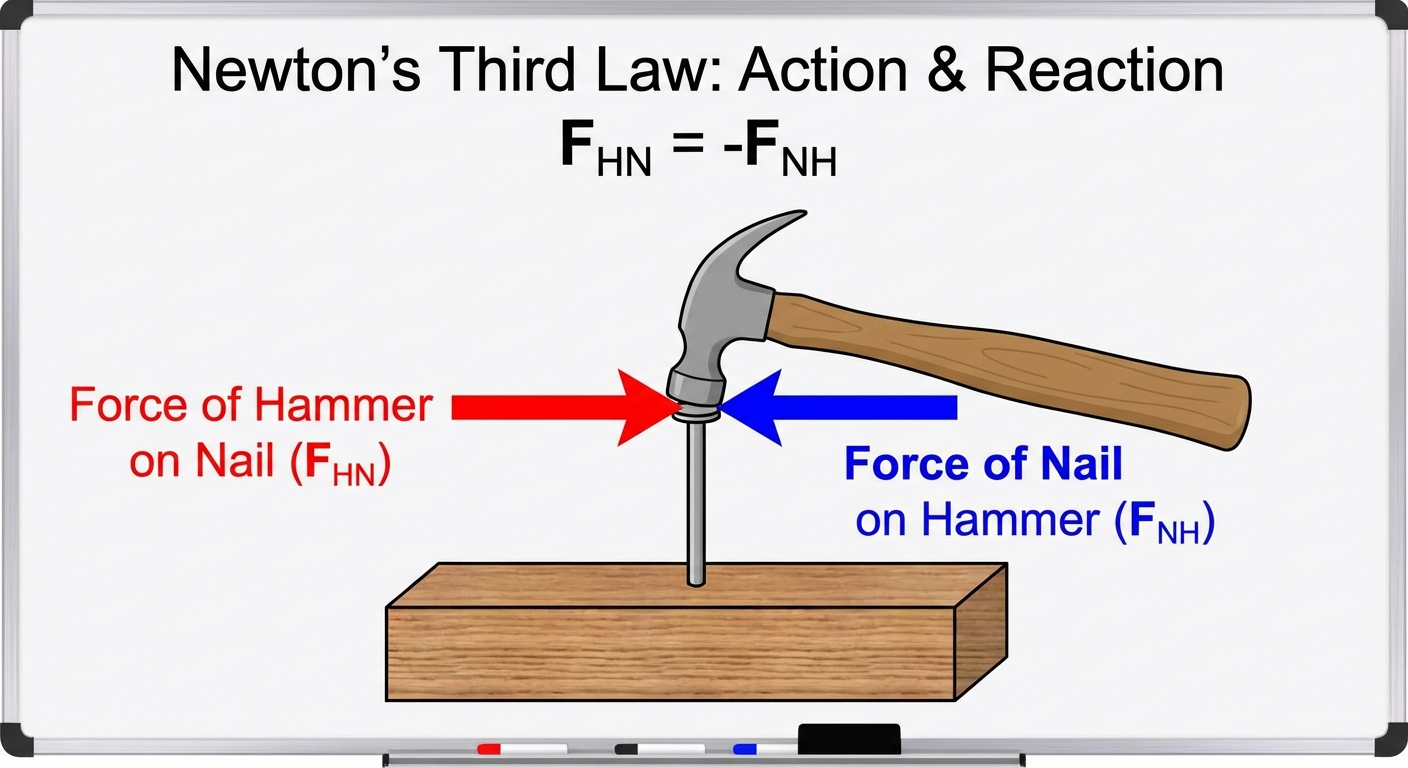
Definition: If Object A exerts a force on Object B, then Object B exerts a force of equal magnitude and opposite direction on Object A.
\vec{F}{A \rightarrow B} = -\vec{F}{B \rightarrow A}
Properties of Third Law Pairs
- Different Objects: The forces act on two different objects. Therefore, they never cancel each other out on a single FBD.
- Simultaneous: The forces exist strictly at the same time. There is no delay.
- Same Type: The forces are of the same nature. If A attracts B gravitationally, B attracts A gravitationally. If A touches B (Normal force), B touches A (Normal force).
Application Example
Consider a horse pulling a cart.
- The misconception: "If the horse pulls the cart, and the cart pulls the horse back with equal force, how do they move?"
- The solution: Analyze the FBD of the entire system or just the horse. The horse moves forward because the friction force the ground exerts on the horse's hooves is larger than the backward pull of the cart.
Common Mistakes & Exam Pitfalls
- The "m" in F=ma: When summing forces on a system (like two blocks connected by a string), the $m$ in $\sum F = ma$ must be the total mass of the system moving at that acceleration.
- Normal Force $\neq$ Gravity: Do not memorize $N = mg$. On an incline, $N = mg\cos\theta$. If an external force pushes down, $N$ increases. Always solve for $N$ using $\sum F_y = 0$.
- Third Law Cancellation: Students often think Third Law pairs cancel out to zero. They only sum to zero if you consider the system containing both objects. If analyzing one object, the reaction force is irrelevant to that object's motion.
- Centripetal Force is not a "Real" Force: Never label a vector $F_c$ on an FBD. Centripetal force is the result (the net force), not a physical interaction. It is provided by tension, gravity, or friction.
- Inertia vs. Force: Objects do not carry a "force of motion" with them. Once a projectile leaves a launcher, the only forces acting on it are gravity (and air resistance, if specified).