Comprehensive Guide to Motivic Analysis and Development
Understanding the Musical Motive
A motive (or motif) is the smallest identifiable musical idea. It serves as the primary building block of a composition. To be considered a motive, a musical fragment must have a distinct characteristic—usually rhythmic, melodic, or harmonic—and it must be reused and developed throughout the piece.
Think of a motive like a "seed" from which the entire melody grows. The most famous example in music history is the opening four notes of Beethoven's Symphony No. 5 (short-short-short-long). This simple pattern is transformed in dozens of ways to create the entire movement.
Key Characteristics
- Length: Usually short (2 to 8 notes).
- Identity: Defined by a specific rhythmic pattern or intervallic contour.
- Function: It creates unity within a piece. When you hear the motive return, even in a changed form, it helps the music sound cohesive.
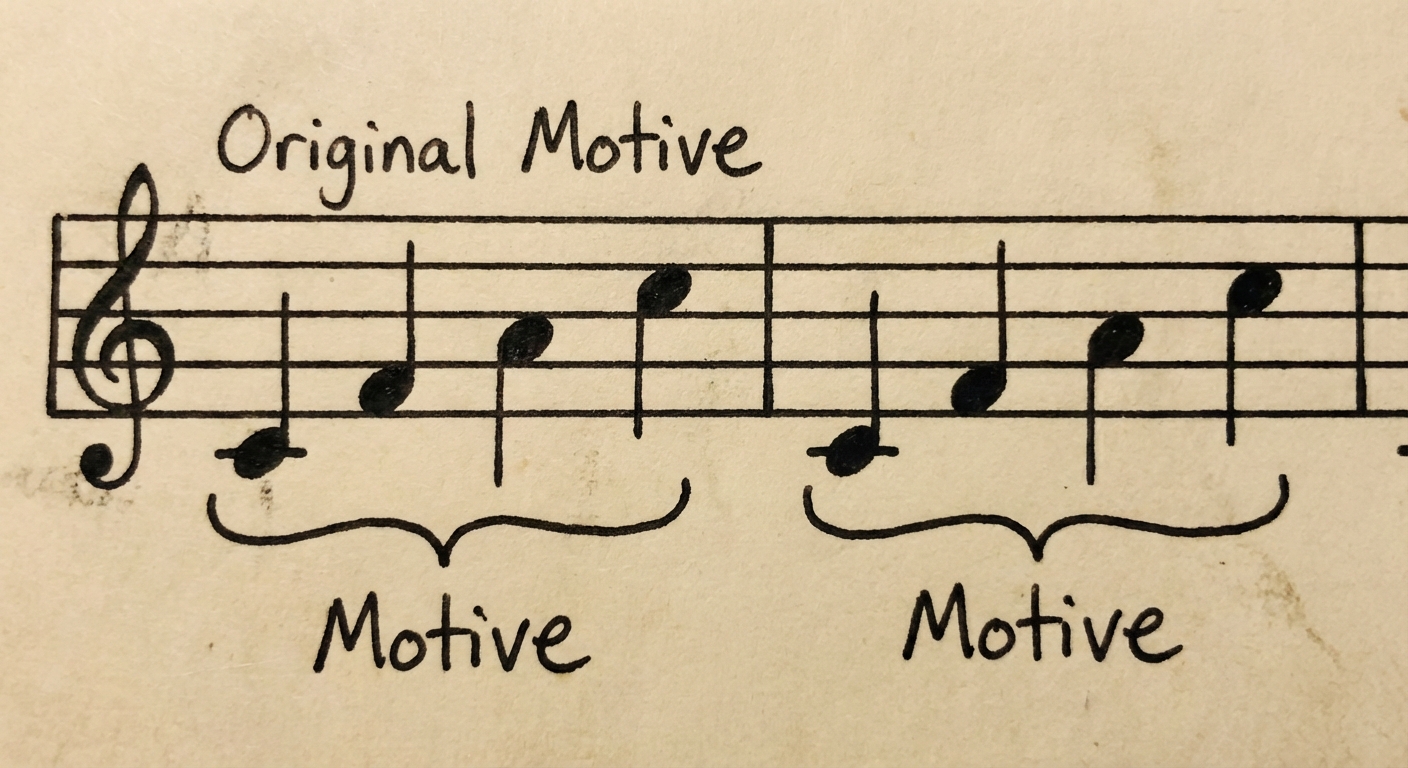
The Sequence: The Engine of Melody
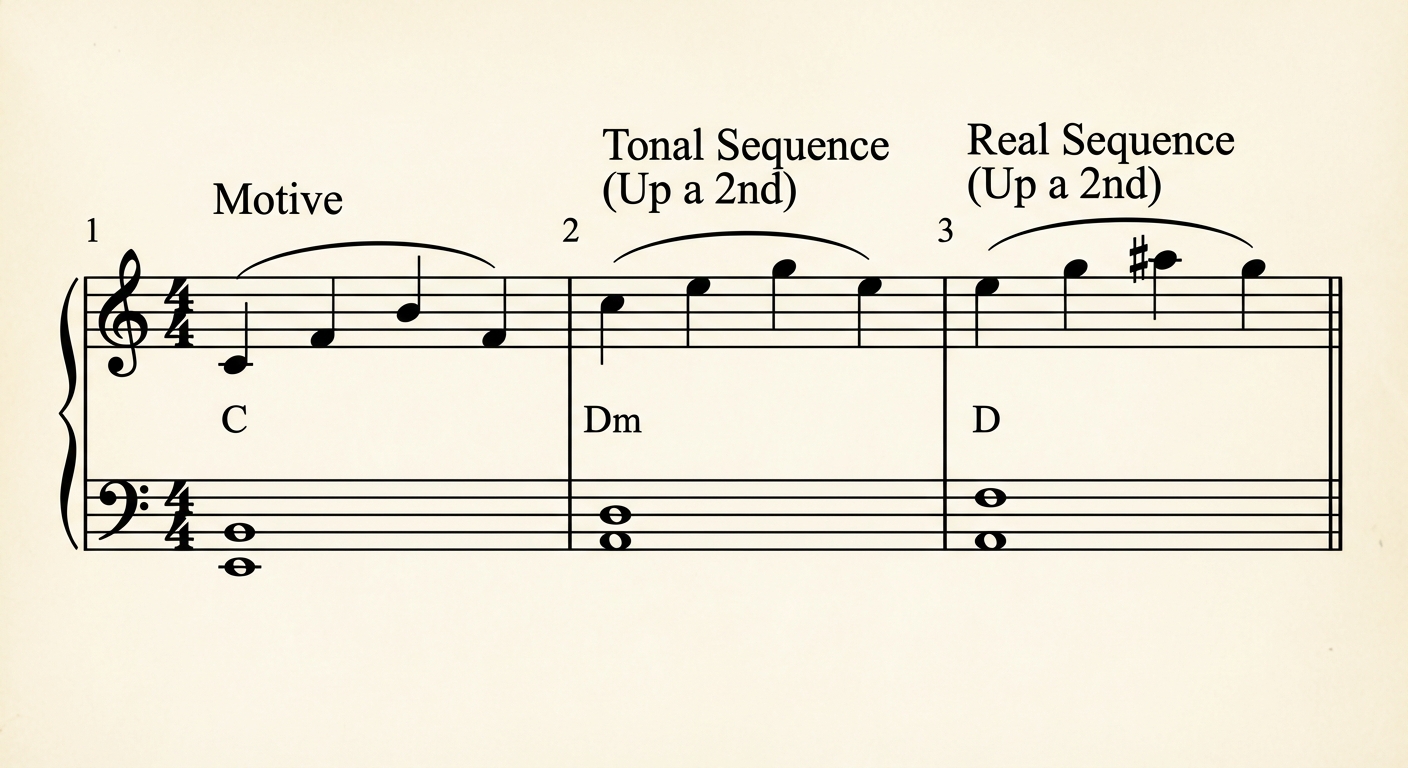
One of the most common ways to extend a motive is through sequence. A sequence occurs when a musical idea is repeated immediately at a different pitch level (transposition). Sequences are vital for the AP Music Theory exam, particularly in Melodic Dictation and Sight Singing.
1. Tonal (Diatonic) Sequence
In a Tonal Sequence, the motive is moved up or down the scale, but no accidentals are added to preserve the exact interval qualities. The pattern stays strictly within the key signature.
- Result: The specific interval qualities (Major vs. Minor) may change to fit the key.
- Example: If a motive in C Major creates a Major 3rd (C to E) and is sequenced up a step (D to F), it becomes a minor 3rd to stay in C Major.
2. Real (Modulating) Sequence
In a Real Sequence, the motive is transposed efficiently by an exact interval. The composer adds accidentals to ensure every interval quality remains identical to the original.
- Result: This often leads to a modulation (change of key).
- Example: If the motive is C to E (Major 3rd), a real sequence up a step would be D to F$\sharp$ (Major 3rd).
3. Modified Sequence
A sequence where the repetition is loose. The general shape or rhythm is repeated at a new pitch level, but some intervals are altered significantly, or the rhythm is slightly adjusted for expression.
Intervallic and Directional Transformations
Composers use various geometric operations to manipulate motives. These are heavily tested in the analysis portion of the AP exam.
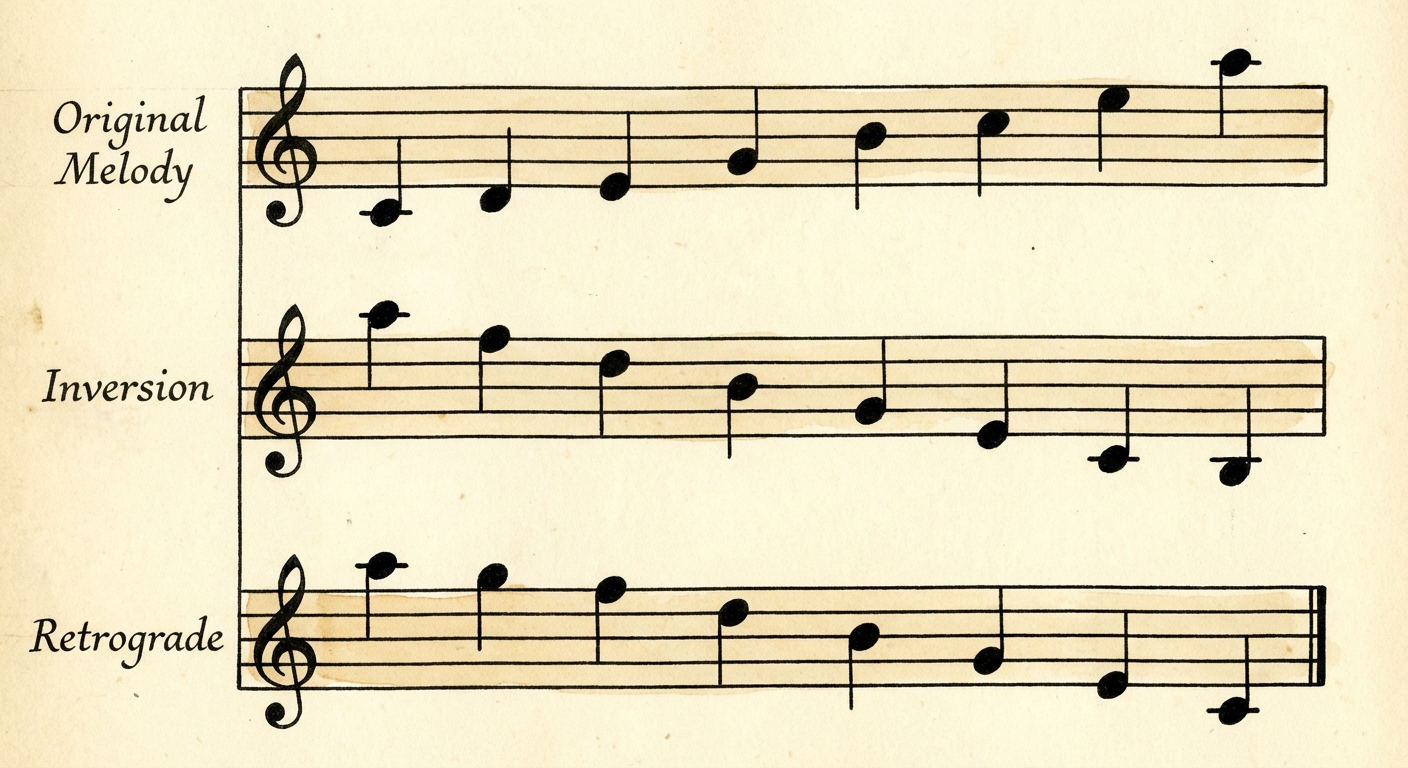
Melodic Inversion
Inversion involves flipping the melodic contour upside down. Imagine a horizontal mirror running through the starting note of the melody.
- Concept: If the original melody goes up a Major 3rd, the inversion goes down a Major 3rd (or a minor 3rd if staying tonal).
- Strict Inversion: Exact intervals are reflected (Up P4 $\rightarrow$ Down P4).
- Tonal Inversion: Using scale degrees to reflect the shape within the key (Up a step $\rightarrow$ Down a step).
Note: Do not confuse Melodic Inversion with Harmonic Inversion (e.g., first inversion triads). Melodic inversion creates a mirror image of the line.
Retrograde
Retrograde is the process of playing a melody backward, from the last note to the first.
- Concept: It is like reading a sentence from right to left.
- Identification: This is often difficult to hear aurally without practice but easy to spot visually in a score. It is less common in Common Practice Era music (1600–1900) but standard in 20th-century serialism.
Retrograde Inversion
This combines both techniques. The melody is played backward (retrograde) AND upside down (inversion). This is a complex device usually reserved for very strict contrapuntal forms (like fugues) or 12-tone serialism.
Rhythmic Transformations
These devices alter the duration of the notes without changing the pitch content.
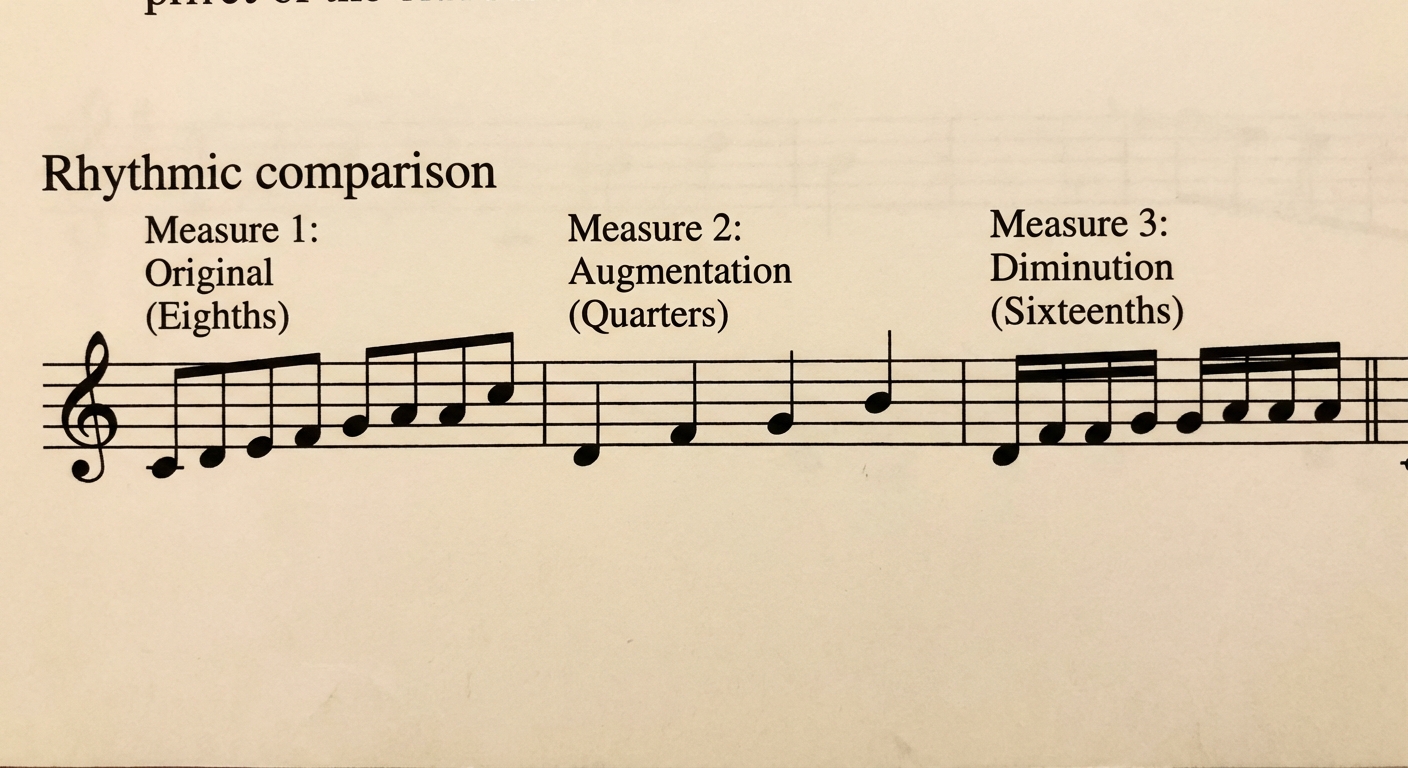
Augmentation
Augmentation involves lengthening the rhythmic values of the motive, usually by a specific ratio (often $2:1$).
- Effect: The melody sounds slower and more majestic, though the tempo of the piece may not change.
- Math: Quarter notes become half notes; eighth notes become quarters.
- Usage: Common in the final content of a Fugue or the ending of a piece to create a sense of grandeur.
Diminution
Diminution is the opposite of augmentation. The rhythmic values are shortened, usually by half.
- Effect: The melody sounds like it is rushing or moving twice as fast.
- Math: Quarter notes become eighth notes; half notes become quarters.
Other Melodic Devices
During melodic analysis questions on the AP Exam, look for these subtler manipulations:
Fragmentation
Breaking the motive into smaller chunks. If a motive has two parts (rhythmic head and lyrical tail), the composer might take just the rhythmic head and repeat it over and over to build tension.
Extension and Truncation
- Extension: Adding material to the motive (usually at the end) to make it longer.
- Truncation: Cutting off the end of the motive, making it shorter than the original.
Internal Expansion
Adding notes inside the motive, often maintaining the original starting and ending points but elaborating the space in between.
Comparison of Devices
| Device | Pitch Change? | Rhythm Change? | Direction Change? | Summary |
|---|---|---|---|---|
| Sequence | Yes (Transposed) | No | No | Same idea, new pitch level |
| Inversion | Yes (Flipped) | No | Yes (Mirrored) | Upside down |
| Retrograde | Yes (Reordered) | Yes (Reordered) | Yes (Reversed) | Backwards |
| Augmentation | No | Yes (Longer) | No | Slower rhythm (values x2) |
| Diminution | No | Yes (Shorter) | No | Faster rhythm (values /2) |
Common Mistakes & Pitfalls
1. Confusing "Real" vs. "Tonal" Sequences
Students often identify a sequence correctly but fail to specify if it is Real or Tonal.
- Check: Look at the accidentals. If the sequence has accidentals that are not in the key signature, it is likely a Real Sequence. If it stays strictly in the key (resulting in slightly different interval sizes), it is Tonal.
2. Melodic Inversion vs. Chord Inversion
On the multiple-choice section, seeing the word "Inversion" requires context.
- If analyzed vertically (harmonies): It refers to bass notes (root/3rd/5th).
- If analyzed horizontally (melodies): It refers to the mirror image of the contour.
3. Missing Rhythmic Augmentation
In complex polyphonic textures (like Bach Fugues), an augmented subject can be hard to spot because it moves so slowly compared to the other fast-moving voices. When analyzing a fugue, always check the bass line or the "slow" voice to see if it is actually the main theme in augmentation.
4. Retrograde Identification
Students rarely "hear" retrograde. Trust your eyes during score analysis. If a melody looks familiar but "wrong," check to see if it reads backward perfectly. If only the rhythm is backward, it is Retrograde Rhythm. If the pitches are backward, it is true Retrograde.