Module 4 Study Notes: Analyzing Rates of Change
Unit 4: Contextual Applications of Differentiation
Calculus is the mathematics of change. While Unit 2 taught you how to calculate derivatives, Unit 4 focuses on what those derivatives represents in the real world. Whether it is a particle moving along a line, water draining from a tank, or the marginal profit of selling a product, the derivative provides a snapshot of instantaneous change.
Interpreting the Meaning of the Derivative in Context
The College Board frequently tests your ability to translate a mathematical expression like $f'(3) = -5$ into a plain-English sentence. To do this correctly, you must understand units, timing, and direction.
Concepts & Definitions
Instantaneous Rate of Change: The derivative $f'(x)$ represents the rate at which the dependent variable ($y$) changes with respect to the dependent variable ($x$) at a specific instant.
Units of the Derivative: The units of the derivative are always a ratio:
The Interpretation Template
When asked to "interpret the meaning of the derivative in the context of the problem," follow this specific template to ensure you earn full points on Free Response Questions (FRQs):
"At [input value with units], the [name of quantity using context] is [increasing/decreasing] at a rate of [absolute value of output] [units of $y$ per unit of $x$]."
Key Rules for Writing:
- Time Specificity: Always state "At time $t =$ …". Do not say "During the time" or "Over the interval."
- Direction: Use the words "increasing" (if $f' > 0$) or "decreasing" (if $f' < 0$).
- Positive Rate: If you use the word "decreasing," report the rate as a positive number. (e.g., "Decreasing at a rate of 5," NOT "Decreasing at a rate of -5").
Example: Draining a Tank
Let $V(t)$ represent the volume of water in a tank (in gallons) at time $t$ (in minutes). Interpret $V'(10) = -3.5$.
- Input: $t = 10$ minutes
- Output Context: Volume of water
- Direction: Negative derivative $\rightarrow$ Decreasing
- Units: Gallons per minute (gal/min)
Correct Interpretation: "At time $t = 10$ minutes, the volume of water in the tank is decreasing at a rate of 3.5 gallons per minute."
Straight-Line Motion: Position, Velocity, and Acceleration
Particle motion represents one of the most common applications of differentiation in AP Calculus. This specifically refers to rectilinear motion (motion along a straight line, such as the x-axis).
The Relationship Ladder
Motion is defined by three connected functions of time $t$:
- Position ($s(t)$ or $x(t)$): The location of the particle relative to the origin at time $t$.
- Velocity ($v(t)$): How fast and in what direction the position is changing.
- Acceleration ($a(t)$): How fast and in what direction the velocity is changing.
Velocity vs. Speed
This is a critical distinction:
- Velocity is a vector; it indicates magnitude (how fast) and direction (sign).
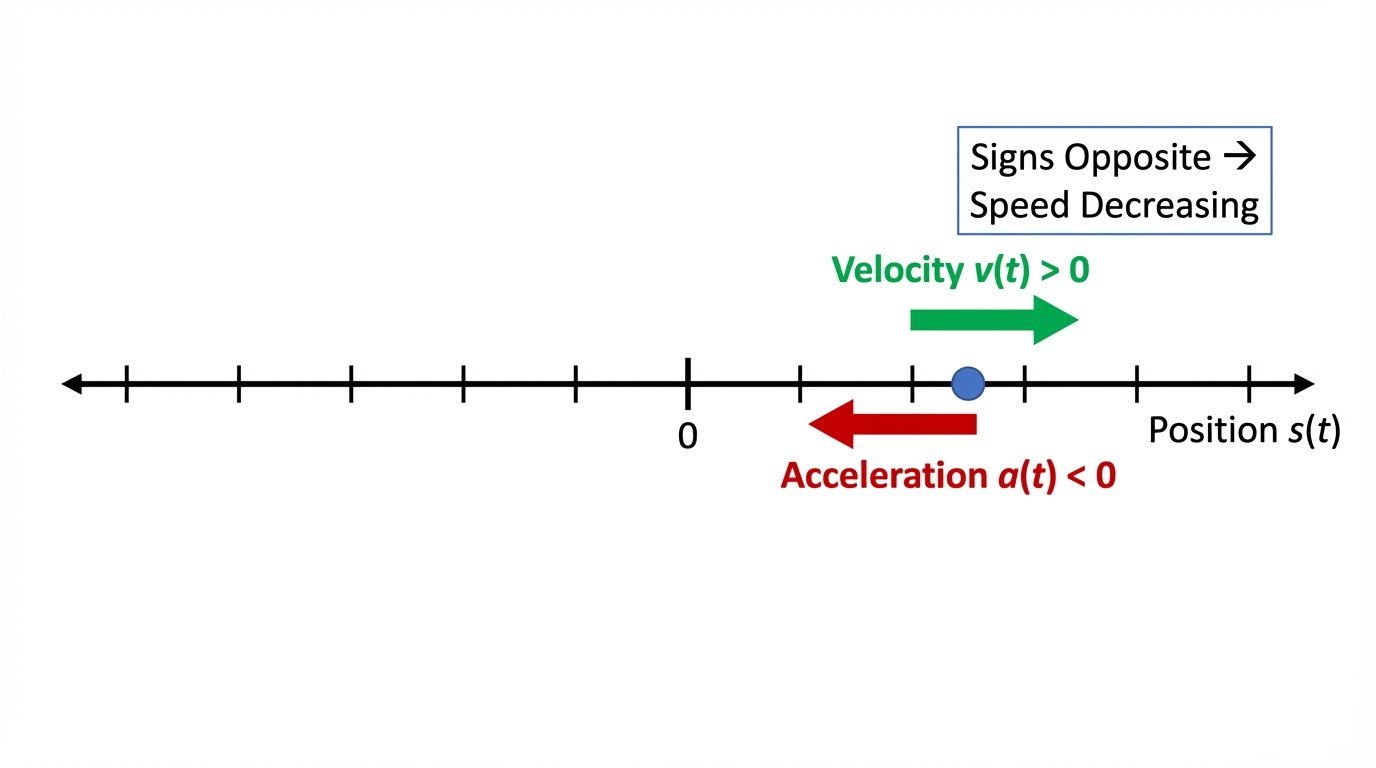
- If $v(t) > 0$, the particle is moving in the positive direction (right or up).
- If $v(t) < 0$, the particle is moving in the negative direction (left or down).
- If $v(t) = 0$, the particle is at rest.
- Speed is a scalar; it indicates magnitude only.
Speeding Up and Slowing Down
Just because acceleration is positive does not mean an object is speeding up. Speeding up depends on the relationship between velocity and acceleration vectors.
| Relationship | Behavior | Analogy |
|---|---|---|
| $v(t)$ and $a(t)$ have the SAME sign | Speeding Up | You are running forward ($+$) and someone pushes you forward ($+$). |
| $v(t)$ and $a(t)$ have OPPOSITE signs | Slowing Down | You are running forward ($+$) but a headwind pushes you back ($-$). |
Algorithm for Analysis:
To determine if a particle is speeding up or slowing down at $t=c$:
- Evaluate $v(c)$. Determine the sign.
- Evaluate $a(c)$. Determine the sign.
- Compare signs.
Rates of Change in Applied Contexts
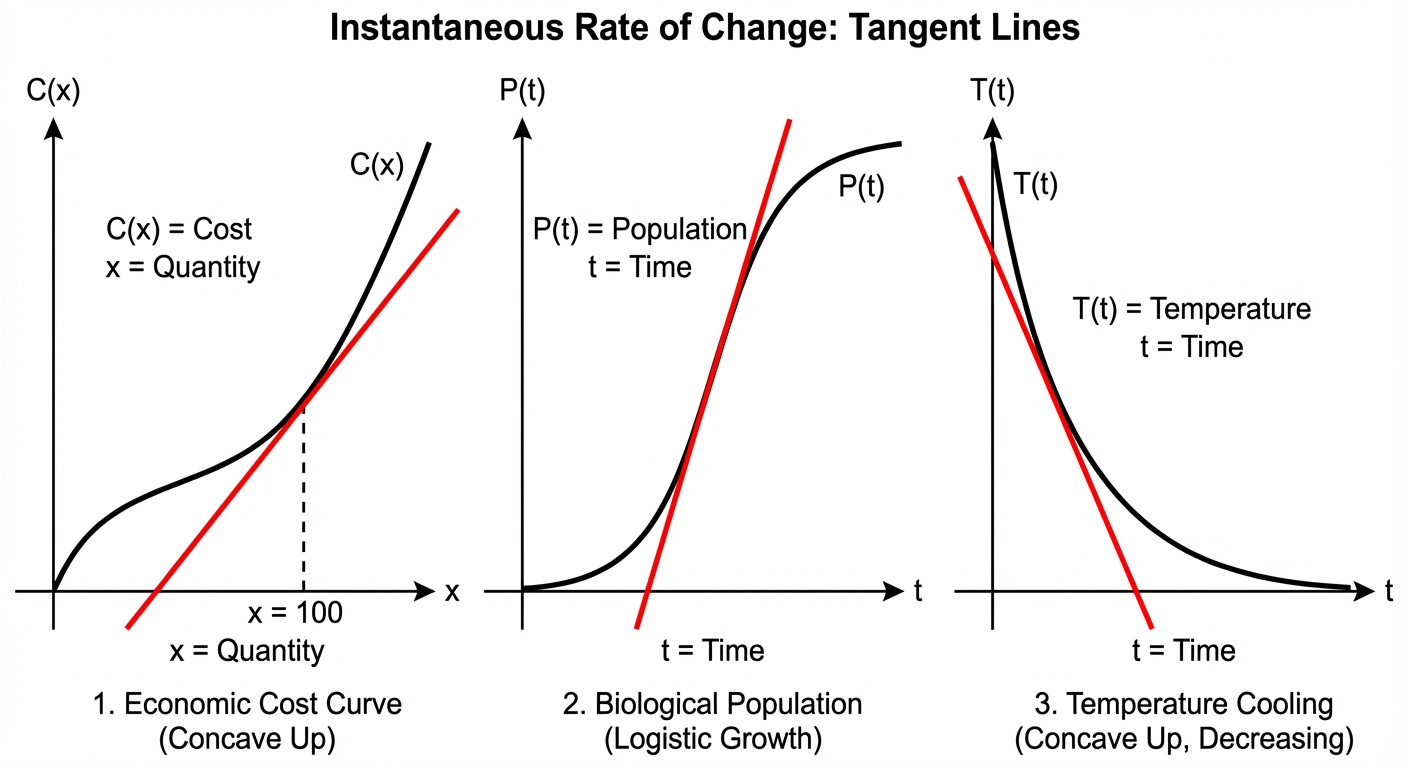
Beyond physics, derivatives measure sensitivity to change in economics, biology, environmental science, and geometry.
Economic Contexts (Marginals)
In economics, the derivative is often called the marginal rate.
- Cost Function ($C(x)$): The cost to produce $x$ items.
- Marginal Cost ($C'(x)$): The approximate cost of producing the $(x+1)^{\text{th}}$ item.
Example:
If $C(x)$ is the cost to produce $x$ widgets, $C'(100) = 25$ means "The cost to produce the 101st widget is approximately $25."
Geometry and Density
Rates of change often link geometric dimensions.
- Linear Density: If $M(x)$ is the mass of a wire of length $x$, then $\frac{dM}{dx}$ is the linear density (mass per unit length) at point $x$.
- Flow Rates: If $V(t)$ is volume, $\frac{dV}{dt}$ is the flow rate.
Steps for Solving Word Problems
- Identify Variables: Read the problem text and assign variables (e.g., let $P(t)$ = population).
- Identify Given Data: Determine what values are known (e.g., $P(0) = 500$) and what rates are known (e.g., $P'(5) = 20$).
- Check Units: Ensure the input units matches the denominator of the derivative and the output units matches the numerator.
- Interpret: Translate the result back into the context of the scenario.
Common Mistakes & Pitfalls
Below are the most frequent errors students make on the AP exam regarding rates of change.
1. The "Decreasing Negative" Error
Mistake: Writing "The temperature is decreasing at a rate of $-5$ degrees."
Correction: This is a double negative. If the function is decreasing, the rate is negative ($f' = -5$), but in English, we say "Decreasing at a rate of 5."
2. Confusing Velocity and Speed
Mistake: Assuming that if acceleration is negative, the particle is slowing down.
Correction: You must check velocity. If velocity is $-10$ and acceleration is $-2$, the object is speeding up in the negative direction.
3. Ignoring Units
Mistake: Providing a numerical answer without units on an FRQ.
Correction: Always write units. If $H(t)$ is height in meters and $t$ is seconds, $H'(t)$ is m/sec.
4. "Over the Interval" vs. "At Time t"
Mistake: Interpreting a derivative $f'(5)$ as "Assuming the rate stays constant for 5 seconds…" or "Between time 0 and 5…"
Correction: The derivative is instantaneous. It applies only at that exact split-second.