APES Unit 5: Resource Management and Forestry
The Tragedy of the Commons
Definition and Core Concept
The Tragedy of the Commons is a fundamental environmental concept introduced by ecologist Garrett Hardin in 1968. It suggests that individuals acting independently and rationally according to their own self-interest usually behave contrary to the best interests of the whole group by depleting some common resource.
In an environmental context, the "commons" refers to a shared, limited resource that is not owned by any specific individual but is available to all (a common-pool resource).
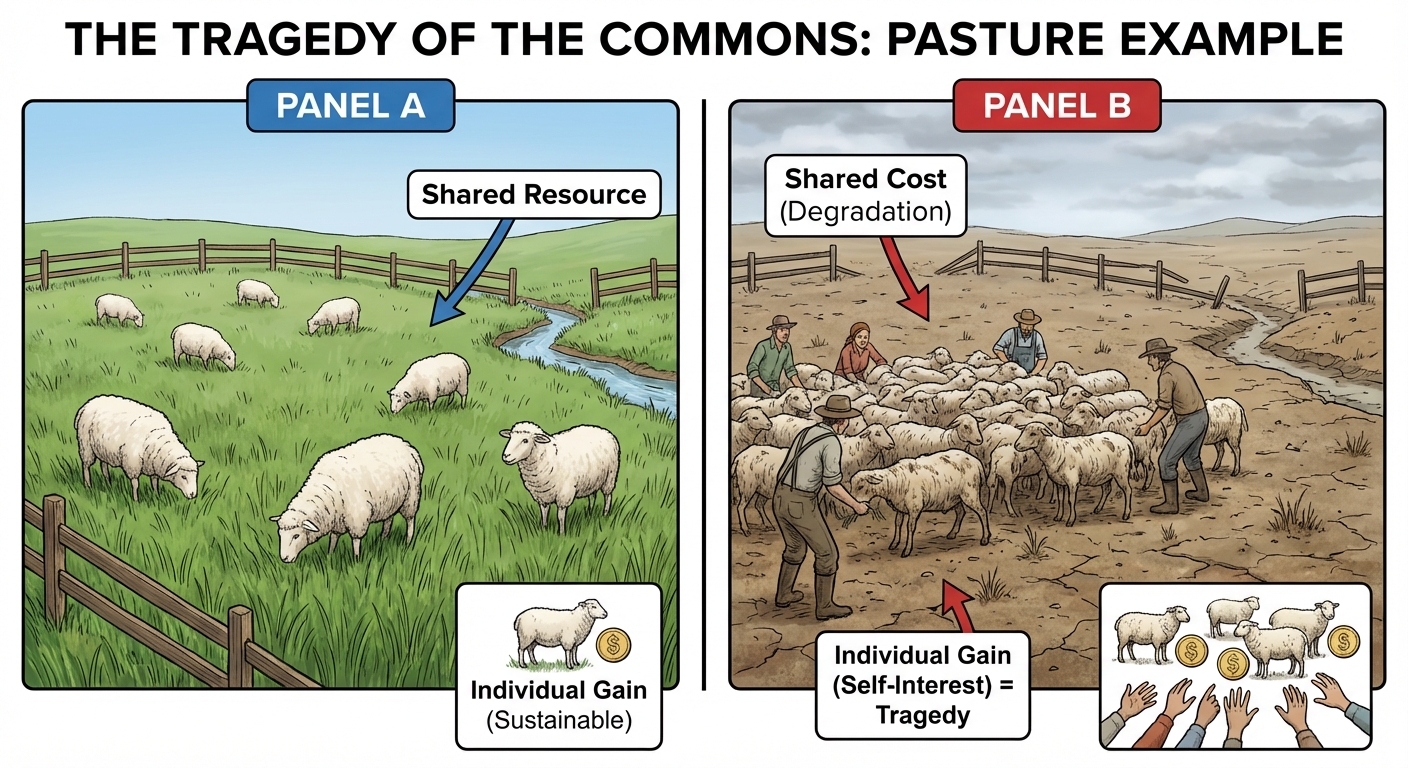
- The Incentive: If a resource is open-access (like the open ocean or public grazing land), an individual gains the full benefit of exploiting an extra unit of that resource.
- The Cost: The cost of exploiting that extra unit (degradation, pollution, depletion) is distributed among all users.
- The Result: Because the individual gets +1 benefit but only a fraction of the cost, the logical economic decision is to take more. When everyone does this, the resource collapses.
Real-World Examples
- Overgrazing: If farmers graze sheep on public land, one farmer adds an extra sheep to gain more wool/meat. The grass is slightly damaged, but the cost is shared. Gradually, the pasture becomes barren.
- Overfishing: In international waters, no single country owns the fish. Commercial fleets race to catch as much as possible before others do, leading to fishery collapse (e.g., Atlantic Cod).
- Groundwater Depletion: Farmers pump water from a shared aquifer. If one farmer conserves, their neighbor might just pump the saved water. This leads to the aquifer drying up faster than it can recharge.
Solutions to the Tragedy
To prevent common resources from being depleted, access must be regulated. This is generally achieved through two primary methods:
- Private Ownership: Converting the commons into private property. An owner has a direct incentive to protect the land to ensure future profit.
- Government Regulation: Laws that limit use via quotas, permits, or taxes (e.g., hunting licenses, fishing catch limits, the Clean Air Act).
Maximum Sustainable Yield (MSY)
Closely related to managing the commons is the concept of Maximum Sustainable Yield (MSY). This is the maximum amount of a renewable resource that can be harvested without compromising the future availability of that resource.
Mathematically, this usually occurs at 50% of the carrying capacity ($K$).
- Logistic Growth: Populations grow quickly when small, but slow down as they approach carrying capacity.
- The Sweet Spot: Harvesting at $\frac{1}{2}K$ keeps the population in its phase of fastest growth, allowing for the fastest replenishment.
Timber Harvesting: Clearcutting
Forests provide essential ecosystem services, including carbon sequestration, air purification, and habitat provisioning. However, they are also a major economic resource for timber and fuel. The method of harvesting trees significantly impacts the environment.
What is Clearcutting?
Clearcutting is a timber harvesting practice where all trees in a given area are removed at once. It is the most economically efficient method for loggers but the most ecologically damaging.
Economic Advantages
- High Profitability: Loggers get the maximum amount of timber for the lowest operational cost.
- Efficiency: Heavy machinery can simply drive through and harvest everything; no time is wasted selecting specific trees.
- Replanting: It facilitates the planting of tree plantations (single-species stands), which are easy to manage and harvest later.
Environmental Consequences
Clearcutting alters the physical environment drastically, leading to a cascade of negative effects.
| Environmental Impact | Mechanism & Consequence |
|---|---|
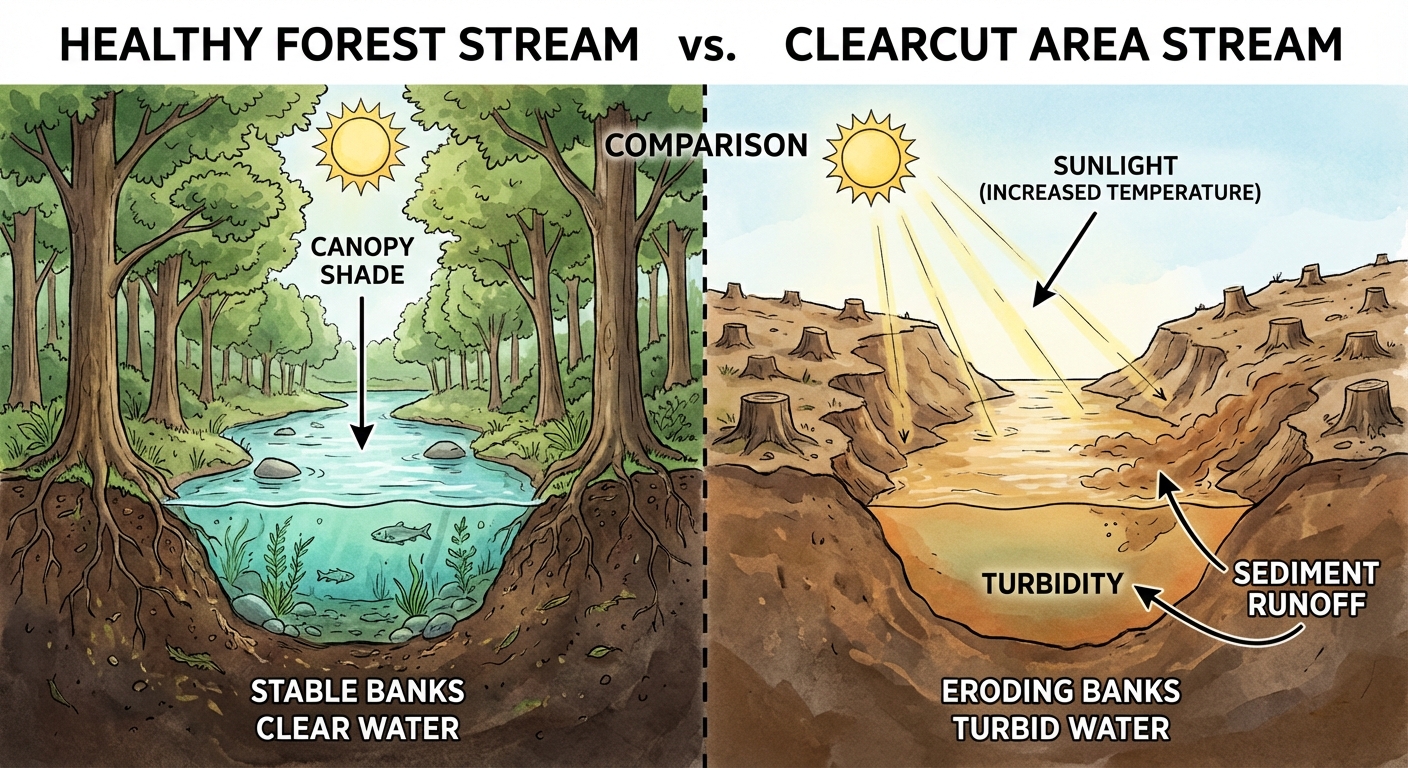
| Soil Erosion | Without tree roots to anchor the soil, wind and rain remove topsoil. This removes nutrients, making forest regrowth difficult. |
| Increased Turbidity | Eroded soil washes into nearby streams and rivers. This creates turbidity (cloudiness), which blocks sunlight for aquatic plants and clogs fish gills. |
| Water Temperature Rise | Removal of riparian (riverbank) trees eliminates shade. Direct solar radiation heats the water. Warmer water holds less dissolved oxygen (DO), stressing aquatic species like trout and salmon. |
| Flooding and Runoff | Forests act as sponges. Without trees, soil compaction occurs, and water runs off the surface immediately rather than infiltrating the ground, causing flash floods. |
| Habitat Fragmentation | It destroys habitats and creates "edges." Edge effects expose species to different temperatures, wind, and predators, harming core-forest species. |
| Loss of Biodiversity | Clearcut areas are often replanted as even-aged monocultures (tree plantations) which lack the structural complexity and genetic diversity of natural forests. |
Alternatives to Clearcutting
While not the focus of this section, understanding alternatives helps contextualize clearcutting:
- Selective Cutting: Harvesting only intermediate-aged or mature trees singly or in small groups. Maintains uneven-aged stands and biodiversity.
- Shelterwood Cutting: Removing trees in stages over a period of years so that mature trees provide shade and seeds for younger trees.
Common Mistakes & Pitfalls
These are frequently missed concepts on the AP exam:
"The Tragedy of the Commons applies to everything."
- Correction: It only applies to resources that are public/open-access and unregulated. If a resource is privately owned, the owner prevents others from using it, so the "tragedy" mechanism (shared cost/individual gain) doesn't apply.
"Clearcutting causes climate change because it releases CO2."
- Nuance: While true, the AP exam often looks for the localized, immediate physical impacts first (erosion, water temperature, soil degradation). Don't forget the albedo effect—clearing dark forests can essentially increase local surface temperature due to loss of evaporative cooling, even if bare ground reflects more light.
"Water gets hot in clearcut streams because of Global Warming."
- Correction: While global warming is real, the specific reason a stream next to a clearcut forest warms up is the loss of direct shade from the tree canopy. Always cite "loss of shade" for stream temperature questions in forestry contexts.
Confusing Erosion with Weathering.
- Correction: Weathering is the breaking down of rocks. Erosion is the movement of that material. Clearcutting increases erosion (movement of soil into water) because roots no longer hold the soil in place.