Unit 3: Foundations of Civil Liberties and Constitutional Protections
The Bill of Rights: Balancing Order and Freedom
Civil liberties formed the core of the debate between Federalists and Anti-Federalists during the ratification of the Constitution. While the Constitution was designed to limit government power, the Bill of Rights (the first 10 amendments) was added to specifically enumerate individual freedoms that the federal government could not infringe upon.
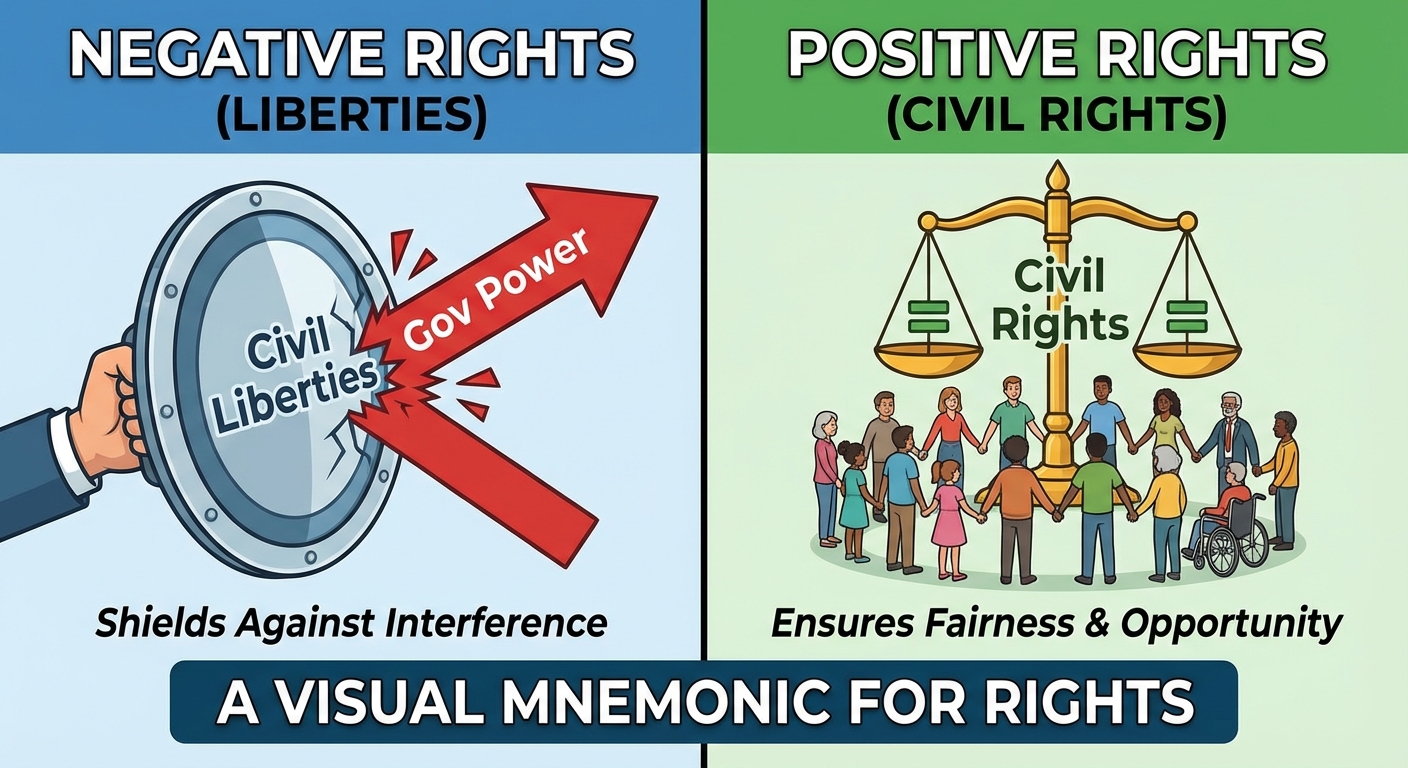
Civil Liberties vs. Civil Rights
It is crucial to distinguish between these two concepts, as they are often used interchangeably but mean different things in AP Gov:
- Civil Liberties (The Shield): Constitutionally established guarantees that protect citizens, opinions, and property against arbitrary government interference. They are limitations on the power of the government.
- Example: Freedom of speech, right to a fair trial.
- Civil Rights (The Sword): Protected rights of individuals against arbitrary or discriminatory treatment by governments or individuals. This usually involves government action to ensure equality.
- Example: Protection against racial discrimination in hiring.
First Amendment Freedoms
The First Amendment protects five fundamental liberties: Religion, Speech, Press, Assembly, and Petition. The Supreme Court has shaped the scope of these protections through landmark rulings.
Freedom of Religion
The First Amendment contains two distinct clauses regarding religion:
The Establishment Clause: Prevents the government from establishing a state religion or prioritizing one religion over others (or religion over non-religion).
- "Wall of Separation": A metaphor used by Thomas Jefferson to describe the separation of church and state.
- Required Case: Engel v. Vitale (1962): The Court ruled that school-sponsored prayer in public schools violates the Establishment Clause, even if the prayer is voluntary and nondenominational.
The Free Exercise Clause: Protects the right of individuals to practice their religion as they please, provided it does not violate public morals or a compelling government interest.
- Required Case: Wisconsin v. Yoder (1972): The Court ruled that compelling Amish students to attend school past the eighth grade violates the Free Exercise Clause. The Court prioritized religious freedom over the state's interest in education.
Freedom of Speech
Not all speech is protected. The Court must balance social order with individual liberty.
Protected Speech
- Symbolic Speech: Nonverbal actions (like burning a flag or wearing an armband) that convey a political message.
- Required Case: Tinker v. Des Moines (1969): Students wore black armbands to protest the Vietnam War. The Court ruled this was protected symbolic speech and that students do not "shed their constitutional rights at the schoolhouse gate" unless the speech causes a "substantial disruption."
Unprotected Speech
- Defamation: False statements that damage reputation (Libel is written; Slander is spoken).
- Obscenity: Offensive sexual material that lacks serious literary, artistic, political, or scientific value.
- "Clear and Present Danger": Speech that poses an immediate threat to national security or public safety.
- Required Case: Schenck v. United States (1919): Charles Schenck distributed leaflets urging men to resist the WWI draft. The Court upheld his conviction, establishing the "Clear and Present Danger" test. (Note: This standard has since been narrowed, but Schenck is the required case for this concept).
Freedom of the Press
A free press is essential for checking government power. The heavy presumption is against Prior Restraint (government censorship of material before it is published).
- Required Case: New York Times Co. v. United States (1971): The Nixon administration tried to stop the publication of the Pentagon Papers (classified documents about Vietnam). The Court ruled that the government did not meet the heavy burden of justification required for prior restraint, fortifying freedom of the press.
The Second Amendment
"A well regulated Militia, being necessary to the security of a free State, the right of the people to keep and bear Arms, shall not be infringed."
For decades, the Court focused on the "militia" clause. However, modern interpretation has shifted toward the "individual right" to own firearms for self-defense.
Key Developments
- D.C. v. Heller (2008): Established that the Second Amendment protects an individual's right to possess a firearm unconnected with service in a militia for traditionally lawful purposes, such as self-defense within the home. (This applied only to the federal government).
Selective Incorporation
Originally, the Bill of Rights only restricted the Federal Government (Barron v. Baltimore, 1833). State governments could theoretically infringe on free speech or religion.
Selective Incorporation is the legal doctrine by which the Supreme Court has nationalized the Bill of Rights, making most of its provisions applicable to the states. This is done through the Due Process Clause of the 14th Amendment.
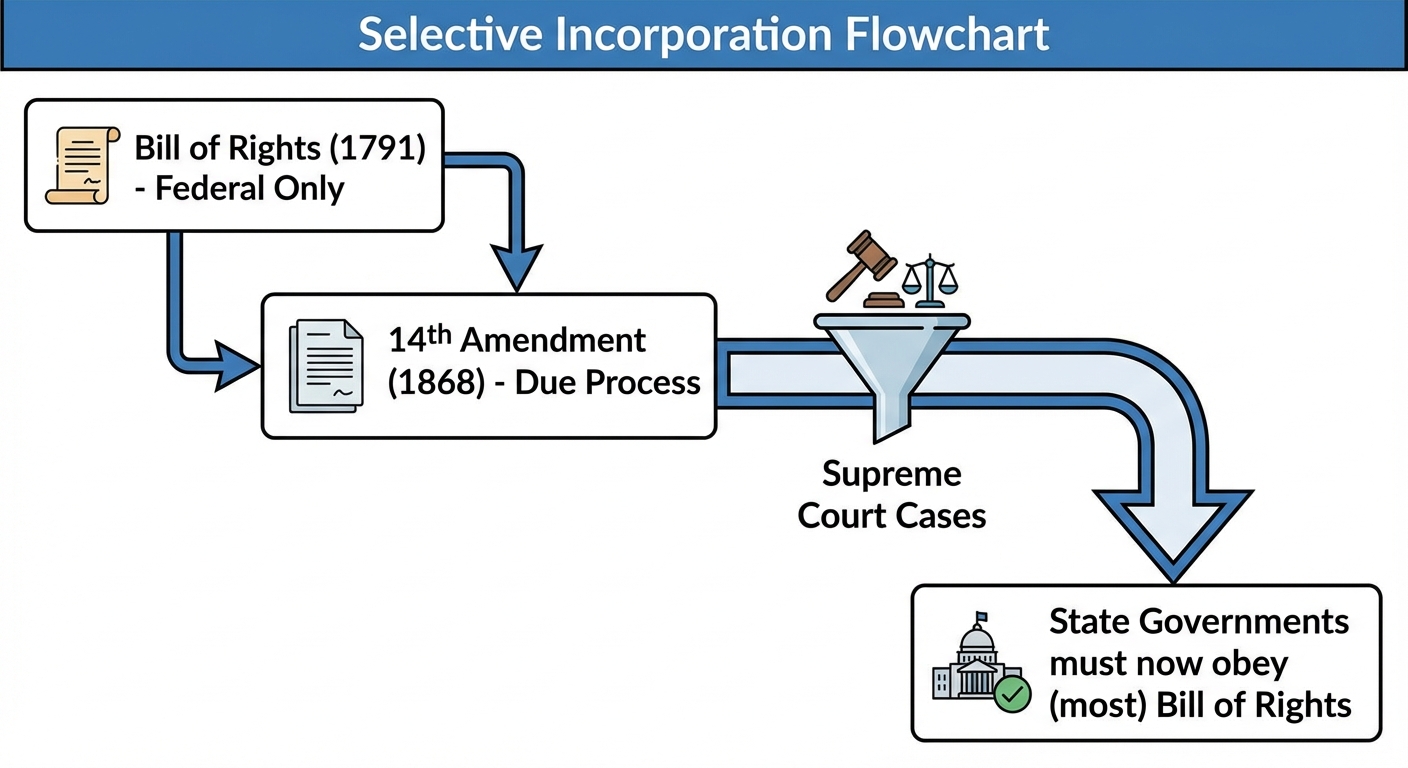
The Process
It is "selective" because the Court did not incorporate the entire Bill of Rights at once. They have done it case-by-case over decades.
Key Incorporation Case
- Required Case: McDonald v. Chicago (2010): Following Heller, the Court ruled that the right to keep and bear arms for self-defense is applicable to the states through the 14th Amendment's Due Process Clause. This incorporated the Second Amendment.
Due Process and the Rights of the Accused
Due process ensures fair treatment through the judicial system. It stems from the 5th and 14th Amendments.
The Fourth Amendment: Search and Seizure
Protects against unreasonable searches and seizures. Police generally need a warrant based on probable cause.
- The Exclusionary Rule: Evidence obtained illegally (in violation of the 4th Amendment) cannot be used in a court of law.
- Mapp v. Ohio (1961) incorporated this rule to the states.
- Exceptions to Warrant Requirement: Consent, plain view, hot pursuit, and searches incident to a lawful arrest.
The Fifth & Sixth Amendments: Fair Trial Rights
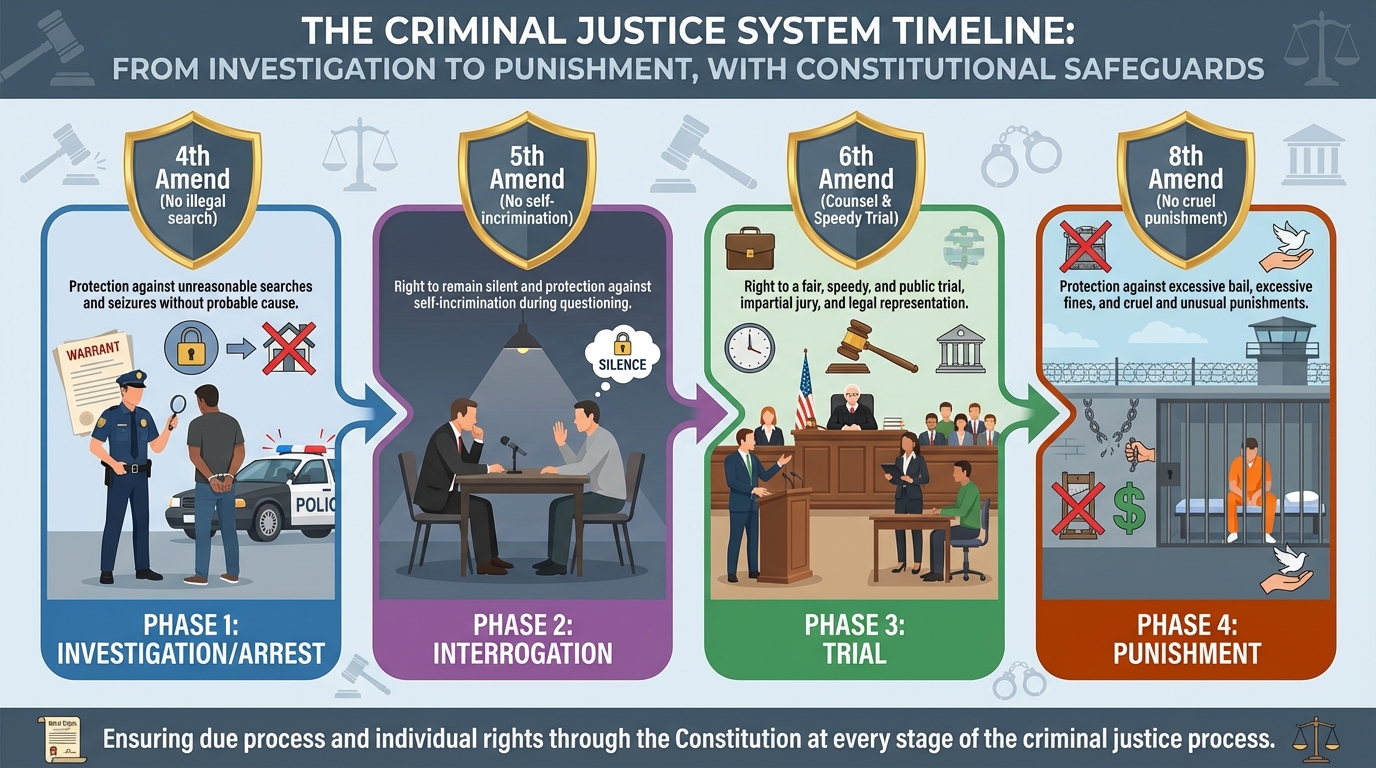
| Amendment | Right | Key Concept/Case |
|---|---|---|
| 5th | Protection against Self-Incrimination | Miranda Warning: Police must inform suspects of rights upon arrest (Miranda v. Arizona). |
| 5th | Double Jeopardy | Cannot be tried twice for the same crime. |
| 5th | Grand Jury Indictment | (Note: This is one of the few liberties not fully incorporated to states). |
| 6th | Right to Counsel | Required Case: Gideon v. Wainwright (1963): Guaranteed the right to an attorney for the poor (indigents) in state felony cases. |
| 6th | Speedy and Public Trial | Prevents indefinite detention and secret trials. |
The Eighth Amendment: Punishment
Prohibits excessive bail, excessive fines, and cruel and unusual punishment.
- Death Penalty: The Court has ruled the death penalty is not inherently cruel and unusual, but restricts its use (e.g., cannot appeal to minors or those with intellectual disabilities).
Substantive Due Process vs. Procedural Due Process
- Procedural Due Process: The government must follow the correct steps (procedures) before taking away life, liberty, or property (e.g., giving notice, a fair hearing).
- Substantive Due Process: Protects fundamental rights from government interference, even if procedural steps are followed. It is often the basis for the right to privacy (e.g., Roe v. Wade, though overturned, relied on this).
Common Mistakes & Pitfalls
- Rights are not Absolute: Students often think Free Speech means you can say anything. You cannot cite speech that incites violence (Clear and Present Danger) or defamation.
- Incorporation Confusion: Remember, the Bill of Rights did not apply to states until the 14th Amendment (ratified 1868) began being used by the Court in the 1920s (Gitlow v. New York). It didn't happen automatically.
- Establishment vs. Free Exercise: Do not mix these up.
- Is the government promoting religion? $
ightarrow$ Establishment (Engel). - Is the government stopping someone from practicing religion? $
ightarrow$ Free Exercise (Yoder).
- Is the government promoting religion? $
- 14th Amendment Clauses: Selective incorporation relies on the Due Process Clause, not the Equal Protection Clause (which is used for Civil Rights/Discrimination cases).