Unit 2: Shaping the Self through Language and Culture
Language and Identity
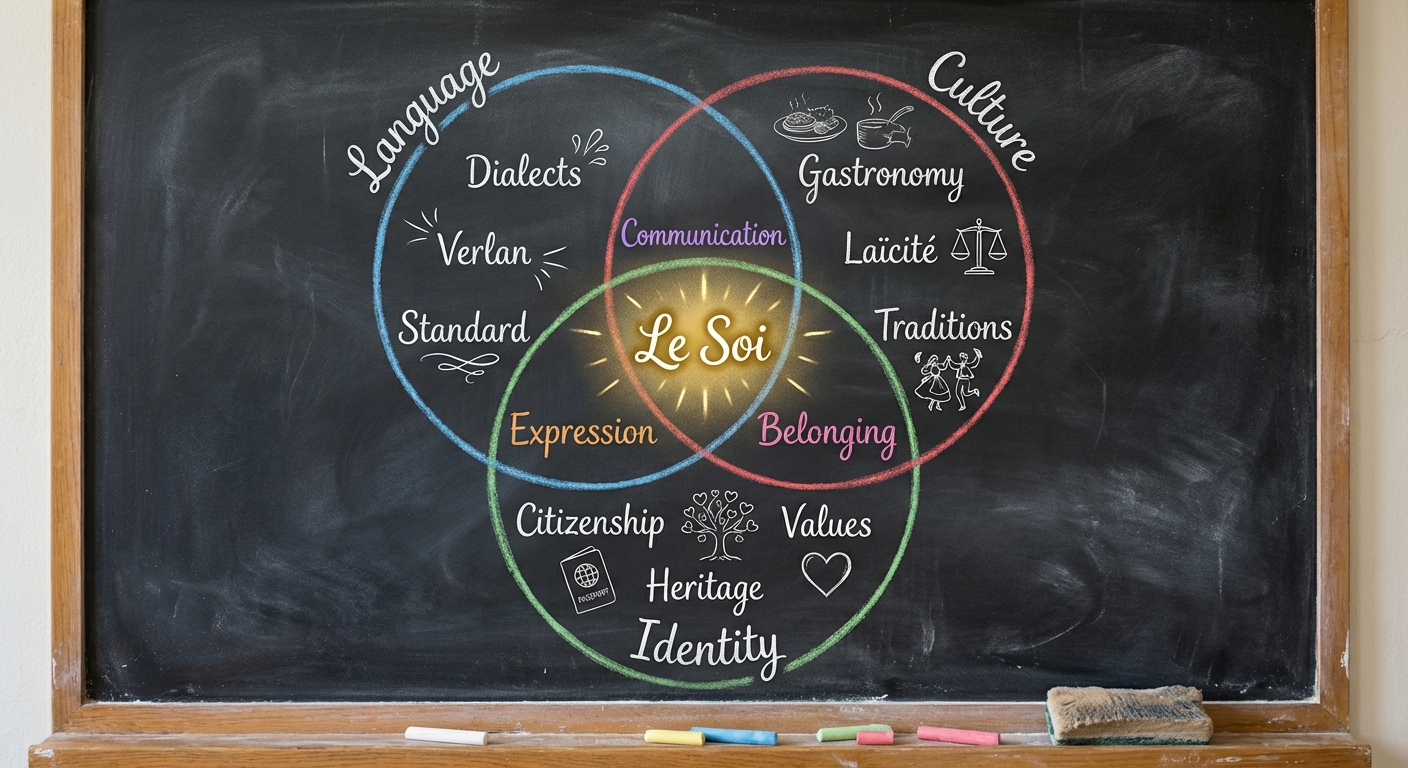
Identity is not static; it is a dynamic puzzle composed of where you live, who you interact with, and—most importantly—how you speak. In the AP French curriculum, you must understand that language (la langue) is the primary vehicle of culture (la culture).
The Role of Linguistic Codes
Language is often defined as le ciment de l'identité (the cement of identity). It creates a sense of belonging to a specific group.
- Standard French (Le français standard): Controlled by institutions like L’Académie française, this represents the formal identity of the nation. It represents prestige and access to socio-economic power.
- Regional Languages (Les langues régionales): While French is the sole official language, distinct identities exist through regional dialects like le breton, l'alsacien, le corse, or le créole (in overseas territories like Martinique or Guadeloupe). Speaking these connects an individual to their heritage (le patrimoine).
- Francophonie: Identity extends beyond France. A Québécois, a Senegalese, and a Swiss person all share the French language but express distinct cultural identities through unique vocabulary and accents.
Social Dialects and Sociolects
How a student speaks in the suburbs (les banlieues) often differs from how a politician speaks in Paris. This variance is a marker of social identity.
- Le Verlan: A form of slang where syllables are inverted (e.g., l'envers becomes verlan). Originally used as a secret code in the suburbs to establish a distinct youth identity and exclude authority figures.
- L'Argot (Slang): Informal language used by specific social groups. It evolves rapidly and creates a strong "in-group" vs. "out-group" dynamic.
- Le Franglais: The modern intrusion of English into French (e.g., le weekend, le shopping). This is a point of tension in French identity, leading to defensive laws like La loi Toubon, which mandates the use of French in public advertising to protect linguistic identity.
| Standard French | Verlan / Argot | Context |
|---|---|---|
| La femme | La meuf | Used colloquially by youth |
| Le policier | Le keuf | Often used in urban/suburban contexts |
| Fou (Crazy) | Ouf | "C'est un truc de ouf!" (It's crazy!) |
Cultural Beliefs and Values
Cultural values function as the lens through which a society views the world. In the Francophone world, certain pillars define the collective identity.
La Laïcité (Secularism)
This is perhaps the most difficult concept for Anglophone students to grasp, yet it is essential for the AP exam.
- Definition: La laïcité is the separation of Church and State. Unlike the U.S., where freedom of religion is emphasized, France emphasizes freedom from religious influence in the public sphere.
- Impact on Identity: Religious signs (like the hijab, large crosses, or kippas) are banned in public schools. The goal is to create a neutral identity where one is a citizen (citoyen) first and a religious believer second.
Gastronomy (La Gastronomie)
French identity is intrinsically linked to food. It is not just about eating; it is about the ritual of the meal.
- Le Repas Gastronomique: In 2010, the "Gastronomic meal of the French" was inscribed on the UNESCO Representative List of Intangible Cultural Heritage.
- Values: Conviviality (la convivialité), tradition, and taking time (French lunch breaks are historically longer than in the US) reflect a value system that prioritizes quality of life over pure productivity.
L'Exception Culturelle
France strongly believes that culture is not a commercial good like any other. The exception culturelle is a political concept introduced by France in international trade negotiations to ensure that states can support and protect their own cultural creation (cinema, music, literature) from being drowned out by global (often American) mass media.
Multiculturalism and Assimilation
The Francophone world, particularly France and Canada, deals with the tension between maintaining a unified national identity and acknowledging diverse roots.
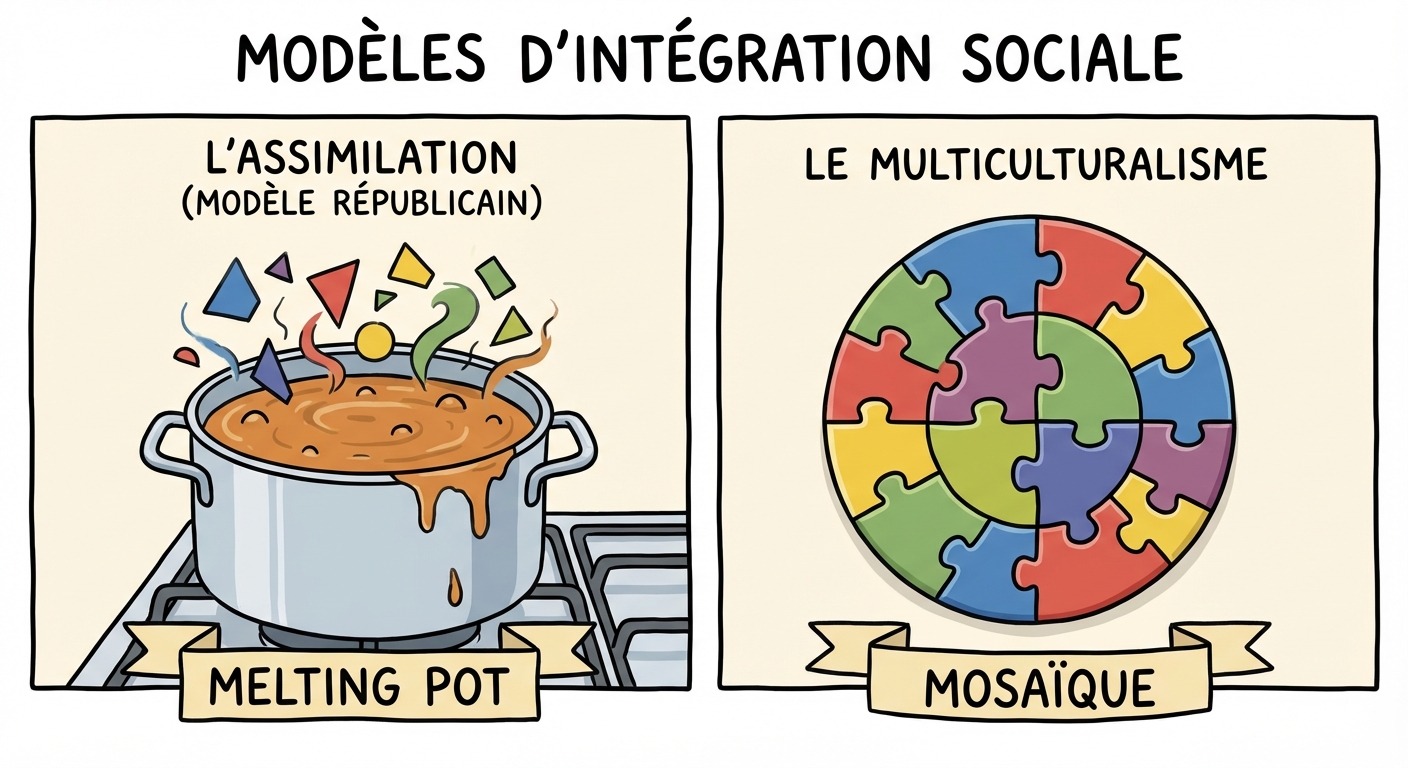
Immigration and The "Mosaic" vs. The "Melting Pot"
- Le Modèle Républicain (Assimilation): Historically, France follows an assimilationist model. The idea is that immigrants should adopt French language and values, effectively "melting" into the existing population. The goal is an indivisible republic where ethnicity is secondary to citizenship.
- Le Multiculturalisme (Canada): Canada, and specifically Quebec, often leans closer to a mosaic model (though Quebec has strict language laws via Bill 101), where different cultures coexist while maintaining their distinct characteristics.
Integration vs. Assimilation
Students must distinguish these terms in their essays:
- Assimilation: Giving up one's original culture to fully adopt the new one. (e.g., changing one's name to sound more French).
- Intégration: Participating in the host society (paying taxes, speaking the language) while retaining private aspects of one's original culture (religion, food, customs).
Tensions in Modern Identity
- Les Banlieues: The suburbs of major cities (Paris, Marseille) are often home to second and third-generation immigrants from the Maghreb (North Africa) and West Africa.
- Identité Hyphenée: Many refer to themselves as Franco-Algériens or Franco-Sénégalais, navigating a dual identity. Socio-economic struggles in these areas often lead to a feeling of exclusion (l'exclusion sociale), challenging the French ideal of "Fraternité."
Common Mistakes & Pitfalls
Confusing Laïcité with Atheism:
- Mistake: Thinking laïcité means banning religion generally.
- Correction: It implies neutrality in public institutions (schools, government), not in private life.
Stereotyping Francophone Identity:
- Mistake: Assuming "French Culture" equals only Metropolitan France (baguettes and berets).
- Correction: You MUST include examples from the wider Francophone world (e.g., Senegal, Quebec, Morocco) in your Cultural Comparisons (Task 4).
Tu vs. Vous (Sociolinguistics):
- Mistake: Using tu with everyone or vous with friends.
- Correction: This isn't just grammar; it's a cultural value of politeness (la politesse). Using the wrong register affects how your identity is perceived (rude vs. distant).
Misunderstanding "Maghrébin":
- Mistake: Using this term to refer to all Africans.
- Correction: Maghrébin refers specifically to people from North Africa (Morocco, Algeria, Tunisia). Use Sub-saharien for countries south of the Sahara.