Comprehensive Guide to Acet the ACT English Section
Understanding the ACT English Format
To master the ACT English section, you must first understand the battlefield. This section focuses on standard written English and rhetorical skills rather than vocabulary memorization or obscure literature trivia.
The Logistics
- Time: 45 minutes
- Questions: 75 questions
- Pace: ~36 seconds per question
- Structure: 5 passages with 15 questions each
The questions are split into two broad categories:
- Usage and Mechanics (53%): Punctuation, grammar, and sentence structure.
- Rhetorical Skills (47%): Strategy, organization, and style.
Section I: Punctuation Rules
Punctuation on the ACT is logical, not stylistic. If you cannot cite a specific rule for a punctuation mark, it likely shouldn't be there.
The "Stop" Punctuation
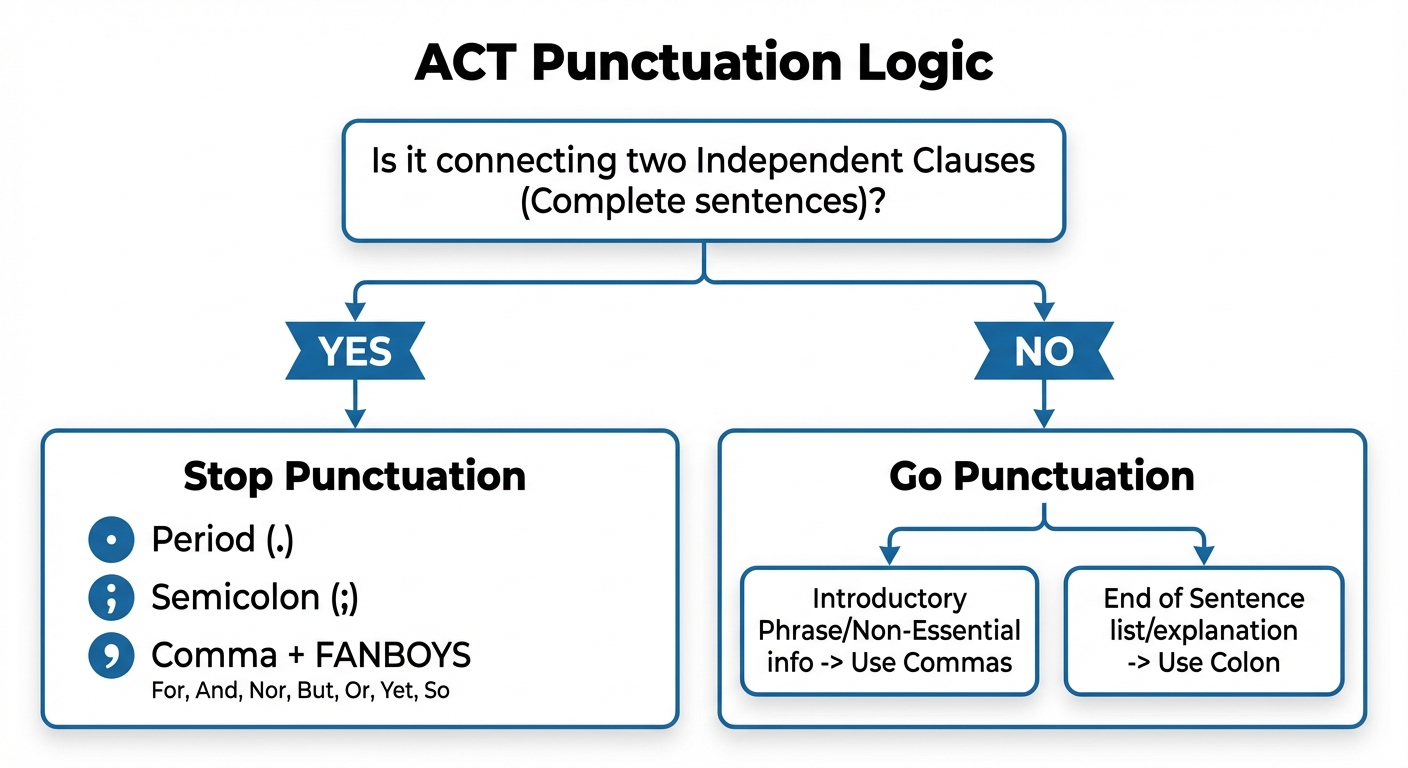
"Stop" punctuation is used to separate two complete thoughts (Independent Clauses). An Independent Clause contains a subject and a verb and can stand alone as a sentence.
The three forms of "Stop" punctuation are grammatically identical on the ACT:
- Period (.)
- Semicolon (;)
- Comma + FANBOYS (For, And, Nor, But, Or, Yet, So)
The Rule: If you can use a period, you can use a semicolon. If the answer choices contain both and the wording is otherwise identical, both are usually wrong (process of elimination).
Example:
- Incorrect: The test is long, it is exhausting. (This is a Comma Splice)
- Correct: The test is long. It is exhausting.
- Correct: The test is long; it is exhausting.
- Correct: The test is long, and it is exhausting.
The "Go" Punctuation
"Go" punctuation links anything other than two independent clauses. This ensures the sentence flows without unnecessary stops.
- No Punctuation: If there is no reason to stop, don't.
- Comma (without FANBOYS): strictly for pauses, lists, or dependent clauses.
Commas
Commas are the most frequently tested punctuation. Use them only for these four reasons:
- The Serial Comma: In a list of three or more items. (e.g., I bought apples, bananas, and pears.)
- Introductory Phrases: Separating the beginning fluff from the main sentence. (e.g., However, I disagreed. or In the morning, the sun rises.)
- FANBOYS: Before a coordinating conjunction connecting two independent clauses.
- Non-Essential Clauses (The Sandwich Rule): Surrounding information that can be removed without changing the sentence's fundamental meaning.
The Sandwich Rule: If the interruptions starts with a comma, it must end with a comma.
My dog, a golden retriever, loves to swim.
Colons and Dashes
While less common, these follow strict rules.
The Colon (:)
- Rule: The clause before the colon must be a complete independent clause. The part after can be a list, a fragment, or a sentence.
- Function: It introduces a list, an explanation, or a definition.
- Example: I have one goal: to pass this test.
The Dash (—)
- Function: Dashes act like stronger commas or parentheses. They indicate a dramatic pause or breakdown in thought.
- Rule: Like commas, they usually come in pairs for non-essential info.
- Example: The test—which was incredibly hard—is finally over.
Section II: Grammar and Usage
Subject-Verb Agreement
The ACT loves to put "garbage" between the subject and the verb to trick you. Ignore the prepositional phrases to find the real subject.
Incorrect: The box of nails are on the table.
Correct: The box [of nails] is on the table.
Special Cases:
- Collective Nouns: Words like group, family, team are singular.
- Each/Every: "Each of the students has a book" (Singular).
Pronoun Usage
Pronouns must agree with their antecedents in number and gender. They must also be in the correct case.
| Case | Usage | Pronouns |
|---|---|---|
| Subjective | Doing the action | I, We, You, He, She, It, They, Who |
| Objective | Receiving the action | Me, Us, You, Him, Her, It, Them, Whom |
| Possessive | Ownership | My, Our, Your, His, Her, Its, Their, Whose |
Who vs. Whom Mnemonic:
- Replace the word with He or Him.
- If He works, use Who.
- If HiM works, use WhoM.
Apostrophes
These indicate possession or contraction.
Possession Rules:
- Singular noun: cat $\rightarrow$ cat's toy
- Plural noun ending in s: cats $\rightarrow$ cats' toys
- Plural noun NOT ending in s: men $\rightarrow$ men's suits
The "Its" Trap:
- It's: Contraction for "It is."
- Its: Possessive (like "his"). The dog wagged its tail.
- Its': Does not exist. Never pick this.
Section III: Rhetorical Skills & Strategy
This section tests your ability to edit usage and style.
Economy (Conciseness)
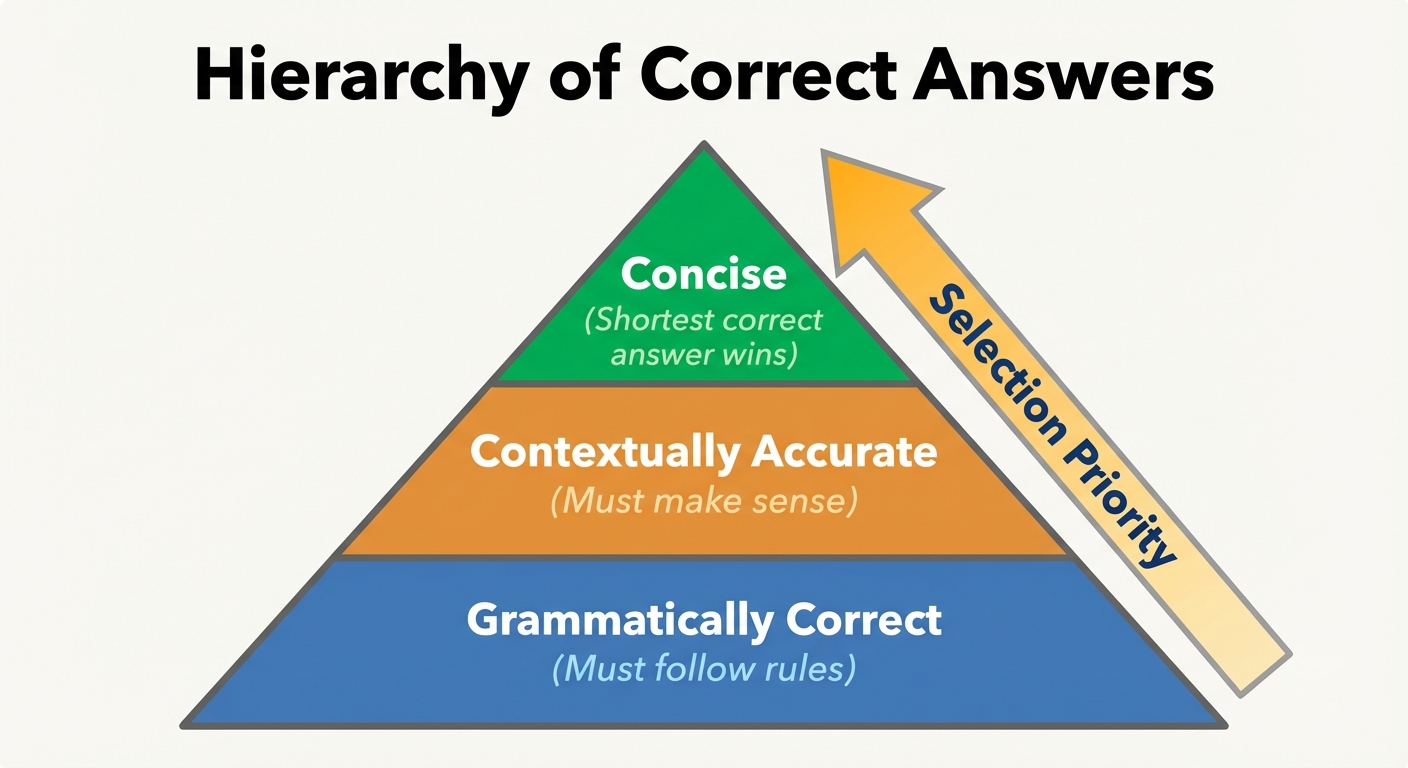
On the ACT, shorter is almost always better, provided it is grammatically correct. Avoid redundancy and wordiness.
Redunancy Examples (Always wrong):
- "The ATM machine" (ATM stands for Automated Teller Machine; "machine" is redundant.)
- "cooperate together" (Cooperate implies together.)
- "descend down" (You cannot descend up.)
Strategy: If you see three long answers and one short answer (or "OMIT"), check the short one first. It is correct ~50% of the time.
Transitions
Transition words act as road signs telling the reader where the logic is going. You must read the previous sentence to determine the relationship.
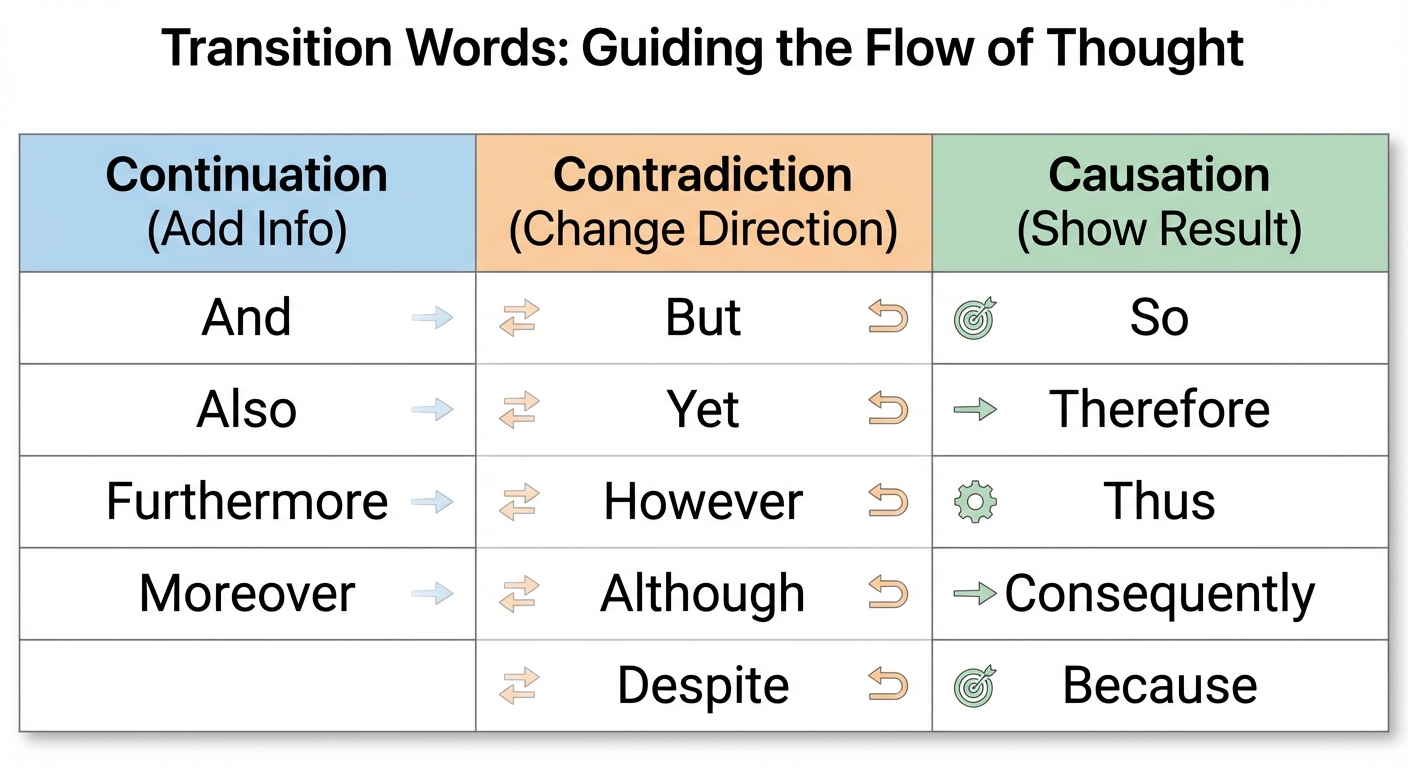
- Continuing (Look alike): Also, Furthermore, Moreover, In addition.
- Contrasting (Turn around): However, Despite, Although, Conversely, But.
- Cause/Effect (Result): Therefore, Thus, Consequently, Because.
Sentence Placement
A question may ask: "Where should Sentence 5 be placed?"
Strategy: Look for clues in Sentence 5 like pronouns (it, they, this) or transition signals that refer to something specific. If Sentence 5 says "This theory…", place it immediately after the sentence that defines the theory.
Section IV: Common Misconceptions & Pitfalls
1. The "Sound" Trap
Mistake: Picking an answer because it "sounds right" in your head.
Correction: Your internal ear is trained on conversational English, which often breaks rules. Rely on grammar rules, not intuition.
2. Misplaced Modifiers
A modifier describes a word. It must be placed right next to the thing it describes.
- Wrong: Walking down the street, the trees looked beautiful. (The trees were not walking down the street.)
- Right: Walking down the street, I thought the trees looked beautiful.
3. Interpreting "OMIT the underlined portion"
Mistake: Thinking "OMIT" is a trick answer.
Correction: If omitting the text makes the sentence grammatically correct and retains the essential meaning, it is usually the right answer because it is the most concise.
4. Then vs. Than
- ThEn: Time (First A, then B).
- ThAn: Comparison (A is greater than B).
5. Could of / Should of
Mistake: Writing "I could of gone."
Correction: This is phonetic slang. The correct form is "I could have gone."
Final Exam Strategy Summary
- Check the answers first: The differences in the answer choices tell you what rule is being tested (e.g., if choices vary in commas, it's a punctuation question).
- Read the whole sentence: Don't just look at the underlined part. The error often depends on the non-underlined context.
- Process of Elimination: Cross out what you know is wrong. If stuck between two, choose the specific/concise one.
- No Change implies correctness: Don't be afraid to pick "No Change." It is the correct answer roughly 25% of the time.