APUSH Unit 4: The Transformation of Society and Borders (1800–1848)
The Second Great Awakening
Origins and Core Beliefs
The Second Great Awakening was a series of religious revivals starting in 1801, based on Methodism and Baptism. Stressed a religious philosophy of salvation through good deeds and tolerance for all Protestant sects. The revivals attracted women, Blacks, and Native Americans.
Unlike the Puritan past (which focused on predestination), this movement emphasized Free Will and individual responsibility for seeking salvation.
- The "Burnt-Over District": A region in Western New York named for the frequency of its "hellfire and brimstone" revivals.
- Charles Grandison Finney: The father of modern revivalism. He devised the "anxious bench" where repentant sinners could sit in full view of the congregation.
- Democratization of Religion: The movement empowered the common man (and woman) to interpret scripture, mirroring the rise of Jacksonian Democracy in politics.
The Concept of Perfectionism
The theological engine driving this era was Perfectionism—the belief that humans could physically achieve a state of moral perfection. This doctrine had a massive social implication: if individuals can be perfected, then society itself can be purified.
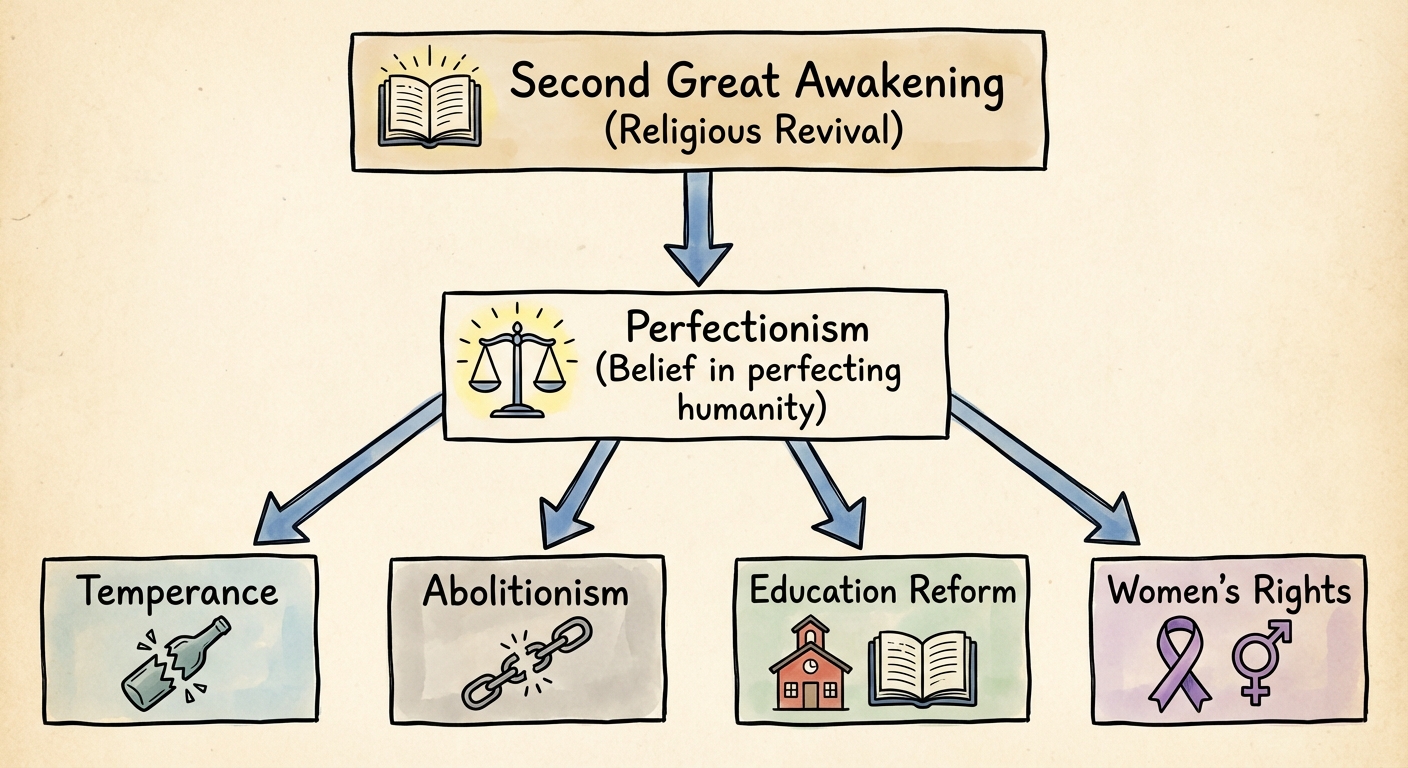
This direct link converts religious energy into the secular Age of Reform.
The Age of Reform Movements
Inspired by the Second Great Awakening and reactions to the rapid changes of the Market Revolution, Americans established voluntary organizations to improve society.
1. Temperance
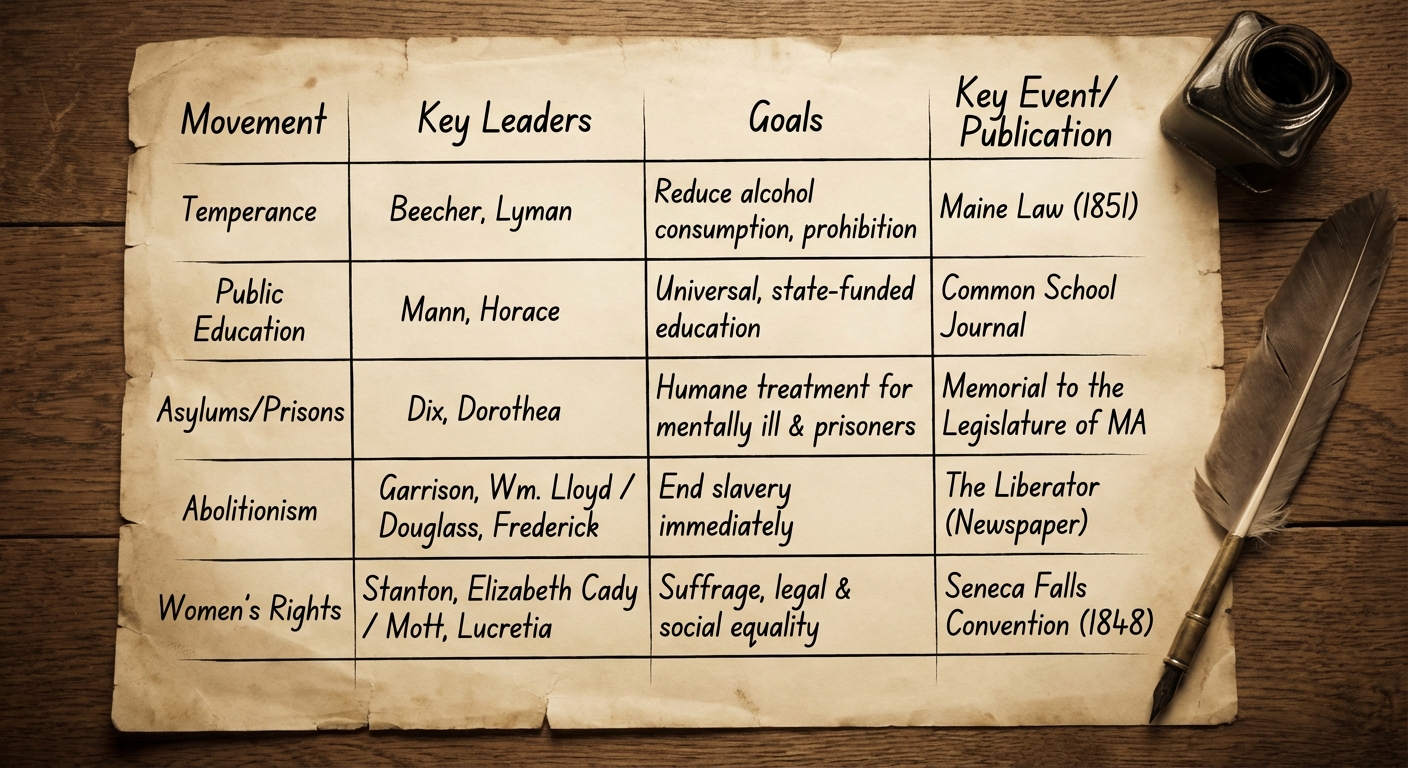
This was the most popular reform movement regarding participation numbers. It targeted alcohol abuse, which was blamed for family violence, poverty, and crime.
- American Temperance Society (1826): Encouraged drinkers to sign a pledge of abstinence.
- Evolution of Strategy: Shifted from "temperance" (moderation) to "prohibition" (legal banning).
- Maine Law (1851): The first law to prohibit the manufacture and sale of liquor.
2. Public Education
Before this era, schooling was private or religious. Reformers viewed public education as essential for instilling democratic values and discipline in the workforce.
- Horace Mann: Known as the "Father of American Education." As secretary of the Massachusetts Board of Education, he advocated for:
- Compulsory attendance
- Longer school years
- Teacher training institutes
3. Asylum and Prison Reform
- Dorothea Dix: A schoolteacher who launched a cross-country crusade after witnessing mentally ill individuals caged in unheated jail cells. Her detailed reports led to the establishment of state-funded mental hospitals.
- Penitentiaries: Prisons shifted from punishment to "penitence" (hence penitentiary), aiming to rehabilitate criminals.
4. Abolitionism
The movement to end slavery became the most divisive reform.
- American Colonization Society (1817): Early moderate attempts to transport freed slaves back to Africa (Liberia). Most African Americans opposed this, identifying as American.
- William Lloyd Garrison: Published The Liberator (1831). He rejected gradualism and demanded the immediate, uncompensated outcome of slavery. He famously burned the Constitution, calling it a "covenant with death" because it permitted slavery.
- Frederick Douglass: A former enslaved person who became the movement's most compelling orator. He published The North Star.
- Nat Turner’s Rebellion (1831): A violent slave uprising in Virginia that resulted in stricter "Slave Codes" across the South, effectively killing Southern abolitionist sentiment.
5. Women's Rights
Women were active in all previous reforms (especially abolition), but found themselves marginalized by male leaders.
- Cult of Domesticity: The prevailing value system that defined a woman's role as maintaining the home as a haven for her husband and children.
- Seneca Falls Convention (1848): Organized by Elizabeth Cady Stanton and Lucretia Mott. It was the first women's rights convention in U.S. history.
- Declaration of Sentiments: Modeled after the Declaration of Independence, it famously stated, "…all men and women are created equal."
The Development of an American Culture
During Period 4, the U.S. struggled to define its cultural identity separate from Great Britain.
Transcendentalism
A philosophical and literary movement centered in New England (mostly 1830s–1850s). It rejected the cold rationalism of the Enlightenment and the dogmatic authority of the church.
- Core Beliefs: The divinity of nature, the value of intuition over reason, and the importance of individualism.
- Ralph Waldo Emerson: His essay Self-Reliance urged Americans to stop imitating European culture and trust their own instincts.
- Henry David Thoreau: Lived in isolation at Walden Pond. His essay Civil Disobedience argued that individuals must disobey unjust laws (influenced by his opposition to the Mexican-American War and slavery). This later influenced MLK Jr. and Gandhi.
The Hudson River School
The first coherent school of American art.
- Subject: Large-scale landscapes of the American wilderness.
- Theme: Romanticism. The paintings depicted nature as sublime and grand, reflecting the nationalist pride of the era.
- Artists: Thomas Cole, Asher Durand.
Utopian Communities
Groups attempting to withdraw from conventional society to create an ideal community.
- Brook Farm: A transcendentalist experiment.
- The Shakers: Practiced celibacy and communal living.
- Oneida Community: Known for "complex marriage" (all men married to all women) and high-quality silverware.
Manifest Destiny and Territorial Expansion
Defining the Concept
Manifest Destiny was a term coined by magazine editor John L. O'Sullivan in 1845. It expressed the belief that the United States had a God-given right and duty to expand its dominion across the North American continent from the Atlantic to the Pacific.
Three Main Drivers:
- Nationalism: American pride and the desire to spread democracy.
- Population Increase: High birth rates and immigration necessitated new land.
- Economic Development: The desire for new markets and ports on the Pacific (trade with Asia).
Texas Annexation
- Mexico encouraged US settlement in Texas in the 1820s (Stephen Austin).
- Tensions rose over slavery (Mexico outlawed it) and religion (Catholicism required).
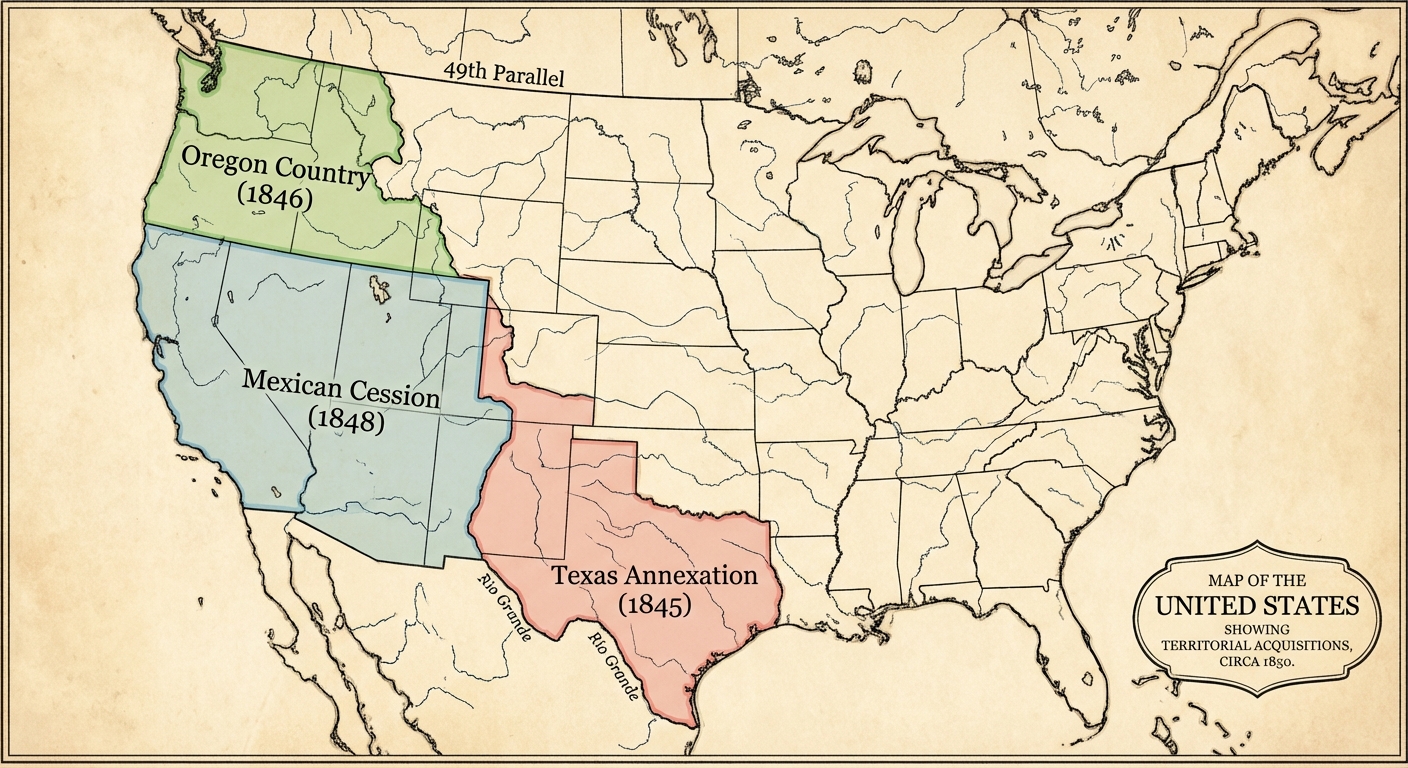
- Lone Star Republic (1836): Texas won independence but was not immediately annexed by the U.S. due to Northern opposition to adding a large slave state.
- Tyler pushed through annexation in 1845, sparking tension with Mexico.
The Oregon Dispute
- Shared by the U.S. and Britain.
- "54° 40' or Fight!": The expansionist slogan of James K. Polk’s 1844 presidential campaign, demanding all of Oregon.
- Resolution: settled diplomatically at the 49th Parallel (1846) to avoid fighting a two-front war (since the war with Mexico had begun).
The Mexican-American War (1846–1848)
Provoked by a border dispute (Rio Grande vs. Nueces River). Polk sent troops into the disputed zone.
- The Opposition: Whigs (including Abraham Lincoln) questioned the war. Lincoln issued the "Spot Resolutions," demanding to know the exact spot on American soil where blood was shed.
- Treaty of Guadalupe Hidalgo (1848):
- Mexico recognized the Rio Grande as the southern border of Texas.
- Mexican Cession: The U.S. took possession of California and New Mexico (modern-day AZ, NV, UT) for $15 million.
The Wilmot Proviso
This is a critical concept for linking Period 4 to Period 5. Congressman David Wilmot proposed that slavery be forbidden in any territory acquired from Mexico.
- It failed in the Senate but passed in the House.
- Significance: It signaled the breakdown of the national party system and the rise of sectional parties. The debate over slavery in the territories would lead directly to the Civil War.
Common Mistakes & Pitfalls
- Chronology of Abolition: Students often think the North was united against slavery in the 1830s-40s. Most Northerners were not abolitionists; they were often racist or indifferent. Abolitionists like Garrison were considered dangerous radicals even in the North.
- Seneca Falls Timing: Do not list the 19th Amendment (1920) as a result of Seneca Falls (1848). Seneca Falls is the start of the organized movement, not the end. The goal of suffrage took 72 years to achieve.
- Manifest Destiny vs. Imperialism: While similar, "Manifest Destiny" usually refers to continental expansion (Period 4). "Imperialism" (Period 7) usually refers to overseas expansion (Philippines, Puerto Rico) roughly 50 years later.
- Domesticity vs. Feminism: The "Cult of Domesticity" is the status quo that women were fighting against (or adhering to), not a reform movement itself.
- Opposition to Expansion: Do not assume all Americans wanted to expand. Whigs generally opposed the Mexican-American War, fearing it was a conspiracy to expand the "Slave Power" of the South.