Unit 1 Study Guide: The Constitutional Framework and Debates
The Battle for Ratification
The transition from the Articles of Confederation to the U.S. Constitution was not immediate or unanimous. It required a fierce political battle between two opposing ideological camps regarding the scope and power of government.
Federalists vs. Anti-Federalists
At the core of the debate was the fear of centralized power versus the need for a functional government.
Federalists: Supporters of the new Constitution.
- Demographics: Often wealthy merchants, landowners, and urban professionals.
- Philosophy: Believed a strong central government was necessary to maintain order, regulate trade, and protect against foreign threats.
- Key Figures: Alexander Hamilton, James Madison, John Jay.
Anti-Federalists: Opponents of the new Constitution.
- Demographics: Often farmers, laborers, and residents of rural areas.
- Philosophy: Feared a strong central government would become tyrannical (like the British monarchy) and infringe on individual liberties. They advocated for strong state governments.
- Key Figures: Patrick Henry, George Mason, Robert Yates (author of Brutus).
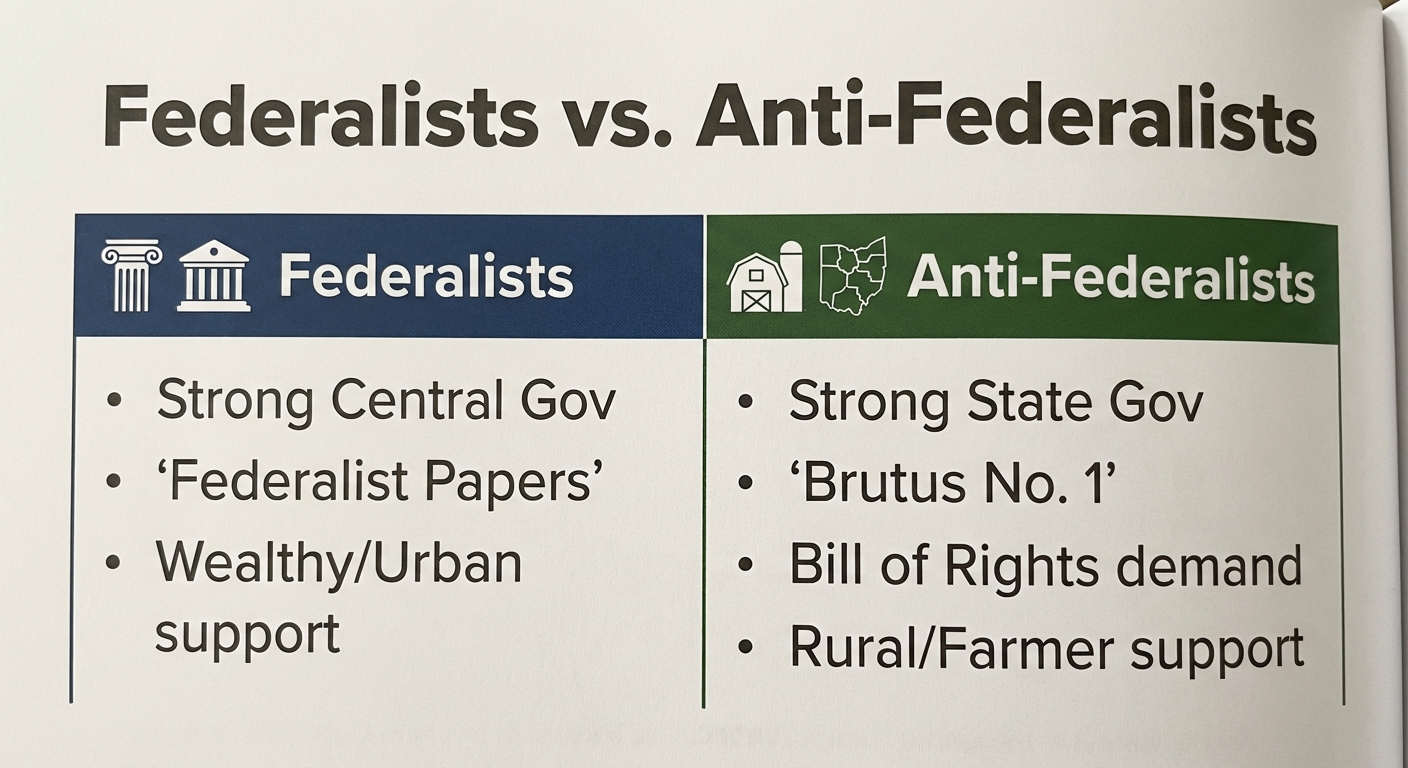
The Grand Compromise: The Bill of Rights
The Constitution was ratified only after the Federalists promised to add a Bill of Rights (the first 10 amendments). This concession was crucial to satisfying Anti-Federalist concerns about individual liberty.
Foundational Documents
To understand the AP Gov exam, you must master the specific arguments found in Federalist No. 10, Federalist No. 51, and Brutus No. 1.
Brutus No. 1 (Anti-Federalist Perspective)
Concept: Looking at the Constitution through the lens of fear regarding centralized power.
- Main Argument: A large, centralized republic is dangerous to personal liberty.
- The "Necessary and Proper Clause" & "Supremacy Clause": Brutus argued these gave the federal government unlimited power, rendering state governments obsolete.
- Representation Issues: In a large republic, representatives would be too far removed from the people (literally and figuratively) to understand their needs, leading to elitism.
- Participatory Democracy: Brutus advocated for small, local democracies where citizens directly influence policy.
Federalist No. 10 (James Madison)
Concept: Handling the dangers of Factions.
- Definition of Faction: A group of citizens united by a common interest adverse to the rights of others or the interests of the community (e.g., political parties, interest groups).
- The Dilemma: You cannot eliminate the causes of factions without eliminating liberty. Therefore, you must control their effects.
- The Solution: A Large Republic.
- In a small democracy, a majority faction can easily tyrannize the minority.
- In a large republic, there are so many competing interests (pluralism) that it is difficult for one single faction to form a majority and dominate.
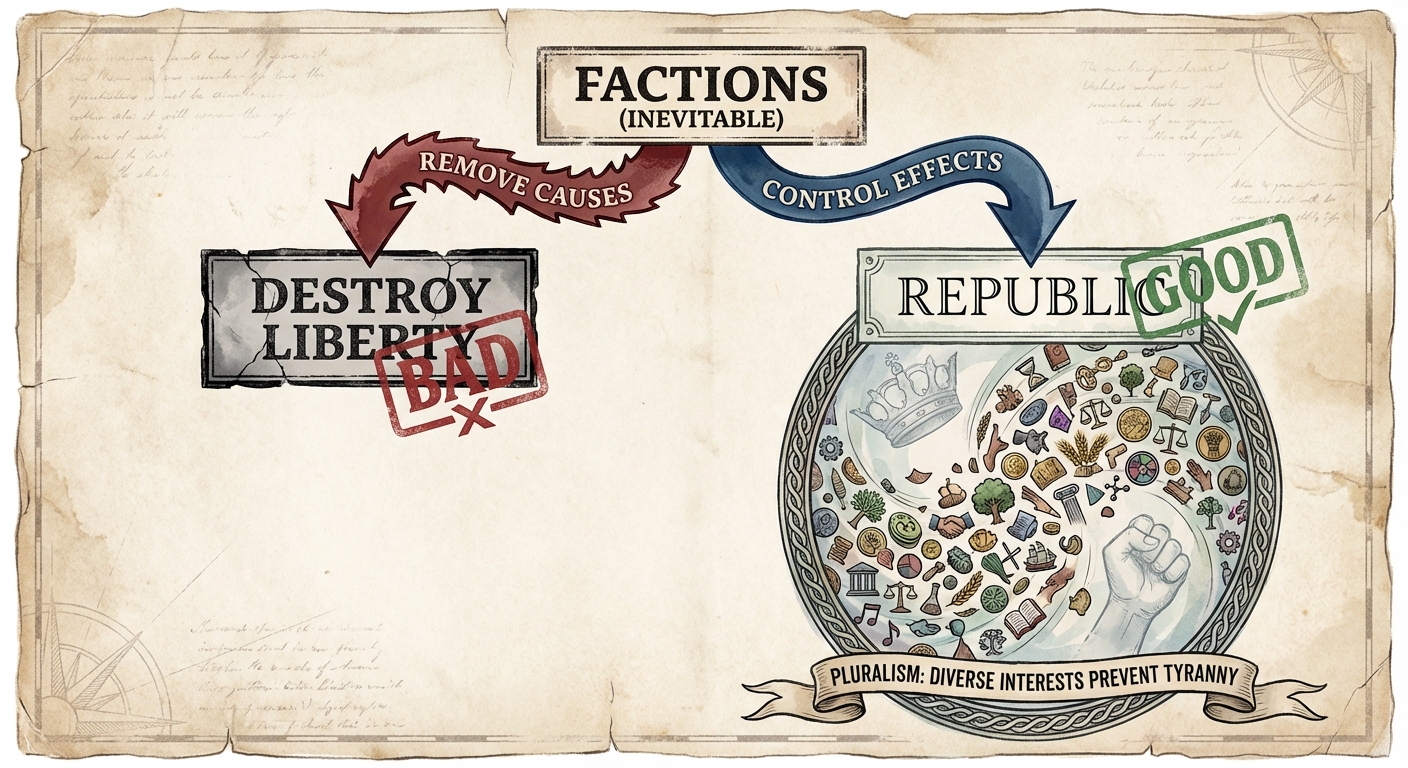
Memory Aid: Fed 10 = Fractions (Factions). A large republic breaks factions into smaller fractions so none can take over.
Federalist No. 51 (James Madison)
Concept: Structure of the Government and Human Nature.
- Famous Quote: "Ambition must be made to counteract ambition."
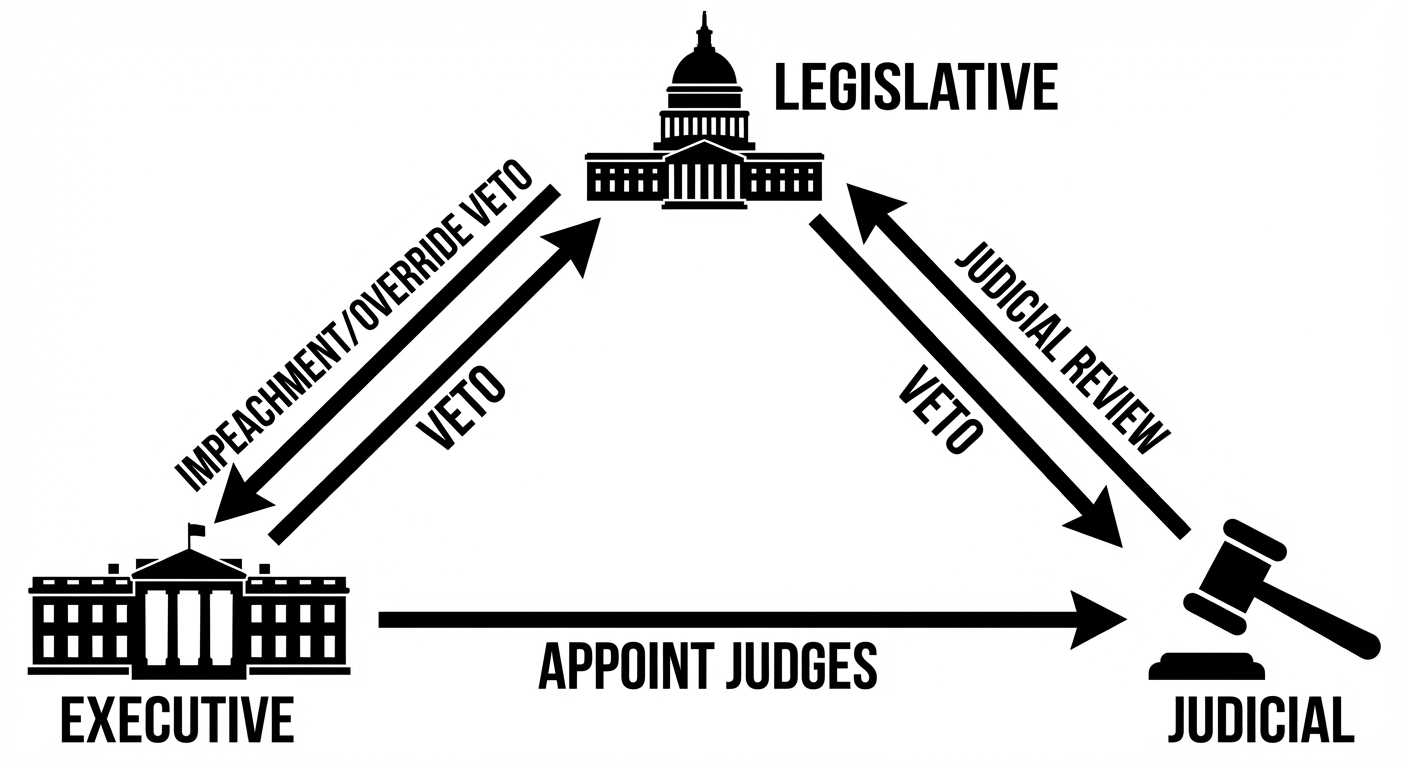
- Main Argument: The government must be structured so that the three branches (Legislative, Executive, Judicial) compete with one another.
- Mechanism: Separation of Powers and Checks and Balances are necessary because men are not angels. By giving each branch the means to resist the others, no single branch becomes tyrannical.
Principles of American Government
The Constitution is built on several specific mechanical principles designed to limit power.
1. Separation of Powers
This separates the government into three distinct branches, each with its own specific functions.
- Legislative: Makes laws (Article I).
- Executive: Enforces laws (Article II).
- Judicial: Interprets laws (Article III).
2. Checks and Balances
Separation is not enough; each branch must have the power to stop or limit the actions of the other branches.
- Example (Veto): Congress passes a bill $\rightarrow$ President vetoes it $\rightarrow$ Congress overrides veto (2/3 vote).
- Example (Appointments): President nominates judge $\rightarrow$ Senate confirms/rejects.
- Example (Judicial Review): Congress passes law $\rightarrow$ Supreme Court declares it unconstitutional.
3. Federalism
The division of power between the National (Federal) government and State governments.
- Enumerated Powers: Powers listed specifically for the Federal government (e.g., declare war, coin money).
- Reserved Powers (10th Amendment): Powers kept by the states (e.g., education, licensing, policing).
- Concurrent Powers: Powers held by both (e.g., taxation).
4. Limited Government & Rule of Law
The government is not all-powerful. It can only do what the people (via the Constitution) allow it to do. Everyone, including elected officials, is subject to the law.
Common Mistakes & Pitfalls
- Confusing Fed 10 and Fed 51: This is the most common error.
- Correction: Old (10) men argue (Factions). 51 looks like S and I (Separation of Institutions/Powers).
- Anti-Federalists vs. Anarchy: Students often think Anti-Federalists hated government.
- Correction: They didn't want no government; they wanted State governments to have the power because they felt local government was more responsive to the people.
- Separation of Powers vs. Checks and Balances: Students use these interchangeably.
- Correction: Separation is the definition of the jobs (You cook, I clean). Checks is the interaction (If you cook bad food, I refuse to clean).
- The Constitution vs. The Declaration: Do not quote "Life, Liberty, and the pursuit of Happiness" when asked about the Constitution.
- Correction: That is the Declaration of Independence. The Constitution is the rulebook (Articles, Ammendments, structure).