Unit 8: Advanced Techniques in Poetic Analysis
Complex Figurative Language: Extended Metaphor and Allegory
In AP English Literature, moving beyond identifying simple similes to analyzing complex comparisons is crucial for maximizing points in Row B (Evidence and Commentary) of the scoring rubric. This section focuses on comparisons that govern the structural entirety of a poem.
Extended Metaphor and The Conceit
An Extended Metaphor is a version of a metaphor that extends over the course of multiple lines, paragraphs, or stanzas of prose or poetry. When this metaphor is particularly clever, elaborate, or paradoxical—often prevalent in the Metaphysical poets like John Donne—it is called a Metaphysical Conceit.
- Total Governance: Unlike a local metaphor (which happens in one line), an extended metaphor controls the logic of the entire poem.
- Complexity: It often juxtaposes two vastly different things (e.g., comparing two lovers to the legs of a drafting compass).
Example: In Edward Taylor’s Huswifery, the speaker compares himself to a spinning wheel. The entire poem tracks the process of making cloth (spinning, weaving, dyeing) as a metaphor for God’s grace transforming the sinful human soul.
Allegory: Narrative as Symbol
While metaphors compare two things, an Allegory is a complete narrative that involves characters and events that stand for an abstract idea or an event.
| Feature | Extended Metaphor | Allegory |
|---|---|---|
| Focus | Comparison of object A to object B | A self-contained story with hidden meaning |
| Usage | Rhetorical device / Figure of speech | Narrative Genre |
| Visibility | The comparison is usually explicit | The meaning is often hidden beneath the plot |
| Example | "Hope is the thing with feathers" | The Faerie Queene (Characters represent virtues) |
Note: Students often confuse Symbolism with Allegory. A symbol is an object within a poem that has meaning; an allegory is the entire poem operating on a symbolic level.
Shifts in Tone and Meaning: The Volta
Identifying the Shift—often referred to as the Volta (Italian for "turn")—is perhaps the single most important analytical skill in Unit 8. A poem rarely says one thing effectively; it establishes a premise and then complicates it.
Locating the Shift
The shift marks the moment the speaker changes their mind, alters their tone, turns from observation to reflection, or moves from the past to the present. You can locate shifts by looking for:
- Conjunctions and Transitions: Words like But, Yet, However, And now, or So often signal a pivot in argument.
- Punctuation: A sudden dash (—), a colon, or a full stop in the middle of a line (caesura) can indicate a break in thought.
- Stanza Breaks: The white space between stanzas often represents a passage of time or a change in perspective.

Analyzing the Function of the Shift
Keep in mind that the shift is not just a structural quirk; it is usually where the theme is revealed.
- Irony: The shift might reveal that the speaker was being sarcastic in the first half.
- Resolution: The shift moves from presenting a problem to offering a solution.
- Complexity: The shift might acknowledge a counter-argument, making the speaker's perspective more nuanced.
Form follows Function: Fixed Forms and Free Verse
In complex analysis, you must explain why a poet chose a specific structure. The structure serves as the "container" for the meaning.
The Sonnet: Argument in a Box
The Sonnet is a 14-line poem, typically written in iambic pentameter. It is almost always an intellectual argument or a struggle to define an emotion.
Petrarchan (Italian) Sonnet:
- Structure: An Octave (8 lines) followed by a Sestet (6 lines).
- Function: The Octave poses a problem, question, or tension. The Sestet provides the resolution or answer. The Volta usually occurs around line 9.
Shakespearean (English) Sonnet:
- Structure: Three Quatrains (4 lines each) and a final Couplet (2 lines).
- Function: The three quatrains offer three variations or examples of the theme. The couplet offers a witty summary, a reversal, or a final conceptual twist.
The Villanelle: The Geometry of Obsession
The Villanelle is a highly repetitive form consisting of 19 lines. It uses two repeating rhymes and two refrains (whole lines repeated verbatim).
- Function of Repetition: Because the poet is forced to say the same lines over and over, Villanelles are excellent for exploring themes of obsession, circular grief, or inevitability.
- Example analysis: In Elizabeth Bishop’s One Art, the refrain "the art of losing isn’t hard to master" evolves in tone from casual to desperate as the poem progresses, even though the words stay mostly the same.
Free Verse: Organic Form
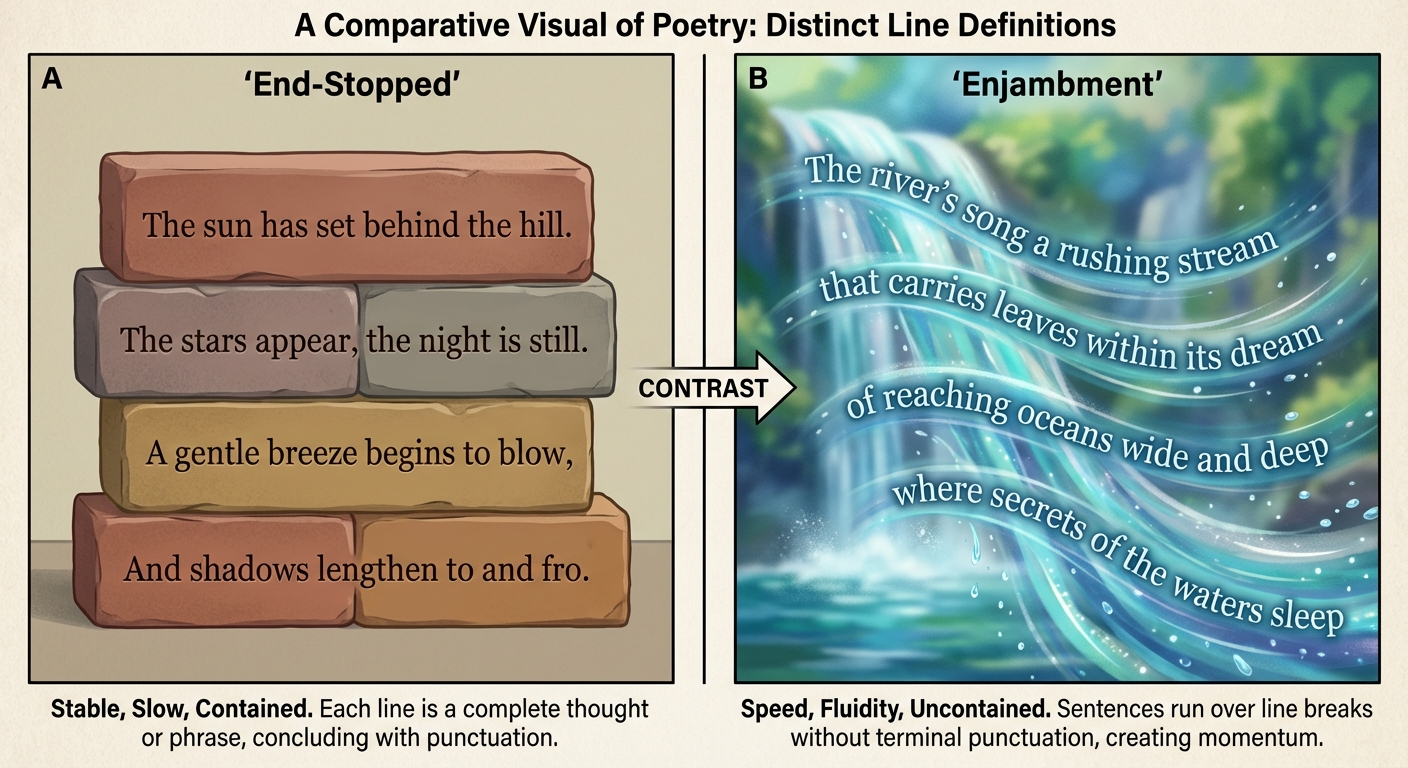
Free Verse has no set rhyme scheme or meter. However, this does not mean it lacks structure. In free verse, the Line Break is the primary tool for emphasis.
- End-Stopped Lines: The sentence finishes at the end of the line (marked by punctuation). This creates a calm, logical, or authoritative pace.
- Enjambment: The sentence runs over the line break without punctuation. This creates speed, tension, anxiety, or a double-meaning (where the end of the line suggests one thing, but the next line completes the thought differently).
Common Mistakes to Avoid in Unit 8
- The "Accounting" Fallacy: Do not just list rhyme schemes (e.g., "The poet uses AABB rhyme"). You must explain how that tightness connects to the meaning—perhaps the rigorous rhyme reflects the speaker's desire for control.
- Confusing Speaker and Poet: Never assume the "I" in the poem is the author. Always refer to the "Speaker." An author may write a sonnet from the perspective of a murderer or a mythical creature.
- Missing the Irony: Advanced poetry often sounds serious but is actually mocking a convention. If you miss the Volta, you might analyze the setup as the main point, missing the actual argument entirely.
- ignoring the Title: In AP Lit, the title is the first line of evidence. It often frames the metaphor or identifies the specific occasion of the poem.