Topic Notes: Unit 7 - Natural Selection
Evidence for Evolution
Evolution is defined as the change in the genetic makeup of a population over time. To support the theory of evolution by natural selection, biologists rely on multiple lines of empirical evidence ranging from the fossil record to molecular sequencing.
1. Geographical Evidence (Biogeography)
Biogeography is the study of the distribution of species and ecosystems in geographic space and through geological time.
- Continental Drift: Organisms found on continents that were once connected (Pangea) show similarities.
- Island Biogeography: Species on islands often resemble species on the nearest mainland rather than species on distant islands with similar climates. This suggests that island species evolved from mainland migrants.
2. Geological Evidence (The Fossil Record)
Fossils provide a visual record of how organisms have changed over time. The fossil record is, however, incomplete.
- Stratigraphy: Fossils found in lower rock layers (strata) are generally older than those in upper layers.
- Dating Methods:
- Relative Dating: Ordering artifacts based on layer sequence.
- Radiometric Dating: Using the decay rates of radioactive isotopes to determine exact age.
- Carbon-14 ($^{14}C$): Used for recent biological remains (up to ~50,000 years).
- Uranium-238 ($^{238}U$): Used for older geological formations.
3. Morphological Evidence (Anatomy)
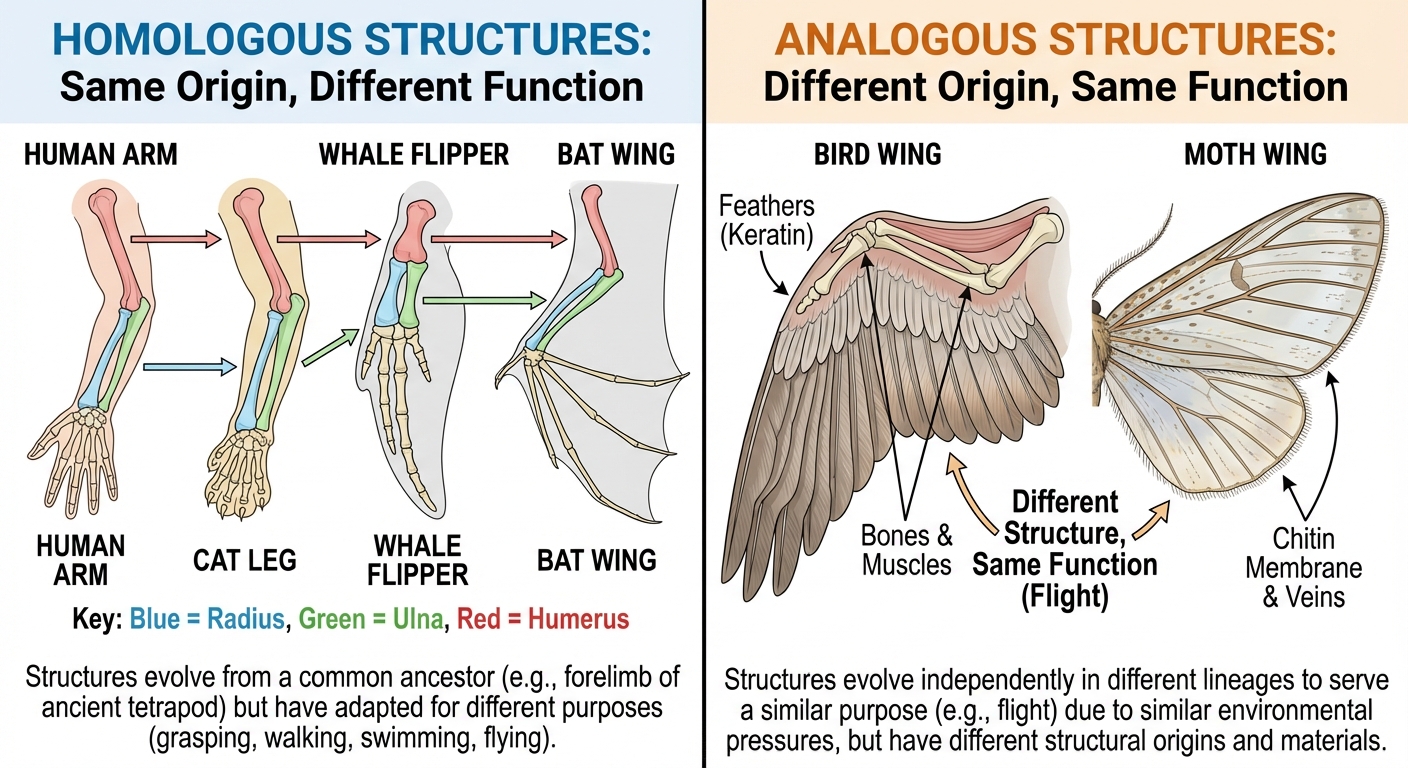
Comparative anatomy provides strong evidence for common ancestry. It is crucial to distinguish between structures that indicate shared lineage and those that result from similar environmental pressures.
| Type | Definition | Evolutionary Pattern | Example | Key Takeaway |
|---|---|---|---|---|
| Homologous Structures | Similar physical features (bone structure) due to shared ancestry, but may serve different functions. | Divergent Evolution | Human arm, Cat leg, Whale flipper, Bat wing. | Proves Common Ancestry. |
| Analogous Structures | Structures with similar functions but different distinct underlying anatomy and no common ancestor. | Convergent Evolution | Bird wing vs. Insect wing; Dolphin (mammal) vs. Shark (fish) body shape. | Proves similar Selective Pressures. |
| Vestigial Structures | Remnants of features that served a function in the organism's ancestors but are currently useless or reduced. | Divergent Evolution | Human appendix, Whale pelvic (hip) bones. | Shows structural change over time. |
Mnemonic: H.D. A.C. — Homologous = Divergent; Analogous = Convergent.
4. Biochemical Evidence (Molecular Biology)
This is currently the most accurate method for determining evolutionary relationships. All life on Earth shares the same genetic machinery.
- DNA/RNA and Proteins: The more similar the nucleotide or amino acid sequences between two species, the more recent their common ancestor.
- Conserved Proteins: Scientists often compare Cytochrome c (used in the ETC of mitochondria) or Hemoglobin across species because they evolve very slowly.
Common Ancestry
Many fundamental molecular and cellular features are shared across all domains of life (Archaea, Bacteria, Eukarya), providing evidence that all organisms share a single common ancestor.
Structural and Functional Evidence
- Genetic Code: DNA and RNA carry genetic information through transcription on translation in all living things. The genetic code (codons) is nearly universal.
- Ribosomes: Found in all forms of life, functioning as the site of protein synthesis.
- Metabolic Pathways: Core metabolic processes like Glycolysis (anaerobic respiration) occur in the cytoplasm of all organisms, suggesting it evolved very early before oxygen was prevalent.
Eukaryotic Common Ancestry
All eukaryotes share specific derived characters not found in prokaryotes:
- Membrane-bound organelles (Mitochondria, Nucleus, ER).
- Linear chromosomes (as opposed to circular chromosomes in prokaryotes).
- Introns (non-coding regions) within genes.
Continuing Evolution
A major misconception is that evolution is a historical event that has "finished." Evolution is a continuous process occurring right now.
Genomic Changes
Populations continue to evolve as their genomes change over time. Defined scientifically, if the allele frequency in a population changes, evolution is occurring.
Evidence of Current Evolution
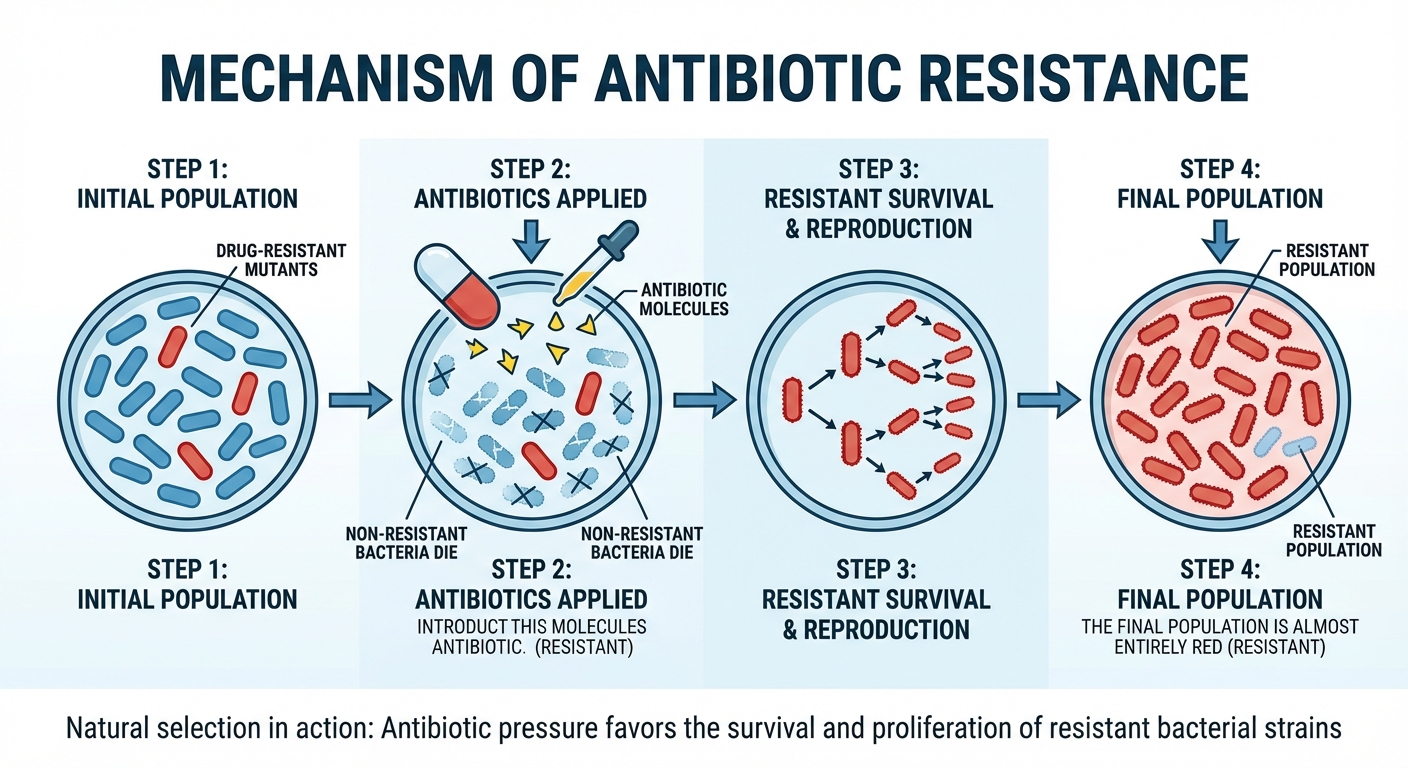
- Antibiotic Resistance:
- Bacteria reproduce rapidly and have high mutation rates.
- When antibiotics are applied, susceptible bacteria die, but those with random mutations conferring resistance survive.
- These survivors reproduce, and the next generation is resistant.
- Note: The antibiotic induces selection, it does not cause the mutation.
- Pathogen Evolution: Viruses like Influenza and SARS-CoV-2 have high mutation rates, changing their surface proteins frequent to evade the host immune system (antigenic drift).
- Peppered Moths: A classic historical example where industrial soot darkened trees, causing dark-colored moths to survive predation better than light-colored moths (Directional Selection).
Origins of Life on Earth
The AP Biology curriculum requires understanding natural models for the origin of biological macromolecules and early cells.
1. Primitive Earth Conditions
- Timeline: Earth formed ~4.6 billion years ago (BYA). Life appeared ~3.9 to 3.5 BYA.
- The Atmosphere: Early Earth had a reducing atmosphere (electron-adding).
- Present: Water vapor ($H2O$), Nitrogen ($N2$), Carbon dioxide ($CO2$), Methane ($CH4$), Ammonia ($NH3$), Hydrogen sulfide ($H2S$).
- ABSENT: Free Oxygen ($O_2$). This is critical because oxygen attacks chemical bonds. The lack of oxygen allowed organic molecules to form and remain stable.
2. The Miller-Urey Experiment (1953)
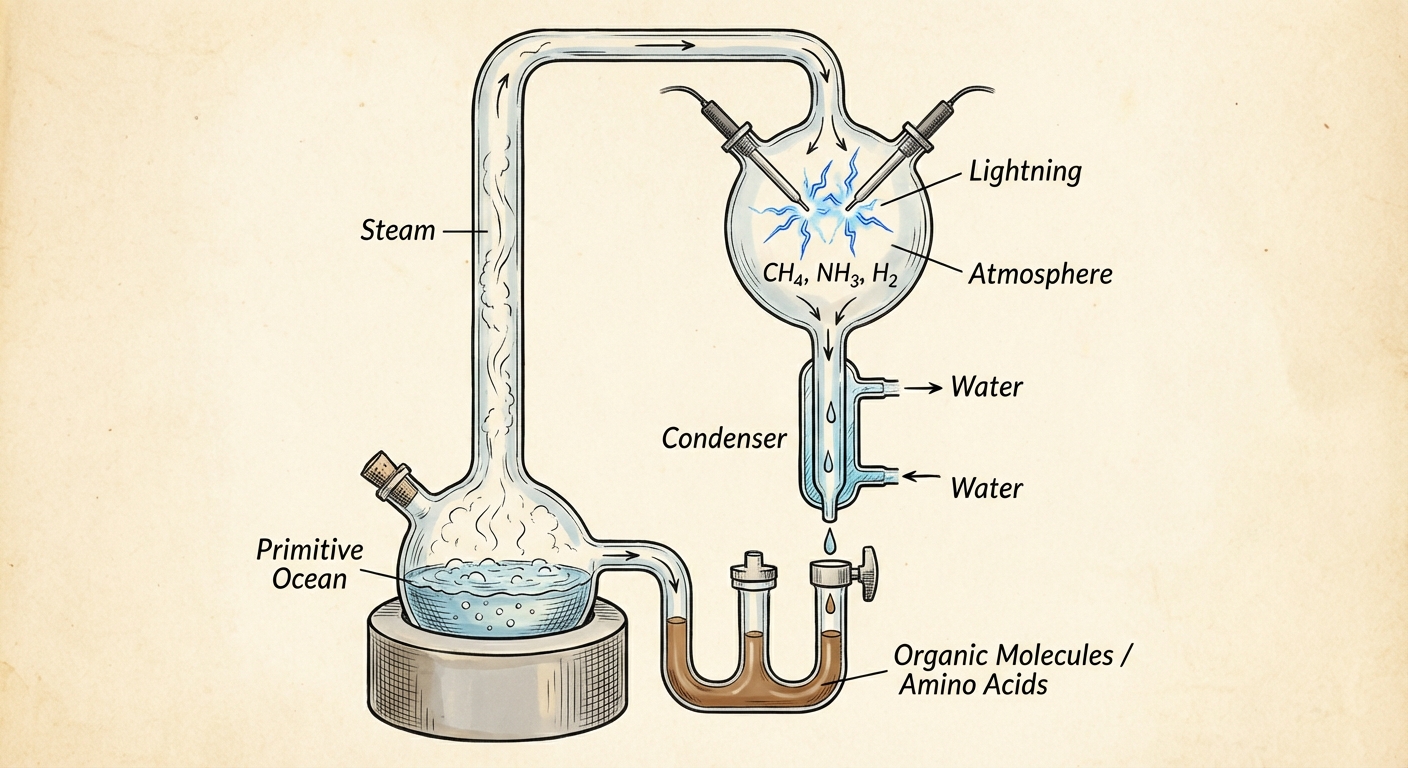
- Setup: Simulated early Earth. They boiled water (ocean), circulated gases like Methane and Ammonia (atmosphere), and introduced sparks (lightning).
- Result: Within days, organic monomers (amino acids) formed from inorganic precursors.
- Conclusion: Organic molecules can form spontaneously under abiotic conditions.
3. The RNA World Hypothesis
How did we get from chemicals to cells? We need a molecule that can store information and do work.
- RNA can do both:
- Heredity: It can store genetic information (like DNA).
- Catalysis: It can function as an enzyme (Ribozyme) to speed up reactions.
- Hypothesis: RNA was the first genetic material. DNA evolved later as a more stable storage molecule.
Common Mistakes & Pitfalls
- "Humans evolved from Chimpanzees."
- Correction: Humans and Chimpanzees share a common ancestor. We are cousins, not descendants.
- "Individual organisms evolve."
- Correction: Evolution happens to populations over generations. An individual cannot change its own genes.
- Confusing Homologous and Analogous.
- Correction: Ask yourself: Do they share a structure (bone layout) or just a job (flying)? Structure = Homologous. Job only = Analogous.
- Teleology (Purpose).
- Correction: Organisms do not evolve "in order to" survive. Mutations are random; selection is non-random. A giraffe didn't stretch its neck to reach leaves; giraffes with longer necks happened to survive better.
- Excluding O2 from Early Earth.
- Correction: Do not claim early Earth had Oxygen. The "Great Oxygenation Event" happened later, largely due to Cyanobacteria performing photosynthesis.