Mastering Contextual Applications of Differentiation
Interpreting the Derivative in Context
Calculus is not just about abstract numbers; it is the language of change in the real world. In Unit 4, we move from calculating derivatives to interpreting them.
The Fundamental Concept
The derivative, $f'(x)$, represents the instantaneous rate of change of $f(x)$ with respect to $x$. Geometrically, this is the slope of the tangent line at a specific point.
When strictly interpreted in context, a derivative statement requires three components to be considered complete on an AP Exam:
- Instantaneous Time/Value: "At time $t = c$…"
- Direction of Change: "…the amount of [quantity] is increasing/decreasing…"
- Rate with Units: "…at a rate of [value] [units of $y$] per [units of $x$]."
Units of Measurement
The units of the derivative are always a ratio: $\frac{\text{Units of Dependent Variable}}{\text{Units of Independent Variable}}$.
- If $C(t)$ is cost in dollars and $t$ is time in hours, $C'(t)$ is dollars per hour.
- If $P(h)$ is population in thousands and $h$ is height in miles, $P'(h)$ is thousands of people per mile.
Straight-Line Motion (Particle Motion)
One of the most common applications of differentiation is analyzing the motion of a particle moving along a line (often the x-axis).
Relationship Between $x(t)$, $v(t)$, and $a(t)$
Motion is defined by three hierarchical functions derived from one another with respect to time ($t$):
| Function | Notation | Definition | Units Example |
|---|---|---|---|
| Position | $x(t)$ or $s(t)$ | Location of the particle relative to the origin. | Meters ($m$) |
| Velocity | $v(t) = s'(t)$ | The rate of change of position. Direction ($+/-$) matters. | Meters/sec ($m/s$) |
| Acceleration | $a(t) = v'(t) = s''(t)$ | The rate of change of velocity. | Meters/sec$^2$ ($m/s^2$) |
Speed vs. Velocity
It is crucial to distinguish between these two:
- Velocity is a vector; it has magnitude (how fast) and direction (sign).
- Speed is a scalar; it is simply the magnitude of velocity.
Speeding Up vs. Slowing Down
A particle does not simply speed up because acceleration is positive. It speeds up when the velocity and acceleration work together.
- Speeding Up: $v(t)$ and $a(t)$ have the SAME sign (both positive or both negative).
- Slowing Down: $v(t)$ and $a(t)$ have OPPOSITE signs.
Example: Speeding Up or Slowing Down?
A particle moves with velocity $v(t) = t^2 - 4$. Is the particle speeding up or slowing down at $t=1$?
- Find Velocity at $t=1$:
(Negative) - Find Acceleration:
(Positive) - Conclusion: Since $v(1)$ is negative and $a(1)$ is positive (opposite signs), the particle is slowing down.
Rates of Change in Non-Motion Contexts
Differentiation applies to any scenario where quantities change, not just physical motion. This includes biology (population growth), economics (marginal cost), and physics (temperature/flow).
Analysis Strategy
The logic remains the same as motion:
- Function: Represents the amount of a quantity.
- Derivative: Represents the rate at which that quantity changes.
- Second Derivative: Represents the rate at which the rate is changing.
Example: The Cooling Coffee
The temperature of a cup of coffee is modeled by $T(m) = 70 + 50e^{-0.1m}$, where $T$ is degrees Fahrenheit and $m$ is minutes.
- Find the rate of cooling at $m=5$:
We need $T'(5)$. - Contextual Interpretation: At 5 minutes, the temperature of the coffee is decreasing by 3.03 degrees Fahrenheit per minute.
Related Rates
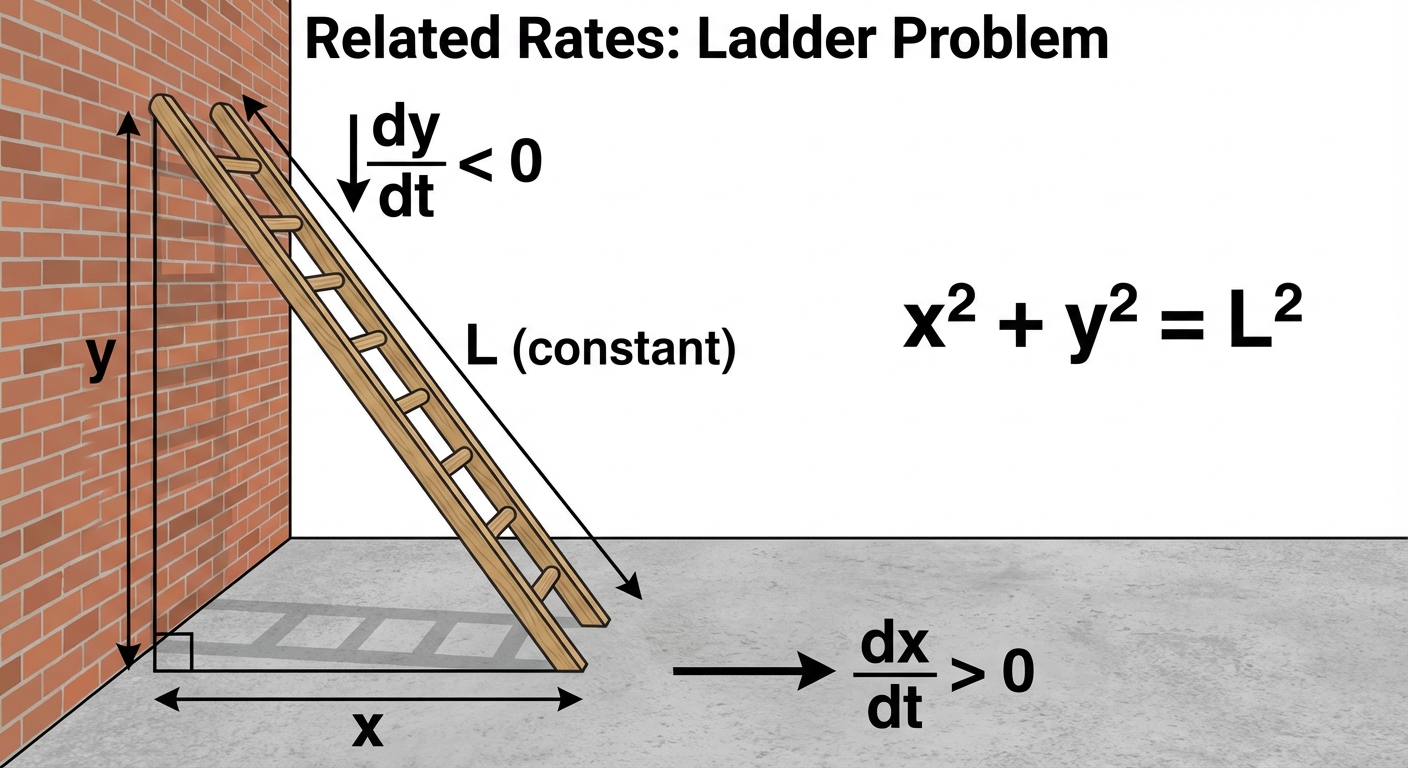
In "Related Rates" problems, two or more variables are changing with respect to time ($t$), and these variables are connected by an equation. The goal is to find the rate of change of one variable given the rate of change of the other.
The Role of Implicit Differentiation
Because the variables (like $x$, $y$, $r$, $V$) are functions of time $t$, you must apply the Chain Rule when differentiating.
- Derivative of $x^2$ with respect to $x$ is $2x$.
- Derivative of $x^2$ with respect to $t$ is $2x \cdot \frac{dx}{dt}$.
Step-by-Step Strategy
- Draw a Picture: Label constants with numbers and changing quantities with variables.
- Identify Knowns & Unknowns: List what you have (e.g., $\frac{dV}{dt}=10$) and what you need.
- Find the Equation: Relate the variables (Pythagorean theorem, Volume formulas, Area formulas, Trig).
- Differentiate: Differentiate both sides with respect to time $t$. Don't forget the notation (e.g., $\frac{dr}{dt}$)!
- Substitute & Solve: Plug in the known values only after differentiating.
Example: The Expanding Balloon
A spherical balloon is inflated at a rate of $10 \text{ in}^3/\text{sec}$. How fast is the radius increasing when the radius is 4 inches?
- Knowns: $\frac{dV}{dt} = 10$, $r=4$. Find: $\frac{dr}{dt}$.
- Equation: Volume of a sphere $V = \frac{4}{3}\pi r^3$.
- Differentiate:
- Substitute:
- Solve:
Linearization (Tangent Line Approximation)
Complex functions can be difficult to calculate mentally (e.g., $\sqrt{4.1}$). Linearization uses the tangent line at a "nice" point to approximate values near that point.
The Formula
The linearization $L(x)$ of a function $f(x)$ at $x=a$ is essentially the point-slope form of a line:
Translating to calculus notation:
Concavity and Error
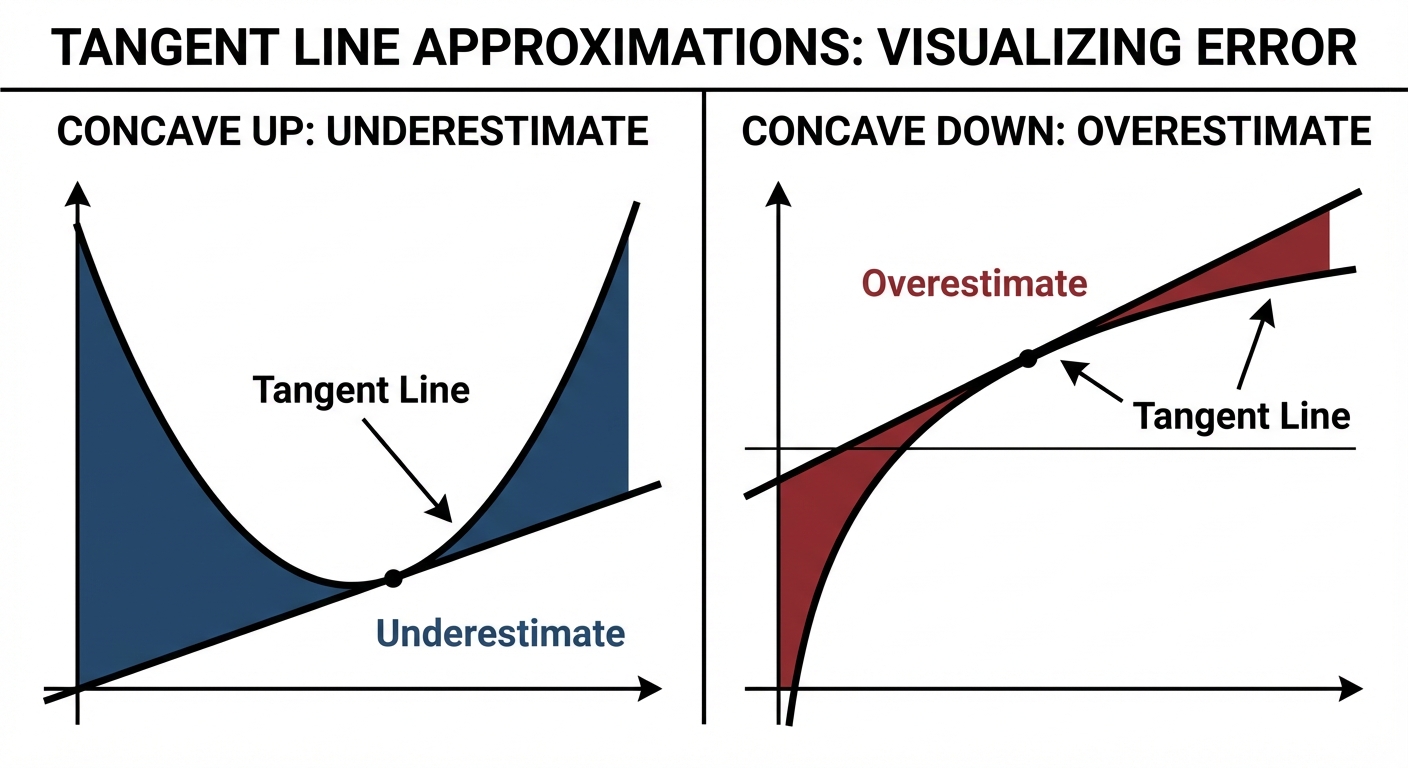
Is our approximation an overestimate or underestimate? This depends on the concavity ($f''(x)$) of the function.
- Concave Up ($f''(x) > 0$): The tangent line sits below the curve. Linearization is an underestimate.
- Concave Down ($f''(x) < 0$): The tangent line sits above the curve. Linearization is an overestimate.
Example:
Estimate $\sqrt{9.1}$ using linearization.
- Choose $a$: Let $a=9$ (a nearby perfect square) and $f(x) = \sqrt{x}$.
- Find Point: $f(9) = 3$.
- Find Slope: $f'(x) = \frac{1}{2\sqrt{x}}$, so $f'(9) = \frac{1}{6}$.
- Build $L(x)$: $L(x) = 3 + \frac{1}{6}(x - 9)$.
- Estimate:
L'Hospital's Rule
L'Hospital's Rule is a powerful tool for evaluating limits that result in indeterminate forms.
The Rule
If $\lim_{x \to c} \frac{f(x)}{g(x)}$ yields $\frac{0}{0}$ or $\frac{\infty}{\infty}$, then:
Provided the limit of derivatives exists.
Crucial Warnings
- Verify Conditions First: You MUST show that the limit equals $\frac{0}{0}$ or $\frac{\infty}{\infty}$ before applying the rule. If you use it on a limit like $\frac{4}{0}$, you will get the wrong answer.
- Not the Quotient Rule: You differentiate the top and bottom independently. Do not use the Quotient Rule ($\frac{lodHi - hidLo}{lo^2}$).
Example:
Evaluate $\lim_{x \to 0} \frac{\sin(2x)}{3x}$.
- Check: Plugging in 0 gives $\frac{\sin(0)}{0} = \frac{0}{0}$. (Indeterminate)
- Apply Rule: Take derivative of numerator and denominator separate.
Num: $\frac{d}{dx}\sin(2x) = 2\cos(2x)$
Denom: $\frac{d}{dx}3x = 3$ - New Limit: $\lim_{x \to 0} \frac{2\cos(2x)}{3}$.
- Solve: $\frac{2\cos(0)}{3} = \frac{2(1)}{3} = \frac{2}{3}$.
Common Mistakes & Pitfalls
- Neglecting the Chain Rule in Related Rates: A common error is writing the derivative of $y^2$ as $2y$ instead of $2y \frac{dy}{dt}$. Remember, we are differentiating with respect to time.
- Plugging in Constants Too Early: In Related Rates, never plug in a value that is changing (like the radius of a growing balloon) before you differentiate. Only plug in constant values (like the length of a ladder) before differentiation.
- Speed vs. Velocity: Students often calculate velocity (which can be negative) when asked for speed (always positive). Remember: Speed = $|v(t)|$.
- Justification on FRQs: Simply saying "the derivative is positive" is often insufficient. Be specific: "Because $v(t) > 0$ and $a(t) > 0$ at $t=2$, the particle is speeding up."
- Misinterpreting L'Hospital's: Applying the rule to determinate forms (e.g., $0/5$ is just 0, not L'Hospital's case) leads to incorrect answers.
Mnemonics
- "Same Signs Speed Up": If velocity and acceleration share the sign (both $+$ or both $-$), the particle speeds up.
- "SSD" (Stop, Substitute, Differentiate?) NO!: It is "DSD": Draw, Stop (identify variables), Differentiate, then Substitute.