Model Comparison: Algebra
═══════════════════════════════════════
Gemini 3 Pro
═══════════════════════════════════════
What You Need to Know
Fluency is key: The "Heart of Algebra" domain makes up approximately one-third of the SAT Math section. Speed and accuracy in manipulating linear equations are critical.
Context matters: You must be able to not only solve equations for but also interpret the meaning of constants and coefficients (like slope and y-intercept) in real-world word problems.
Systems logic: A significant portion involves analyzing systems of equations—not just finding the solution, but identifying how many solutions exist (one, zero, or infinite) based on the structure of the equations.
Linear Equations in One Variable
At the core of algebra is the ability to solve for a single unknown. On the SAT, these questions range from simple arithmetic isolation to complex multi-step problems involving fractions and variables on both sides.
Solving Techniques
To solve a linear equation, apply inverse operations to isolate the variable.
Distribute:
Group variables: Subtract from both sides.
Isolate: Add to both sides.
The Three Types of Solutions
Not all equations yield a single number. You must recognize these special cases immediately:
One Solution: The variables do not cancel out, leaving a distinct value.
Example:
No Solution (Contradiction): The variable terms cancel out, leaving a false statement. This means the lines are parallel and never intersect.
Example: (False)
Infinite Solutions (Identity): The variable terms cancel out, leaving a true statement. This means the expressions represent the exact same line.
Example: (True)
Exam Focus
Why it matters: SAT questions often ask you to find the value of a constant such that the equation has no solution or infinite solutions.
Typical question patterns:
"For what value of does the equation have no solution?" (Answer: , because slopes must be equal).
Rearranging literal equations: "Solve for ."
Common mistakes: Distributing a negative sign incorrectly (e.g., becoming instead of ).
Linear Functions and Equations in Two Variables
These questions focus on the relationship between two variables, typically and , graphed on a coordinate plane.
Key Forms of Linear Equations
Form | Formula | Usage |
|---|---|---|
Slope-Intercept | Easiest for graphing and identifying slope/intercept. | |
Point-Slope | Best when writing an equation given a slope and a point. | |
Standard Form | Common in word problems dealing with combinations of two items. |
Interpreting Slope and Intercept
In word problems, the math concepts map to specific real-world meanings:
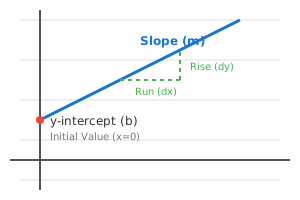
Slope (): The Rate of Change. Look for keywords like "per," "every," or "rate."
Formula:
Y-Intercept (): The Initial Value or flat fee. The value of when .
Parallel and Perpendicular Lines
Parallel: Same slope (), different y-intercepts.
Perpendicular: Negative reciprocal slopes ().
Example: If line A has slope , a perpendicular line has slope .
Exam Focus
Why it matters: Interpretation questions are high-frequency. You may be given a model like and asked "What is the best interpretation of the number 20?"
Typical question patterns:
Converting Standard Form () to Slope-Intercept Form to identify the slope ().
Calculating the slope from a table of values.
Common mistakes: Confusing the and values in the slope formula (putting instead of ).
Systems of Linear Equations
A system consists of two or more linear equations. The solution is the point where the lines intersect.
Solving Methods
Substitution: Isolate one variable in the first equation and plug it into the second.
Best when one variable has a coefficient of 1 (e.g., ).
Elimination (Combination): Add or subtract the equations to eliminate a variable.
Best when variables are aligned and coefficients are multiples (e.g., and ).
Number of Solutions in Systems
Just like single-variable equations, systems have three possibilities based on the geometric relationship of the lines:
Number of Solutions | Geometric Meaning | Algebraic Condition |
|---|---|---|
One Solution | Lines intersect at one point | Different Slopes () |
No Solution | Parallel lines | Same Slope, Different Intercepts () |
Infinite Solutions | Identical lines | Same Slope, Same Intercept () |
Exam Focus
Why it matters: Recognizing the condition for "no solution" without fully solving the system saves valuable time.
Typical question patterns:
"If the system has no solution, what is the value of ?"
Word problems involving two different items (e.g., "Adult tickets cost , child tickets cost , total sales were …").
Common mistakes: Forgetting to multiply the constant term on the right side of the equals sign when scaling an equation for elimination.
Linear Inequalities
Inequalities work similarly to equations but represent regions of possible solutions rather than specific points.
Solving and Graphing
The Golden Rule: When you multiply or divide an inequality by a negative number, you must flip the inequality sign.
-2x > 10 \rightarrow x < -5
Graphing Lines:
Strict inequalities (<, >) use dashed lines.
Inclusive inequalities () use solid lines.
Shading:
y > … or : Shade the region above the line.
y < … or : Shade the region below the line.

Systems of Inequalities
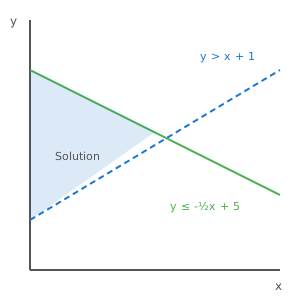
The solution to a system of inequalities is the overlapping shaded region where all inequalities are true simultaneously. Points on a solid boundary line are solutions; points on a dashed boundary line are not.
Exam Focus
Why it matters: These questions test visual literacy—can you match an algebraic statement to a graph?
Typical question patterns:
"Which graph represents the system and y < -x?"
"Is point a solution to the system?" (Test by plugging in values).
Common mistakes: Shading the wrong side of a vertical line (x > 3 is to the right, x < 3 is to the left).
Quick Review Checklist
Can you rewrite into form correctly?
Do you know the specific condition required for a system to have zero solutions?
Can you calculate the slope given two points, and ?
Do you remember to flip the inequality sign when dividing by a negative number?
Can you interpret what the y-intercept represents in a real-world word problem?
Can you identify perpendicular slopes (e.g., and )?
Final Exam Pitfalls
The "No Solution" Trap
Mistake: Trying to solve for and when the question asks for a constant that creates no solution.
Fix: Immediately set the slopes equal to each other () and solve for . Do not solve for .
Units Mismatch
Mistake: Using minutes in an equation designed for hours.
Fix: Always check if the rate (e.g., miles per hour) matches the time variable given (e.g., 30 minutes). Convert minutes to hours before plugging it in.
Sign Errors in Elimination
Mistake: Subtracting the entire second equation but forgetting to distribute the negative sign to the constant term.
Fix: Instead of subtracting, multiply the second equation by and add the two equations. Addition is less prone to error than subtraction.
Inequality Boundary Points
Mistake: Assuming a point on the line is a solution for a strict inequality (< or >).
Fix: If the line is dashed (< or >), points exactly on the line are not solutions. Only points in the shaded region count.
═══════════════════════════════════════
GPT 5.2 Pro
═══════════════════════════════════════
What You Need to Know
SAT Math Algebra (per College Board’s SAT Math content domains) focuses on linear equations, linear inequalities, linear functions, and systems—often in real-world contexts like rates, costs, and comparisons.
You must fluently move between forms of a line (especially and ), interpret (rate of change) and (starting value), and solve for unknowns accurately.
Many questions test not just solving, but modeling: setting up an equation/inequality from words, tables, or graphs, then interpreting the solution.
SAT Math questions appear as multiple-choice and student-produced response; algebra skills are among the most frequently used across the test.
Linear equations in 1 variable
Core idea
A linear equation in one variable is an equation that can be written as where are constants and . Solving means finding the value of that makes the equation true.
Key skills
Inverse operations: undo addition/subtraction, then multiplication/division.
Distribute and combine like terms correctly:
Handle fractions/decimals strategically:
Multiply both sides by the least common denominator to clear fractions.
Worked example 1 (distribution)
Solve .
Distribute:
Add to both sides:
Divide by :
Worked example 2 (fractions)
Solve .
Multiply both sides by (LCD):
Simplify:
Subtract :
Divide by :
Exam Focus
Why it matters: One-variable linear equations are a foundation—SAT often embeds them in word problems and multi-step algebra.
Typical question patterns:
Solve an equation with parentheses and like terms (e.g., ).
Solve for a variable in a formula (literal equations), e.g., isolate .
Word problem leading to (tax, discounts, fees).
Common mistakes:
Distributing incorrectly (forgetting to multiply every term inside parentheses).
Sign errors when moving terms (especially subtracting negatives).
Clearing fractions inconsistently (not multiplying every term by the LCD).
Linear equations in 2 variables
Core idea
A linear equation in two variables represents a line in the coordinate plane. Common forms:
Form | Equation | What it highlights |
|---|---|---|
Slope-intercept | Slope and intercept | |
Standard | Integer coefficients; useful for elimination | |
Point-slope | Line through a point with slope |
Key skills
Convert between forms (often from to ).
Find intercepts quickly:
-intercept: set .
-intercept: set .
Build an equation from information:
From slope and a point.
From two points.
Worked example 1 (standard to slope-intercept)
Convert to slope-intercept form.
Subtract :
Divide by :
So and .
Worked example 2 (equation through two points)
Find the line through and .
Slope:
Use with :
Equation:
Exam Focus
Why it matters: Lines are central to SAT algebra modeling—equations represent relationships (cost vs. quantity, distance vs. time).
Typical question patterns:
Convert forms and identify and .
Use intercepts to interpret a context (starting fee, break-even point).
Write the equation given two points or a table pattern.
Common mistakes:
Mixing up slope formula order; remember consistent subtraction: .
Treating or in as slope (it isn’t unless rearranged).
Arithmetic slips when isolating (especially dividing every term by ).
Linear functions
Core idea
A linear function is a function whose output changes at a constant rate. It can be written as:
Equivalent to if
Interpreting parameters
= rate of change (rise/run). In contexts, it’s often a unit rate (e.g., dollars per hour).
= initial value (value when ).
Common representations and what SAT asks
Equation: identify and .
Table: compute constant change in per change in .
Graph: read slope from two points.
Words: translate to .
Worked example 1 (table to function)
A table shows points and on a linear function.
Slope:
Since , .
Function:
Worked example 2 (real-world model)
A gym charges a signup fee of plus per month. Let be months and be total cost.
Model:
Interpretation: is monthly rate; is starting cost.
Exam Focus
Why it matters: SAT frequently tests function interpretation—linking slope/intercept to meaning is a high-value skill.
Typical question patterns:
Given a context, identify what and represent.
Compare two linear functions to decide which grows faster.
Evaluate: compute or solve .
Common mistakes:
Confusing with —only gives the intercept.
Using the wrong “change in ” when finding slope from a table.
Treating a non-constant rate table as linear (check that slope is consistent).
Systems of 2 linear equations in 2 variables
Core idea
A system of linear equations is two linear equations with the same variables, such as:
\begin{cases}
ax + by = c \
px + qy = r
\end{cases}
A solution must satisfy both equations. Graphically, it’s the intersection of two lines.
Types of solutions
One solution: lines intersect once.
No solution: lines are parallel (same slope, different intercept).
Infinitely many solutions: lines are the same (equivalent equations).
Methods
Substitution: solve one equation for a variable, plug into the other.
Elimination: add/subtract equations to eliminate a variable (often easiest with standard form).
Worked example (elimination)
Solve:
\begin{cases}
2x + y = 11 \
2x - y = 1
\end{cases}
Add equations to eliminate :
Solve:
Substitute into :
Solution: .
SAT modeling note
Systems often represent constraints (e.g., tickets sold of two types). Your job is to define variables clearly, then translate sentences to equations.
Exam Focus
Why it matters: Systems test multi-step reasoning and modeling; they appear in both pure algebra and word problems.
Typical question patterns:
Solve for using elimination/substitution.
Determine number of solutions by comparing slopes/intercepts.
Word problem: two unknown quantities with two conditions.
Common mistakes:
Eliminating incorrectly (forgetting to multiply an entire equation).
Algebra slip after substitution (especially distributing negatives).
Misinterpreting “no solution” vs “infinite solutions” (check proportionality of coefficients and constants).
Linear inequalities in 1 or 2 variables
Core idea
A linear inequality uses <, \le, >, \ge and describes a set of solutions.
One-variable inequalities
Solve like equations, with one critical rule:
If you multiply or divide both sides by a negative number, flip the inequality sign.
Worked example 1 (flip the sign)
Solve .
Subtract :
Divide by and flip:
Compound inequalities
Example: 2 \le 3x + 1 < 10
Subtract from all three parts: 1 \le 3x < 9
Divide by : \frac{1}{3} \le x < 3
Two-variable inequalities
A linear inequality in two variables describes a half-plane:
Boundary line from the related equation (replace inequality with ).
Solid line for or ; dashed line for < or >.
Use a test point (often if allowed) to decide which side to shade.
Worked example 2 (test point)
Graph/identify the solution region for y > -x + 2.
Boundary: (dashed because >).
Test point :
Check: 0 > -(0) + 2 \Rightarrow 0 > 2 (false)
Shade the side not containing (above the line in this case).
Exam Focus
Why it matters: Inequalities are common in constraint and “range of values” problems—especially when interpreting conditions.
Typical question patterns:
Solve and express the solution set (including compound inequalities).
Identify which value satisfies an inequality (plug-and-check options).
Interpret a graphed half-plane or write an inequality from a graph.
Common mistakes:
Forgetting to flip the sign when dividing/multiplying by a negative.
Using solid vs dashed boundary incorrectly.
Testing the wrong point or plugging into the boundary equation instead of the inequality.
Quick Review Checklist
Can you solve equations accurately, including with parentheses and fractions?
Can you rearrange into and identify and ?
Can you find the equation of a line from two points using ?
Can you interpret as a rate of change and as an initial value in context?
Can you solve a system using elimination and check the solution in both equations?
Can you decide whether a system has 0, 1, or infinitely many solutions?
Can you solve inequalities and remember when to flip the inequality sign?
Can you determine the correct shaded region for using a test point?
Final Exam Pitfalls
Sign errors when distributing or moving terms — Write one step per line and re-check negatives (especially ).
Forgetting to flip an inequality — Any time you divide or multiply by a negative (like ), reverse < to > (and to ).
Mixing up slope and intercept — In , is the coefficient of and is the value when .
Elimination mistakes in systems — If you multiply an equation by a number, multiply every term (including constants) before adding/subtracting.
Misreading what a solution means — For a system, a solution is an ordered pair ; for an inequality, the solution is a set/range, not a single value unless specified.
═══════════════════════════════════════
Claude Opus 4.6
═══════════════════════════════════════
Generation failed: 400 {"type":"error","error":{"type":"invalidrequesterror","message":"Your credit balance is too low to access the Anthropic API. Please go to Plans & Billing to upgrade or purchase credits."},"requestid":"req011CYmP4zfaNTmW1jRt573D7"}
═══════════════════════════════════════
Claude Opus 4.6
═══════════════════════════════════════
What You Need to Know
Algebra accounts for approximately 35% of the SAT Math section (roughly 13–15 questions out of 44), making it the single highest-weighted domain on the entire test.
Every algebra question ultimately tests your ability to set up, manipulate, or interpret linear relationships — whether as equations, inequalities, functions, or systems.
The SAT rewards strategic reasoning over brute-force calculation: look for structure, use substitution or elimination efficiently, and always check whether the question asks for the variable, an expression, or a real-world interpretation.
Comfort with slope-intercept form, point-slope form, and standard form is essential — you need to convert between them fluently.
Linear Equations in 1 Variable
A linear equation in one variable is an equation that can be simplified to the form , where . Solving means isolating the variable through inverse operations.
Core Techniques
Distribute any parentheses.
Combine like terms on each side.
Move variable terms to one side and constants to the other.
Divide by the coefficient.
Worked Example
Solve:
Step | Work |
|---|---|
Distribute | |
Combine like terms | |
Subtract | |
Add | |
Divide by |
Special Cases
Outcome | Meaning | Example |
|---|---|---|
One solution | Unique value of | |
No solution | Variable cancels, false statement | |
Infinitely many solutions | Variable cancels, true statement |
The SAT frequently asks you to find a value of a constant that makes an equation have no solution or infinitely many solutions.
Exam Focus
Why it matters: These questions appear in both the no-calculator and calculator modules and test foundational algebraic fluency.
Typical question patterns:
Solve for (often the answer is a fraction)
"For what value of does the equation have no solution?"
"What is the value of given the equation?" (solve for the expression, not alone)
Common mistakes:
Forgetting to distribute a negative sign across parentheses
Answering with the value of when the question asks for an expression like
Dividing incorrectly when the coefficient is negative
Linear Equations in 2 Variables
A linear equation in two variables takes the general form and represents a straight line on the coordinate plane. Every point on the line is a solution.
Key Forms
Form | Equation | Best Used For |
|---|---|---|
Slope-intercept | Reading slope and y-intercept directly | |
Standard | Finding intercepts, working with systems | |
Point-slope | Writing an equation from a point and slope |
Slope
The slope measures the rate of change between two points and :
Memory aid: "Rise over run" — vertical change divided by horizontal change.
Intercepts
y-intercept: Set and solve for .
x-intercept: Set and solve for .
Parallel vs. Perpendicular Lines
Relationship | Slope Condition |
|---|---|
Parallel | Same slope: |
Perpendicular | Negative reciprocal: |
Exam Focus
Why it matters: Understanding linear equations in two variables is the foundation for graphing, systems, and word problems throughout the algebra domain.
Typical question patterns:
Identify the slope or y-intercept from an equation or graph
Write the equation of a line given two points or a point and slope
Determine if two lines are parallel or perpendicular
Common mistakes:
Mixing up and when calculating slope (subtracting in different orders)
Forgetting to convert to slope-intercept form before reading the slope
Confusing "perpendicular" with "negative slope" rather than "negative reciprocal"
Linear Functions
A linear function is a function of the form whose graph is a straight line. The SAT tests your ability to interpret these functions in context.
Interpreting in Context
When a word problem says "A repair company charges a \$50 service fee plus \$30 per hour," the function is:
Slope (): the rate — cost per hour
y-intercept (): the initial value — the flat service fee
Function Notation
means substitute into the function
If , then is the x-intercept (also called the zero of the function)
Worked Example
A gym membership costs \$25 per month after a \$60 sign-up fee. Write a function for total cost after months and find the cost after 8 months.
The total cost after 8 months is .
Exam Focus
Why it matters: The SAT emphasizes real-world interpretation of slope and intercept — expect at least 2–3 questions that ask "what does the number represent in context?"
Typical question patterns:
"Which of the following represents the meaning of the slope?"
Evaluate for a given value
Determine the zero of the function in context
Common mistakes:
Confusing slope with y-intercept when interpreting word problems
Misidentifying which quantity is independent () vs. dependent ()
Giving the value of when asked for when
Systems of 2 Linear Equations in 2 Variables
A system of two linear equations consists of two equations with two unknowns. The solution is the point where the two lines intersect.
Solution Methods
Method | When to Use |
|---|---|
Substitution | One variable is already isolated or easy to isolate |
Elimination | Coefficients can be matched by simple multiplication |
Worked Example (Elimination)
Solve: and
Add the two equations: , so .
Substitute back: .
Solution: .
Number of Solutions
Condition | Graph | Solutions |
|---|---|---|
Different slopes | Lines intersect | Exactly one |
Same slope, different intercept | Parallel lines | None |
Same slope, same intercept | Same line | Infinitely many |
Exam Focus
Why it matters: Systems questions appear regularly and often in word-problem form (e.g., ticket prices, mixture problems).
Typical question patterns:
Solve and find or another combined expression
"How many solutions does the system have?"
Set up a system from a word problem and solve
Common mistakes:
Forgetting to multiply both sides of an equation when using elimination
Solving for one variable but forgetting to find the other (or the expression asked for)
Misinterpreting "no solution" — this means parallel lines, not
Linear Inequalities in 1 or 2 Variables
A linear inequality uses <, >, , or instead of . The solution is a range of values (1 variable) or a region of the coordinate plane (2 variables).
One-Variable Inequalities
Solve just like equations with one critical rule:
When you multiply or divide both sides by a negative number, flip the inequality sign.
Example: -3x + 6 > 12
-3x > 6
x < -2 (sign flipped)
Two-Variable Inequalities
The inequality y > mx + b represents the region above the line .
Inequality | Line Style | Shaded Region |
|---|---|---|
y > mx + b | Dashed | Above |
Solid | Above | |
y < mx + b | Dashed | Below |
Solid | Below |
Systems of Inequalities
The solution to a system of inequalities is the overlapping shaded region of all inequalities.
Exam Focus
Why it matters: Inequality questions test both algebraic manipulation and graphical reasoning, and they appear in both pure math and word-problem contexts.
Typical question patterns:
Solve a one-variable inequality and identify the solution on a number line
Identify which graph represents a given inequality
Determine whether a point satisfies a system of inequalities
Common mistakes:
Forgetting to flip the inequality sign when dividing by a negative
Confusing dashed (strict inequality) with solid (inclusive inequality) lines
Shading the wrong side of the boundary line
Quick Review Checklist
Can you solve a linear equation in one variable, including ones with no solution or infinitely many solutions?
Do you know how to convert between slope-intercept, standard, and point-slope forms?
Can you calculate slope from two points using ?
Can you interpret slope and y-intercept in a real-world context?
Do you know when two lines are parallel vs. perpendicular?
Can you solve a system of equations using both substitution and elimination?
Can you determine the number of solutions a system has without fully solving it?
Do you remember to flip the inequality sign when multiplying or dividing by a negative?
Can you graph a linear inequality and identify the correct shaded region?
Can you set up equations or systems from word problems?
Final Exam Pitfalls
Reading the question too quickly — The SAT often asks for instead of . Always re-read what the question is asking for before selecting your answer.
Forgetting to flip the inequality sign — This is the single most common algebra error. Whenever you multiply or divide by a negative, reverse the direction of the inequality.
Confusing "no solution" with — "No solution" means no value of works (the equation is a contradiction). It does not mean the answer is zero.
Misidentifying slope vs. y-intercept in word problems — The slope is always the rate (per unit), and the y-intercept is the starting or fixed value. Read carefully to distinguish them.
Arithmetic errors in elimination — When multiplying an equation to align coefficients, multiply every single term, including the constant on the right side.
Ignoring the domain in context problems — If represents months or items sold, negative and non-integer values may not make sense. Always check whether your answer is reasonable in context.