Unit 1: Advanced Kinematics in Two Dimensions
Reference Frames and Relative Motion
Motion is not absolute; it is defined by your point of view. In physics, this point of view is called a frame of reference.
Concept: It's All Relative
When you state that a car is moving at $20 \text{ m/s}$, you are implicitly making that statement with respect to the ground (the Earth). However, if you were sitting in a different car moving at $20 \text{ m/s}$ right next to it, the first car would appear stationary to you.
This leads to the concept of Relative Velocity.
- Inertial Reference Frame: A frame of reference that is moving at a constant velocity (not accelerating). Newton's laws hold true here without needing fictitious forces.
The Relative Motion Equation
To calculate how fast an object $A$ moves relative to an observer $C$, we use vector addition. The standard notation is $\vec{v}_{AC}$, meaning "the velocity of $A$ with respect to $C$."
The chain rule for relative velocity is:
Where:
- $\vec{v}_{AC}$ is the velocity of object $A$ relative to frame $C$.
- $\vec{v}_{AB}$ is the velocity of object $A$ relative to frame $B$.
- $\vec{v}_{BC}$ is the velocity of frame $B$ relative to frame $C$.
Note: If you need to reverse a reference frame (e.g., you have $\vec{v}{AB}$ but need $\vec{v}{BA}$), simply flip the sign (direction):
Example Scenario: The River Boat
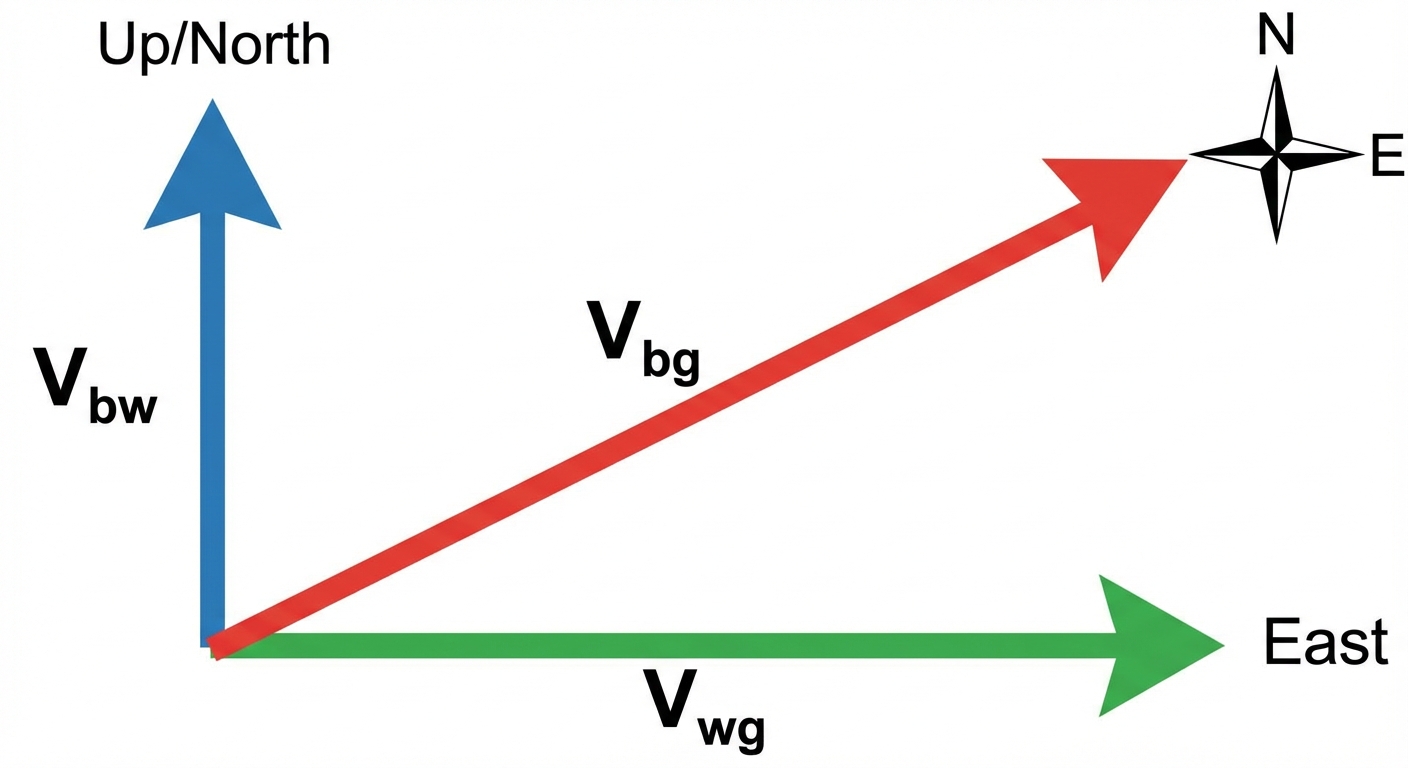
A boat heads North across a river at $4 \text{ m/s}$ relative to the water. The river current flows East at $3 \text{ m/s}$ relative to the ground. What is the velocity of the boat relative to a person standing on the ground?
Solution:
Define vectors:
- $\vec{v}_{b/w} = 4 \text{ m/s}$ (North)
- $\vec{v}_{w/g} = 3 \text{ m/s}$ (East)
- Target: $\vec{v}_{b/g}$
Apply the equation:
$\vec{v}{b/g} = \vec{v}{b/w} + \vec{v}_{w/g}$Since these are perpendicular vectors, we define the magnitude using the Pythagorean theorem:
Find direction using $\theta = \tan^{-1}(\frac{y}{x})$:
Vectors and Motion in Two Dimensions
In 1D motion, we used signs ($+$ and $-$) to indicate direction. In 2D, we must analyze motion using components. The "Golden Rule" of 2D Kinematics is:
The horizontal ($x$) motion and vertical ($y$) motion are completely independent of each other.
They share only one variable: Time ($t$).
Vector Decomposition
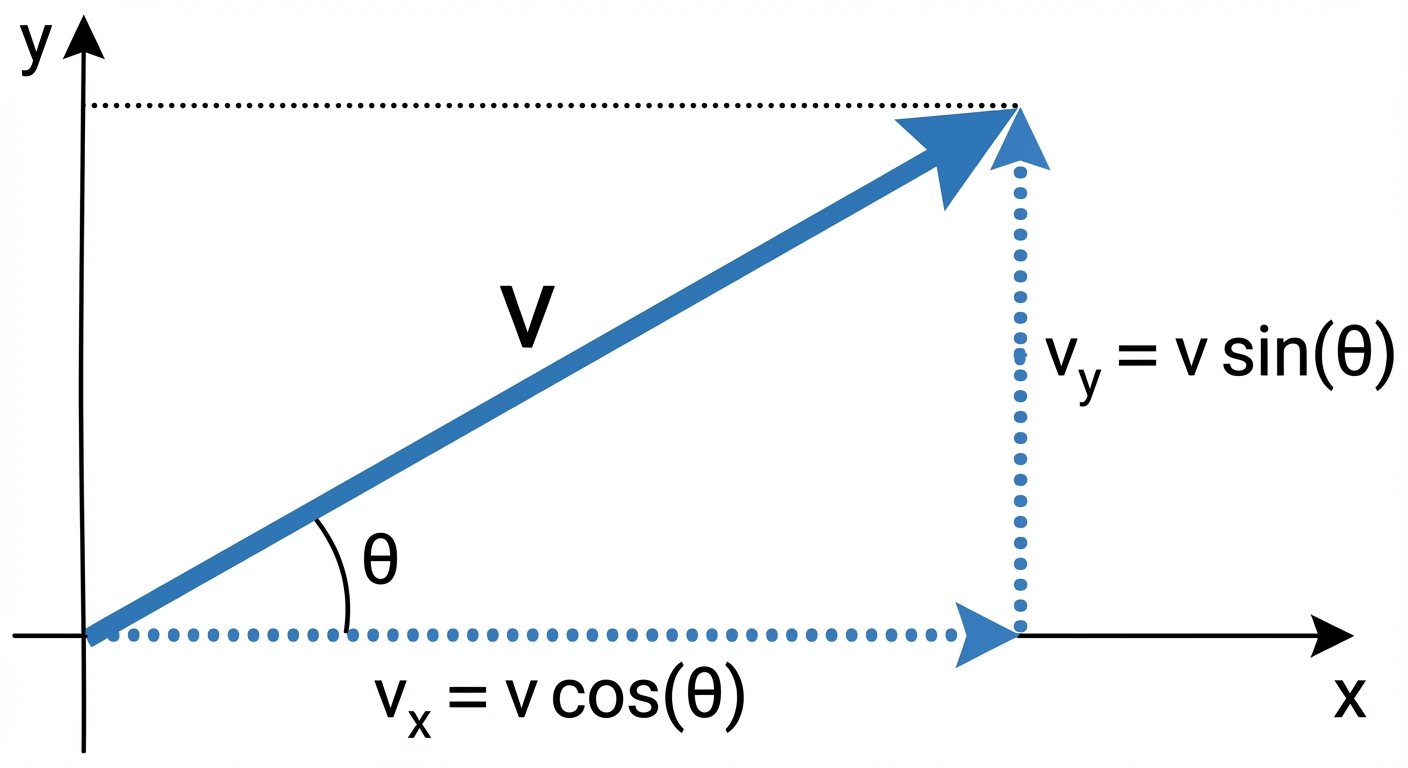
Any velocity vector $\vec{v}$ launched at an angle $\theta$ relative to the horizontal must be broken down into components.
| Component | Formula | Description |
|---|---|---|
| Horizontal ($x$) | The "across" speed. usually constant in projectile motion. | |
| Vertical ($y$) | The "up/down" speed. Affected by gravity. |
Projectile Motion
Projectile motion is a form of 2D motion where an object is given an initial velocity and then moves under the influence of gravity alone (ignoring air resistance).
1. Horizontal Characteristics (The X-Axis)
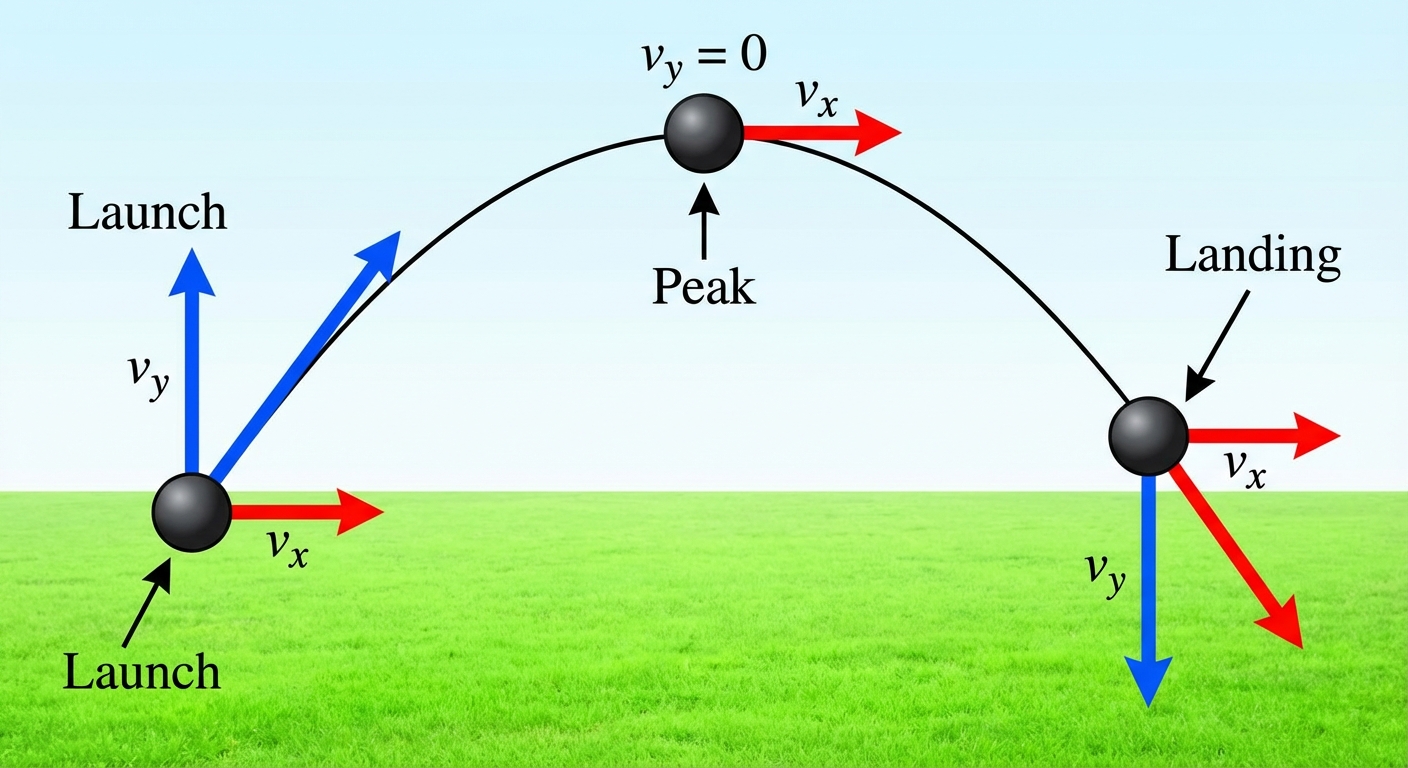
Because gravity acts only vertically ($down$), there is zero acceleration in the horizontal direction.
- $a_x = 0$
- $v_x = \text{constant}$
- Equation:
2. Vertical Characteristics (The Y-Axis)
The object is in free fall.
- $a_y = -g$ (approx $-9.8 \text{ m/s}^2$ or $-10 \text{ m/s}^2$)
- At the peak of the flight, the vertical velocity is momentarily zero ($v_y = 0$).
- Equation:
- Equation:
Worked problem: The Cliff Launch
A ball is kicked horizontally off a $20\text{m}$ high cliff with a velocity of $15 \text{ m/s}$. Find the horizontal distance (range) the ball travels.
Solution:
Break it down:
- X-axis: $v{0x} = 15 \text{ m/s}$, $ax = 0$, $x_0 = 0$, find $x$.
- Y-axis: $y0 = 20\text{m}$, $y = 0$ (ground), $v{0y} = 0 \text{ m/s}$ (launched horizontally), $a_y = -10 \text{ m/s}^2$.
Find Time ($t$) using Y-axis data:
Find Range ($x$) using X-axis data and time:
Common Mistakes & Pitfalls
Mixing X and Y variables: This is the most fatal error. You cannot put vertical acceleration ($g$) into a horizontal equation. Never use the total velocity $v$ in a calculation; always use $vx$ or $vy$.
- Correct: $x = v_x t$
- Incorrect: $x = v_{total} t$
Assuming $v = 0$ at the top: At the peak of a projectile's arc, the vertical velocity $vy$ is zero. However, the horizontal velocity $vx$ is not zero (unless thrown straight up). The object is still moving sideways.
Forgetting Negative Signs: Displacement and velocity are vectors. If you define "up" as positive, then gravity ($g$) must be negative ($-9.8 \text{ m/s}^2$), and falling displacement must be negative.
Misinterpreting "Dropped" vs. "Thrown":
- If an object is dropped from a moving plane, its initial horizontal velocity is the same as the plane's velocity ($v{0x} = v{\text{plane}}$).
- It does not start from rest relative to the ground.
Adding Vectors Arithmetically: If velocity A is $3$ and velocity B is $4$, the resultant is only $7$ if they are in the same direction. If they are perpendicular, the resultant is $5$. Always use vectors/Pythagoras.