Comprehensive Guide to Parametric, Vector, and Polar Calculus
Parametric Equations and Curves
Basics of Parametric Equations
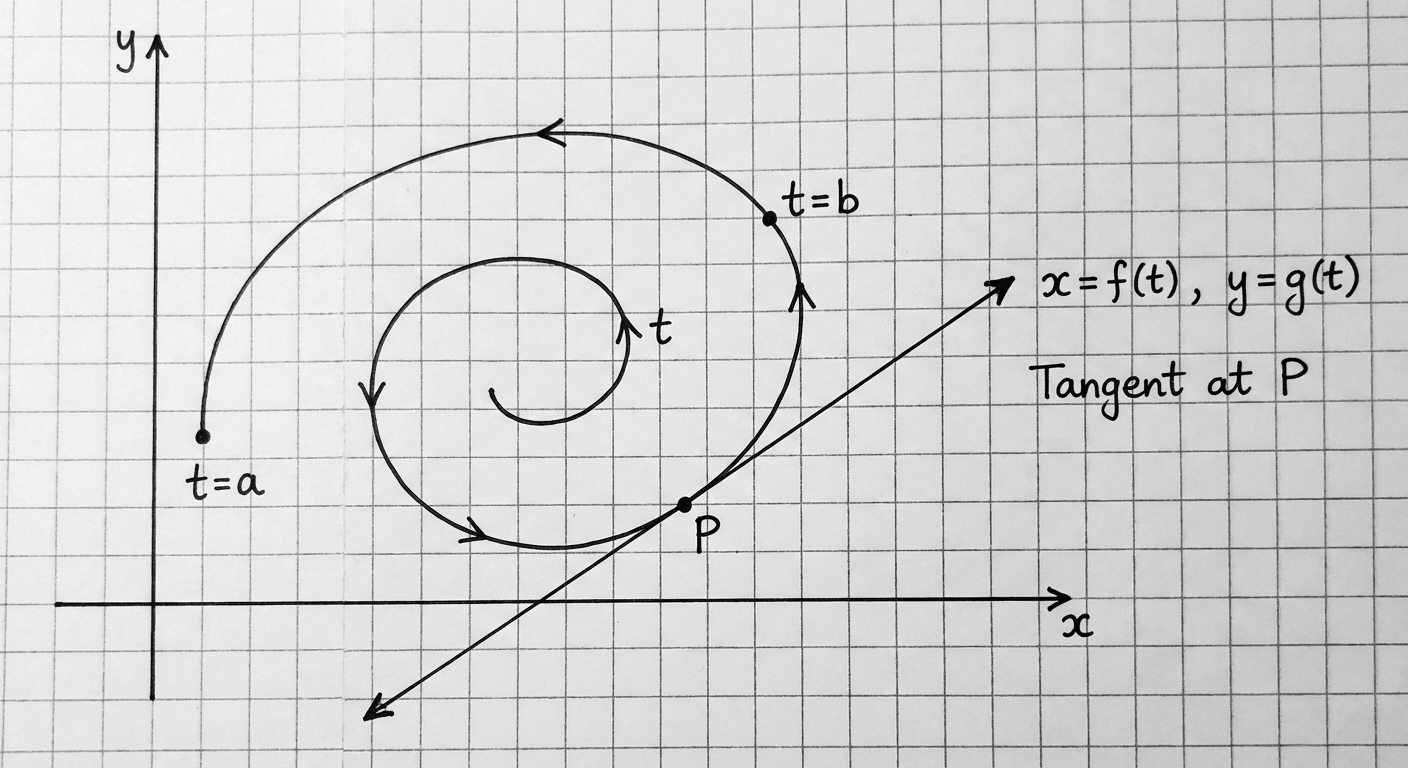
In standard Cartesian coordinates, we define graphs as $y = f(x)$, describing a static relationship between horizontal and vertical position. However, in Parametric Equations, we introduce a third variable, called a parameter (usually represented as $t$ for time), to define both $x$ and $y$ independently.
A plane curve is defined by a pair of functions:
Here, $x$ and $y$ are dependent variables, and $t$ is the independent variable. As $t$ varies over an interval $I$, the point $(x(t), y(t))$ traces a curve in the plane. Unlike a static graph, a parametric curve has an orientation or direction of motion.
Differentiation in Parametrics
To analyze the slope of a parametric curve at a specific point, we need to find $\frac{dy}{dx}$. We apply the Chain Rule:
Tangent Lines
- Horizontal Tangents: Occur where $\frac{dy}{dt} = 0$ and $\frac{dx}{dt} \neq 0$.
- Vertical Tangents: Occur where $\frac{dx}{dt} = 0$ and $\frac{dy}{dt} \neq 0$.
The Second Derivative
A frequent potential pitfall on the AP exam is the second derivative. It is not typically $\frac{y''(t)}{x''(t)}$. Instead, it represents the rate of change of the slope with respect to $x$:
Process:
- Find the first derivative $\frac{dy}{dx}$.
- Differentiate that result with respect to $t$.
- Divide by $\frac{dx}{dt}$ again.
Arc Length of Parametric Curves
To find the distance a particle travels along a curve from $t=a$ to $t=b$, we integrate the speed. Because $x$ and $y$ change independently, we use the Pythagorean theorem on their rates of change:
Vector-Valued Functions
Vector-valued functions are essentially parametric equations written in vector notation. They bridge the gap between calculus and physics, accurately modeling position, velocity, and acceleration.
Definitions and Derivatives
A vector-valued function is often written as:
Differentiation and integration are performed component-wise:
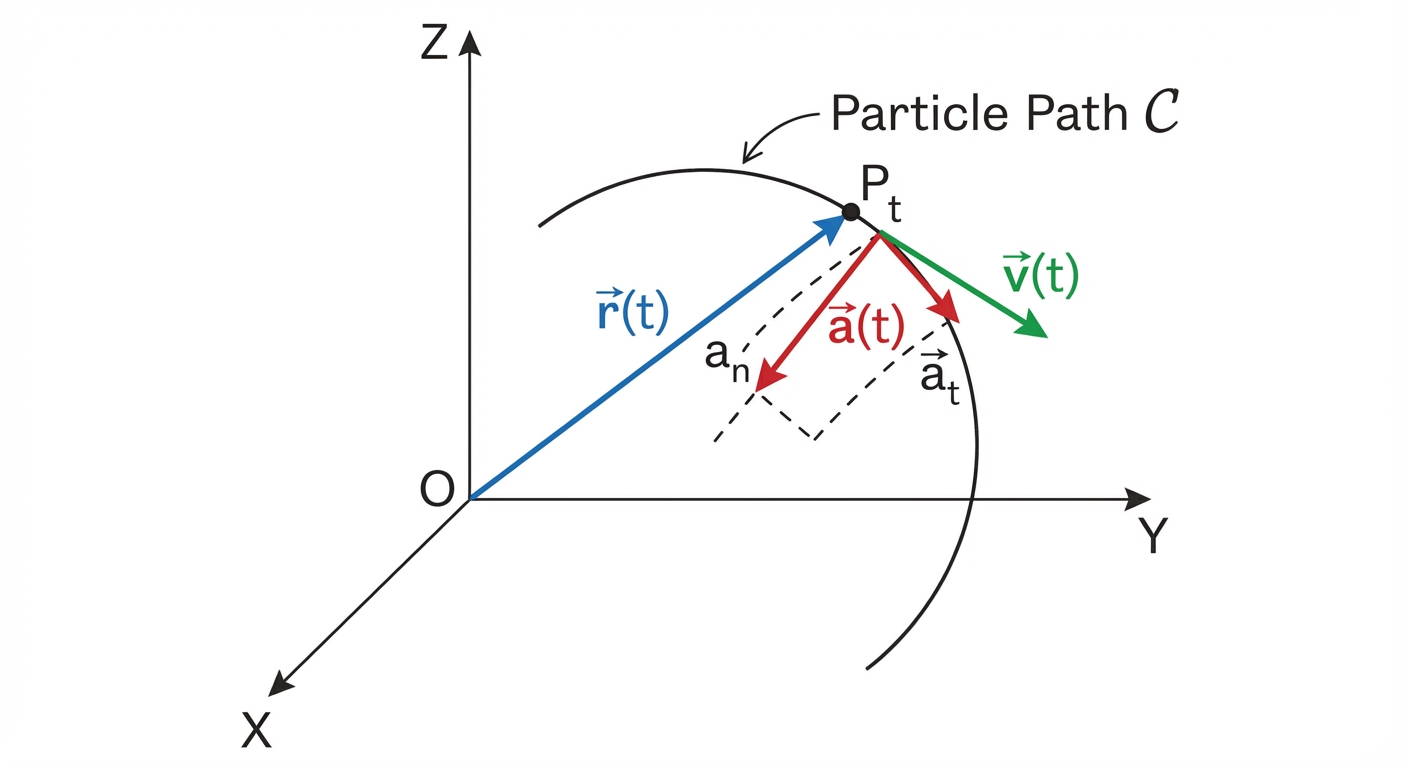
- Position: $\vec{r}(t) = \langle x(t), y(t) \rangle$
- Velocity: $\vec{v}(t) = \vec{r}'(t) = \langle x'(t), y'(t) \rangle$
- Acceleration: $\vec{a}(t) = \vec{v}'(t) = \langle x''(t), y''(t) \rangle$
Motion Descriptors
In particle motion problems, you must distinguish between these key terms:
Speed: The magnitude of the velocity vector (a scalar).
Displacement: The net change in position (a vector).
Total Distance Traveled: The integral of speed (a scalar). This matches the arc length formula.
Common Mistakes regarding Vectors:
- Confusing speed (scalar) with velocity (vector).
- Forgetting that $\vec{v}(t)$ is always tangent to the path of motion.
- Integrating velocity gets you displacement, not total distance (unless the particle never changes direction).
Polar Coordinates
The Polar Coordinate System
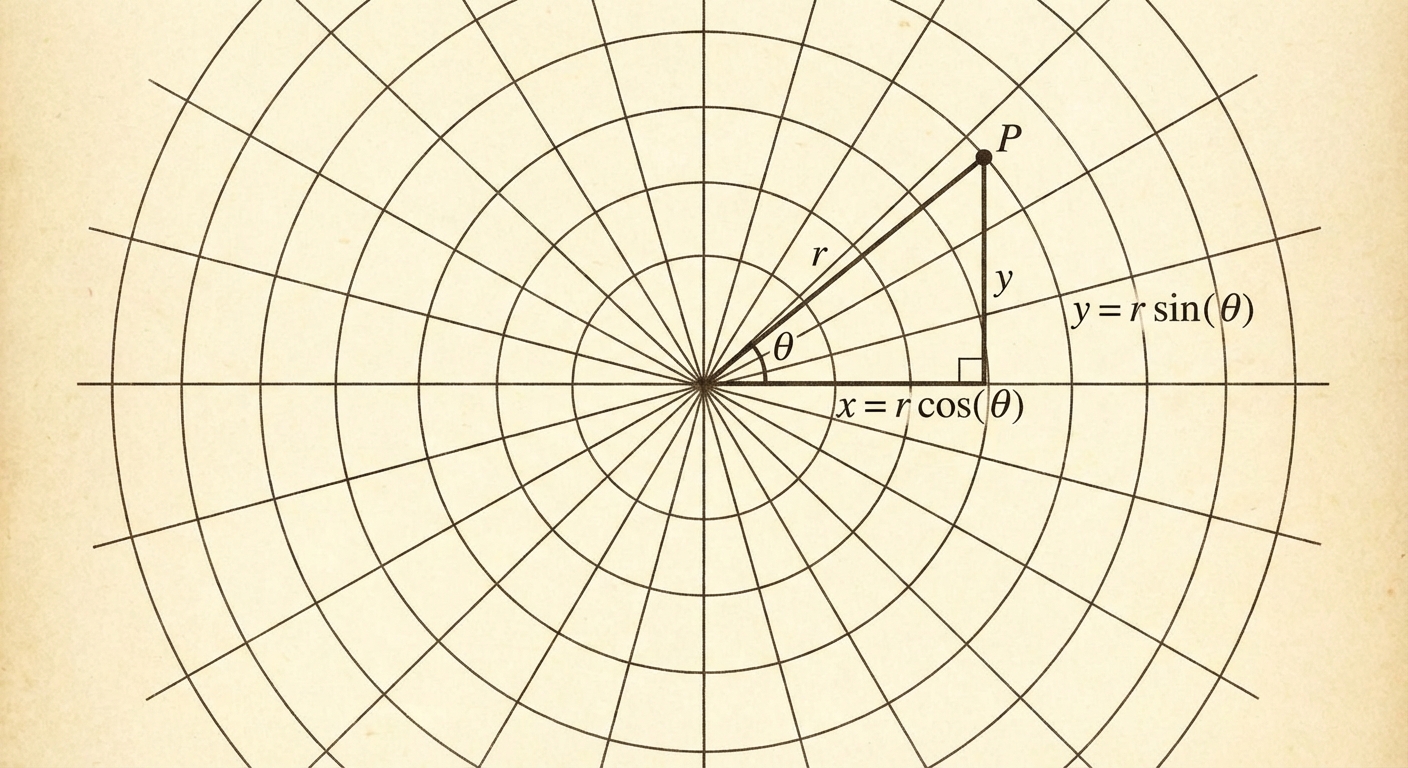
Instead of horizontal and vertical distances $(x, y)$, polar coordinates use a distance from the origin (radius $r$) and an angle from the positive x-axis ($\theta$).
Conversions
Converting between Cartesian and Polar is based on right-triangle trigonometry:
Polar to Cartesian:
Cartesian to Polar:
Derivatives and Slopes in Polar
To find the slope of the tangent line $\frac{dy}{dx}$ for a polar curve $r = f(\theta)$, we treat it as a parametric set where $\theta$ is the parameter.
Since $x = r \cos \theta$ and $y = r \sin \theta$, we substitute $f(\theta)$ for $r$ using the Product Rule:
Note: $r'$ represents $\frac{dr}{d\theta}$.
Area in Polar Coordinates
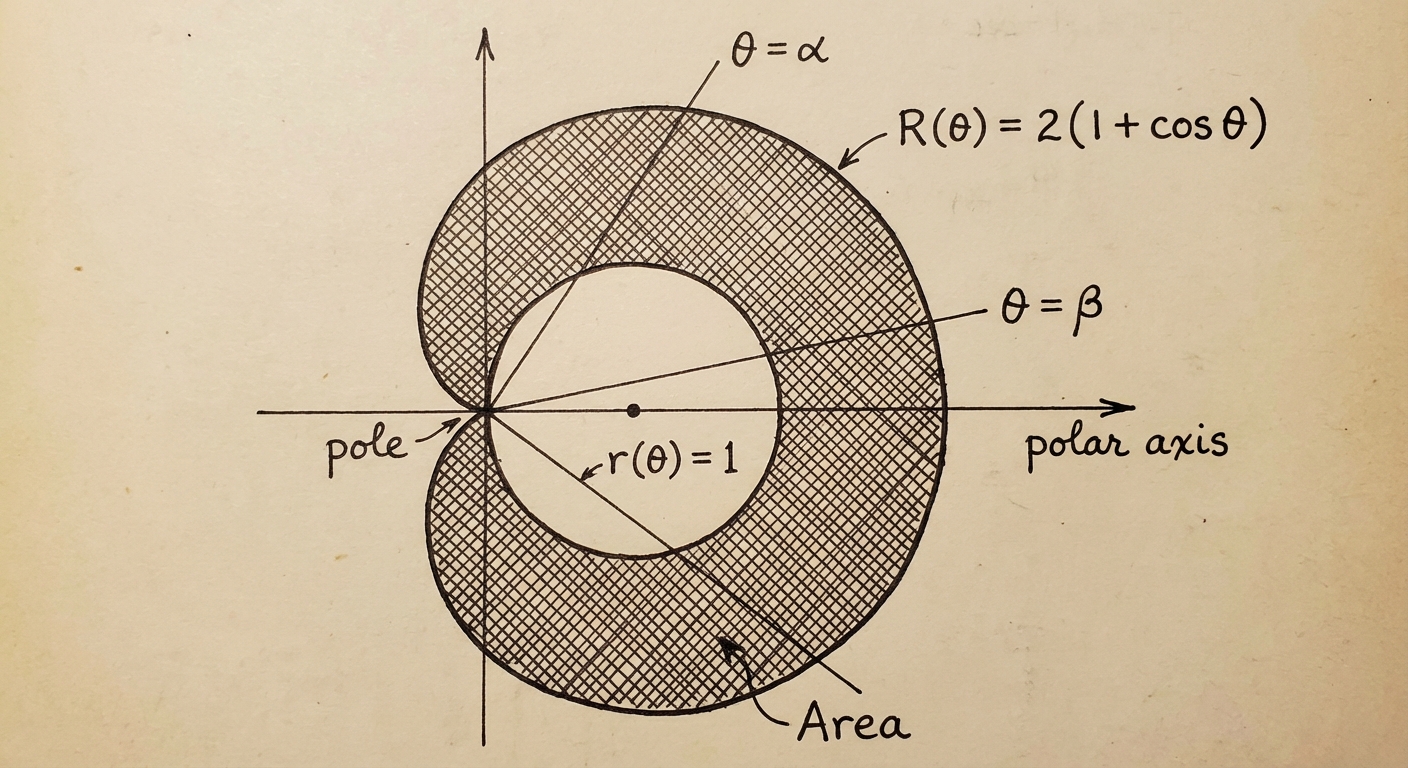
The area bounded by a polar curve is derived from the area of a circular sector ($A = \frac{1}{2}r^2\theta$). Since $r$ changes as $\theta$ changes, we integrate:
Area Between Two Curves
To find the area between an "outer" curve $R(\theta)$ and an "inner" curve $r(\theta)$:
Crucial Note: We subtract the squares of the radii ($R^2 - r^2$). We do NOT calculate $(R-r)^2$. This is a difference of areas, not a square of the difference.
Arc Length of Polar Curves
Although less common than parametric arc length, it is part of the BC curriculum. It is derived from the parametric formula:
Section Summary: Common Pitfalls
- The Second Parametric Derivative: Students often calculate $\frac{y''(t)}{x''(t)}$. Remember, you must differentiate $\frac{dy}{dx}$ with respect to $t$ and then divide by $\frac{dx}{dt}$.
- Polar Area Constant: Forgetting the $\frac{1}{2}$ in front of the integral is the most common error in Unit 9.
- Polar Difference of Squares: When finding the area between polar curves, write $R^2 - r^2$, never $(R - r)^2$.
- Vector Magnitude: Speed is the magnitude of velocity. It must be positive (it involves a square root). Velocity is a vector (indicated by angle brackets $\langle, \rangle$). don't confuse the two.