Unit 3 Study Guide: Foundations of Political Behavior
Political Culture and Socialization
Defining Political Culture
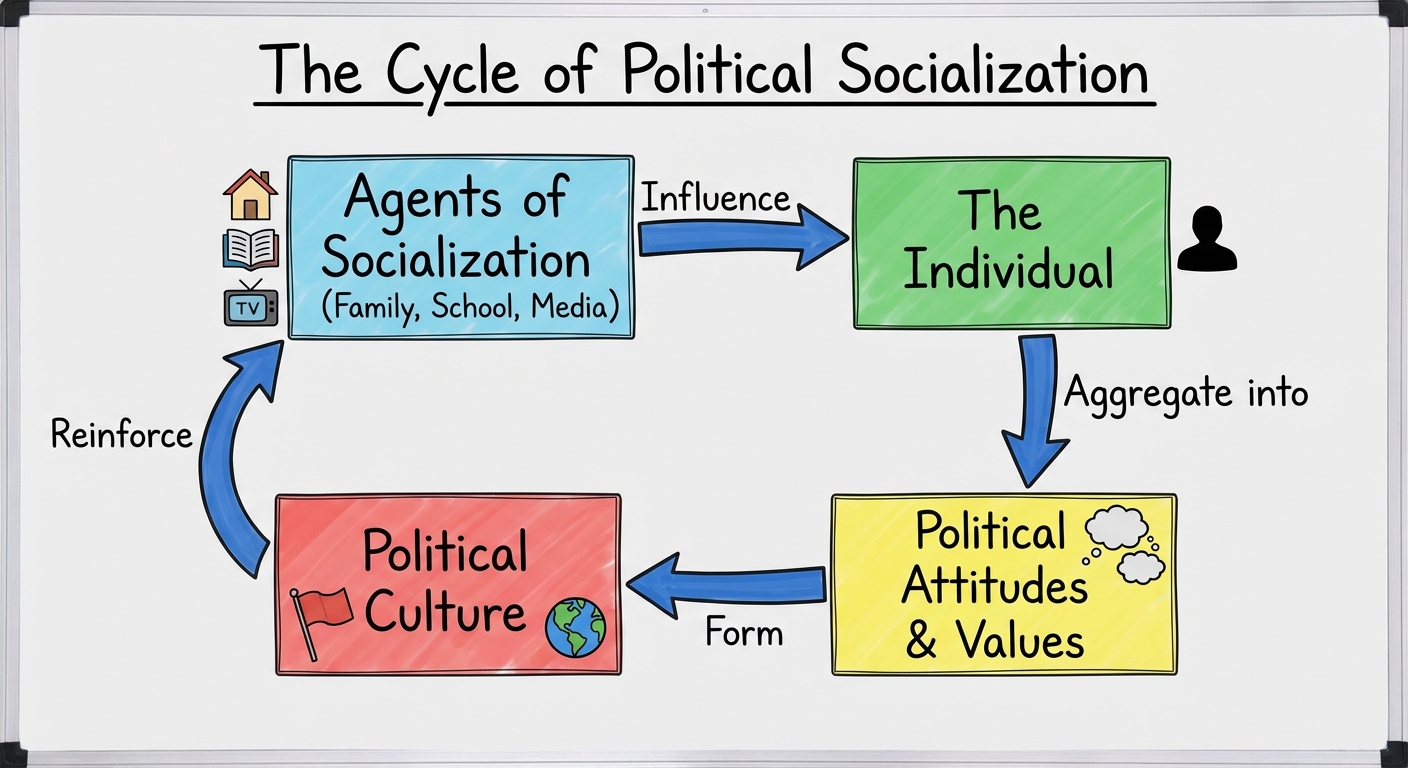
Political Culture refers to the deep-seated, collective history, values, beliefs, and traditions that influence political behavior within a nation. It is distinct from public opinion, which refers to immediate views on specific leaders or issues. While public opinion changes rapidly, political culture is durable and slow to change.
Political culture defines the norms of a society—what citizens consider "normal" or "acceptable" behavior from their government.
Political Socialization
Political Socialization is the lifelong process by which individuals acquire their political attitudes and beliefs. This process ensures the continuity of political culture across generations.
Agents of Socialization
These are the institutions or individuals that convey political norms:
- Family: Usually the most important agent. Children often inherit the political leanings and party identifications of their parents.
- Schools/Education: Governments use curricula to instill patriotism and national history. In authoritarian regimes (e.g., China, Iran), this is heavily controlled to ensure loyalty to the state or ideology.
- Religious Institutions: Crucial in countries where religion and state interact closely (e.g., Iran, Nigeria, parts of Mexico).
- Media: In democratic regimes, distinct media outlets shape diverse viewpoints. In authoritarian regimes, state-run media serves as a propaganda tool (e.g., Russia, China).
- Peer Groups & Social Class: Social circles and economic standing reinforce shared values.
Types of Political Culture
- Consensual Political Culture: Citizens generally agree on how decisions are made, what issues are important, and how to solve problems (e.g., United Kingdom).
- Conflictual Political Culture: Citizens are sharply divided, often on legitimacy of the regime itself or fundamental solutions to major problems (e.g., Nigeria).
Political Beliefs and Values
Within the AP Comparative Government curriculum, you must understand specific ideological frameworks and how they manifest in the six course countries.
Core Value Concepts
- Individualism: Belief in individual civil liberties and freedom over governmental restrictions. (Strong in the West/UK; weaker in China/Russia).
- Neoliberalism: An economic belief favoring free-market capitalism, privatization, and reduced government intervention. This has been a major force in Mexico (since the 1980s) and Nigeria.
- Communism: Belief in the abolition of private property with the state attempting to achieve economic equality (official ideology of China).
- Socialism: Belief that the state should play a strong role in regulating the economy and providing public benefits (healthcare, education) to ensure some measure of equality.
- Fascism: Extreme nationalist ideology favoring authoritarian rule and the suppression of rights for the sake of the state.
- Populism: Political philosophy that supports the rights and power of the "common people" in their struggle against a privileged elite. (Seen recently in Mexico with AMLO, and globally).
Post-Materialism
Post-Materialism is a theory suggesting that as societies become wealthier and basic needs (safety, food, shelter) are met, citizens prioritize higher-level values.
- Materialist concerns: Economic growth, physical security, order.
- Post-Materialist concerns: Environmental protection, gender equality, human rights.
- Application: The United Kingdom exhibits strong post-materialist values. China, still focusing on rapid growth and stability, remains largely materialist, though environmental protests are rising.
Country-Specific Values (The AP Six)
| Country | Key Aspect of Political Culture |
|---|---|
| United Kingdom | Pragmatism and tradition. High legitimacy naturally accepted. "Gradualism" in change. |
| Russia | Statism: The belief that the state should control either economic or social policy (or both) for the sake of order. Survival over self-expression. |
| China | Confucianism (hierarchy/obedience) mixed with Maoism (egalitarianism/mass line). Current focus: Economic prosperity > political freedom. |
| Mexico | Transitions from authoritarianism. Struggle between clientelism (vote-buying) and true democratic competition. Strong national pride (nationalism). |
| Nigeria | Fragmented. Loyalty is often to the ethnic group or religion first, nation second. Prebendalism suggests officials feel entitled to government revenues to benefit their own ethnic group. |
| Iran | Theocracy. Political culture is split between religious hardliners and secular reformers. Sharia law is the supreme value for the state. |
Civil Society and Social Capital
Defining Civil Society
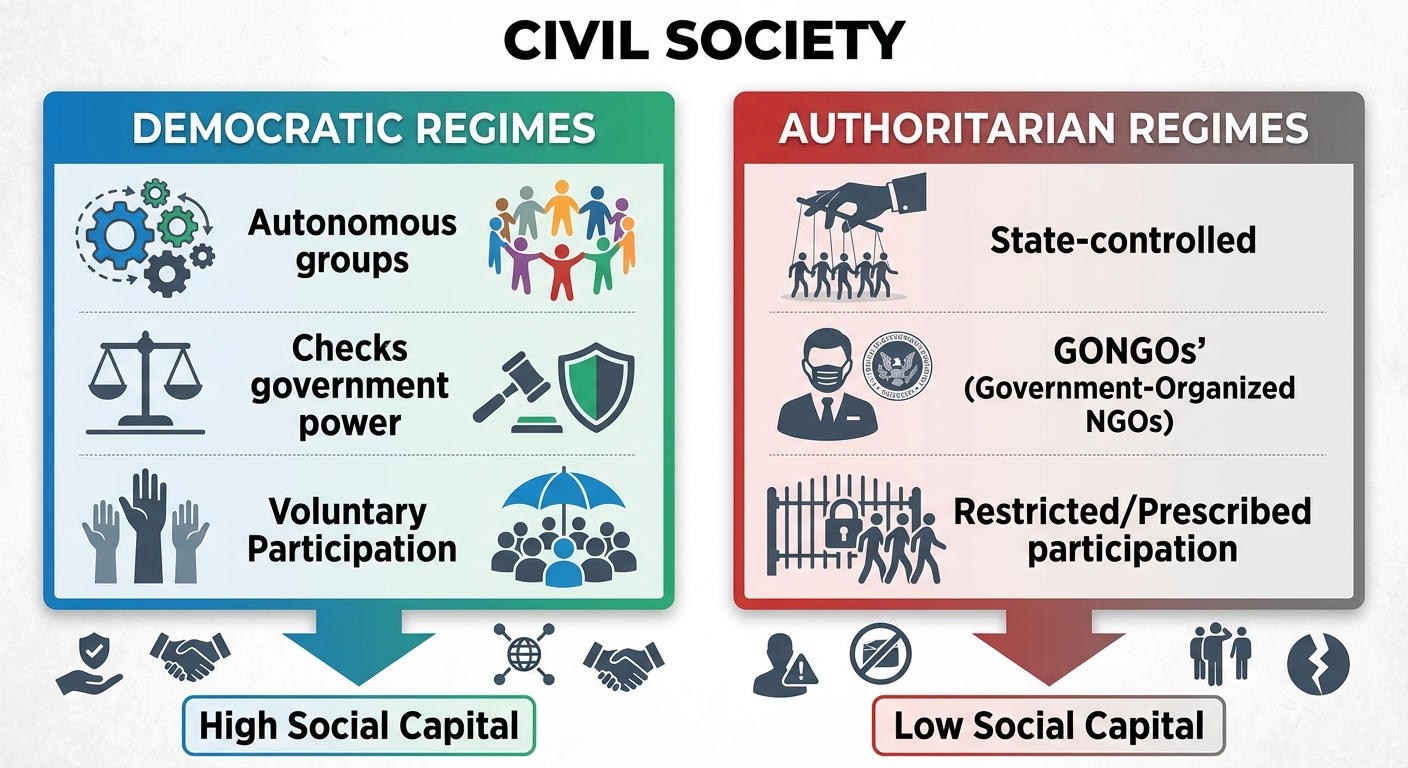
Civil Society refers to voluntary organizations outside of the state that help people define and advance their own interests. These groups are autonomous from the state.
- Examples: Religious groups, charities, sports clubs, labor unions, environmental groups, professional associations.
- Rule of Thumb: If the government creates it or runs it, it is not civil society.
Social Capital
Social Capital is the level of trust, reciprocity, and cooperation among citizens.
- High Social Capital: leads to democracy. People trust each other and the government; they work together to solve problems (e.g., UK).
- Low Social Capital: leads to authoritarianism or instability. People rely only on close family or clan connections and mistrust the state (e.g., Nigeria, Russia).
Civil Society in Different Regimes
In Democratic Regimes (UK, Mexico, Nigeria)
Civil society is generally robust and protected. It acts as a check on government power (accountability) and allows for political participation.
- Note on Nigeria/Mexico: While democratic, civil society faces threats from violence (cartels in Mexico, Boko Haram in Nigeria) and corruption.
In Authoritarian Regimes (China, Russia, Iran)
The state views independent civil society as a threat.
- Co-optation: The state creates "fake" civil society groups (often called GONGOs—Government-Organized Non-Governmental Organizations) to control the narrative.
- Restriction: Laws require NGOs to register as "foreign agents" (Russia) or strictly limit their ability to advocate for policy changes (China).
- Corporatism: The government incorporates interest groups into the state system, giving the state a monopoly on representation and preventing outside groups from forming.
Common Mistakes & Pitfalls
Confusing Political Culture with Ideology:
- Mistake: "The political culture in the UK is Conservative."
- Correction: Conservatism is an ideology/party. The political culture of the UK is increasingly post-materialist, pragmatic, and respectful of the rule of law.
Civil Society vs. Government Agencies:
- Mistake: Thinking a government-funded welfare agency is 'civil society.'
- Correction: Civil society must be voluntary and autonomous. If the state runs it, it's the state.
Stereotyping Countries:
- Mistake: "Everyone in Iran loves theocracy."
- Correction: Political culture is not monolithic. Iran has a significant cleavage (divide) between the younger, reform-minded population and the older, conservative clerical establishment.
Misunderstanding "Corporatism":
- Mistake: Thinking it means "rule by corporations/businesses."
- Correction: In Comparative Gov, Corporatism describes a system where the government controls access to policy-making by sanctioning officially recognized groups (unions, business groups) and excluding others.