Foundations of Human Expression: Global Prehistory (30,000–500 BCE)
Foundations of Human Expression: Global Prehistory (30,000–500 BCE)
Introduction to Global Prehistory
Prehistoric art includes all artistic production created prior to the invention of written records. Because there are no primary texts from these cultures to explain the artwork, art historians rely on archaeology, ethnography (comparisons to modern indigenous cultures), and formal analysis to interpret meaning.
The Two Main Eras
Understanding the shift between these two eras is crucial for Unit 1:
- Paleolithic (Old Stone Age):
- Lifestyle: Hunter-gatherer, nomadic.
- Art Characteristics: Portable objects (mobility is key), cave paintings deep within the earth.
- Key Themes: Animals, survival, fertility, shamanism.
- Neolithic (New Stone Age):
- Lifestyle: Agriculture, domestication of animals, settled communities (The "Neolithic Revolution").
- Art Characteristics: Monumental architecture, heavy pottery, formalized religious sites.
- Key Themes: Cycles of nature, ancestors, stability, celestial alignment.
Methodology: How Do We Know?
Since the artists left no written explanation, historians use scientific and deductive methods:
- Carbon-14 Dating: Measures the decay of radioactive carbon in organic matter (bone, charcoal) to determine age.
- Stratigraphic Archaeology: Analyzing soil layers; objects found in deeper layers are generally older.
- Ethnographic Analogy: Using the practices of modern or recent hunter-gatherer societies to hypothesize about prehistoric functions (e.g., comparing San people's rituals to the Apollo 11 stones).
1. Paleolithic Rock Art & Painting
This section covers art created on natural rock surfaces, often in caves or on portable loose stones.
➼ Apollo 11 Stones
- Location: Wonderwerk Cave, Namibia
- Date: c. 25,500–25,300 B.C.E.
- Media: Charcoal on quartzite (portable)
- Form & Content:
- Depicts a feline-like animal with human hind legs (a therianthrope).
- Strict profile view (side view) allows for immediate identification of the species.
- Context:
- Named after the 1969 moon landing (the year they were discovered).
- Found with 7 fragments.
- Significance: Proof of early human capacity for symbolic thought and conceptual representation rather than just realistic observation.
➼ Great Hall of the Bulls
- Location: Lascaux, France (Paleolithic Europe)
- Date: 15,000–13,000 B.C.E.
- Media: Rock painting (Charcoal, Iron Ore, Plants)
- Technique:
- Pigment blown through hollow bones or applied with moss/hair.
- Utilizes the natural contours of the rock to suggest volume (relief).
- Form:
- Twisted Perspective (Composite View): Bodies are in profile, but horns are frontal. This descriptive approach ensures the viewer sees "all" of the animal's features.
- Superimposition: Images painted over one another over generations.
- Context & Theory:
- Located deep in caves (not a dwelling space), implying ritual use.
- Hunting Magic Theory: Painting the animal ensures a successful hunt.
- Shamanism: The cave acts as a liminal space between the earth and the spirit world.

➼ Running Horned Woman
- Location: Tassili n’Ajjer, Algeria
- Date: 6,000–4,000 B.C.E.
- Media: Pigment on rock
- Form:
- Hierarchical Scale: The female figure is significantly larger than the background figures.
- Dots on the body suggest scarification (ritual skin marking) or body paint.
- Horns suggest divinity or ceremonial attire.
- Context:
- Found in a region that was once lush grassland (evidence of climate change).
- The site contains thousands of paintings spanning thousands of years.
- Likely depicts a deity or a priestess engaged in a ritual favoring rain or fertility.
2. Neolithic Sculpture & Ceramics
As humans settled, art became more specialized, utilizing clay (ceramics) and harder stones (jade, greywacke) that required time and stability to produce.
➼ Beaker with Ibex Motifs
- Location: Susa, Iran
- Date: 4,200–3,500 B.C.E.
- Media: Painted terra cotta
- Form:
- Stylized: Not realistic; features are exaggerated (huge horns on the Ibex).
- Geometric Composition: The horns form a circle; the layout is linear and balanced.
- Registers (bands) of decoration: Wading birds (top), hunting dogs (middle), Ibex (center).
- Technique: Use of a slow wheel (technological advancement) and kiln firing.
- Context:
- Funerary object: Found near a burial site in a cemetery, likely for the afterlife.
- Clan symbol: The symbol inside the horns probably identifies the family or group.
➼ Jade Cong
- Location: Liangzhu, China
- Date: 3,300–2,200 B.C.E.
- Media: Carved Jade (Nephrite)
- Technique:
- Jade is extremely hard; it cannot be cut with knives. It must be abraded (rubbed) with sand and water. This implies huge labor and a highly stratified society (rich enough to support artisans).
- Form:
- Square hollow tube with a circular interior.
- Decorated with abstract faces (mask-like motifs) utilizing fine lines.
- Interpretation:
- Later Chinese symbolism suggests Square = Earth and Circle = Sky/Heavens.
- Found in graves of high-ranking individuals, often burned (ritual purpose).
➼ Tlatilco Female Figurine
- Location: Central Mexico
- Date: 1,200–900 B.C.E.
- Media: Ceramic
- Form:
- Wide hips, narrow waist, elaborate hairstyles (indicates importance of hair in this culture).
- Bifacial (Two-faced): Creates a sense of duality (life/death, waking/sleeping).
- Context:
- Found in graves; likely related to fertility or shamanistic duality.
- Tlatilco culture noted for genetic anomalies (conjoined twins), which may have been revered.
➼ The Ambum Stone
- Location: Enga Province, Papua New Guinea
- Date: c. 1500 B.C.E.
- Media: Greywacke (very hard sedimentary stone)
- Form:
- Free-standing composite figure (anteater head? fruit bat? human body?).
- Smooth, curved surface requiring weeks of chipping and hammering.
- Context:
- Oldest artwork from Oceania in the content area.
- Likely used as a pestle (tool for grinding) for ritual food/narcotics.
- Considered a sacred object (simting bilong tumbuna - "bones of the ancestors") by the Enga people today.
3. Ritual Stones & Monumental Architecture
➼ Anthropomorphic Stele
- Location: Arabian Peninsula
- Date: 4th Millennium B.C.E.
- Media: Sandstone
- Definition: A Stele is an upright stone slab used to mark a grave or site.
- Form:
- Abstracted human figure (trapezoidal head, belted waist, double-bladed sword).
- Minimalist design.
- Context:
- Found along ancient trade routes.
- Stylistic similarities to steles found in Jordan suggest active cultural exchange and trade across the pre-Islamic Arabian region.
➼ Camelid Sacrum in the Shape of a Canine
- Location: Tequixquiac, Central Mexico
- Date: 14,000–7,000 B.C.E.
- Media: Bone (sacrum)
- Form:
- The natural shape of the sacrum (triangular bone at the base of the spine) was modified with carvings to look like a dog or wolf skull.
- Context:
- Sacred Geography of the Body: In later Mesoamerican cultures, the sacrum is viewed as a "second skull" and the seat of the soul/fertility. This work suggests this belief has very ancient roots.
➼ Terra Cotta Fragment (Lapita)
- Location: Solomon Islands (Oceania)
- Date: 1000 B.C.E.
- Media: Incised Terra Cotta
- Technique: Dentate Stamping (using a comb-like tool to press designs into wet clay before firing).
- Form:
- geometric patterns (circles, hatching).
- One of the earliest representations of a human face in Oceanic art.
- Context:
- The Lapita people were master navigators.
- The geometric patterns on the pottery are directly linked to traditional Polynesian tattooing and barkcloth (tapa) designs.
➼ Stonehenge
- Location: Wiltshire, UK (Neolithic Europe)
- Date: c. 2500–1600 B.C.E.
- Media: Sandstone (Sarsen) and Bluestone
- Architecture Terms:
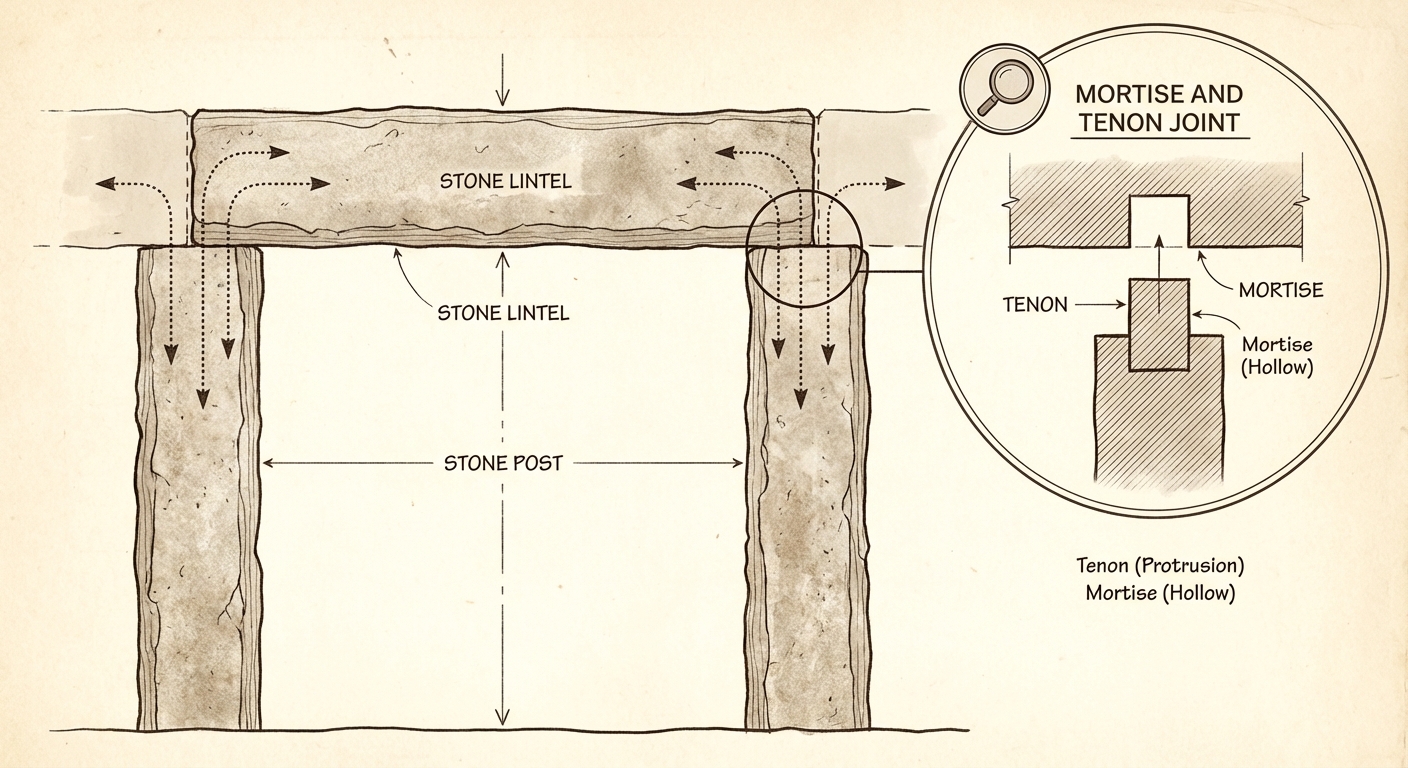
- Post-and-Lintel: Two upright stones (posts) support a horizontal beam (lintel).
- Mortise-and-Tenon: A "lego-like" joint where a projection (tenon) fits into a hole (mortise) to secure the lintel.
- Megalith: A large stone used in prehistoric building.
- Henge: A circular ditch and bank arrangement.
- Phases of Construction:
- Circular ditch (Aubrey holes) used for burial.
- Wooden posts.
- Stone arrangement (transported from Wales, over 150 miles away—showing immense organization and devotion).
- Function:
- Astronomical observatory (oriented toward the summer solstice sunrise).
- Burial site for elite males.
- Healing center (bluestones were thought to have curative powers).
Comparison & Connections (For FRQs)
| Feature | Work A | Work B | Connection/Contrast |
|---|---|---|---|
| Human Figure | Anthropomorphic Stele | Tlatilco Figurine | Both abstract the human form. The Stele represents male warrior culture/trade; the Tlatilco figure represents female fertility/duality. |
| Animal Form | Apollo 11 Stones | Camelid Sacrum | Both zoomorphic. Apollo 11 is 2D pictorial representation; Sacrum utilizes the 3D natural shape of the bone to "find" the animal form. |
| Sacred Space | Lascaux | Stonehenge | Lascaux is a private, hidden, interior ritual space. Stonehenge is a public, monumental, exterior communal space. |
Common Mistakes & Pitfalls
"Art for Art's Sake":
- Mistake: Thinking prehistoric artists made things just to look pretty.
- Correction: Prehistoric art always has a function (survival, ritual, funerary, or fertility). It was utilitarian or spiritual, not decoration.
Confusing Paleolithic and Neolithic:
- Mistake: Saying Stonehenge was built by hunter-gatherers.
- Correction: Monumental architecture (Stonehenge) requires a settled society (Neolithic) with a surplus of food and labor.
Twisted Perspective:
- Mistake: Calling it "cubism" or "abstract."
- Correction: Use the term Twisted Perspective or Composite View. It is a descriptive approach to show the most identifiable parts of the animal simultaneously.
Geography Errors:
- Mistake: Placing the Runing Horned Woman in Europe.
- Correction: She is in Algeria (Africa). Always map the works to their continent.