Unit 10: Global Contemporary Perspectives (1980 CE – Present)
Postmodernism in Art
The Shift from Modern to Postmodern
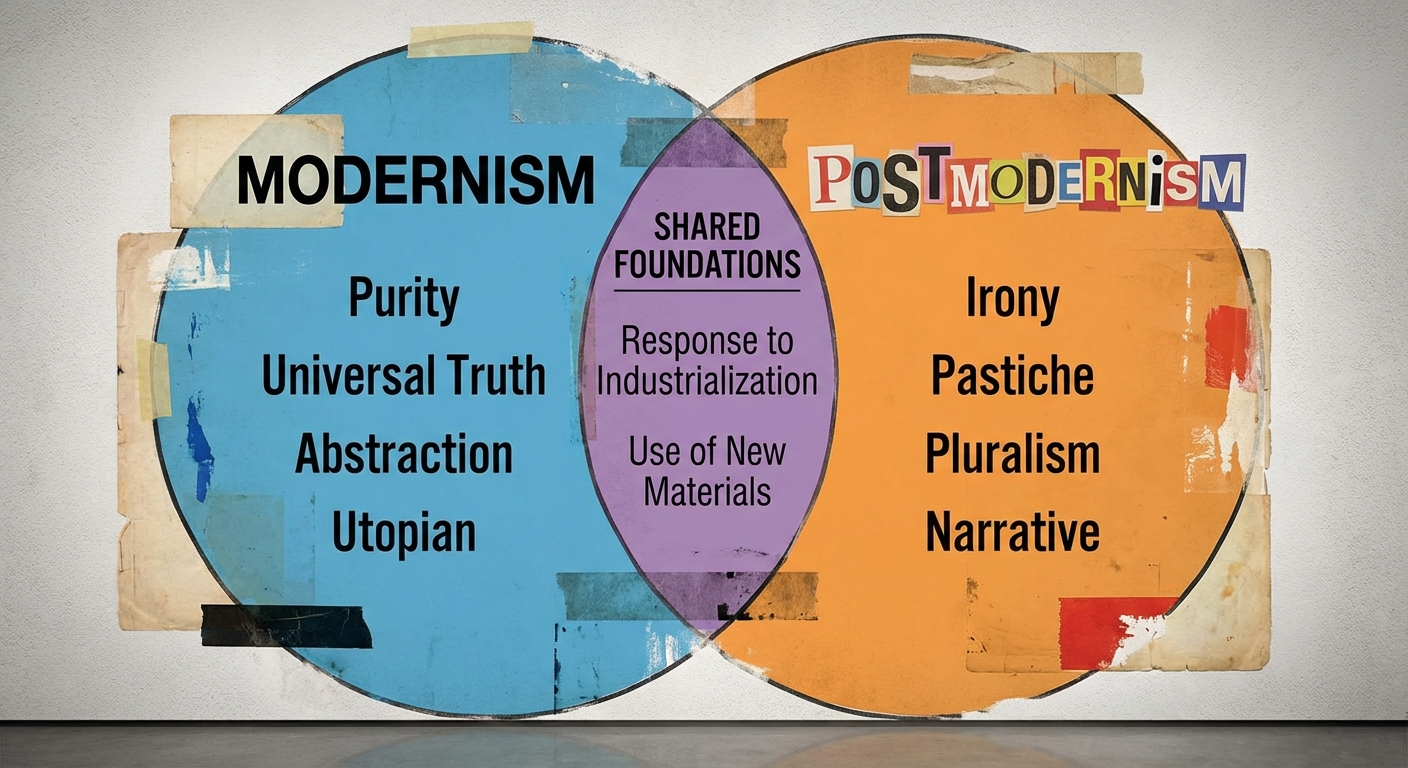
Unlike Modernism (c. 1860–1970), which sought purity, universal truths, and abstraction (think: "Less is More"), Postmodernism embraces complexity, contradiction, and ambiguity (think: "Less is a Bore"). It emerged in the late 20th century as a reaction against the rigidity of Modernism.
Key Characteristics:
- Pluralism: The acceptance of multiple viewpoints rather than a single universal truth.
- Appropriation: The practice of taking existing objects or images (from art history or pop culture) and recontextualizing them with little variation.
- Rejection of Originality: Postmodernists argue that because images are recycled constantly in mass media, true "originality" is a myth.
- Blurring of High and Low Art: Mixing fine art museum culture with pop culture, kitsch, and mass production.
Key Themes and Strategies
1. Identity Politics & The Gaze
Artists began using art to explore race, gender, sexuality, and class, often critiquing historical power structures.
- Cindy Sherman: In works like Untitled (#228) (from the History Portraits series), Sherman uses photography not to capture reality, but to construct artificial identities. By dressing up as historical figures (specifically Judith holding the head of Holofernes), she critiques the Male Gaze and the history of how women are represented in Old Master paintings. She appears grotesque and artificial, highlighting that gender is a performance.
- Jean-Michel Basquiat: His work Horn Players combines graffiti style (low art) with jazz history (high culture appreciation) and anatomical drawings. He reclaims African American history in a predominantly white art world.
2. Kitsch and Banality
- Jeff Koons: A master of the "banal." In Pink Panther (1988), he pairs a porcelain sculpture of a 1960s B-movie star (Jayne Mansfield) with the cartoon Pink Panther. The work is deliberately kitsch—art considered to be in poor taste due to excessive garishness or sentimentality. Koons challenges the viewer: Why do we value "high art" over the mass-market figurines found in a grandmother's living room?
Comparison Table: Modernism vs. Postmodernism
| Feature | Modernism | Postmodernism |
|---|---|---|
| Goal | Purity, Universal Truth, Originality | Critique, Irony, Pastiche |
| Style | Abstraction, Formalism, Minimalism | Eclectic, Decorative, Narrative |
| Inspiration | The Subconscious, Nature, Theory | History, Mass Media, Pop Culture |
| Author | The isolated genius | The borrower/remixer |
Installation and Site-Specific Art
Redefining the Space
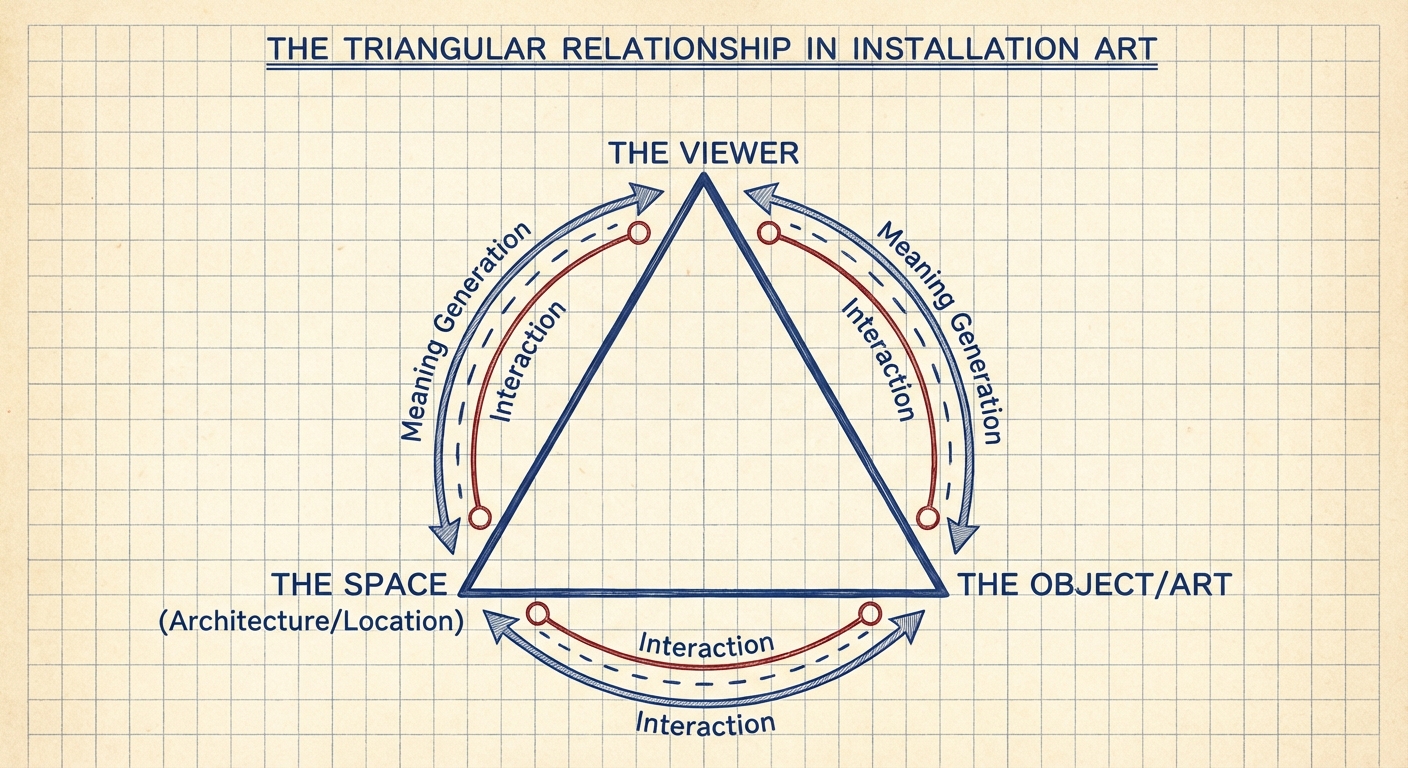
Installation Art differs from traditional sculpture because it transforms the perception of a space. The viewer does not just look at the art; they are inside the art. The environment is part of the work.
Site-Specific Art is designed for a specific location. If you move the artwork, it loses its meaning or is destroyed.
Transformations and Interventions
1. Environmental Intervention
- Christo and Jeanne-Claude: The Gates (2005) in Central Park, NYC. This was a massive site-specific work consisting of 7,503 saffron-colored fabric panels.
- Ephemeral: It lasted only 16 days. The temporary nature creates urgency and emphasizes the experience of the moment.
- It highlighted the pre-existing paths of the park, forcing viewers to re-examine a familiar landscape.
2. Institutional Critique
- Doris Salcedo: Shibboleth (2007) at the Tate Modern. Salcedo literally cracked the concrete floor of the museum hall. The crack represents the immigrant experience—the separation and borders felt by unwanted people in Europe.
- Meaning: It is a scar that remains even after the museum filled the crack; a permanent reminder of division within the institution.
3. Mass Production & Individuality
- Ai Weiwei: Kui Hua Zi (Sunflower Seeds) (2010). The installation consisted of 100 million porcelain sunflower seeds spread across the floor.
- Process: Each seed was individually hand-painted by artisans in Jingdezhen, China.
- Concept: It critiques the "Made in China" narrative of cheap mass production by highlighting the labor of individuals. It also references the conformist propaganda of the Cultural Revolution (people as seeds following Chairman Mao, the sun).
Video Art and Digital Media
Technology as a Medium
In the Global Contemporary era, technology moved from being a tool (for making art) to being the medium itself. Video art introduced the element of time (time-based media) into visual arts.
Key Developments and Works
1. The Father of Video Art
Nam June Paik pioneered the use of television sets as sculptural objects.
- Work: Electronic Superhighway (1995).
- Visuals: A massive map of the U.S. outlined in neon lights, populated by hundreds of TV screens playing clips associated with each state.
- Concept: Paik predicted the "information superhighway" (internet). He argues that media defines our understanding of the world; we know states not by visiting them, but by the media images we consume (e.g., The Wizard of Oz for Kansas).
2. Spiritual Immersion
Bill Viola uses video technology to explore spiritual and universal human experiences (birth, death, consciousness), often using slow-motion effects.
- Work: The Crossing (1996).
- Visuals: A double-sided projection. On one side, a man is consumed by fire; on the other, he is inundated by water.
- Concept: It references Eastern and Western religious traditions (baptism, cremation, Shiva as destroyer). Slow motion forces the viewer to meditate on the cycle of destruction and renewal.
3. Digital Fantasy
Mariko Mori combines traditional Japanese imagery with futuristic digital manipulation.
- Work: Pure Land (1998).
- Visuals: A still from a 3D video installation. A female figure (the artist) floats as a deity above a lotus blossom in a candy-colored landscape with alien musicians.
- Concept: It updates the iconography of the Amida Buddha for a digital generation, creating a serene, immersive utopia.
Common Mistakes & Pitfalls
Confusing "Modern" with "Contemporary":
- Mistake: Calling art from 2024 "Modern Art."
- Correction: "Modern Art" refers to a specific historical period (c. 1860–1970). Everything from 1980 to today is Contemporary or Postmodern.
Misinterpreting Appropriation:
- Mistake: Thinking artists like copycats or plagiarists (e.g., assuming Cindy Sherman is just taking selfies).
- Correction: Always analyze the intent. Appropriation is a deliberate conceptual strategy to critique the original meaning. Sherman is critiquing the role of women in art, not trying to be a painter.
Ignoring the "Site" in Site-Specific:
- Mistake: Assuming artwork like The Gates could be moved to another park.
- Correction: If the AP exam asks about The Gates or Spiral Jetty, you MUST discuss how the work interacts with that specific location's geography, history, or environment.
Overlooking the "Viewer's Experience":
- Mistake: Describing Installation art only by what it looks like.
- Correction: You must describe how the viewer interacts with it. Do they walk on it? Does it surround them? Is it multi-sensory (sound/sight)?