Unit 8: Global Fragmentation and Realignment (1900–Present)
Decolonization After 1900
Overview and Context
Decolonization refers to the process by which colonies achieved independence from imperial powers, particularly after World War II. While the desire for self-determination existed prior to 1945, the war acted as a catalyst. European powers (Britain, France, Netherlands) were economically devastated and morally compromised, making the maintenance of vast overseas empires increasingly difficult.
Two distinct pathways to independence emerged during this period:
- Negotiated Independence: Achieved primarily through political maneuvers and treaties.
- Armed Struggle: Achieved through warfare when colonial powers refused to relinquish control.
Negotiated Independence
In colonies where the imperial power realized the cost of control outweighed the benefits, or where non-violent movements were highly organized, power was transferred relatively peacefully.
Key Case Study: India (British Raj)
- The Indian National Congress (INC), led by Mohandas Gandhi, utilized civil disobedience (Salt March, non-compliance).
- The Muslim League, led by Muhammad Ali Jinnah, advocated for a separate state for Muslims, fearing Hindu dominance in a unified India.
- Outcome: In 1947, Britain partitioned the Raj into two independent states: India (Hindu majority) and Pakistan (Muslim majority). This was a political success but a humanitarian crisis, displacing millions.
Key Case Study: British West Africa (Ghana)
- Kwame Nkrumah led the independence movement in the Gold Coast (later Ghana) using strikes and protests modeled after Gandhi.
- In 1957, Ghana became the first sub-Saharan African nation to gain independence, serving as an inspiration for the rest of the continent.
- Nkrumah later became a leading advocate for Pan-Africanism (the idea of political/cultural unity among African nations).
Independence through Armed Struggle
Violent decolonization usually occurred in colonies where there were significant European settler populations or where the colony was viewed as an extension of the mainland.
Key Case Study: Algeria (vs. France)
- Algeria was legally considered a part of France, not just a colony. A large population of French settlers (pieds-noirs) lived there.
- The National Liberation Front (FLN) utilized guerilla warfare and terrorism against French civilians; the French military responded with brutal torture campaigns.
- Outcome: Independence was granted in 1962, but the war caused the collapse of the French Fourth Republic and mass migration of settlers back to France.
Key Case Study: Vietnam (vs. France)
- Led by Ho Chi Minh and the Viet Minh (communists).
- After WWII, France tried to reassert control over Indochina.
- The decisive battle at Dien Bien Phu (1954) forced the French to withdraw, leading to the partition of Vietnam into North (Communist) and South (US-aligned), setting the stage for the Vietnam War.
| Feature | Negotiated Independence | Armed Struggle |
|---|---|---|
| Primary Tactic | Civil disobedience, politicking | Guerilla warfare, uprisings |
| European Stance | "Managed retreat" | "Hold at all costs" |
| Settler Population | Generally Low | High (e.g., French in Algeria) |
| Examples | India, Ghana, French West Africa | Algeria, Vietnam, Kenya (Mau Mau) |
Newly Independent States
Once independence was achieved, new nations faced the challenge of state-building. They had to define their borders, choose economic systems, and navigate the Cold War rivalry.
Political Instability and Partition
Imperial boundaries rarely aligned with ethnic or religious realities in Africa and Asia. The withdrawal of colonial powers often left a power vacuum or resulted in the partition of land.
- India/Pakistan Partition: As mentioned, this created violence. It also left a lingering geopolitical conflict over the region of Kashmir, heavily militarized to this day.
- Israel and Palestine: In 1948, the British Mandate in Palestine ended. The UN proposed a partition, but war broke out immediately. The creation of Israel led to the displacement of Palestinians, creating a long-term regional conflict involving major Cold War powers.
Governments Guiding Economic Life
Many newly independent leaders believed that strong government intervention was necessary to modernize their economies rapidly. They often adopted socialist or state-guided capitalist policies.
Gamal Abdel Nasser (Egypt)
- Technically gained full autonomy in the 1950s.
- Advocated Pan-Arabism.
- Suez Crisis (1956): Nasser nationalized the Suez Canal (taking it from British/French owners) to fund the Aswan High Dam. This symbolized a victory of a new state over old imperial powers.
Indira Gandhi (India)
- Daughter of Jawaharlal Nehru; served as Prime Minister.
- Oversaw the Green Revolution in India (use of GMO seeds, pesticides, and fertilizers to increase food production).
- She nationalized major banks and coal industries to stabilize the economy, though this led to issues with corruption and inefficiency later.
Julius Nyerere (Tanzania)
- Promoted Ujamaa (familyhood), a form of African socialism based on cooperative agriculture.
- While it improved literacy and healthcare, the collectivized farming failed economically, making Tanzania dependent on foreign aid.
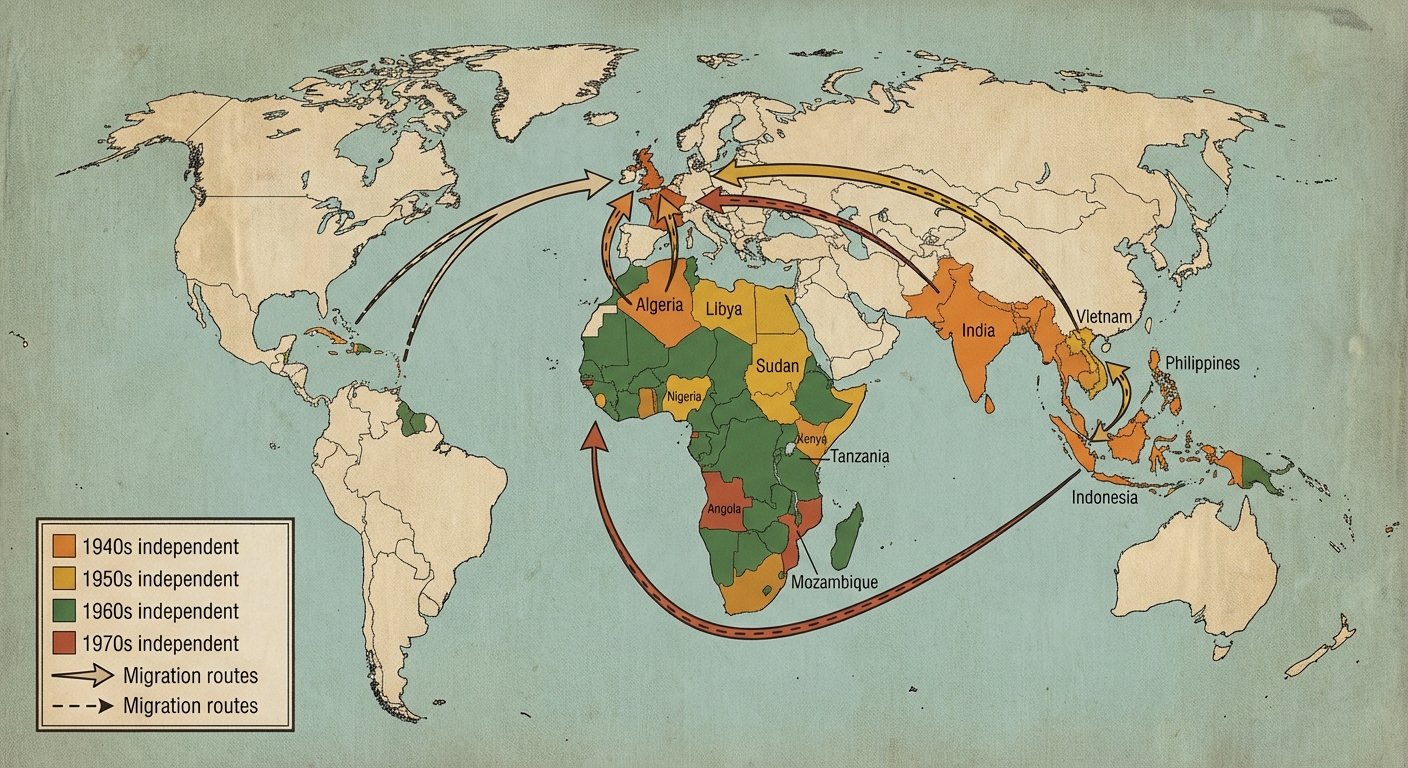
Migration to Metropoles
A major demographic trend of this era was the migration of former colonial subjects to the Metropole (the home territory of the former colonial power).
- South Asians/Indians $\rightarrow$ United Kingdom: Filled labor shortages after WWII (e.g., railways, healthcare).
- Algerians/West Africans $\rightarrow$ France: Similar labor migration, though often facing cultural segregation in suburbs ($banlieues$).
- Filipinos $\rightarrow$ United States: Continued strong ties led to migration for medical and naval work.
This migration maintained a cultural link between the colony and the colonizer, even after political ties were severed.
End of the Cold War
The Cold War (c. 1947–1991) shaped the infancy of these new nations. Its conclusion brought massive global realignment.
Causes of the Collapse
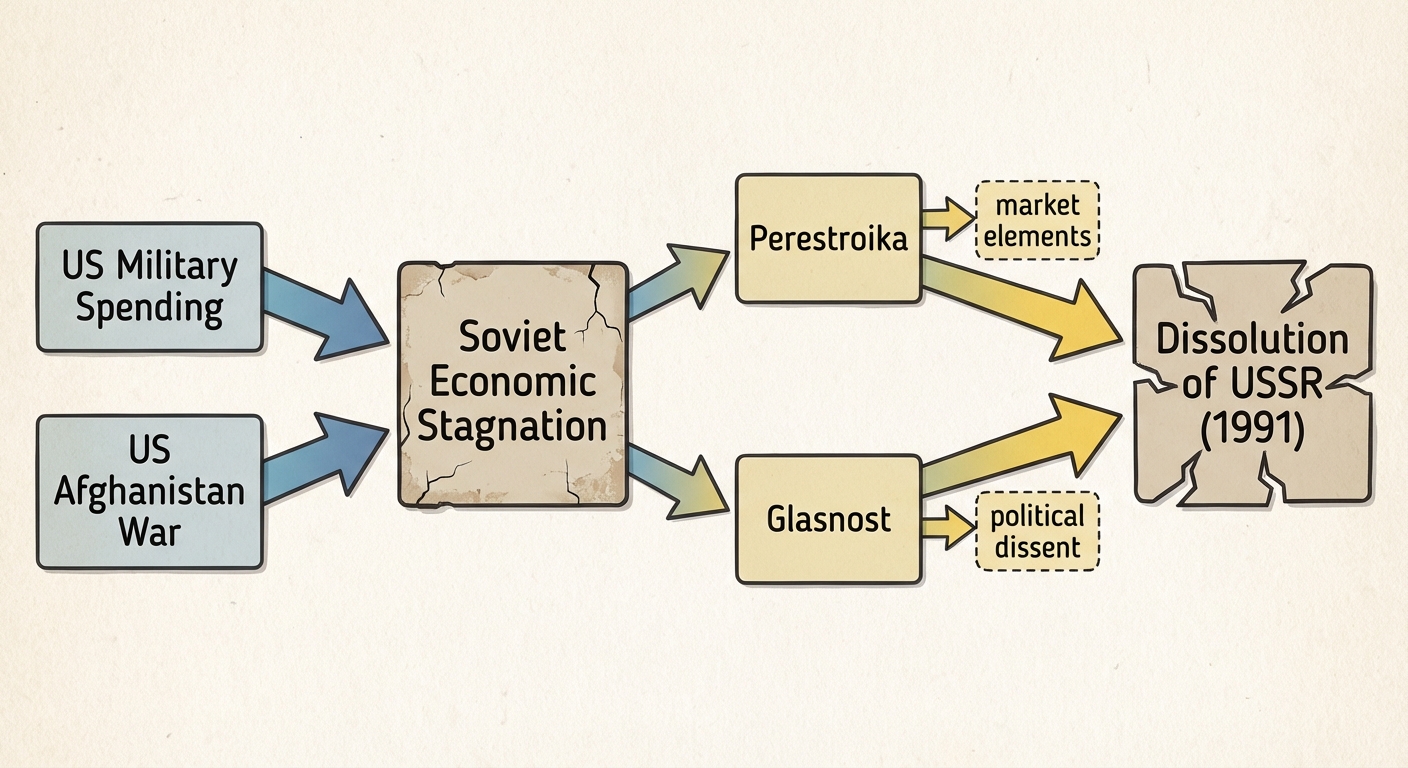
The decline of the Soviet Union was driven by a combination of US aggression, internal economic failure, and resistance in satellite states.
- Military and Technological Pressure: Under President Ronald Reagan, the US increased military spending (e.g., SDI/"Star Wars"). The Soviet economy, already stagnant, could not sustain the spending required to catch up.
- Failed Invasion of Afghanistan (1979–1989): Often called the "USSR's Vietnam." Soviet troops could not defeat the Mujahideen (supported by the US), leading to low morale and high costs.
- Gorbachev's Reforms: Soviet leader Mikhail Gorbachev (came to power in 1985) attempted to save the USSR through reforms that inadvertently hastened its fall:
- Perestroika (Restructuring): Allowed limited free-market elements and private enterprise.
- Glasnost (Openness): Allowed political freedom and criticism of the government. Once people could criticize the state, they demanded its end.
1989 and the Dissolution
In 1989, nations in Eastern Europe (Poland, East Germany, Hungary) launched protests. Utilizing Glasnost, they demanded independence. The Berlin Wall fell in November 1989.
By 1991, the Soviet Union itself dissolved into 15 independent republics (including Russia, Ukraine, and Kazakhstan). The Cold War was officially over.