Unit 6 Comprehensive Study: Accumulation and Definite Integrals
Exploring Accumulations of Change
Understanding calculus often begins with the relationship between a rate of change and the total amount of change over time. In Unit 6, we transition from differentiation (finding the rate) to integration (finding the accumulation).
The Geometric Interpretation
Visually, if you graph a rate of change function $f(t)$ (where the $y$-axis represents a rate, such as velocity or gallons per minute, and the $x$-axis represents time), the area under the curve bounded by the $x$-axis over an interval $[a, b]$ represents the total accumulated change in that quantity.
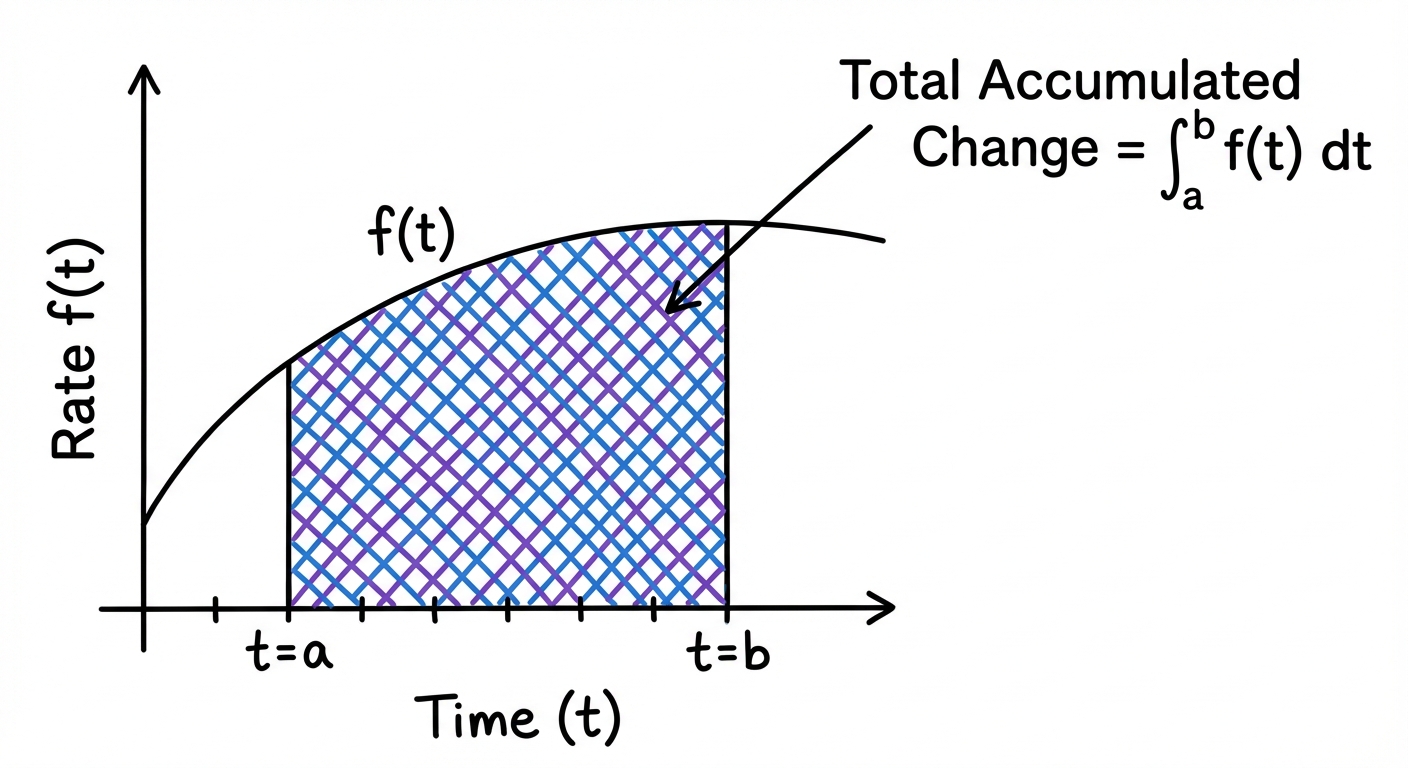
Dimensional Analysis
One of the best ways to verify you have set up an accumulation problem correctly is by checking the units.
- If the $y$-axis is $f(x)$ with units U.
- And the $x$-axis is $x$ with units V.
- The area is a product of width and height: $Area ≈ height \times width = U \times V$.
Example:
If $v(t)$ is the velocity of a particle in meters per second ($m/s$) and $t$ is time in seconds ($s$), the area under the graph represents:
If the function $f(t)$ is positive, the accumulation is positive. If $f(t)$ is negative (below the $x$-axis), the accumulation is considered negative.
Approximating Areas with Riemann Sums
Before we can calculate exact areas using integrals, we must understand how to approximate them using geometry. This process forms the foundation of the Definite Integral. A Riemann Sum approximates the area under a curve by slicing the region into shapes (usually rectangles or trapezoids) with widths of $\Delta x$ and summing their areas.
Types of Riemann Sums
There are four primary methods tested on the AP exam. For a function $f(x)$ on interval $[a, b]$ divided into $n$ subintervals:
- Left Riemann Sum (LRAM): The height of the rectangle is determined by the function value at the left endpoint of the subinterval.
- Right Riemann Sum (RRAM): The height is determined by the function value at the right endpoint.
- Midpoint Riemann Sum (MRAM): The height is determined by the function value at the midpoint of the subinterval.
- Trapezoidal Sum: Uses trapezoids instead of rectangles to better fit the slant of the curve. The area of a trapezoid is $\frac{1}{2}\Delta x(h1 + h2)$.
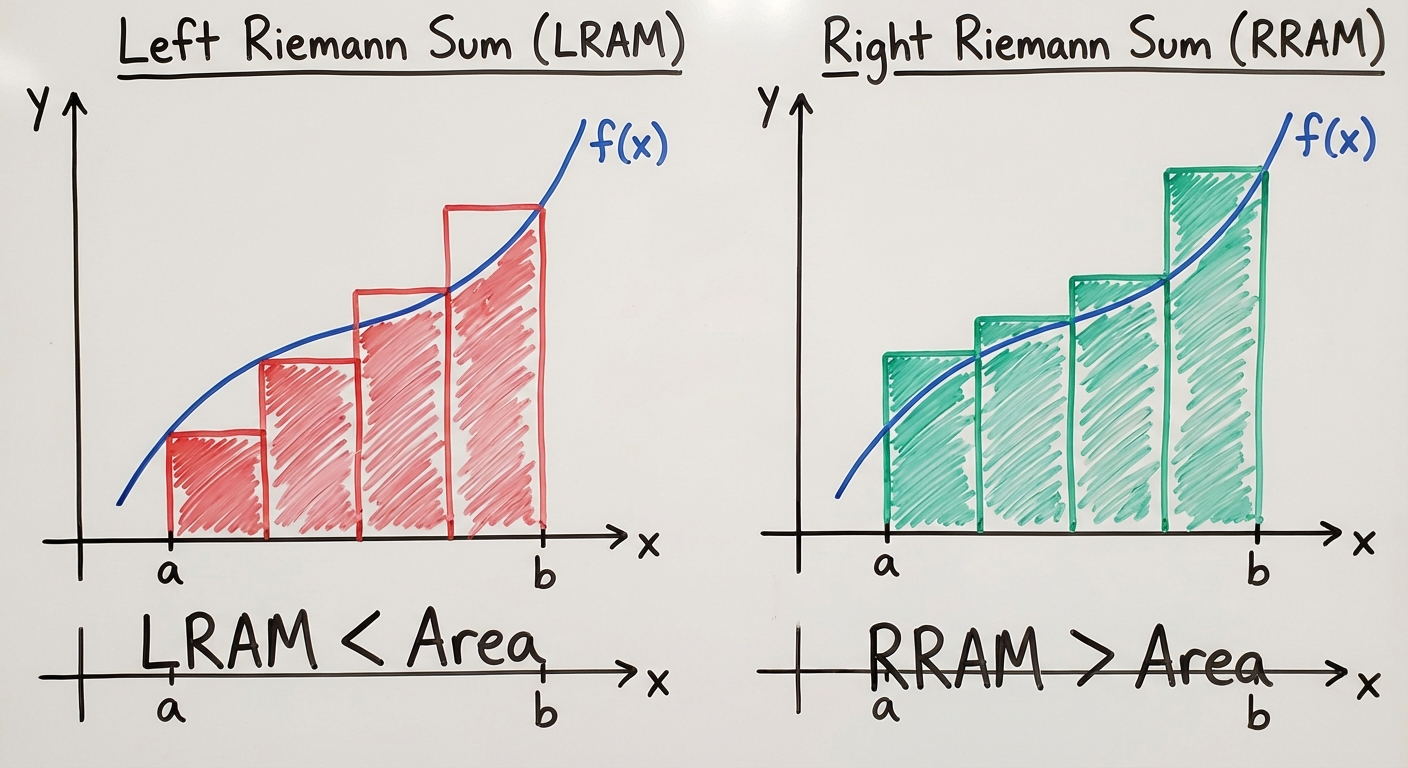
Calculating Approximations
Example Scenario:
Estimate the area under $f(x) = x^2$ on $[0, 4]$ using 4 equal subintervals.
- Width of each interval ($ \Delta x$) = $\frac{4-0}{4} = 1$.
- Intervals: $[0,1], [1,2], [2,3], [3,4]$.
| Method | Formula | Calculation | Result |
|---|---|---|---|
| LRAM | $\Delta x [f(0) + f(1) + f(2) + f(3)]$ | $1[0 + 1 + 4 + 9]$ | 14 |
| RRAM | $\Delta x [f(1) + f(2) + f(3) + f(4)]$ | $1[1 + 4 + 9 + 16]$ | 30 |
| Trapezoid | $\frac{\Delta x}{2} [f(0) + 2f(1) + 2f(2) + 2f(3) + f(4)]$ | $\frac{1}{2}[0 + 2(1) + 2(4) + 2(9) + 16]$ | 22 |
Overestimation vs. Underestimation Rules
One of the most frequent AP questions asks if a sum is an over- or under-approximation. This depends on the behavior of the graph.
For Rectangles (LRAM/RRAM): Look at whether $f(x)$ is Increasing or Decreasing.
- If $f(x)$ is Increasing: LRAM = Under, RRAM = Over.
- If $f(x)$ is Decreasing: LRAM = Over, RRAM = Under.
For Trapezoids: Look at Concavity ($f''(x)$).
- If $f(x)$ is Concave Up: Trapezoids lie above the curve $\rightarrow$ Overestimate.
- If $f(x)$ is Concave Down: Trapezoids lie below the curve $\rightarrow$ Underestimate.
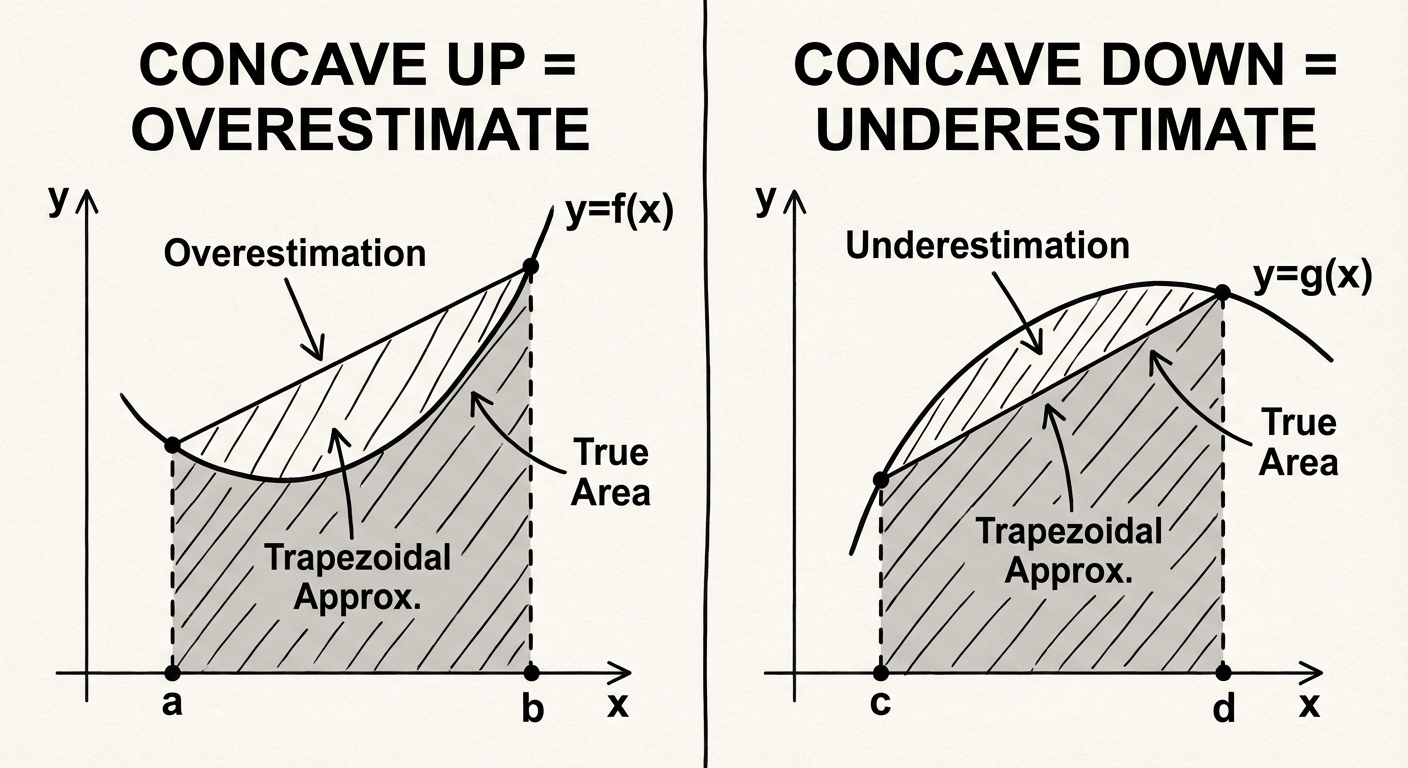
Riemann Sums, Summation Notation, and Definite Integral Notation
This topic bridges the gap between the approximation (Riemann Sum) and the exact value (Definite Integral). This is often tested visually or by asking you to convert a complex summation into integral notion.
The Limit Definition of the Definite Integral
As the number of rectangles ($n$) approaches infinity, the width of each rectangle ($\Delta x$) approaches zero, and the approximation becomes the exact area.
Where:
- $\int_a^b$ is the integral sign with limits from $a$ to $b$.
- $\Sigma$ represents the Riemann Sum.
- $f(c_k)$ represents the height of the $k$-th rectangle.
- $\Delta x$ represents the width of the rectangles.
Translating Between Sums and Integrals
To convert a limit of a sum into an integral, identify the components using the formulas below. The standard Right Riemann Sum definition is:
Component Matching Table:
| Concept | Integral Notation | Summation Notation |
|---|---|---|
| Width | $dx$ | $\Delta x = \frac{b-a}{n}$ |
| Sample Point ($x$-value) | $x$ | $x_k = a + k\Delta x$ |
| Lower Limit | $a$ | Constant added inside $f( )$ |
| Upper Limit | $b$ | $a + (\text{numerator of } \Delta x)$ |
Worked Example:
Convert the following limit to a definite integral:
Step 1: Identify $\Delta x$.
The term outside the function (and multiplied by $k$ inside) is $\frac{5}{n}$.
So, width $= 5$, meaning $b - a = 5$.
Step 2: Identify $a$.
The constant added to the variable term inside the function is $3$. So, $a = 3$.
Step 3: Find $b$.
Since $b - a = 5$ and $a = 3$, then $b - 3 = 5$, so $b = 8$.
Step 4: Identify the function $f(x)$.
The structure is $\sqrt{\text{input}}$. So $f(x) = \sqrt{x}$.
Result:
Common Mistakes and Pitfalls
- Assuming Uniform Widths: In tabular problems (data tables), $\Delta x$ is often not constant. You cannot factor out a single $\Delta x$. You must calculate the area of each rectangle/trapezoid individually: $A = (x2-x1)h1 + (x3-x2)h2 + \dots$
- Confusing Concavity and Slope: When determining error for Trapezoidal sums, students often look at whether the graph is increasing/decreasing. This is incorrect; you must look at concavity (Second Derivative). Slope matters for rectangles; concavity matters for trapezoids.
- The $n$ vs $k$ confusion: In summation notation, $n$ is the total number of rectangles (goes to infinity), while $k$ (or $i$) is the counter. Don't mix them up when identifying the variable $x$.
- Forgetting the Limits: When converting from summation to integral, remember that the function $f(a + k\Delta x)$ inside the sum becomes just $f(x)$ in the integral, but the information about $a$ moves to the integral bounds.