Economic Transformation of the Gilded Age (1865–1898)
The Engines of Growth: Railroads and Technology
The Gilded Age—a term coined by Mark Twain—suggests a period that was glittering on the surface but often corrupt or decaying underneath. Economically, however, it was an era of unprecedented expansion, driven largely by the completion of a national transportation network and technological innovation.
The Transcontinental Railroads
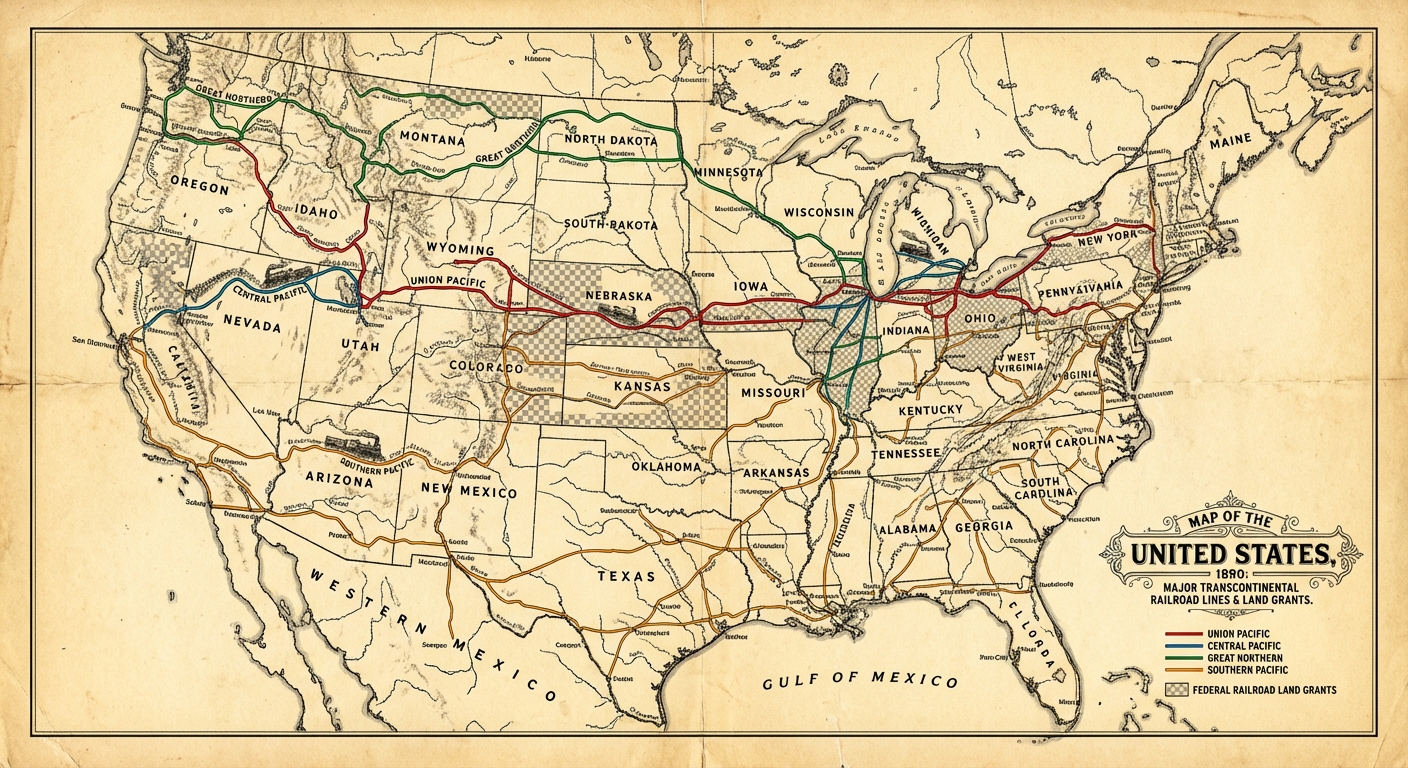
Before the Civil War, markets were regional. After the war, the railroad turned the United States into a massive, integrated national market. This allowed for mass production and mass consumption.
- The Pacific Railway Act (1862): The federal government provided massive subsidies in the form of loans and land grants to companies (like the Union Pacific and Central Pacific) to build the transcontinental railroad.
- Economic Impact:
- Opened the West to settlement and mining.
- Stimulated the steel and coal industries.
- Standardized time: The creation of four standard time zones in 1883 was necessary to manage train schedules.
Technological Innovations
Rapid industrialization was fueled by a surge in patents and new technologies that increased efficiency and productivity.
- The Bessemer Process: A method for blowing air through molten iron to burn off impurities. It transformed steel production from a slow, expensive luxury into a cheap, mass-produced commodity. Steel enabled skyscrapers, heavier machinery, and stronger rails.
- Communication & Power:
- Alexander Graham Bell (1876): Invented the telephone, revolutionizing business communication.
- Thomas Edison: Established the first modern research lab at Menlo Park. His perfection of the incandescent light bulb and electrical power distribution allowed factories to operate 24 hours a day, regardless of sunlight.
In economic terms, technology increased the efficiency of labor:
As technology ($T$) improved, the Output grew significantly without a proportional increase in Input costs, driving profits up.
The Rise of Industrial Capitalism
This era saw the shift from small-scale manufacturing to massive corporations. Business leaders utilized new organizational strategies and ideologies to consolidate power and eliminate competition.
Corporate Consolidation Strategies
Entrepreneurs like Andrew Carnegie (Steel), John D. Rockefeller (Oil), and J.P. Morgan (Banking) dominated their industries. They were viewed dualistically:
- Captains of Industry: Innovators who built the economy, provided jobs, and lowered prices.
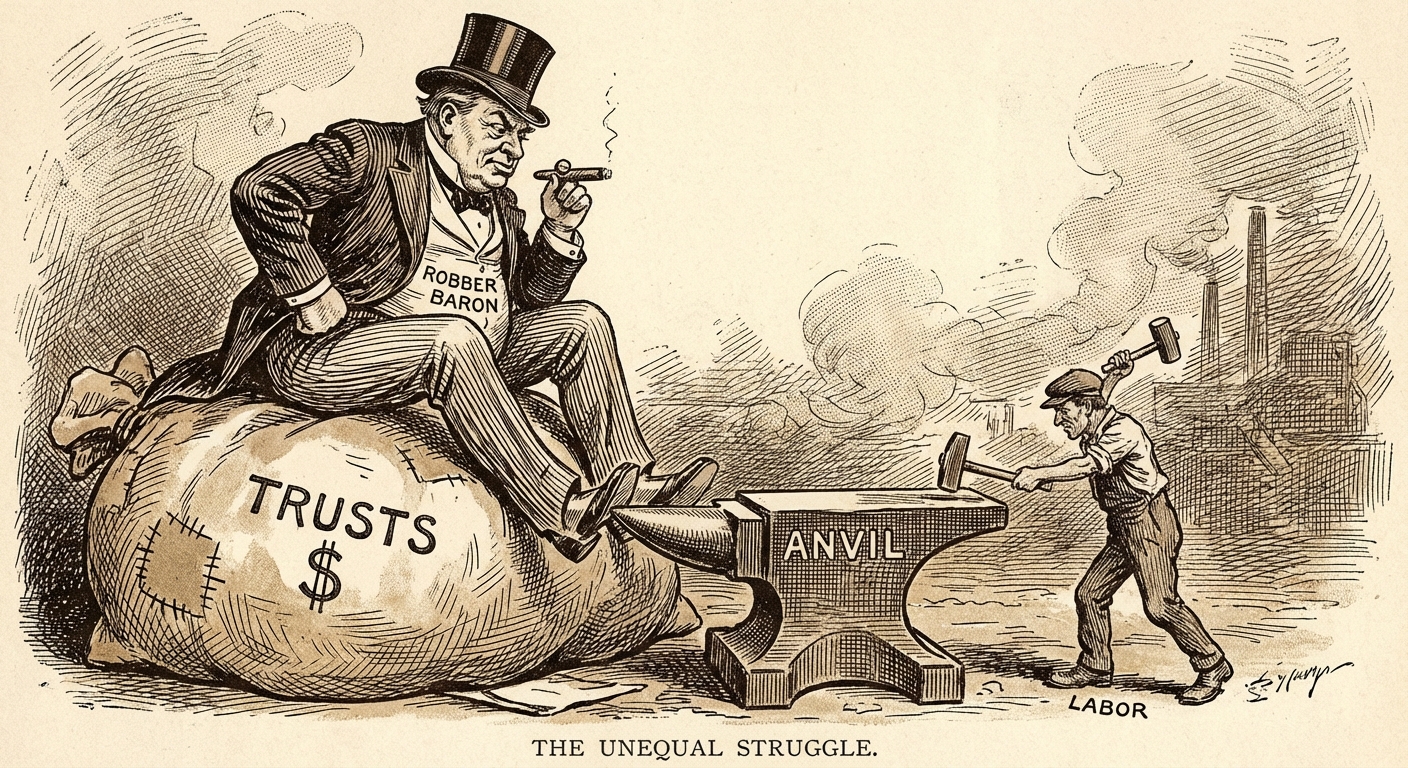
- Robber Barons: Greedy tycoons who exploited workers, corrupted politicians, and stifled competition.
To maximize profits, these leaders used two primary structures:
| Strategy | Definition | Primary Example | Key Concept |
|---|---|---|---|
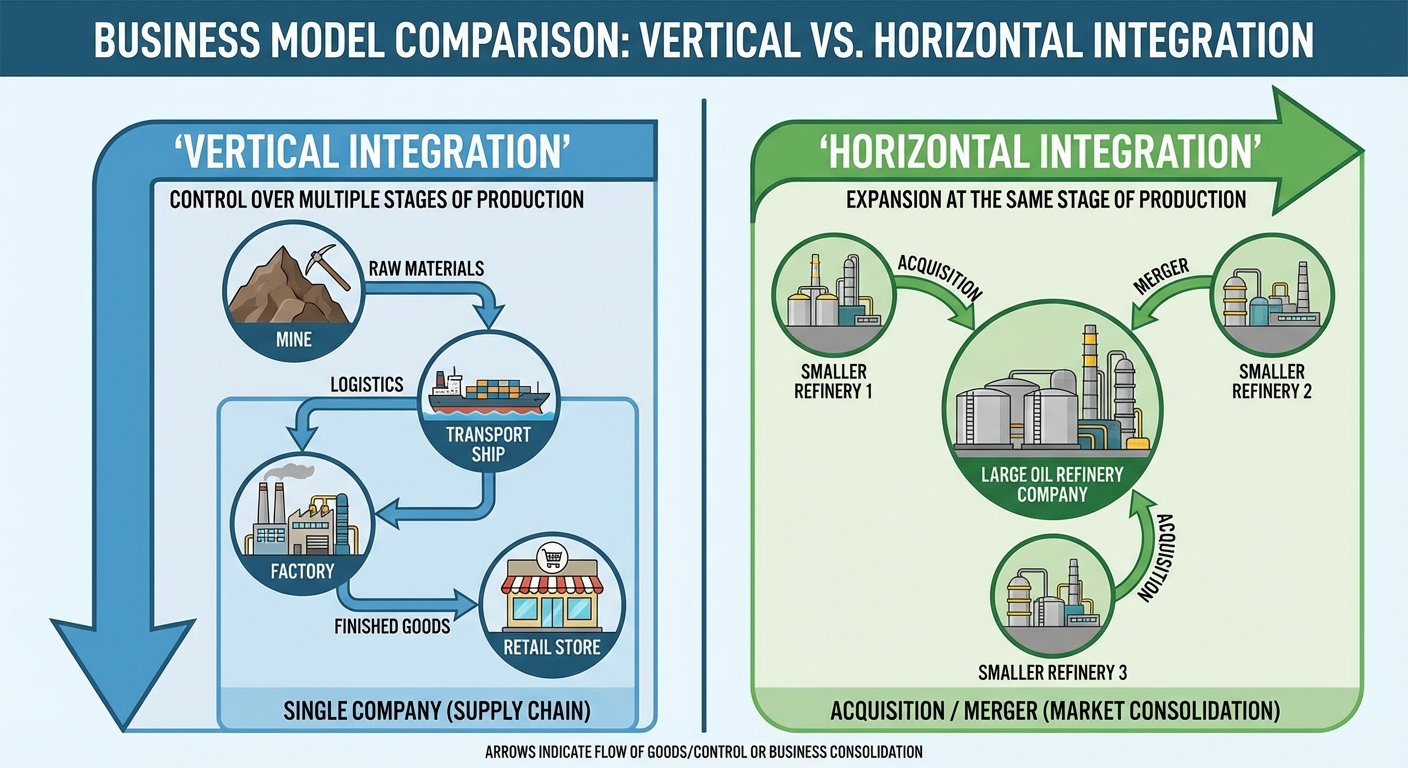
| Vertical Integration | Controlling every stage of the production process, from raw materials to distribution. | Andrew Carnegie (Carnegie Steel) owned the mines, the ships, the railroads, and the mills. | elimination of middle-men costs |
| Horizontal Integration | Merging with or acquiring competitors in the same industry to create a monopoly. | John D. Rockefeller (Standard Oil) bought out rival oil refineries. | elimination of competition |
The Trust and The Holding Company
- Trusts: Stockholders in various smaller oil companies assigned their stock to a board of trustees in Standard Oil. This centralized control without technically "owning" the companies, bypassing early anti-monopoly laws.
- Holding Companies: A company created to buy and possess the shares of other companies, which it then controls.
Economic Ideologies of the Elite
Wealthy industrialists justified their success and the wealth gap using specific intellectual frameworks:
Laissez-Faire Capitalism: The belief that government should not interfere in the economy ("hands-off"). Prices and wages should be determined by the "invisible hand" of the market supply and demand.
- Note: While businesses liked laissez-faire regarding regulation/taxes, they paradoxically loved government intervention when it came to tariffs (protection from foreign competition) and subsidies.
Social Darwinism: Adapted from biologial theory by thinkers like Herbert Spencer and William Graham Sumner. They argued that "survival of the fittest" applied to business. Wealth was a sign of God's favor or superior ability; poverty was a sign of personal failure or inferiority. Therefore, helping the poor would interfere with nature.
The Gospel of Wealth: Articulated by Andrew Carnegie in his essay Wealth. He argued that the wealthy had a God-given responsibility to carry out philanthropy—giving money away to build libraries, universities, and concert halls (not direct charity to the poor) to improve society.
Labor in the Gilded Age
While industrialization lowered prices for goods, it often came at a high cost to workers. The standard of living generally rose, but the gap between the rich and poor widened drastically.
Conditions of the Working Class
- Wages: Real wages rose, but income inequality was stark. Many families relied on two incomes.
- Hours: Average work week was 60 hours (10 hours/day, 6 days/week).
- Safety: The U.S. had one of the highest industrial accident rates in the world due to a lack of safety regulations.
- Child Labor: Widespread in textile mills and coal mines to support family income.
The Rise of Labor Unions
Labor organized to demand better conditions, higher wages, and an 8-hour workday. However, they faced hostility from employers and the government.
1. The Knights of Labor (est. 1869)
- Leader: Terence Powderly.
- Membership: Open to all workers (skilled and unskilled, women, and African Americans). Included idealistic reform goals (abolition of child labor, trusts).
- Downfall: rapid decline after the Haymarket Square Riot (1886). An anarchist threw a bomb during a labor protest in Chicago; the public unfairly associated the violence with the Knights of Labor.
2. The American Federation of Labor (AFL) (est. 1886)
- Leader: Samuel Gompers.
- Membership: An association of skilled craft unions (cigar makers, carpenters). Generally excluded women and unskilled laborers.
- Philosophy: "Bread and Butter" unionism. They avoided broad social reform and focused strictly on higher wages, shorter hours, and better conditions.
- Success: Because skilled workers were harder to replace than unskilled ones, the AFL was more successful and survived longer.
Major Labor Strikes
Strikes were the primary weapon of unions, but the government usually sided with business owners, using court injunctions or federal troops to break them.
- Great Railroad Strike of 1877: Triggered by wage cuts. President Hayes sent federal troops to end the strike, setting a precedent that the government would use force to protect business interests.
- Homestead Strike (1892): At Carnegie's steel plant. Pinkerton detectives fought workers; the union was crushed, ending unionization in the steel industry for decades.
- Pullman Strike (1894): Led by Eugene V. Debs and the American Railway Union. Stopped rail traffic. President Cleveland sent troops, arguing the strike interfered with the delivery of the U.S. Mail. Debs was jailed.
Common Mistakes & Pitfalls
- Sherman Antitrust Act Confusion: Students often think this act (1890) immediately broke up monopolies. Correction: The wording was vague ("restraint of trade"). In the 1890s, the courts actually used it against labor unions, arguing that strikes restrained trade. It wasn't used effectively against trusts until Theodore Roosevelt (Progressive Era).
- Populists vs. Unions: Do not confuse the Populist Party (farmers/grange movement) with industrial Labor Unions. While they shared some enemies (railroads, banks), they were distinct groups with different bases (agrarian vs. urban).
- Government Role: A common misconception is that the government was purely "hands-off" (laissez-faire). Correction: The government was hands-off regarding regulation, but very "hands-on" in providing land grants, tariffs, and military support to break strikes.
- "New South" Reality: Students often assume the South industrialized at the same pace as the North. Correction: While there was some growth (textiles, Birmingham steel), the South remained largely agricultural and poor under the sharecropping system.