Comprehensive Guide to AP Biology Unit 5: Heredity
Unit 5: Heredity
5.1 & 5.2 Meiosis and Genetic Diversity
Definitions & Concepts
Meiosis is a specialized form of cell division that produces gametes (sex cells: sperm and egg) with half the number of chromosomes as the parent cell. This reduction is vital for sexual reproduction to ensure the chromosome number usually remains constant across generations.
- Diploid ($2n$): A cell containing two full sets of chromosomes (one set from each parent). Somatic (body) cells are diploid.
- Haploid ($n$): A cell containing only one set of chromosomes. Gametes are haploid.
- Homologous Chromosomes: A pair of chromosomes (one maternal, one paternal) that are similar in size, shape, and genetic content. They carry genes for the same traits at the same loci (positions), though the specific alleles may differ.
- Sister Chromatids: Identical copies of a chromosome connected by a centromere (formed during S-phase of Interphase).
Phases of Meiosis
Meiosis involves two sequential rounds of division: Meiosis I (reductional division) and Meiosis II (equational division).
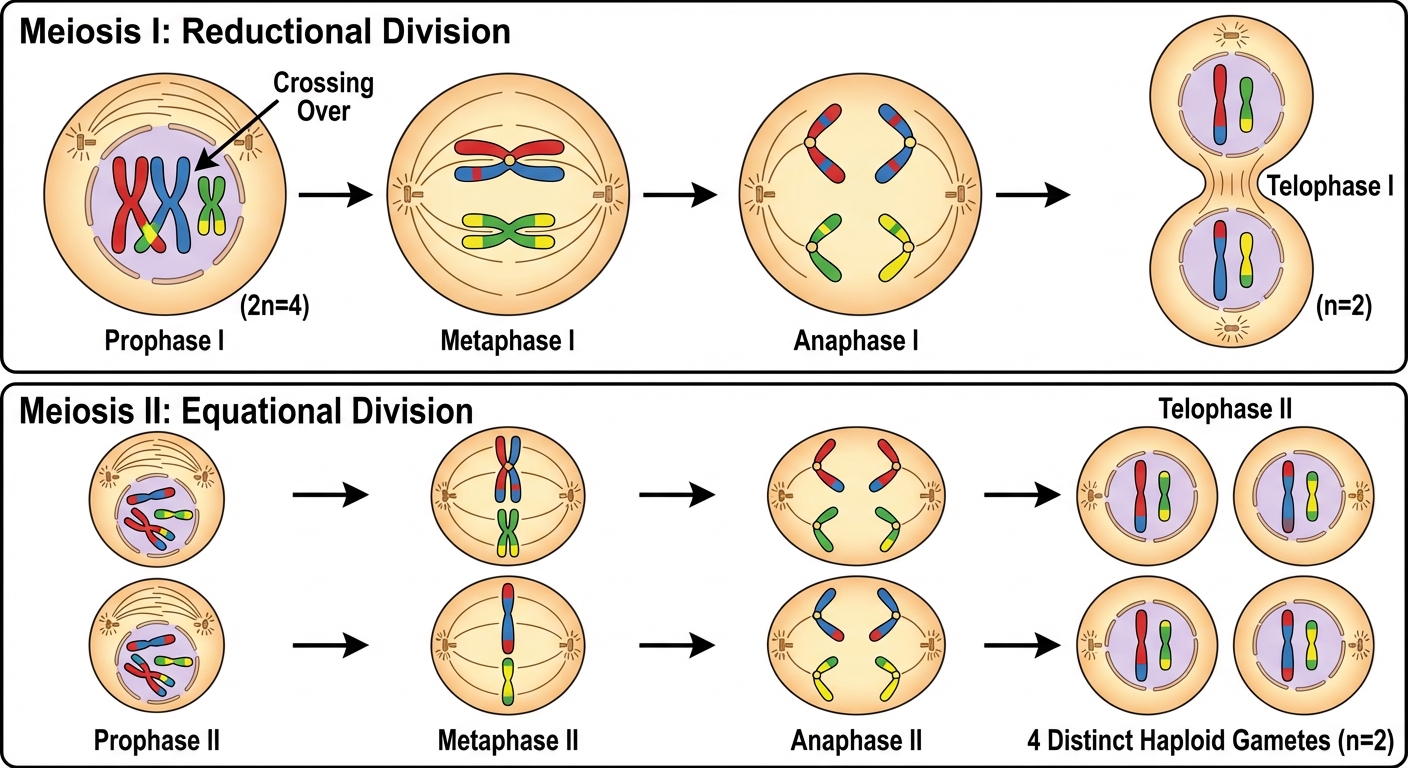
Meiosis I: Separating Homologous Chromosomes
- Prophase I (Crucial Step):
- Chromosomes condense.
- Synapsis: Homologous chromosomes pair up to form tetrads (groups of four chromatids).
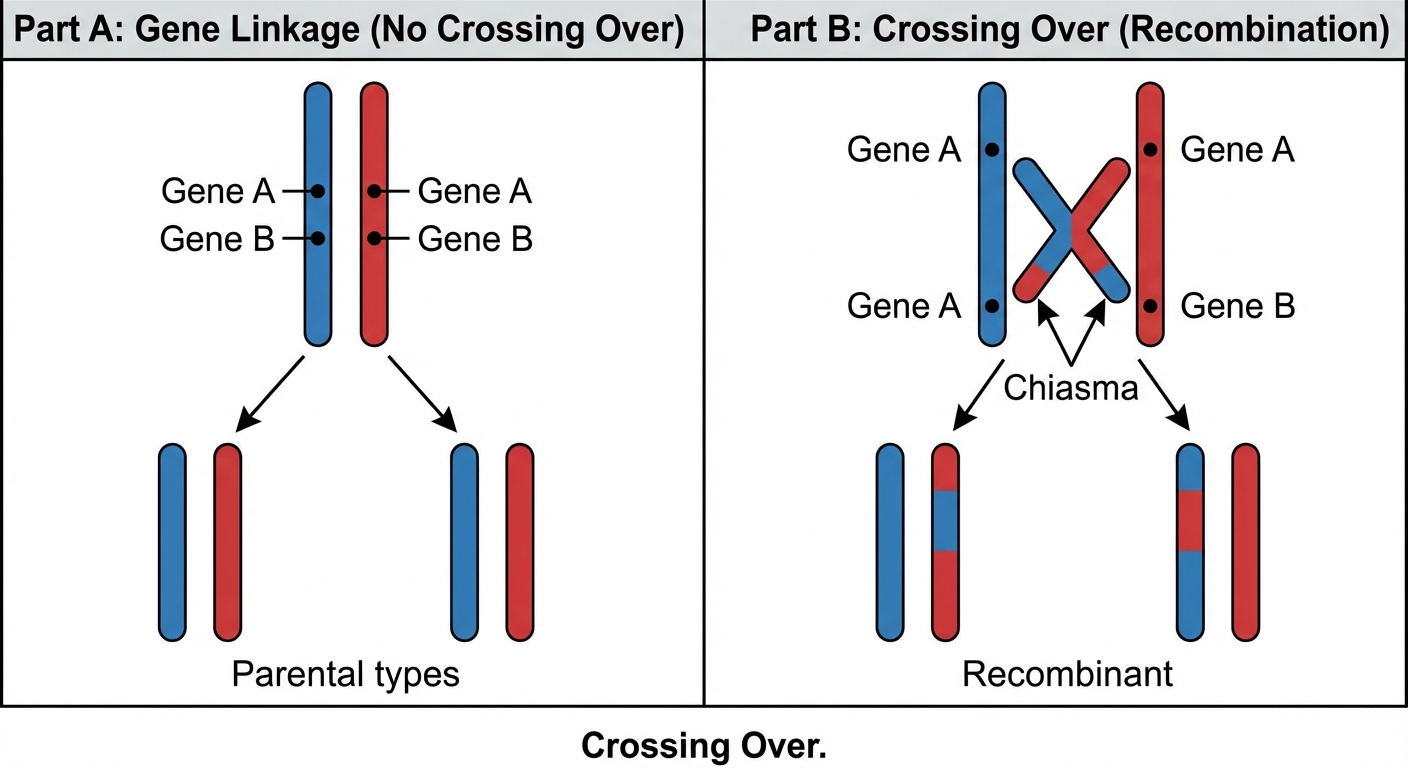
- Crossing Over: Non-sister chromatids exchange genetic material at points called chiasmata. This creates recombinant chromosomes, mixing maternal and paternal DNA.
- Metaphase I:
- Tetrads align at the metaphase plate.
- Independent Assortment: The orientation of homologous pairs is random (maternal or paternal can be on either side).
- Anaphase I:
- Homologous pairs separate and move to opposite poles.
- Note: Sister chromatids remain attached at the centromere.
- Telophase I & Cytokinesis:
- Two haploid daughter cells form. Each chromosome still consists of two sister chromatids.
Meiosis II: Separating Sister Chromatids
Similar to Mitosis, but starting with haploid cells.
- Prophase II: Spindle apparatus reforms.
- Metaphase II: Chromosomes align single-file at the plate.
- Anaphase II: Centromeres split; sister chromatids separate.
- Telophase II & Cytokinesis: Nuclei reform, resulting in four genetically unique haploid cells.
Sources of Genetic Variation
Evolution relies on genetic variation. Meiosis and sexual reproduction introduce variation via three mechanisms:
- Crossing Over (Prophase I): Produces recombinant chromosomes, combining DNA from both parents into a single chromosome.
- Independent Assortment (Metaphase I): The random alignment of homologous pairs allows for $2^n$ possible combinations of chromosomes in gametes (In humans: $2^{23} \approx 8.4$ million combinations).
- Random Fertilization: Any sperm can fuse with any egg, effectively squaring the number of possible outcomes.
Common Mistakes
- Sister Chromatids vs. Homologous Pairs: Students often confuse these. Homologues separate in Meiosis I; Sister Chromatids separate in Meiosis II (and Mitosis).
- Interphase II: DNA is NOT replicated between Meiosis I and II. If it were, the cell would not achieve the haploid state.
5.3 Mendelian Genetics
Key Terminology
- Allele: Alternative versions of a gene (e.g., Purple $P$ vs. White $p$).
- Genotype: The genetic makeup (e.g., $PP$, $Pp$, $pp$).
- Phenotype: The observable physical trait (e.g., Purple flowers).
- Dominant: An allele that is fully expressed in the phenotype of a heterozygote.
- Recessive: An allele whose phenotypic effect is not observed in a heterozygote.
Mendel's Laws
1. Law of Dominance
In a heterozygote, the dominant allele will mask the recessive allele. The recessive trait only appears if the organism is homozygous recessive.
2. Law of Segregation
During gamete formation, the two alleles for a heritable character separate (segregate) so that each gamete gets only one. This corresponds to the separation of homologous chromosomes in Anaphase I.
3. Law of Independent Assortment
Genes for distinct traits can segregate independently during the formation of gametes. This applies only to genes on different chromosomes (or far apart on the same one). This corresponds to Metaphase I alignment.
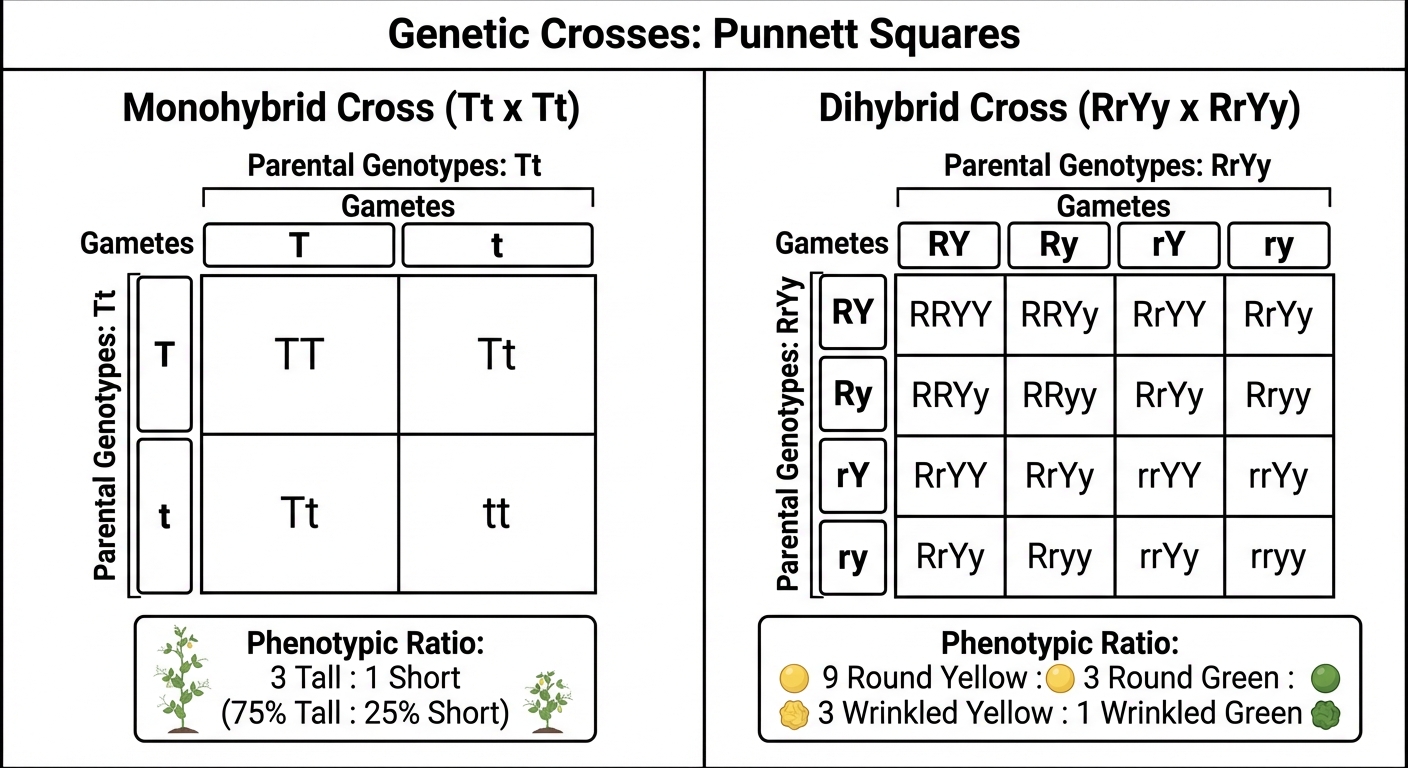
Probability Rules
To solve genetics problems without drawing massive Punnett squares, use probability rules.
Multiplication Rule (Product Rule): The probability that two independent events will occur together (Event A AND Event B).
Example: Probability of genotype pp in a cross of Pp x Pp is $1/2 \times 1/2 = 1/4$.Addition Rule (Sum Rule): The probability that any one of two or more mutually exclusive events will occur (Event A OR Event B).
Example: Probability of a dominant phenotype (PP or Pp) in a cross of Pp x Pp is $1/4 (PP) + 1/4 (Pp) + 1/4 (pP) = 3/4$.
Chi-Square Goodness of Fit Test
In AP Biology, you must use the Chi-Square test to determine if your data matches phenotypic predictions (Mendelian ratios) or if the variance is due to other factors (linkage, environmental influence).
Formula:
- $o$: Observed frequency
- $e$: Expected frequency (based on a Punnett square/null hypothesis)
- Degrees of Freedom (df): Number of phenotypic categories minus 1 ($n - 1$).
- Null Hypothesis ($H_0$): There is no statistically significant difference between observed and expected frequencies (any difference is due to chance).
- Critical Value: Use the $p = 0.05$ column on the reference table. If $\chi^2 > \text{Critical Value}$, reject the null hypothesis (something else is happening!).
5.4 Non-Mendelian Genetics
Mendelian rules are the baseline, but nature often deviates from simple dominance.
Gene Linkage
Genes located near each other on the same chromosome tend to be inherited together. This violates the Law of Independent Assortment.
- Parental Types: Offspring with phenotypes matching one of the parents.
- Recombinants: Offspring with non-parental phenotypes (result of crossing over).
Recombination Frequency (RF):
- Map Units: 1% Recombination Frequency = 1 Map Unit (Centimorgan). This allows us to map the relative distance of genes on a chromosome.
- Rule of Thumb: If RF > 50%, the genes behave as if they are on different chromosomes (unlinked).
Sex-Linked Traits
Traits carried on sex chromosomes (X or Y). Most are X-linked.
- Males (XY): Hemizygous. They express whatever allele is on their single X chromosome, making them much more susceptible to X-linked recessive disorders (e.g., Hemophilia, Color Blindness, Duchenne Muscular Dystrophy).
- Females (XX): Must inherit two recessive alleles to express the disorder. Heterozygous females are carriers.
Barr Bodies: In female mammals, one X chromosome is randomly inactivated in each somatic cell during development. This condenses into a Barr body. This creates a mosaic effect (e.g., Calico cats).
Other Inheritance Patterns
| Pattern | Definition | Key Example | Resulting Ratio (F2 Heterozygote cross) |
|---|---|---|---|
| Incomplete Dominance | Heterozygotes show a blend of the two alleles. | Red x White snapdragons = Pink | 1 Red : 2 Pink : 1 White |
| Codominance | Heterozygotes express both alleles simultaneously and separately. | AB Blood Type (Both A and B antigens present). | 1 Type A : 2 Type AB : 1 Type B |
| Multiple Alleles | More than two allele options exist for a gene. | ABO Blood Group ($I^A, I^B, i$). | Varies |
| Polygenic Inheritance | A single trait is controlled by two or more genes (additive effect) | Human height, skin color. | Bell Curve (Continuum) |
Non-Nuclear Inheritance
- Mitochondria and Chloroplasts contain their own DNA.
- These traits are randomly assorted to daughter cells but are inherited maternally (from the egg/ovule) in animals and plants. Sperm/pollen contributes almost no cytoplasm.
- Example: Mitochondrial myopathy or variegated leaves in plants.
5.5 Environmental Effects on Phenotype
Genotype + Environment = Phenotype. Genes provide the potential, but the environment determines expression.
Phenotypic Plasticity
The ability of one genotype to produce more than one phenotype when exposed to different environments.
- Example 1: Hydrangeas. Flower color changes based on soil pH (Blue in acidic soil, Pink in basic soil).
- Example 2: Himalayan Rabbits. Fur color depends on temperature. Cold areas (ears, feet) grow black fur; warm body areas grow white fur.
5.6 Chromosomal Inheritance & Pedigrees
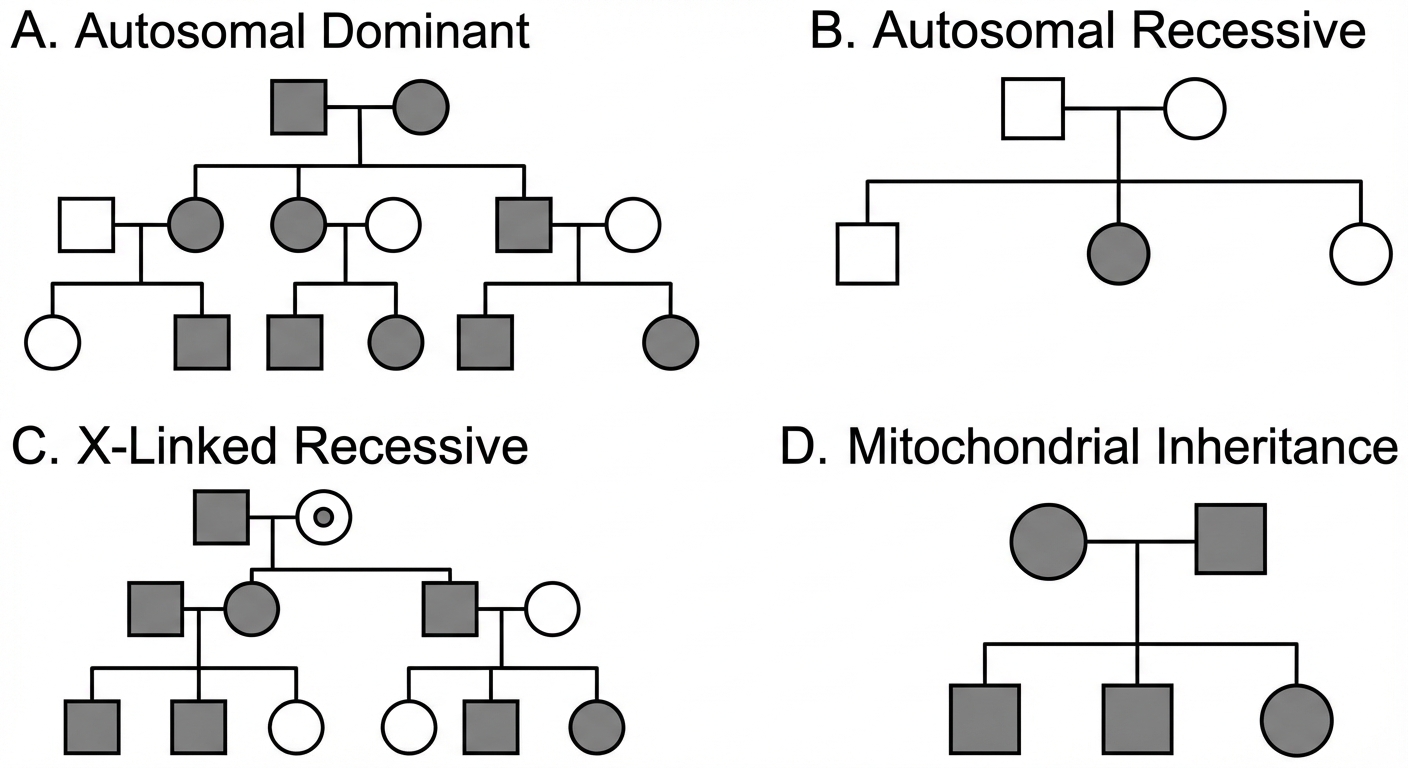
Pedigree Analysis
A visual chart tracking a trait through generations.
- Autosomal Dominant: Does not skip generations. Affected parents can have unaffected children.
- Autosomal Recessive: often skips generations. Unaffected parents (carriers) can have affected children.
- X-Linked Recessive: More males affected. Mothers pass to sons. Affected daughters must have affected fathers.
- Mitochondrial: Passed from mother to ALL offspring.
Chromosomal Abnormalities
Errors in Meiosis can lead to Aneuploidy (incorrect chromosome number).
- Nondisjunction: The failure of homologous chromosomes (Anaphase I) or sister chromatids (Anaphase II) to separate properly.
- Trisomy: Three copies of a chromosome ($2n + 1$).
- Down Syndrome: Trisomy 21.
- Monosomy: One copy of a chromosome ($2n - 1$).
- Turner Syndrome: Female with only one X chromosome (XO).
Common Mistakes in Unit 5
- Dominant $\neq$ Common: Students assume dominant traits are always the most common. This is false (e.g., Polydactyly is dominant but rare).
- Gametes in Punnett Squares: When setting up a square for genotype $AaBb$, gametes are $AB, Ab, aB, ab$. Do NOT write $Aa$ on one side and $Bb$ on the other.
- Chi-Square Conclusion: Never say the data "proves" the hypothesis. Say the data "fails to reject" the null hypothesis.
- Linked Genes: A recombination frequency of 50% is indistinguishable from independent assortment. Mapping only works well below 50%.