Unit 5: Angular Momentum & Conservation Laws
Angular Momentum of Particles and Systems
Angular momentum is one of the most fundamental quantities in physics. Just as linear momentum ($p$) quantifies the "oomph" of an object moving in a straight line, Angular Momentum ($L$) quantifies the intensity of rotational motion. It is a conserved vector quantity, making it a powerful tool for solving complex mechanics problems where Newton's laws would be difficult to apply directly.
defining Angular Momentum for a Point Particle
Many students mistakenly believe that an object must be spinning (like a top) to have angular momentum. However, a point particle moving in a straight line possesses angular momentum relative to a specific origin or pivot point.
The angular momentum $\vec{L}$ of a single particle is defined by the cross product of its position vector relative to the origin ($\vec{r}$) and its linear momentum vector ($\vec{p}$).
Since $\vec{p} = m\vec{v}$, this can be written as:
Magnitude and Direction
To find the magnitude of the angular momentum, we use the property of the cross product:
Where:
- $m$ is the mass of the particle.
- $v$ is the speed of the particle.
- $r$ is the distance from the chosen origin to the particle.
- $\theta$ is the angle between the position vector $\vec{r}$ and velocity vector $\vec{v}$ (when placed tail-to-tail).
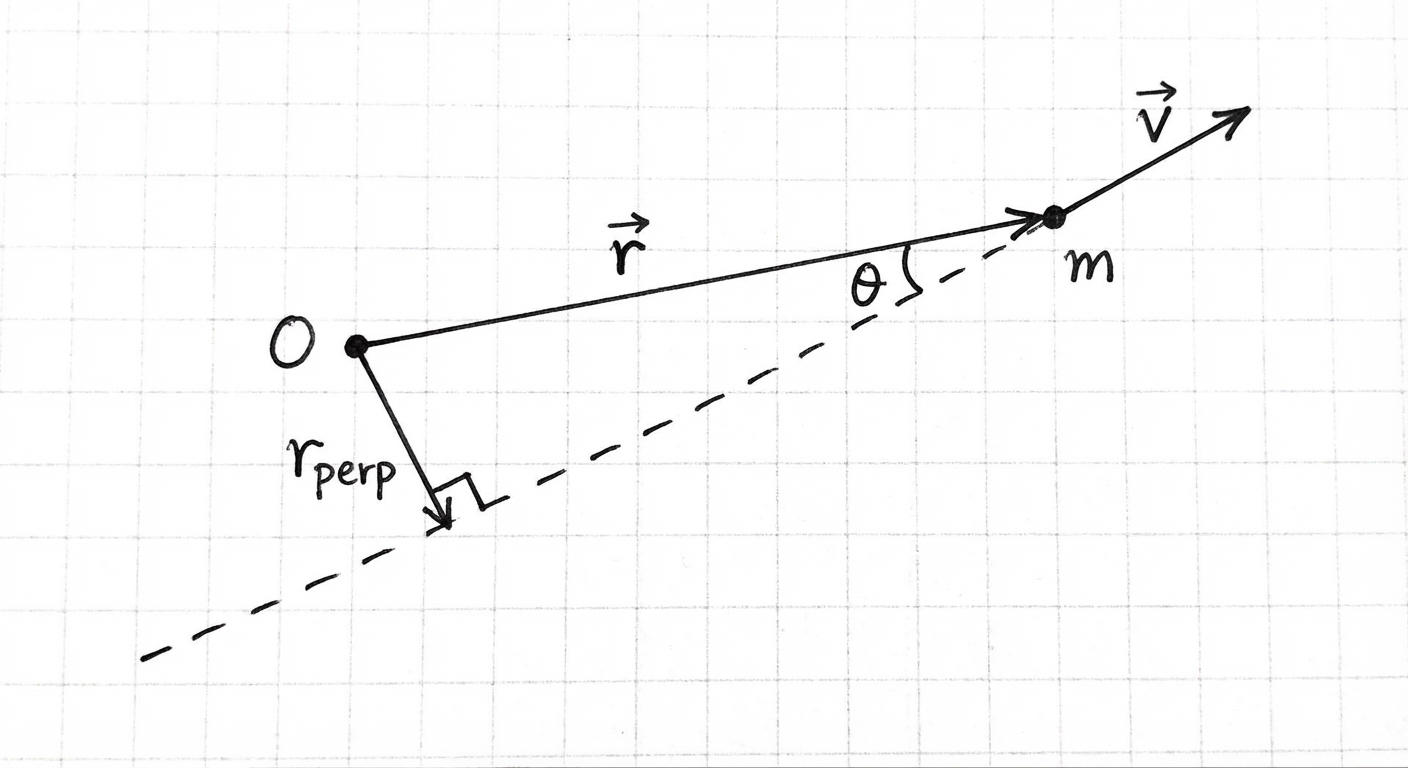
Alternatively, you can think of this using the lever arm ($r_{\perp}$) concept, similar to torque:
The Right-Hand Rule:
To determine the direction of $\vec{L}$:
- Point your fingers in the direction of $\vec{r}$.
- Curl them toward the direction of $\vec{v}$.
- Your thumb points in the direction of $\vec{L}$ (usually along the z-axis, into or out of the page).
Angular Momentum of a Rigid Body
For a system of many particles forming a rigid object rotating about a fixed axis (like a wheel or a sphere), we sum the angular momenta of all individual particles. This simplifies to a scalar equation involving the Moment of Inertia ($I$) and Angular Velocity ($\omega$).
Note that the direction of $\vec{L}$ is the same as the direction of the angular velocity vector $\vec{\omega}$ (determined by curling fingers in the direction of spin).
Relating Torque to Angular Momentum
In linear mechanics, force is the time derivative of momentum ($F_{net} = \frac{dp}{dt}$). In rotational mechanics, the net external torque is the time derivative of angular momentum:
This relationship explains why a net torque causes a change in rotational speed (angular acceleration).
Linear vs. Angular Comparision Table
Relationships in translation map directly to rotation. Memorizing these analogies significantly reduces your study load.
| Concept | Translational (Linear) | Rotational (Angular) |
|---|---|---|
| Inertia | Mass ($m$) | Moment of Inertia ($I$) |
| Velocity | Velocity ($v$) | Angular Velocity ($\omega$) |
| Momentum | $p = mv$ | $L = I\omega$ |
| Newton's 2nd Law | $\vec{F} = \frac{d\vec{p}}{dt}$ | $\vec{\tau} = \frac{d\vec{L}}{dt}$ |
| Kinetic Energy | $K = \frac{1}{2}mv^2$ | $K = \frac{1}{2}I\omega^2$ |
Conservation of Angular Momentum
The full power of angular momentum is revealed in its conservation law. This is one of the "Big Three" conservation laws in mechanics (along with Energy and Linear Momentum).
The Conservation Principle
If the net external torque on a system is zero, the total angular momentum of the system remains constant.
This applies to both isolated objects changing their shape and systems of objects interacting (colliding).
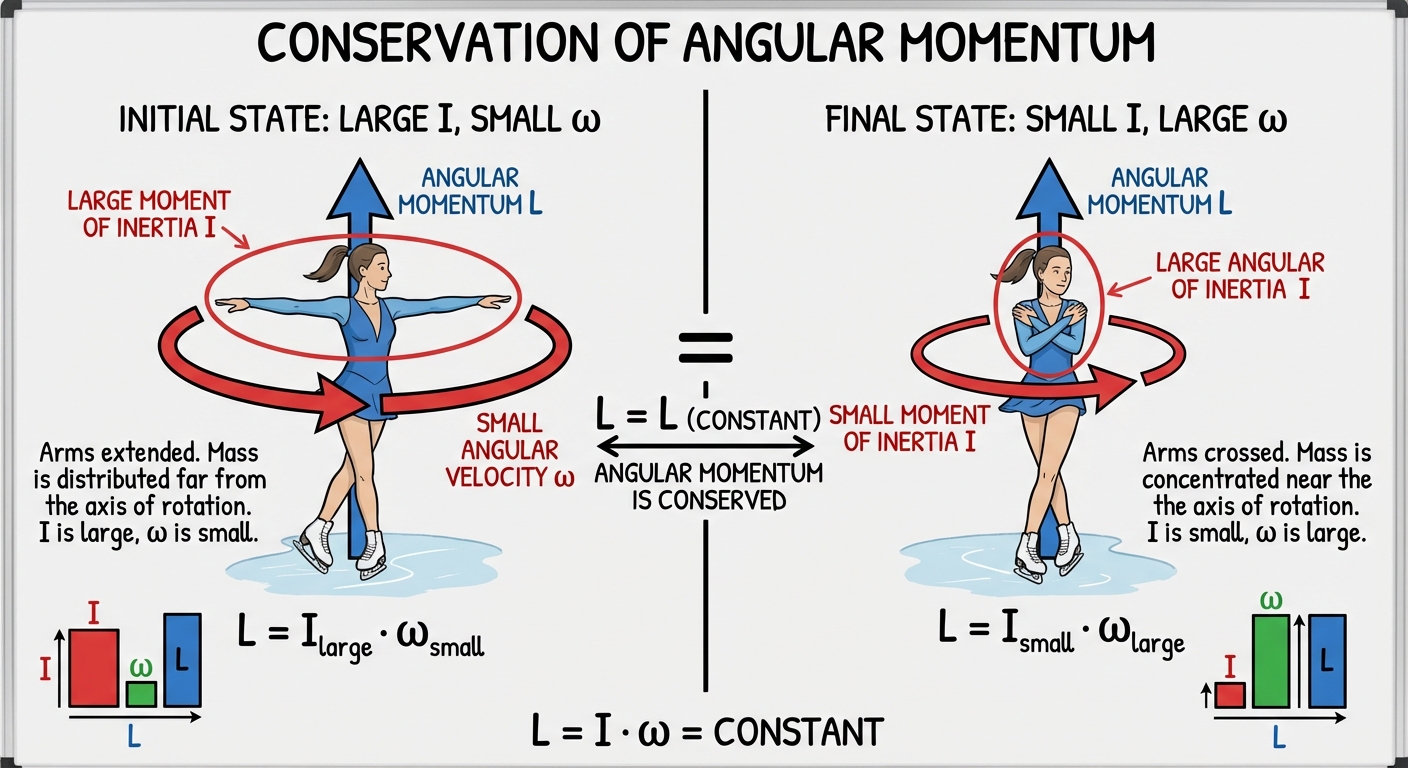
Case 1: Changing Moment of Inertia (The "Ice Skater" Effect)
Consider a single object that can change its mass distribution, like an ice skater or a diver.
- Scenario: An ice skater spinning with arms outstretched brings them in tight against their body.
- Analysis: Bringing arms in decreases $r$, which decreases the Moment of Inertia ($I$). Since $L$ must remain constant, the angular velocity ($\omega$) must increase to compensate.
Case 2: Rotational Collisions
Conservation of angular momentum is crucial for analyzing collisions where objects rotate, such as a bullet striking a pivoted rod or a person jumping onto a merry-go-round.
In these problems, linear momentum is often not conserved because the pivot point exerts an external force holding the rod in place. However, because that pivot force acts at the axis of rotation ($r=0$), it exerts zero torque. Therefore, angular momentum around the pivot is conserved.
Examples & Worked Problems
Example 1: Determining Angular Momentum of a Linear Object
Question: A 2.0 kg rock is thrown horizontally with a speed of 10 m/s. At the instant it passes a point directly 5.0 meters above an observer on the ground, what is the angular momentum of the rock relative to the observer?
Solution:
- Identify Formula: Use the point particle formula $\vec{L} = \vec{r} \times \vec{p}$.
- Determine Geometry: The observer is the origin. The rock is at position $y=5$. The velocity is horizontal ($x$-direction). The angle between $\vec{r}$ (pointing up) and $\vec{v}$ (pointing right) is $90^\circ$.
- Calculate Magnitude:
Example 2: The Bullet and The Rod (Worked Problem)
Scenario: A wooden rod of mass $M$ and length $D$ hangs vertically from a frictionless pivot at its top end. A bullet of mass $m$ traveling horizontally with velocity $v_0$ strikes the bottom of the rod and embeds itself. What is the angular velocity of the rod/bullet system immediately after the collision?
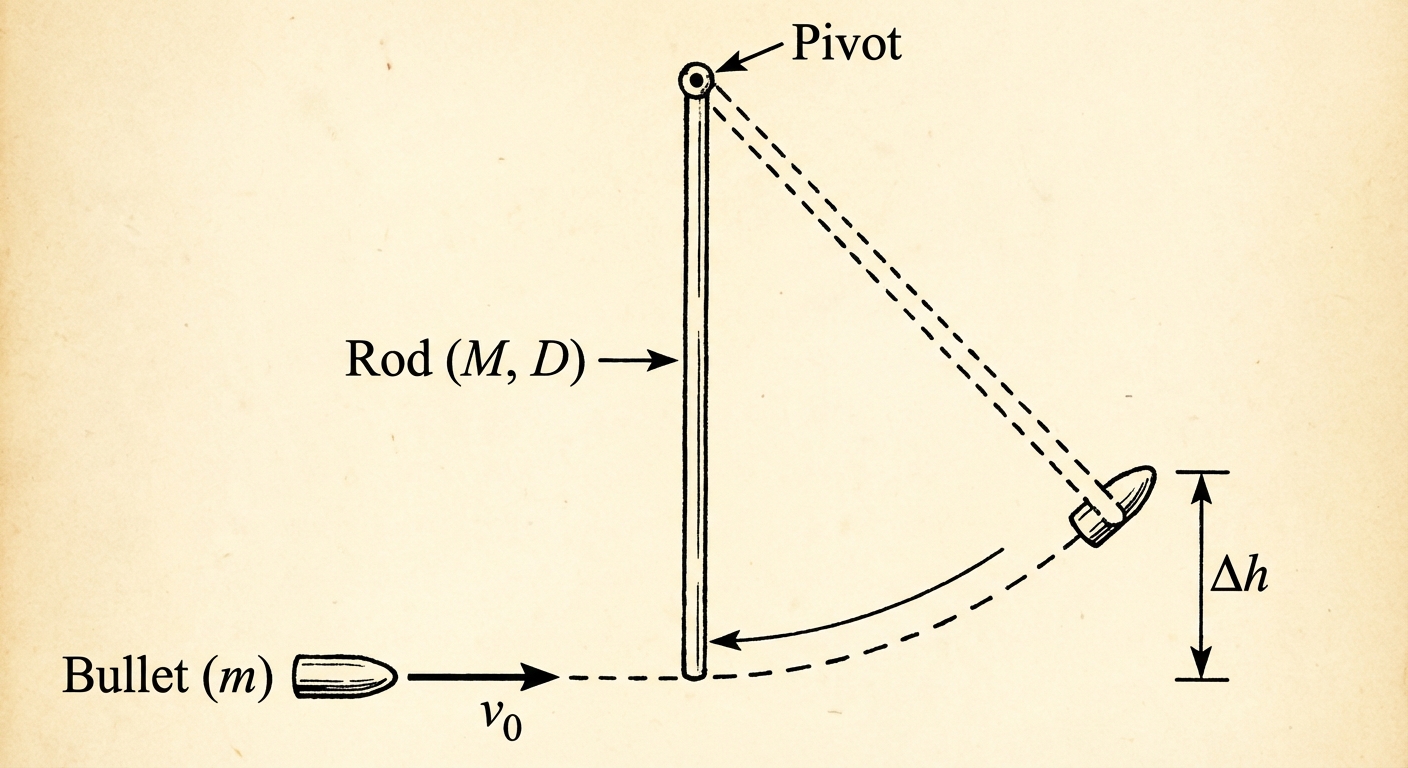
Step-by-Step Solution:
1. Define the System: The system is Bullet + Rod.
2. Check Conservation Laws:
- Linear Momentum? NO. The pivot exerts an external force to keep the rod from flying away.
- Energy? NO. This is an inelastic collision (embedding); kinetic energy is lost to heat/deformation.
- Angular Momentum? YES. The pivot force acts at the axis, so torque is zero.
3. Set up Conservation:
4. Calculate $L{initial}$:
Initially, only the bullet has momentum. Relative to the pivot (top of rod), the bullet is at distance $D$.
5. Calculate $L{final}$:
Now the bullet and rod rotate together as a single rigid body. We need the total Moment of Inertia ($I{total}$).
(Rod pivoted at end)
(Point mass at distance D)
6. Solve:
Divide by $D$ (assuming $D \neq 0$):
Common Mistakes & Pitfalls
Assuming $L=0$ for straight-line motion:
- The Mistake: Thinking a particle traveling in a straight line has no angular momentum.
- Correction: It always has angular momentum relative to any point not on its line of travel. Use $L = mvr_{\perp}$.
Confusing Conservation Laws in Collisions:
- The Mistake: Using Conservation of Linear Momentum for a rod moving on a pivot, or Conservation of Energy for an inelastic collision.
- Correction: Always assume energy is lost in collisions unless told elastic. Always look for external forces (like pivots) that break linear momentum conservation. If the pivot is the only external force, use Angular Momentum about that pivot.
Forgetting the "System" I:
- The Mistake: In the bullet/rod problem, calculating the final inertia only using the rod ($1/3 ML^2$) and forgetting to add the mass of the bullet ($mL^2$).
- Correction: Once embedded or attached, the striking object becomes part of the rotating mass. Add their Moments of Inertia.
Mixing up $r$ vs $r_{\perp}$:
- The Mistake: Using the full distance $r$ without the $\sin\theta$ component.
- Correction: Always verify: are $r$ and $v$ perpendicular? If not, use the cross product rule or identify the lever arm distance (shortest distance from pivot to line of velocity).