Unit 6 Study Guide: Position, Perspective, and Bias in Argumentation
The Core Distinction: Position vs. Perspective
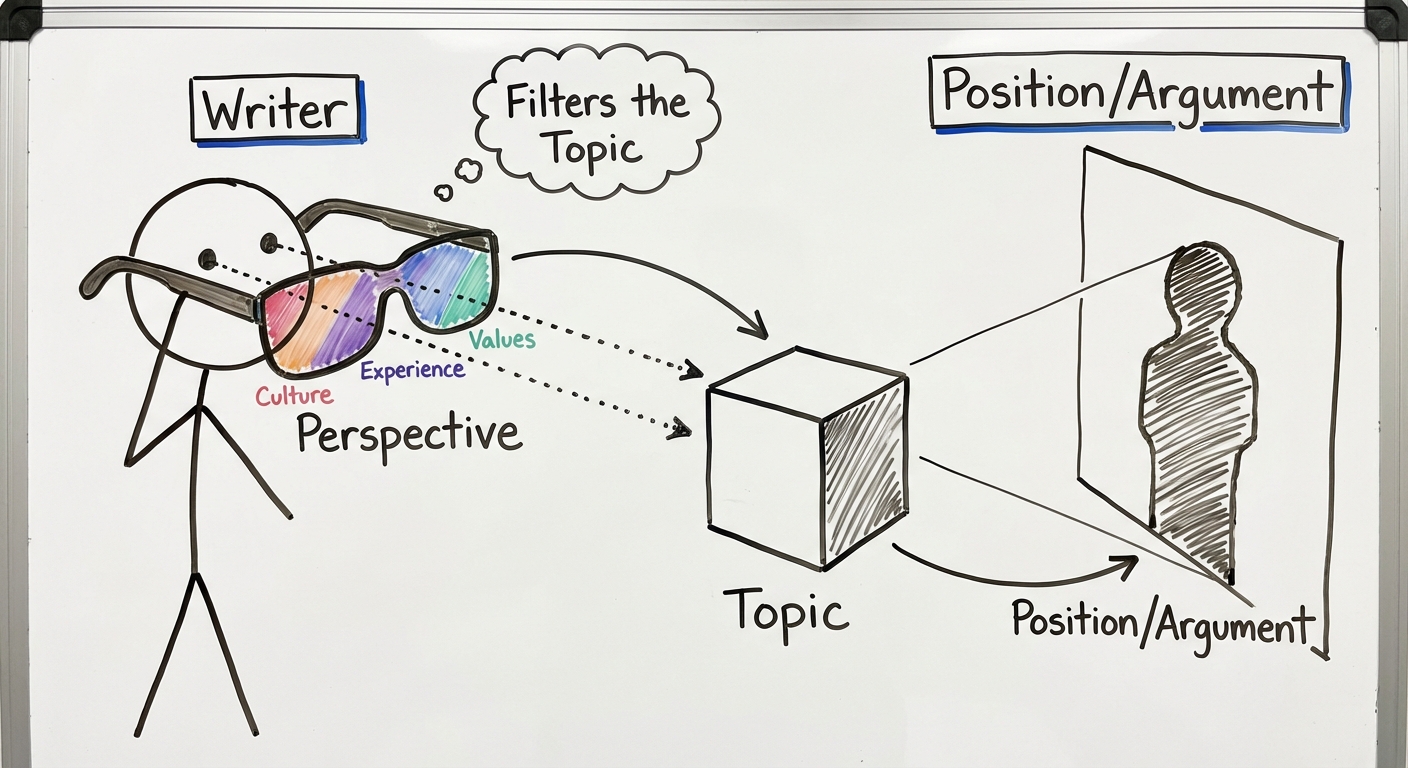
In AP English Language, Unit 6 specifically focuses on how a writer’s background and worldview influence their argument. Before analyzing bias, you must fundamentally realize that no text is neutral. Every argument is filtered through a specific set of experiences.
Defining Key Terms
Students often confuse "position" and "perspective," but in rhetorical analysis, they refer to two distinct concepts:
- Position: The specific stance or claim the writer makes on an issue. This is the “What” of the argument (e.g., “The city should raise taxes to fund the subway system”).
- Perspective: The “lens” through which the writer sees the world. This is the “Who” and “Why” behind the argument. It is shaped by identity markers such as race, gender, class, occupation, education, and geography (e.g., A daily commuter who relies on the subway vs. a wealthy car owner who rarely visits the city center).
- Purpose: The goal the writer hopes to achieve (e.g., To persuade voters to approve the levy).
How Perspective Shapes Purpose
A writer's perspective dictates which rhetorical choices they believe will best serve their purpose. For example, consider two writers arguing for the same position (banning single-use plastics) but with different perspectives:
Writer A (Marine Biologist):
- Perspective: Scientific, ecological, data-driven.
- Choices: Uses Latin names for species, cites ocean acidification statistics, appeals to logos regarding ecosystem collapse.
- Purpose: To prove the scientific necessity of the ban.
Writer B (Small Business Owner fighting pollution):
- Perspective: Economic, community-focused, pragmatic.
- Choices: Discusses the cost of litter cleanup, appeals to civic pride (pathos), uses anecdotes about tourists avoiding dirty beaches.
- Purpose: To convince the chamber of commerce that cleanliness is profitable.
Because their perspectives differ, their lines of reasoning differ, even if their ultimate position is the same.
Bias and Underlying Assumptions
Re-thinking Bias
In casual conversation, Bias is often used as a negative term implying unfairness or deception. However, in AP Lang, bias simply refers to a writer’s inclination or tendency toward a particular viewpoint.
- It is not inherently bad. All writers have bias because all writers have a perspective.
- Analysis Task: Your job is not to “catch” the writer being biased, but to explain how their bias (inclination) shapes their evidence and framing.
Identifying Assumptions (The Evaluation Bridge)
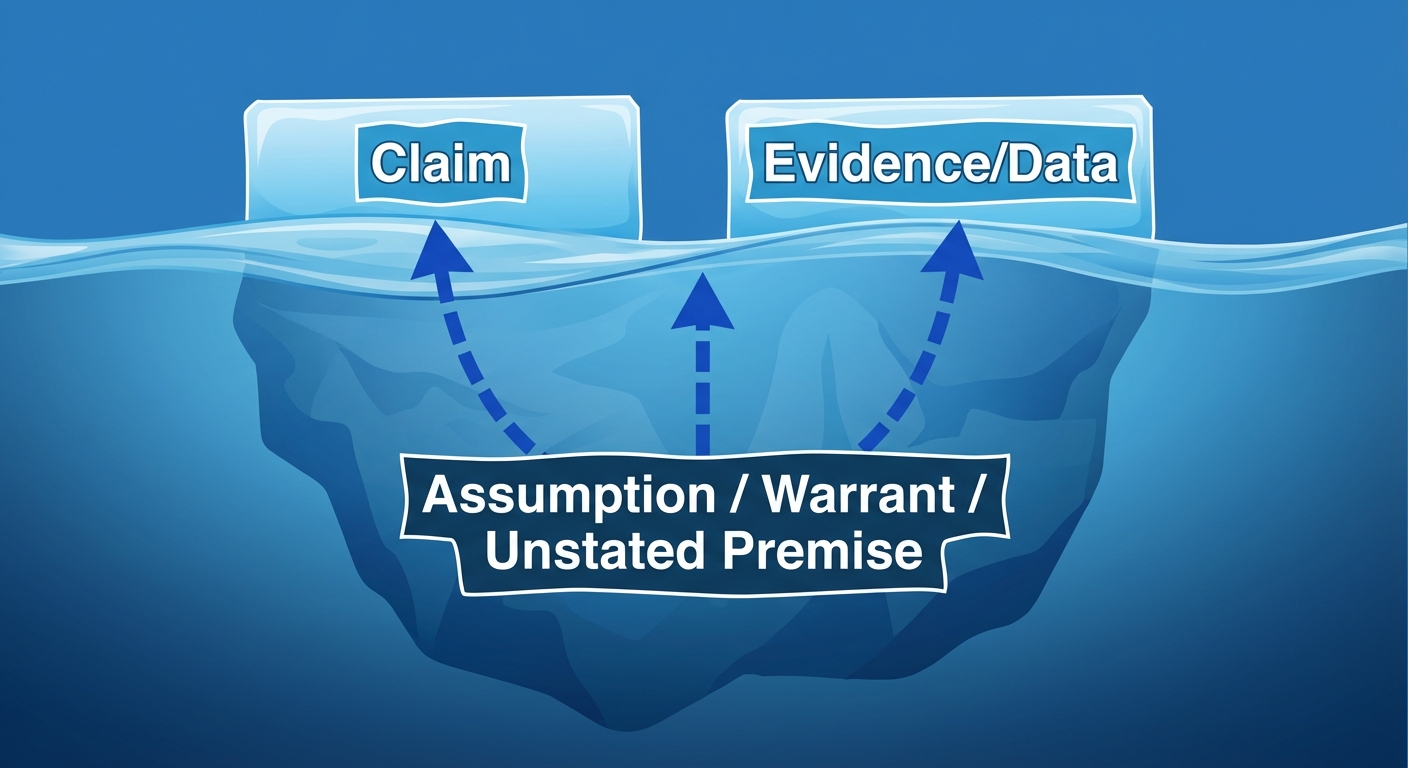
Arguments rarely state every single belief required to make them work. They rely on Assumptions—unstated premises that the writer believes the audience also holds.
In the Toulmin model of argumentation, this is often called the Warrant. It acts as the glue between the data and the claim.
Example of Unstated Assumptions
Claim: *"You should buy this electric vehicle to save money."
Evidence: *"Gas prices are projected to rise by 20% next year."*
- Unstated Assumption 1: The cost of electricity will not rise at the same rate as gas.
- Unstated Assumption 2: The upfront cost of the electric vehicle doesn't outweigh the gas savings.
- Unstated Assumption 3: The audience cares about financial savings more than vehicle performance or aesthetic.
If the audience does not share these assumptions (e.g., they value speed over savings, or they live in an area with high electricity costs), the argument fails. Analyzing perspective requires you to dig beneath the surface text to find these hidden pillars.
Evaluating the Effectiveness of an Argument
Once you have identified the writer's perspective and assumptions, you must evaluate how effective the argument is for the specific intended audience.
Key Evaluation Criteria
Alignment of Values
Does the writer understand what the audience values? An argument is effective when the writer's perspective allows them to tap into the audience's existing beliefs.- Example: A doctor (perspective) writing to parents (audience) about vaccines might effectively emphasize "safety" and "protection" rather than complex biochemistry.
Breadth of Evidence
Does the writer's bias cause them to ignore crucial counterarguments? An argument becomes ineffective if the writer's perspective creates a "blind spot."- Pitfall: If a writer argues for strict school uniforms based on their perspective as a disciplined military veteran, but fails to address the financial burden on low-income families, the argument loses effectiveness for a school board concerned with equity.
Tone and Diction
Does the writer’s perspective result in a tone that alienates the audience? (e.g., condescension, jargon, or excessive emotionalism).
Practical Application: The “Gap” Analysis
To evaluate effectiveness, look for the “gap” between the speaker and the audience.
| Element | Question to Ask | Effect on Argument |
|---|---|---|
| Shared Assumption | Do speaker and audience agree on the basics? | Closes the Gap (Effective) |
| Conflicting Values | Does the speaker value X while the audience values Y? | ** widens the Gap** (Ineffective) |
| Blind Spots | Did the speaker miss a reality obvious to the audience? | Breaks Trust (Ineffective) |
Rhetorical Situation Mnemonics
To quickly analyze perspective in a text, remember SPACE CAT. While often used for general analysis, focus specifically on the S and A for Unit 6.
- Speaker (Who is it? What are their credentials/biases/identity?)
- Purpose (What do they want?)
- Audience (Who are they? What do they value/assume?)
- Context (What is happening in the world?)
- Exigence (Why write this now?)
Common Mistakes & Pitfalls
1. Analyzing Bias as a “gotcha” moment
- Mistake: Writing, "The author is biased because he is a man, so his argument is invalid."
- Correction: Instead write, "The author’s perspective as a male in a male-dominated field leads him to focus on professional hierarchy rather than the collaborative nuances cited by his female counterparts."
2. Confusing Position and Perspective
- Mistake: Stating the perspective is "that we should vote for the law."
- Correction: That is the position. The perspective is "a concerned citizen who has personally experienced the negative effects of the current law."
3. Ignoring the “Why”
- Mistake: Identifying an assumption but not explaining its function.
- Correction: Always explain how the assumption connects the evidence to the claim. If the assumption is weak, the argument crumbles.
4. Assuming the Universal Audience
- Mistake: Thinking the writer is talking to "everyone."
- Correction: Writers rarely write for everyone. Identify the specific demographic or group (e.g., "Skeptical voters," "Medical professionals") to truly evaluate if the perspective aligns with the audience's needs.