Mastering ACT English: Rhetorical Skills and Conventions
Precise and Varied Word Choice
Success on the ACT English section requires more than just knowing grammar rules; it requires an ear for the Knowledge of Language. This category tests your ability to select the most specific word for the context and, crucially, to eliminate unnecessary words.
The Economy of Language (Conciseness)
The most frequent stylistic error tested on the ACT is redundancy. The ACT prefers the shortest, most direct way to express an idea, provided no meaning is lost.
- The Golden Rule: If three answer choices express the same idea but vary in length, the shortest answer is correct roughly 80-90% of the time, unless it creates a grammatical error.
- Redundancy: This occurs when words repeat the same meaning.
Common Redundancy Patterns to Avoid:
| Type | Incorrect / Redundant | Correct / Concise |
|---|---|---|
| Synonyms | cooperate together, joint collaboration | cooperate, collaboration |
| Time | at 3 p.m. in the afternoon, annually every year | at 3 p.m., annually |
| Definitions | a beginner who is inexperienced | a beginner |
Diction and Vocabulary in Context
Sometimes, a word is grammatically permissible but contextually wrong. You must choose words that fit the precise meaning of the sentence.
- Nuance: Choosing between stare, glance, and glare. A "glare" implies anger, while a "glance" is brief. Context cues (like an angry character) dictate the choice.
- Frequently Confused Words: The ACT loves testing homophones or near-homophones.
High-Yield Word Pairs:
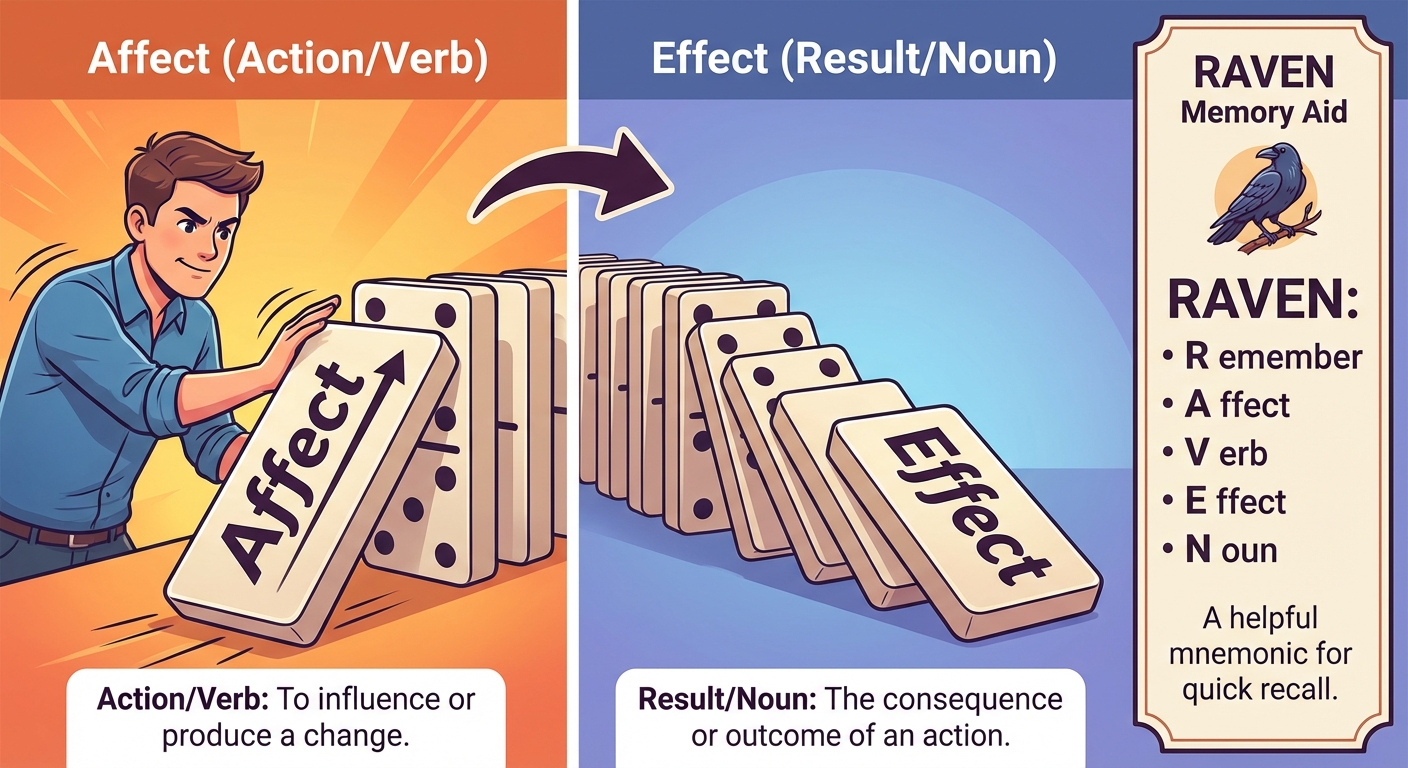
- Affect vs. Effect: Affect is usually a verb (to influence); Effect is usually a noun (a result).
- Than vs. Then: Than is for comparisons; Then is for time.
- Could of vs. Could have: "Could of" is always incorrect. The correct spelling is "Could have."
Clear and Varied Sentence Structure
This section deals with syntax—the arrangement of words and phrases. The goal is clarity and flow. Disorganized sentences confuse the reader and disrupt the logic of the passage.
Parallel Structure
Parallelism demands that items in a list or comparison share the same grammatical form. If you start a list with a noun, continue with nouns. If you use an -ing verb, keep using -ing verbs.
Formula for Parallel Lists:
Where $Form(Item1) = Form(Item2) = Form(Item_3)$
- Incorrect: She likes hiking, swimming, and to ride a bike.
- Correct: She likes hiking, swimming, and biking.
Modifier Placement
Modifiers are words or phrases that describe something. They must be placed immediately next to the noun they describe.
Dangling Modifiers
A dangling modifier occurs when the descriptive phrase begins a sentence, but the subject doing the action is missing or placed incorrectly.
- Incorrect: Walking down the street, the trees looked beautiful. (The trees cannot walk.)
- Correct: Walking down the street, I thought the trees looked beautiful.
Misplaced Modifiers
- Incorrect: He served steak to the men on paper plates. (Were the men standing on paper plates?)
- Correct: He served steak on paper plates to the men.
Consistent Tone and Style
The ACT requires you to act as an editor ensuring the passage maintains a consistent voice.
Formality and Register
Most ACT passages are written in Standard Written English. They are academic but not overly archaic, and professional but not slangy.
- Avoid Slang: Words like "cool," "sketchy," or "stuff" are usually incorrect unless the passage is explicitly a casual narrative.
- Avoid Overly Fancy Language: Do not pick a "big word" just because it sounds smart. If a simple word works, use it. "Utilize" is rarely better than "use."
Consistency (The Chameleon Rule)
Look at the non-underlined portions of the paragraph to determine the style. If the author uses formal scientific terms (e.g., "examine," "hypothesize"), do not choose an answer choice that uses casual phrasing (e.g., "check it out," "guess").
Grammar, Punctuation, and Mechanics
This is the foundation of the ACT English test, making up over 50% of the questions. These rules are rigid and logic-based.
Punctuation Traffic Signals
Think of punctuation marks as traffic signals that tell you how to connect ideas. We can group them by how strong they are.
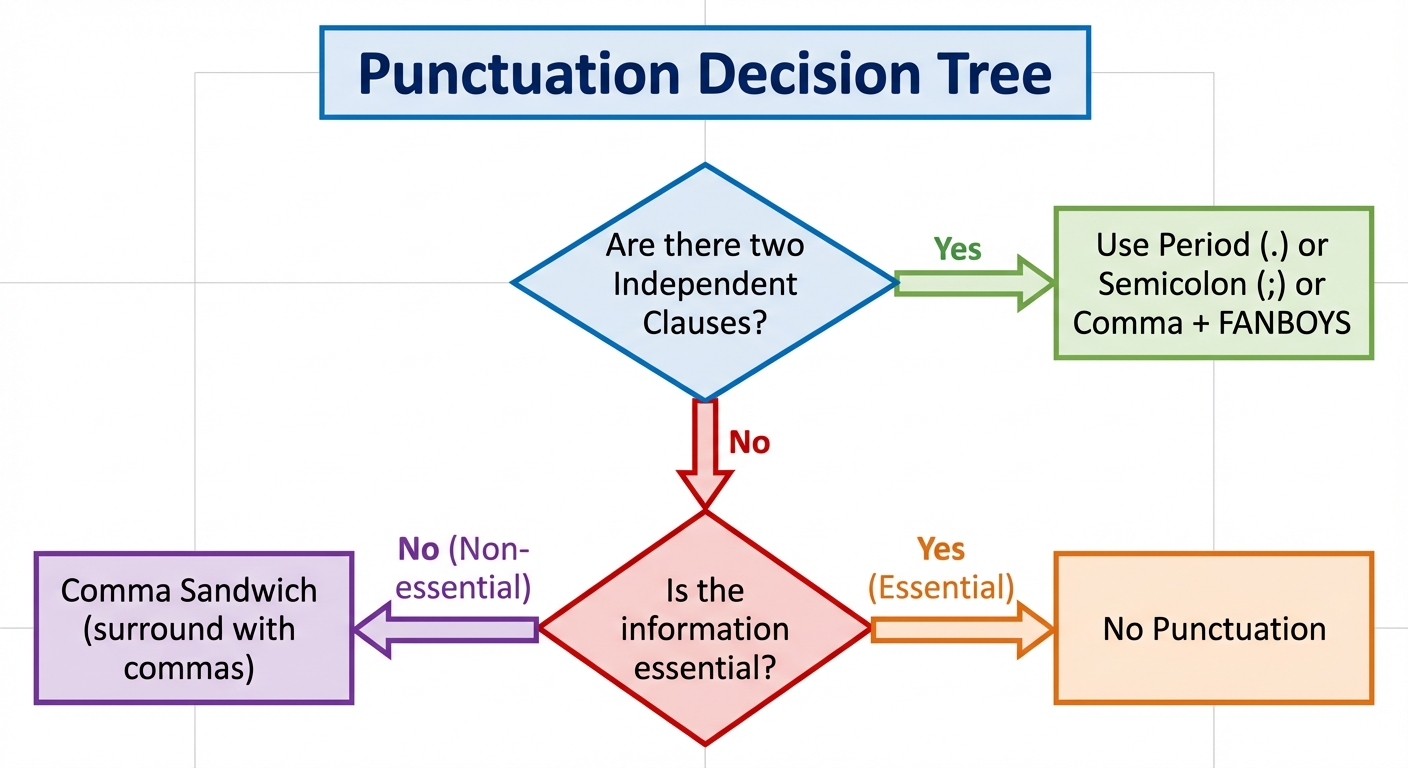
1. The "Stop" Punctuation (Separating Independent Clauses)
An Independent Clause (IC) is a full sentence with a subject and a verb. To connect them, you need strong punctuation.
The following are grammatically identical on the ACT:
- Period: $.$
- Semicolon: $;$
- Colon (sometimes): $:$
- Comma + FANBOYS: $, + (For, And, Nor, But, Or, Yet, So)$
The Comma Splice Error:
Using ONLY a comma to join two independent clauses is a fatal error.
- Incorrect: It was raining, I took an umbrella.
- Correct: It was raining; I took an umbrella. / It was raining, so I took an umbrella.
2. The "Go" Punctuation (Connecting Clauses)
Commas have specific jobs besides the FANBOYS rule:
- Introductory phrases: After the game, we went home.
- Lists: Apples, bananas, and pears.
- Non-Essential Appositives: Phrases that describe a noun but can be removed without changing the core meaning.
- Concept: Mr. Jones, my refined neighbor, loves opera. (You can remove "my refined neighbor").
- Rule: Use a "Comma sandwich." Put a comma before AND after the non-essential phrase.
3. The Colon and Dash
- The Colon (:): Must follow a complete independent clause. It introduces a list, a definition, or an explanation.
- Rule: $IC + : + (List/Explanation)$
- Example: I need three things: flour, sugar, and eggs.
- The Dash (—): Used for emphasis or abrupt interruptions.
- Two dashes function exactly like parentheses or two commas for non-essential information.
Possession vs. Contraction (Apostrophes)
This is a high-frequency error type involving pronouns and nouns.
| Word | Function | Meaning |
|---|---|---|
| Its | Possessive Pronoun | Belongs to "it" |
| It's | Contraction | "It is" |
| Its' | Non-existent | Never correct on the ACT |
| Their | Possessive Pronoun | Belongs to "them" |
| They're | Contraction | "They are" |
| There | Location/Abstract | "Over there" |
Noun Possession Rules:
- Singular: Add 's (e.g., The dog's bone).
- Plural ending in s: Add only ' (e.g., The dogs' bones).
- Plural not ending in s: Add 's (e.g., The men's room).
Common Mistakes & Pitfalls
- The "Sounds Good" Trap: Do not rely on your internal pause or what sounds natural. Spoken English is often grammatically incorrect. Rely on the rules.
- Ignoring the "No Change" Option: roughly 25% of ACT questions are correct as written. If you can't find a specific error, do not force a change.
- Redundancy: Students often choose the longest answer thinking it looks more "academic." Always check the shortest answer first.
- Misidentifying Subjects: In the phrase "The box of nails is heavy," the subject is box (singular), not nails (plural). Ignore the prepositional phrase "of nails" when checking subject-verb agreement.
- Ambiguous Pronouns: If a sentence uses "he," "she," or "it," but there are two possible antecedents (nouns it could refer to), it is incorrect. You must replace the pronoun with the specific noun.