AP Unit 1 Comprehensive Review: The Contact Period
1.1 Native American Societies Before Contact (Pre-1491)
Definition & Context
The Pre-Columbian era covers the history of the Americas before the arrival of Christopher Columbus in 1492 (defined creatively as 1491 in the AP curriculum).
- Migration: The first humans arrived 15,000–20,000 years ago, likely crossing the Bering Land Bridge (Beringia) connecting Siberia and Alaska during the Ice Age. As the planet warmed, sea levels rose, submerging the bridge and isolating the Americas.
- Diversity: By 1491, North and South America were home to roughly 50–70 million people speaking hundreds of languages with diverse social structures tailored to their environments.
- Key Concept: Native populations were not monolithic; their lifestyles were dictated by their geography and climate.
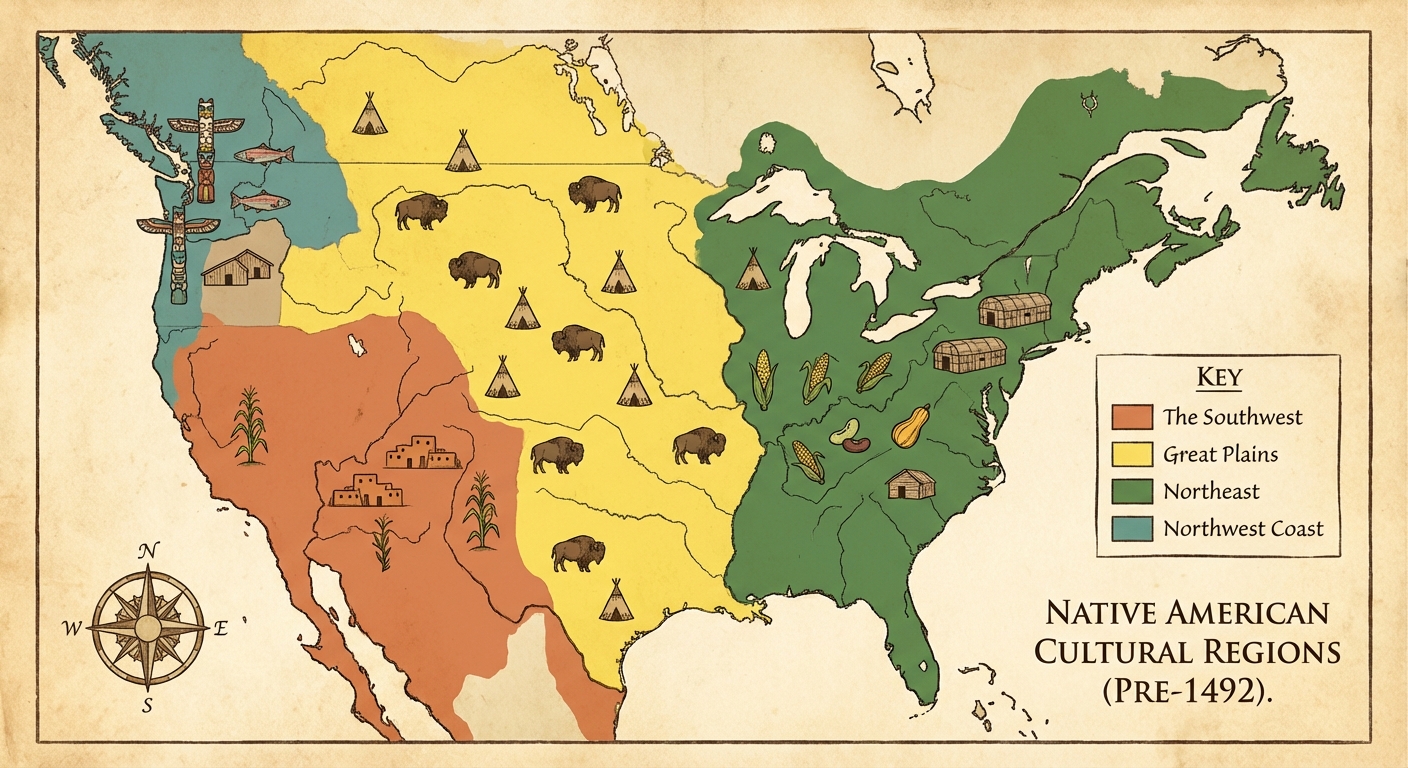
Regional Cultures & Adaptations
| Region | Environment | Key Adaptation (Economy) | Characteristics |
|---|---|---|---|
| Southwest | Arid/Dry (New Mexico, Arizona) | Maize (Corn) Cultivation | Built sophisticated irrigation systems to farm corn, beans, and squash. Lived in permanent stone/adobe villages (e.g., Pueblo people like the Anasazi). |
| Great Plains & Basin | Grasslands, flat, dry | Nomadic Hunting & Gathering | Lack of natural resources led to a mobile lifestyle hunting bison. Note: Horses were NOT present yet; they arrived with the Spanish. |
| Northeast & Atlantic | Forests, rivers | Mixed Agriculture & Hunter-Gatherer | "Three Sisters" farming (corn, beans, squash) allowed for permanent settlements, supplemented by hunting. Matrilineal societies (e.g., Iroquois Confederacy and Algonquian). |
| Northwest & California | Ocean, abundant resources | Foraging/Fishing | Did not need to farm due to abundance of nuts, berries, whales, and salmon. Lived in dense, settled communities with rigid social hierarchies (e.g., Chinook). |
Social Structure
- Animism: Most groups believed the natural world was filled with spiritual power.
- Land Use: Land was generally viewed as a communal resource for the tribe, not a commodity to be bought, sold, or fenced (a major source of future conflict).
- Identity: Social structure often relied on kinship networks. In many societies (like the Iroquois), power and lineage were passed down through women (Matrilineal).
1.2 European Exploration: Causes and Effects
The Impetus for Exploration
European exploration was driven by the desire to bypass Muslim-controlled trade routes to Asia and access spices and luxury goods directly. The motivations are remembered by the 3 Gs:
- Gold: Search for new sources of wealth (gold, silver, trade routes).
- Glory: Competition between nations (power and status) and individual fame.
- God: The desire to spread Christianity (Catholicism by Spain/France, later Protestantism by England).
Technological Enablement
New maritime technology made trans-Atlantic voyages possible:
- Caravel: A fast, maneuverable Portuguese ship with lateen (triangular) sails.
- Sextant & Astrolabe: Instruments for measuring latitude and celestial positioning.
- Joint-Stock Companies: (Emerging later) Business models where investors pooled capital to fund colonization, reducing individual risk.
The Christopher Columbus Moment (1492)
- Sponsored by Ferdinand and Isabella of Spain.
- Landed in the Bahamas (San Salvador); encountered the Taino people.
- Significance: While the Norse arrived earlier (c. 1000 CE), Columbus initiated the Contact Period—sustained European interaction with the Americas.
1.3 The Columbian Exchange
Definition
The Columbian Exchange was the trans-Atlantic trade of plants, animals, people, and diseases between the Western Hemisphere (The New World) and the Eastern Hemisphere (The Old World: Europe, Africa, Asia).
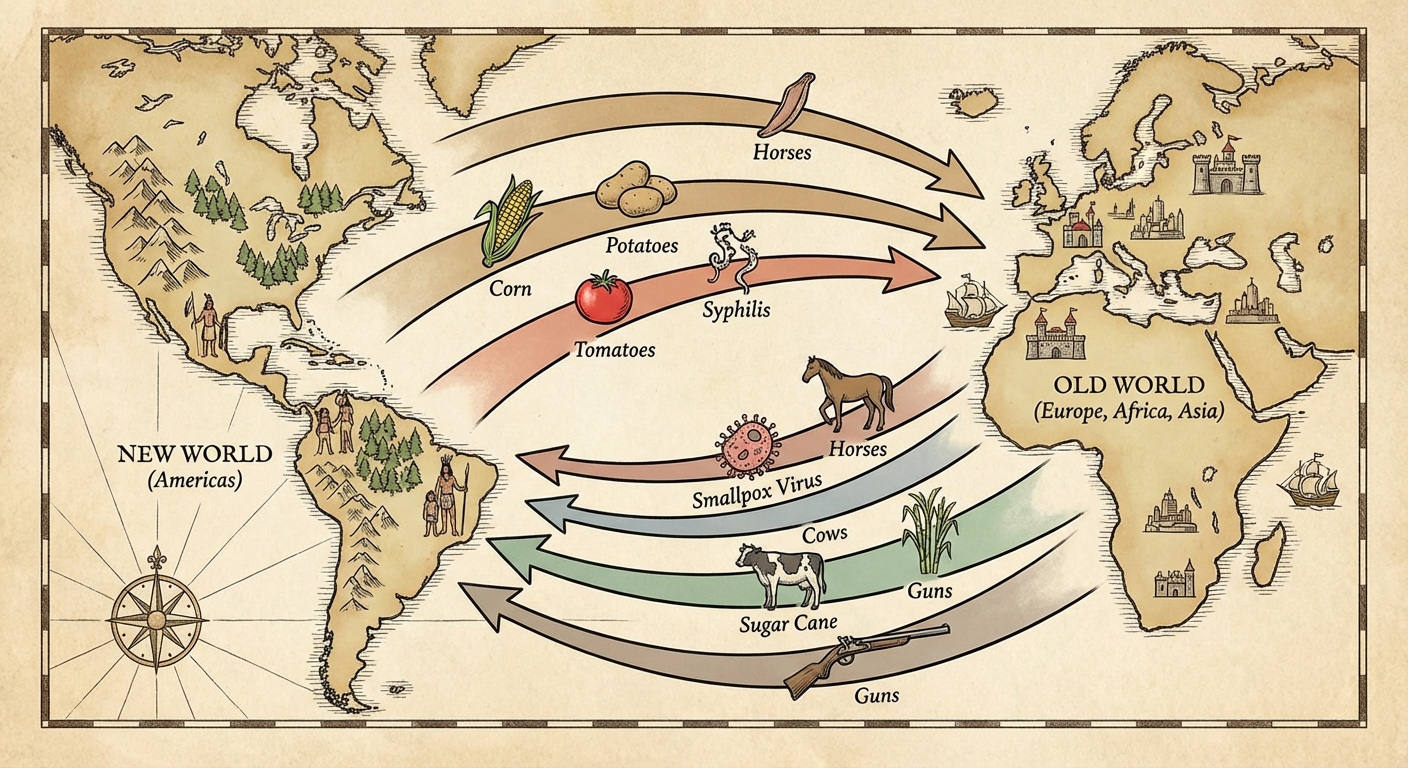
Biological Flows
| Direction | Items Exchanged | Impact |
|---|---|---|
| Old World $\rightarrow$ New World | Diseases: Smallpox, Measles, Influenza Animals: Horses, Cattle, Pigs Crops: Wheat, Sugar, Rice, Coffee | Diseases decimated Native populations (mortality rates of 90% in some areas). The Horse revolutionized Plains Indian culture (hunting/warfare). Sugar became the primary cash crop driving the demand for slave labor. |
| New World $\rightarrow$ Old World | Crops: Maize (Corn), Potatoes, Tomatoes, Tobacco, Cacao Disease: Syphilis | High-calorie crops (Corn/Potatoes) caused a massive population boom in Europe. Maize became a staple crop in Africa and China. |
Economic Impact on Europe
- The influx of mineral wealth (silver/gold) from the Americas helped end Feudalism and triggered the rise of Capitalism.
1.4 The Spanish Empire in the Americas
Pattern of Conquest
Spain dominated the Americas during the 1500s (the "Spanish Century").
- Conquistadors: Soldiers like Cortés (conquered Aztecs) and Pizarro (conquered Incas) secured land for the Crown.
- Treaty of Tordesillas (1494): The Pope divided the burgeoning New World between Spain and Portugal. Spain got the vast majority of the Americas; Portugal got Brazil.
Labor Systems
To extract wealth (Gold/Silver/Sugar), the Spanish implemented coercive labor systems:
- Encomienda System:
- Definition: The Spanish Crown granted colonists authority over a specific number of Natives. The colonist promised to "protect" and Christianize them in exchange for their labor.
- Reality: It was a brutal form of slavery.
- Repartimiento System: Replaced Encomienda; slightly more regulated but still oppressive forced labor.
- African Slavery: As Native populations died from disease and overwork (and because Natives knew the terrain and could escape), the Spanish began importing enslaved Africans via the Asiento System.
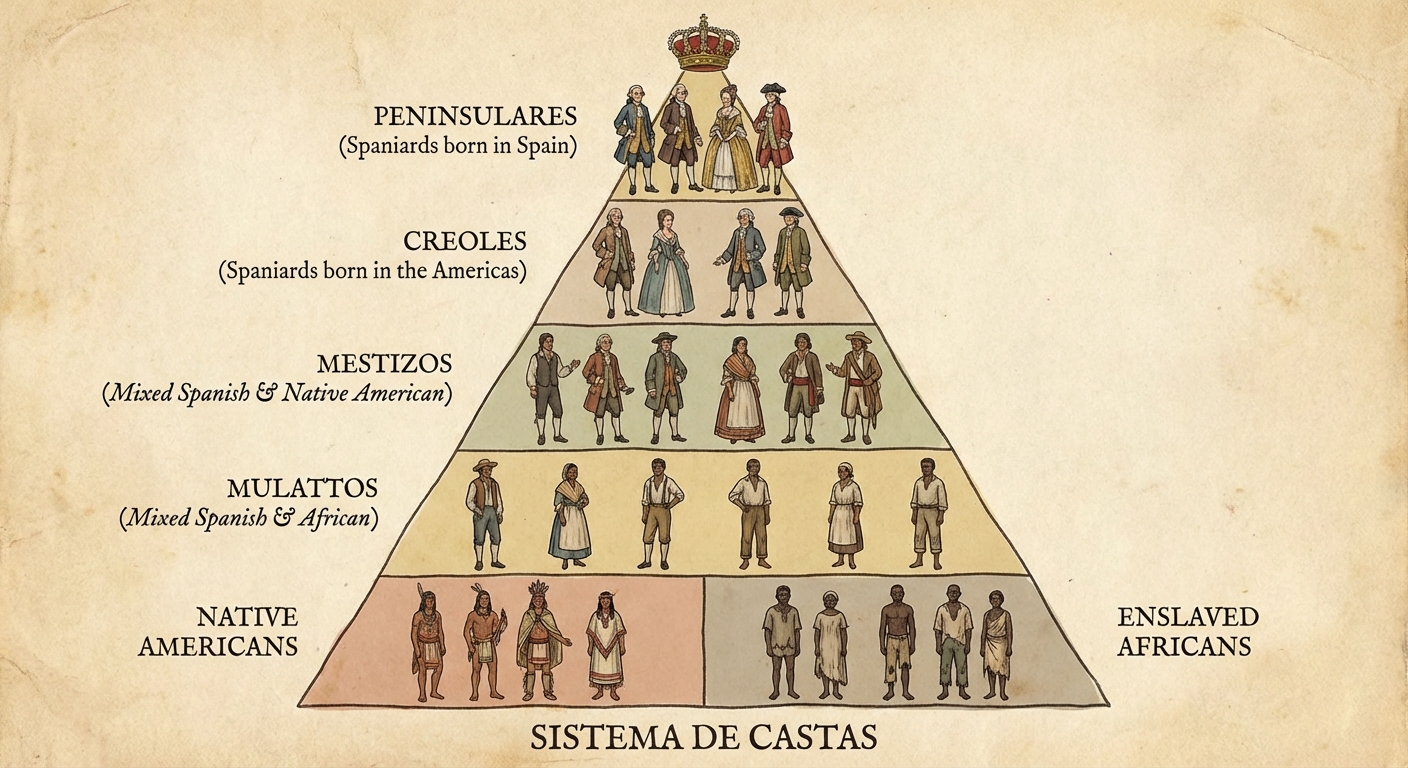
The Spanish Caste System (Casta)
Unlike the English who generally segregated from Natives, the Spanish intermarried, creating a racially mixed society with a rigid hierarchy based on "purity of blood."
- Peninsulares: Born in Spain (Highest power).
- Creoles (Criollos): Born in the Americas to Spanish parents.
- Mestizos: Mixed Spanish and Native American ancestry.
- Mulattos: Mixed Spanish and African ancestry.
- Native Americans & Enslaved Africans: Bottom of the hierarchy.
1.5 Interactions, Conflict, and Divergent Worldviews
Key Debates: Humanity of Natives
As news of brutality reached Europe, a moral debate ensued regarding the treatment of Indigenous peoples.
- The Valladolid Debate (1550–1551):
- Bartolomé de Las Casas: A priest who argued that Natives were human, capable of becoming Christians, and should not be enslaved. He wrote A Short Account of the Destruction of the Indies.
- Juan de Sepúlveda: Argued that Natives were subhuman savages and that the Spanish had a right to rule them under "natural law."
Native Resistance & Adaptation
Native Americans did not passively accept conquest. They resisted through:
- Military: Wars (e.g., Acoma Massacre, Pueblo Revolt—though Pueblo Revolt is 1680, widely citing it as a result of these tensions is common).
- Cultural Preservation: Maintaining secret religious practices alongside Catholicism.
- Migration: Fleeing deeper inland.
African Resistance
Enslaved Africans developed strategies to preserve their dignity and culture:
- Maroon Communities: Escaped slaves formed independent settlements (notably in the Caribbean and Brazil).
- Cultural Syncretism: blending Christianity with African spirituality (e.g., Voodoo/Vodou) and maintaining musical/oral traditions.
Comparison of European Colonizers (Brief Overview)
While Spain dominated Period 1, others made contact by the late 1500s.
- Spain: Conquest, conversion (Catholic), encomienda, widespread intermarriage.
- France: Focus on fur trade (coureurs du bois), Jesuits, generally friendlier relations/alliances with Natives (e.g., Huron), less settlement density.
- England: (Late to the party). Arrival at Roanoke (1587 - failed) and Jamestown (1607). Focused on agriculture (Tobacco), expulsion of Natives rather than subjugation, and family migration (Pilgrims later).
1.6 Common Mistakes & Pitfalls
The "Horse" Fallacy:
- Mistake: Thinking all Native Americans rode horses before 1492.
- Correction: Horses are irrelevant to Pre-Columbian society. They were reintroduced by the Spanish. The stereotype of the Great Plains horse warrior applies to post-contact history.
Monolith Mistake:
- Mistake: Treating Native Americans as a single culture.
- Correction: They were incredibly diverse. The sedentary agricultural Pueblos were nothing like the nomadic Great Plains hunters or the rigidly hierarchical Pacific Northwest fishers.
Timeline Confusion (Jamestown vs. Plymouth):
- Mistake: Confusing the start dates. Period 1 ends in 1607.
- Correction: 1607 is the founding of Jamestown (First Permanent English Settlement). Plymouth and the Mayflower (Pilgrims) do not happen until 1620 (Period 2). Do not use Pilgrims/Puritans as examples for Period 1 essays.
Population Decline:
- Mistake: Attributing Native deaths primarily to warfare.
- Correction: While war was brutal, disease (smallpox) was by far the biggest killer, wiping out up to 90% of the population, often before European physical arrival in an area.