Study Notes: Global Conflict & Power Shifts (1900–1945)
Unit 7: Global Conflict (c. 1900–Present)
Shifting Power After 1900
The 20th century began with the collapse of older, land-based empires due to a combination of internal decay and external pressure. This power vacuum sets the stage for global conflict.
Collapse of Land-Based Empires
Three major empires collapsed in the early 1900s, shifting the global balance of power:
- The Qing Dynasty (China)
- Internal Factors: Ethnic tension (Han Chinese vs. Manchu rulers), famine, low tax revenue.
- External Factors: European industrial imperialism (Spheres of Influence).
- Result: Revolution of 1911 led by Sun Yat-sen; ended 2,000 years of imperial rule and established a republic.
- The Ottoman Empire ("The Sick Man of Europe")
- Factors: Failed modernization (Tanzimat reforms didn't go far enough), rising nationalism among diverse ethnic groups (Greeks, Slavs, Arabs).
- Turkification: A distinct move toward Turkish nationalism, which alienated Arab populations.
- Result: Collapsed after WWI; replaced by the Republic of Turkey under Mustafa Kemal Ataturk.
- The Russian Empire
- Factors: Slow industrialization, loss in the Russo-Japanese War (1905), peasant discontent.
- Result: The Bolshevik Revolution (1917).
The Mexican Revolution (1910–1920)
A major challenge to the existing political order in the Americas.
- Cause: Dictator Porfirio Díaz allowed foreign control of resources and extreme wealth inequality.
- Key Figures: Pancho Villa and Emiliano Zapata (leaders of redistributive peasant movements).
- Outcome: The Constitution of 1917, which provided land redistribution, universal suffrage, and public education.
World War I (1914–1918)
The Causes of WWI (M.A.I.N.)
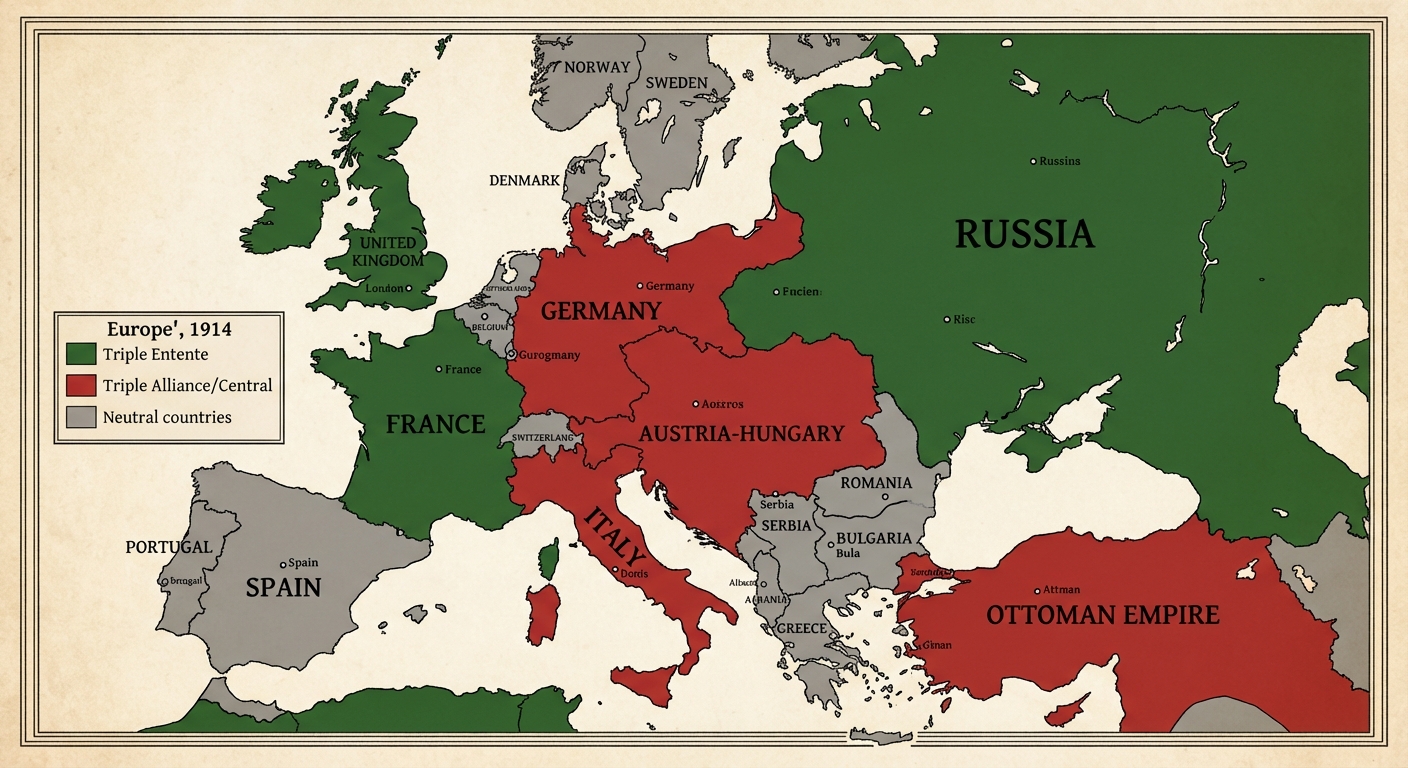
While the assassination of Archduke Franz Ferdinand (heir to the Austro-Hungarian throne) by Serbian nationalist Gavrilo Princip was the immediate spark, the underlying causes are remembered by the acronym MAIN:
- M — Militarism: Aggressive military buildup (e.g., Britain vs. Germany naval race).
- A — Alliances: Secret treaties meant a local conflict became global.
- Triple Entente: Britain, France, Russia.
- Triple Alliance: Germany, Austria-Hungary, Italy.
- I — Imperialism: Competition for colonies in Africa and Asia increased tension.
- N — Nationalism: The desire for self-determination (e.g., Slaves in the Balkans wanting freedom from Austria-Hungary).
Conducting "Total War"
Definition: A war in which nations commit all domestic resources (economic, human, and industrial) to the war effort, blurring the line between combatants and civilians.
- Government Intervention: Governments set prices, censored media, and imprisoned activists.
- Technology: Industrialization led to mass casualties via machine guns, poison gas, submarines (U-boats), and tanks.
- Trench Warfare: Led to a stalemate, particularly on the Western Front.
- Propaganda: Art and media used to mobilize populations and demonize the enemy.
- Global Participation: European powers used colonial subjects (e.g., Indian troops fighting for Britain, West Africans for France) to fight.
The Outcome
- US Entry (1917): Prompted by the Zimmermann Telegram (Germany asking Mexico to attack the US) and unrestricted submarine warfare (sinking of the Lusitania).
- Treaty of Versailles (1919):
- Forced Germany to accept "War Guilt," pay massive reparations, and downsize the military.
- Created the League of Nations (proposed by Woodrow Wilson's Fourteen Points), but the US refused to join, weakening it.
- Mandate System: Instead of independence, colonies of the Central Powers (Ottoman/German) were transferred to Britain and France.
The Interwar Period (1919–1939)
The Russian Revolution
Russia withdrew from WWI due to internal revolution.
- February Revolution (1917): Czar Nicholas II abdicated; provisional government took over but failed to leave the war.
- Bolshevik Revolution (Oct 1917): Led by Vladimir Lenin and the Bolsheviks (communists) under the slogan "Peace, Land, and Bread."
- Governance: Established the USSR (Soviet Union). Abolished private trade.
The Great Depression
A global economic collapse triggered by the US Stock Market Crash (1929), bank failures, and agricultural overproduction.
Responses to the Depression:
- United States: The New Deal (FDR). Used Keynesian Economics (government deficit spending) to stimulate the economy.
- Soviet Union: Five-Year Plans (Stalin). Rapid industrialization and collectivization of agriculture. While the rest of the world struggled, the USSR's command economy grew (at a massive human cost).
- Fascist States: Moved toward military buildup to solve unemployment.
The Rise of Fascism
Fascism is an authoritarian, ultra-nationalist political ideology characterized by dictatorial power and suppression of opposition.
| Feature | Fascism (Germany/Italy) | Communism (USSR) |
|---|---|---|
| Goal | National glory & racial purity | Classless society |
| Economy | Alliances with business owners | State ownership of everything |
| Similarities | Totalitarian control, secret police, suppression of dissent |
- Italy: Benito Mussolini (Blackshirts) took power in 1922.
- Germany: Adolf Hitler (Nazi Party) rose due to resentment over Versailles and hyperinflation. Became Chancellor in 1933.
- Spain: Francisco Franco won the Spanish Civil War (1936–1939) with German/Italian help (a "dress rehearsal" for WWII).
World War II (1939–1945)
Causes
- Unsustainable Peace Settlement: The Treaty of Versailles humiliated Germany.
- Expansionism:
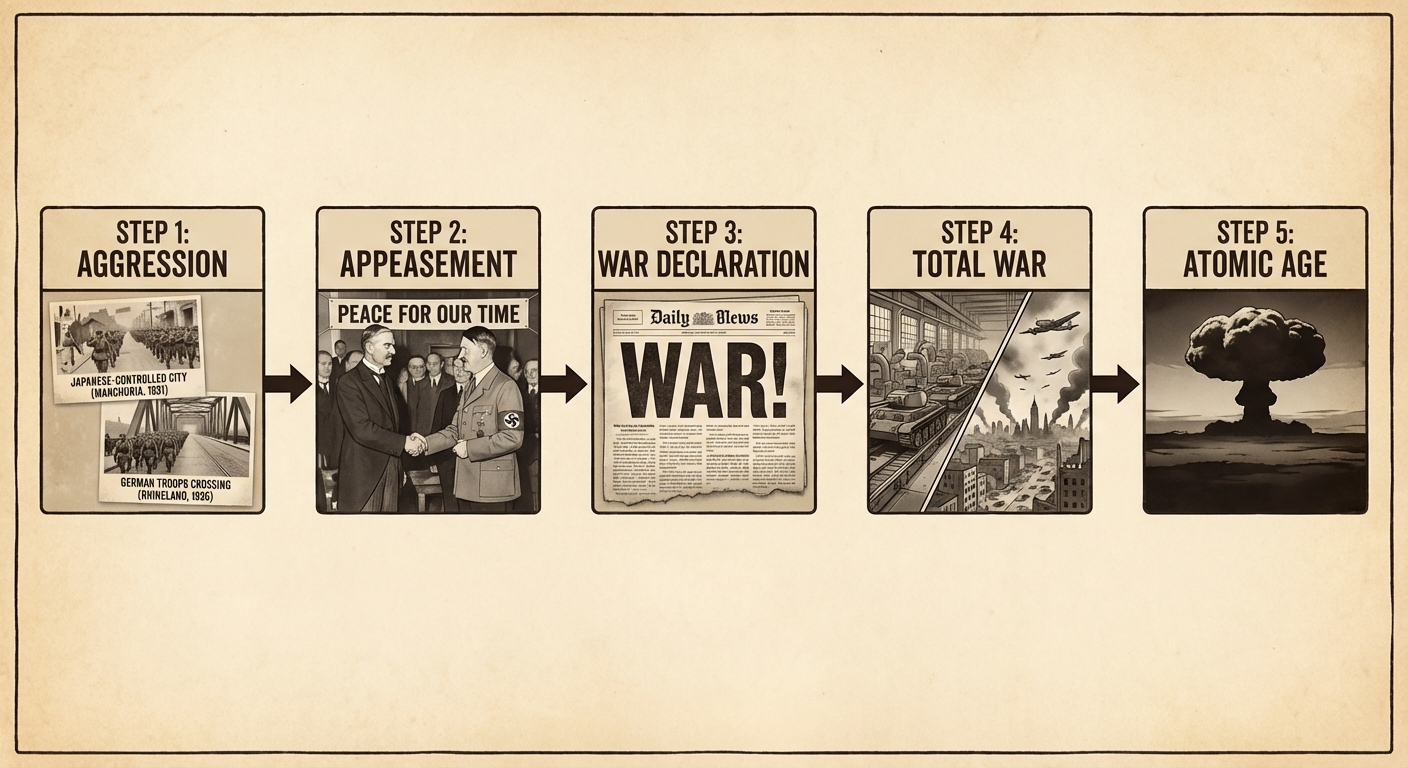
- Germany: Invaded Rhineland, Austria (Anschluss), and Sudetenland. Britain/France used Appeasement (giving in to avoid war) at the Munich Conference.
- Japan: Invaded Manchuria (1931) and China (1937).
- Italy: Invaded Ethiopia.
- Invasion of Poland (1939): The immediate cause of the war in Europe.
Conducting the War
- Alliances:
- Axis Powers: Germany, Italy, Japan.
- Allied Powers: Britain, USA, USSR (after Germany broke the Nazi-Soviet Non-Aggression Pact).
- Strategies:
- Blitzkrieg: German "lightning war" (fast tanks + air support).
- Island Hopping: US strategy in the Pacific to cut off Japanese supply lines.
- Total War (Again): Firebombing of cities (Hamburg, Dresden, Tokyo) and the use of the Atomic Bomb (Hiroshima, Nagasaki).
Mass Atrocities (Topic 7.8)
Unit 7 specifically focuses on how 20th-century conflicts enabled genocides and ethnic violence.
Key Genocides
- Armenian Genocide (1915): The Ottoman government systematically killed ethnic Armenians (Christians) during WWI, accusing them of colluding with the enemy (Russia).
- The Holocaust (1941–1945): Nazi Germany's "Final Solution" to kill Jews, Roma, disabled people, and LGBTQ+ individuals. 6 million Jews murdered.
- Ukrainian Holodomor (1932–1933): Not direct warfare, but a man-made famine engineered by Stalin to force Ukrainians into collectivization. Over 3 million died.
- Rwanda (1994): (Often covered in Unit 7 or 9) Hutu extremists killed Tutsis. UN peacekeepers were restricted from intervening.
Common Mistakes & Pitfalls
- Confusing the Alliances:
- Correction: Italy was with the Central Powers initially in WWI but switched sides. In WWII, Italy was firmly Axis. Japan was with the Allies in WWI but Axis in WWII.
- "Appeasement" vs. "Isolationism":
- Correction: Appeasement was Britain/France giving Hitler land to stop him. Isolationism was the US policy of trying to stay out of European affairs entirely.
- Misunderstanding "Total War":
- Correction: It doesn't just mean fighting really hard. It specifically refers to mobilizing civilians (women in factories, rationing food, targeting cities).
- Communism vs. Fascism:
- Correction: They are enemies. Fascists allow private property (if it serves the state); Communists abolish it. Do not use the terms interchangeably just because both are dictatorships.
Summary Timeline
- 1914-1918: World War I
- 1917: Russian Revolution
- 1919: Treaty of Versailles
- 1929: Great Depression Begins
- 1931: Japan invades Manchuria
- 1939: Germany invades Poland (WWII starts)
- 1941: Pearl Harbor (US enters)
- 1945: WWII Ends; United Nations formed