AP Calculus AB Unit 2: Basic Differentiation Rules (Power, Linearity, Trig, Exponential, Logarithmic)
Overview: What derivatives measure + a reliable workflow
A derivative measures how fast a function’s output changes when the input changes. Geometrically, it is the slope of the tangent line to the graph at a point. Although the limit definition of the derivative works for any differentiable function, it can be time-consuming. Basic Differentiation Rules are efficient algebraic shortcuts that still match what the limit definition would give.
Proficiency with these rules is critical for success in AP Calculus AB because they form the foundation for the Chain Rule and Implicit Differentiation later in the course.
A practical habit that prevents many errors is the workflow:
Rewrite → Differentiate → Simplify
In other words, before applying calculus, use algebra to rewrite the function into a form that matches known derivative patterns (especially rewriting radicals and rational expressions using exponents).
Limit definition (reference)
Notation reference (common on AP problems)
| Meaning | Common notations |
|---|---|
| Derivative of y with respect to x | |
| Derivative of f(x) | |
| Operator notation |
All of these represent the same idea: the instantaneous rate of change.
Exam Focus
- Typical question patterns:
- Use correct derivative notation in free-response work (for example, show the step from the function to its derivative clearly).
- Identify when you should algebraically rewrite an expression before differentiating.
- Common mistakes:
- Notation sloppiness: Do not write the function equal to its derivative.
This incorrectly implies the function equals its derivative. Use implication-style notation instead.
- Treating an expression as “ready to differentiate” when it needs rewriting first.
Power Rule
The Power Rule is one of the most important differentiation shortcuts because so many functions in calculus (especially polynomials) are built from powers of the variable.
What the Power Rule says
If
%%LATEX6%%
then
%%LATEX7%%
Here, the exponent n can be any real number for which the expression makes sense on the domain you’re using (integers, fractions, negatives, etc.). In particular, if n is a rational number, then the function is differentiable on its appropriate domain.
Why it matters
The Power Rule makes derivatives of polynomials almost immediate, and it also handles negative exponents (reciprocals) and fractional exponents (radicals). Once you can differentiate powers quickly, you can combine the Power Rule with the linearity rules (sum, difference, constant multiple) to differentiate many multi-term functions.
How it works (intuition, not a full proof)
Starting from the limit definition,
If
%%LATEX9%%
then you would expand
%%LATEX10%%
(sometimes via the binomial theorem), simplify so an h factor cancels, and then take the limit as h approaches 0. That cancellation step is why powers differentiate “cleanly,” consistently producing
Using the Power Rule carefully
A reliable process is:
- Identify the exponent n.
- Multiply by n.
- Subtract 1 from the exponent.
A common mental model is: “bring the exponent down, then reduce it by 1.”
Key Strategy: rewrite radicals and rational expressions as exponents
Using the Power Rule is often easiest if you rewrite first.
For example, a term like a square root can be rewritten using a fractional exponent, and a term like a fraction in x can be rewritten using a negative exponent.
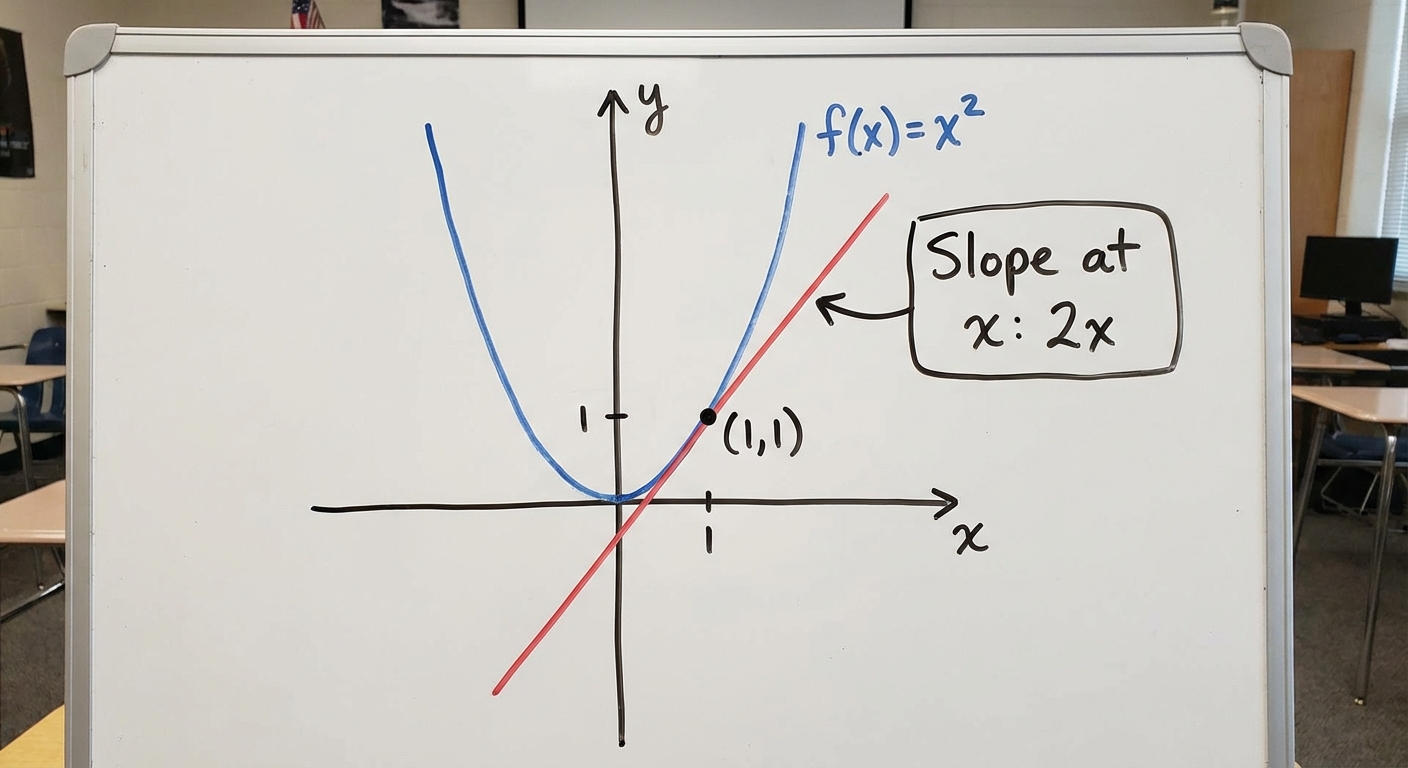
Examples (worked step-by-step)
Example 1: Differentiate a positive integer power
%%LATEX12%%
%%LATEX13%%
Example 2: Differentiate a negative power
%%LATEX14%%
%%LATEX15%%
It can help to rewrite the result as a fraction:
Example 3: Differentiate a fractional power
%%LATEX17%%
%%LATEX18%%
You could interpret
%%LATEX19%%
as
%%LATEX20%%
when x is nonnegative, but you do not need to rewrite it unless the problem asks.
What goes wrong (common misconceptions)
Students commonly make these errors:
- Forgetting that the exponent changes. For instance, writing the derivative as
%%LATEX21%% instead of %%LATEX22%% - Confusing negative exponents. A negative exponent indicates a reciprocal, not a negative value, but the Power Rule still applies normally.
- Failing to rewrite radicals before differentiating. Trying to differentiate a cube root “in your head” often leads to errors. Always write it explicitly as a power first.
- Assuming the Power Rule covers everything that “looks like a power.” The Power Rule directly applies to
%%LATEX23%% not necessarily to something like %%LATEX24%%
(which requires the Chain Rule, typically taught alongside or soon after these basics).
Exam Focus
- Typical question patterns:
- Differentiate polynomials like
- Differentiate expressions involving negative or fractional exponents such as
- Use derivatives to interpret rates of change (velocity from position, marginal change, slope at a point).
- Common mistakes:
- Dropping the exponent without subtracting 1.
- Mishandling negative exponents when rewriting in fraction form.
- Simplification errors (especially with fractional coefficients).
- Forgetting to rewrite radicals explicitly as powers before applying
Derivative Rules: Constant, Constant Multiple, Sum, Difference (Linearity)
Real calculus problems rarely involve a single term like a power of x. You usually see functions built by combining simpler pieces—adding, subtracting, or multiplying by constants. The good news is that differentiation behaves nicely with these operations.
A big idea to internalize is that differentiation is linear: it distributes over addition and subtraction, and you can pull constant factors out.
Derivative of a constant (Constant Rule)
A constant function has the form
%%LATEX28%%
where c is a real number. Its derivative is
%%LATEX29%%
This makes intuitive sense because a horizontal line has slope 0 everywhere.
Constant Multiple Rule
If you multiply a function by a constant, you multiply its derivative by the same constant:
Sum Rule and Difference Rule
If a function is a sum or difference, differentiate term-by-term:
%%LATEX31%%
%%LATEX32%%
How to apply linearity (a reliable process)
When you see a function like
- Break it into pieces.
- Differentiate each piece.
- Add the results back together.
Examples (worked step-by-step)
Example 1: Polynomial with a constant term
Differentiate term-by-term.
For the first term:
For the second term:
For the constant:
So
Example 2: Negative exponents and multiple terms
%%LATEX39%%
Differentiate each term:
%%LATEX40%%
%%LATEX41%%
%%LATEX42%%
So
%%LATEX43%%
If desired, rewrite as fractions:
%%LATEX44%%
Worked Example: Rewrite → Differentiate → Simplify (polynomial with radicals and rational terms)
Find the derivative for
Step 1: Rewrite
Step 2: Differentiate (apply rules)
Step 3: Simplify
What goes wrong (common misconceptions)
- Forgetting to differentiate every term (often the middle term in longer expressions).
- Treating the derivative of a constant as the constant. It must be 0.
- Losing negative signs when applying the Difference Rule. Be deliberate when copying terms.
- Confusing “constant multiple” with a true product. Multiplying by a number is covered here; multiplying by another variable expression is not (that requires the Product Rule later).
- Evaluating before differentiating. If you are asked for a value like
you must find the general derivative
first, and only then substitute x equals 2. If you substitute first, you may turn the expression into a constant, and the derivative of a constant is 0.
Exam Focus
- Typical question patterns:
- Differentiate multi-term functions efficiently using term-by-term differentiation.
- Evaluate the derivative at a specific point (for example, compute
after finding
).
- Interpret slope or rate of change for linear combinations (for example, total velocity from component functions).
- Common mistakes:
- Arithmetic errors with coefficients (especially negatives and fractions).
- Writing
(incorrect; derivatives add, they do not multiply).
- Forgetting that x means x to the first power, so its derivative is 1.
- Plugging in a value (like 2) before differentiating.
Derivatives of Trigonometric Functions
Trigonometric functions appear in periodic phenomena: sound waves, rotating wheels, seasonal temperature cycles, and any situation with repeating behavior. In calculus, their derivatives are essential because they connect “position-like” and “velocity-like” behavior in oscillations.
Transcendental functions (exponentials, logarithms, and trigonometry) cannot be differentiated using the Power Rule, so you must memorize their standard derivative forms.
Angle mode and units (radians matter)
These derivative formulas assume angles are measured in radians, not degrees. If you use degrees, the clean relationships below break unless you include extra conversion factors.
Core trig derivative formulas (all six)
You are expected to know the derivatives of all six trigonometric functions:
These are “known facts” derived from limit definitions and trig identities. On the AP exam, you are generally expected to apply them correctly rather than re-derive them.
Why these derivatives make sense (conceptual picture)
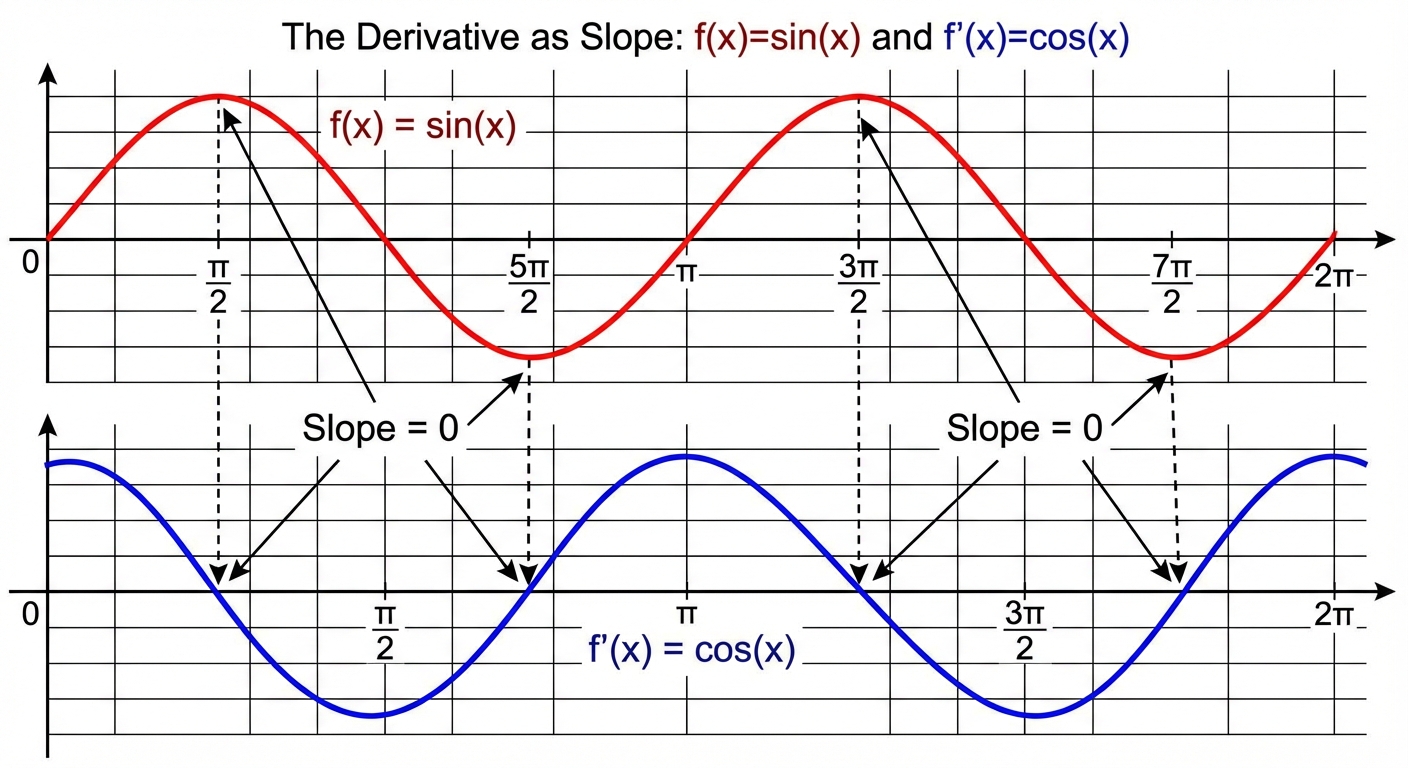
Sine and cosine are phase-shifted versions of each other, so differentiation acts like a phase shift for sinusoidal motion: the rate of change of a sine wave is a cosine wave.
The negative sign in the cosine derivative is not random. Since cosine has a maximum at x equals 0 and then immediately decreases, the slope just to the right of 0 must be negative.
Visual connection (sine and cosine)
The other four: tangent, cotangent, secant, cosecant (memorize)
These are often derived using the Quotient Rule (covered later), but for now they are standard forms to memorize.
Memory aids
The “PSST” mnemonic:
- Tangent goes with Secant
- Cotangent goes with Cosecant
The Negative “Co” Rule:
- All trig functions starting with “c” (cos, cot, csc) have negative derivatives.
How to use trig derivatives with linearity
Many problems at this stage combine trig terms with constants and sums/differences, such as
You can differentiate term-by-term using the Constant Multiple Rule and Sum/Difference Rules.
Examples (worked step-by-step)
Example 1: Sums of trig functions
%%LATEX61%%
%%LATEX62%%
%%LATEX63%%
%%LATEX64%%
So
Example 2: Tangent and secant
%%LATEX66%%
%%LATEX67%%
So
What goes wrong (common misconceptions)
- Missing the negative sign:
This is one of the most common small errors with big consequences.
- Mixing up derivatives:
but
- Forgetting domain issues. For example, tangent and secant are undefined where cosine equals 0, so the original function (and its derivative) is not defined at those points.
- Using degrees instead of radians.
Exam Focus
- Typical question patterns:
- Differentiate expressions like
- Compute a slope at a point by evaluating a trig derivative, for example find
- Interpret periodic rate-of-change situations (for example, height of a Ferris wheel vs. time).
- Common mistakes:
- Sign errors for cosine, cosecant, and cotangent derivatives (use the Negative “Co” Rule).
- Writing
(confusing the derivative with the original function).
- Not recognizing when a trig function is undefined at the evaluation point.
Derivatives of Exponential and Logarithmic Functions
Exponential and logarithmic functions model growth and decay, scaling, and processes where the rate of change depends on the current amount (compound interest, population growth, radioactive decay). In calculus, they are especially powerful because exponentials have the special property that their derivative is proportional to themselves.
Transcendental functions (exponentials and logarithms included) cannot be differentiated using the Power Rule, so you must memorize their specific forms.
Exponential functions and their derivatives
The natural exponential
The function
%%LATEX75%%
is special because its derivative is exactly itself:
%%LATEX76%%
This “self-replicating” behavior is why e to the x is the natural language of continuous growth and differential equations.
General base exponentials
For a constant base a with a greater than 0 and a not equal to 1,
Here, ln(a) is just a constant scaling factor.
Logarithmic functions and their derivatives
Natural log
For x greater than 0,
Conceptually, ln x grows slowly, and its slope decreases as x increases, matching the behavior of 1 over x.
Log base a
For x greater than 0 and a greater than 0 with a not equal to 1,
This follows from the identity
Visual Tip (helps you remember the scaling factor)
Since
%%LATEX81%%
and
%%LATEX82%%
the general-base formulas must “reduce” correctly to the base-e case. If you forget whether a factor of ln(a) belongs, check that your formula works when a equals e.
How to differentiate mixed exponential/log expressions (within basic rules)
At this stage, you can handle sums/differences and constant multiples like
because each term matches a basic derivative pattern and linearity applies.
Be careful about domain: ln x and log base a of x require x greater than 0 in real-valued AP Calculus contexts, so the whole function is restricted accordingly.
Examples (worked step-by-step)
Example 1: Combine exponentials and logs with sums
%%LATEX84%%
Differentiate term-by-term:
%%LATEX85%%
%%LATEX86%%
%%LATEX87%%
So
Example 2: Log base 10 derivative
%%LATEX89%%
%%LATEX90%%
What goes wrong (common misconceptions)
- Forgetting the ln(a) factor for a to the x. Students often write
but the correct derivative is
- Confusing the Power Rule with exponential rules. The Power Rule applies when the base is variable and the exponent is constant; exponential rules apply when the base is constant and the exponent is variable.
A common incorrect attempt is:
The correct derivative is:
- Mixing up ln x and e to the x:
but
- Ignoring domain restrictions: ln x and log base a of x require x greater than 0.
- Assuming log properties let you “split” logs incorrectly. For example, rewriting ln(x+1) as ln x plus ln 1 is not valid, and differentiating ln(x+1) would require the Chain Rule (beyond the narrow “basic rules” scope).
Exam Focus
- Typical question patterns:
- Differentiate linear combinations such as
- Evaluate derivatives at specific points, for example compute
when
- Interpret growth or decay rates when the model uses e to the x or a to the x.
- Common mistakes:
- Omitting ln(a) in
- Treating ln x as though it differentiates to ln x.
- Plugging in non-positive values when evaluating expressions involving ln x.
- Trying to apply the Power Rule to exponentials (base constant, exponent variable).