Unit 5: Harmony and Voice Leading II - Functional Harmony
The Harmonic Phrase Model
In tonal music, harmony is not just a random sequence of chords; it follows a grammatical logic known as functional harmony. In AP Music Theory, this logic is summarized by the Phrase Model. Understanding this model is the foundation for part-writing and analysis in Unit 5.
The Standard Progression
The basic syntax of a musical phrase typically follows this trajectory:
Tonic (T) $\rightarrow$ Predominant (PD) $\rightarrow$ Dominant (D) $\rightarrow$ Tonic (T)
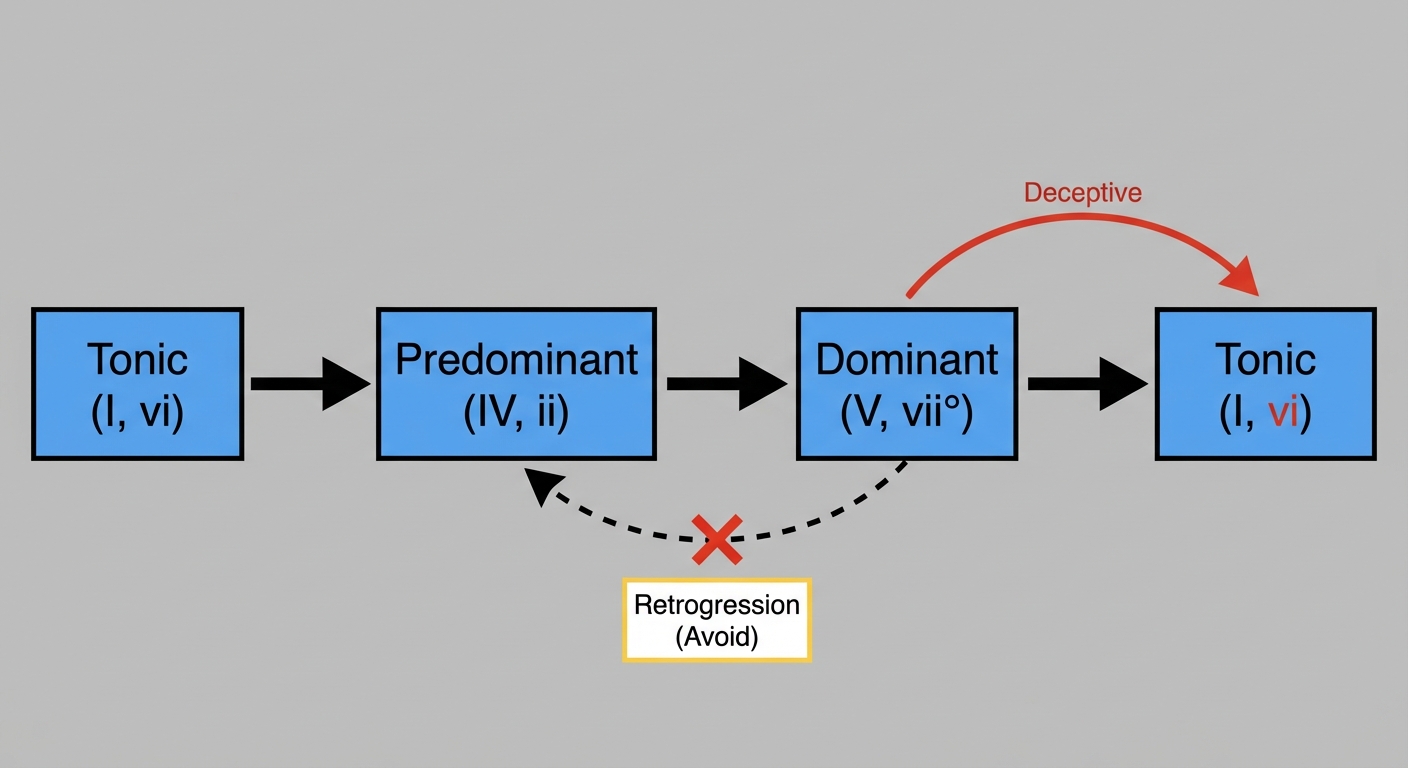
- Tonic (T): Stability. The home base ($I$ or $i$, sometimes substituted by $vi$ or $VI$).
- Predominant (PD): Preparation. Pulls away from the tonic and sets up the dominant ($IV$ or $ii$).
- Dominant (D): Tension. Demands resolution back to the tonic ($V$ or $vii^\circ$).
Key Concept: You generally do not move backward through the chart. For example, moving from Dominant ($V$) back to Predominant ($ii$) is called retrogression and is generally avoided in Common Practice Style (and on the AP exam).
Predominant Function: The ii and IV Chords
The most common chords used to prepare the dominant are the Supertonic ($ii$) and the Subdominant ($IV$). These are the "Predominants."
The Subdominant ($IV$ or $iv$)
The $IV$ chord represents a departure from stability. It often leads to $V$ (a "plagal" motion if it goes back to $I$, but usually it goes to $V$ first).
- Voice Leading: When moving $IV \rightarrow V$, the roots move by step. To avoid parallel perfect fifths and octaves, the upper three voices usually move in contrary motion to the bass.
The Supertonic ($ii$ or $ii^\circ$)
The $ii$ chord is generally considered a stronger predominant than $IV$. It shares the same root movement logic as the circle of fifths ($ii \rightarrow V$ is a falling fifth).
- In Major Keys: The chord is minor ($ii$).
- In Minor Keys: The chord is diminished ($ii^\circ$).
- Because $ii^\circ$ is a diminished triad, it is dissonant. It is very frequently found in first inversion ($ii^{\circ6}$). This places the third of the chord in the bass, improving its stability and voice-leading smoothness.
Comparing $ii$ and $IV$
While both are Predominants, you can move from $IV \rightarrow ii$ (moving from a weaker predominant to a stronger one), but you almost never move $ii \rightarrow IV$.
Common Progression: $I \rightarrow IV \rightarrow ii \rightarrow V \rightarrow I$
The Circle of Fifths Progression
One of the strongest harmonic motions in music is root movement by descending perfect fifths (or ascending perfect fourths). This is the driving force behind the standard $ii - V - I$ turnaround.
In a longer sequence, the circle of fifths progression might look like this in a major key:
Rules for Part-Writing Circular Progressions
- Root Movement: Roots fall by fifths ($A \rightarrow D \rightarrow G \rightarrow C$).
- Voice Leading: Alternate between complete chords with third-to-third voice leading ranges. Often, if you hold common tones and move the other voices to the nearest chord tone, you will naturally alternate between close structure and open structure, or you will create a sequence in the upper voices.
Second Inversion Triads: The Six-Four Chords
Perhaps the most specifically tested concept in Unit 5 is the Six-Four Chord (a triad with the fifth in the bass, figured bass notation $^6_4$).
In the Common Practice Period ($1600-1900$), the $6/4$ chord is considered dissonant because the interval of a fourth against the bass is treated as unstable. Therefore, you cannot use $6/4$ chords freely. They must function in one of four specific ways.
Universal Rule for 6/4 Chords: ALWAYS double the bass (the 5th of the chord). Never double the root or the third.
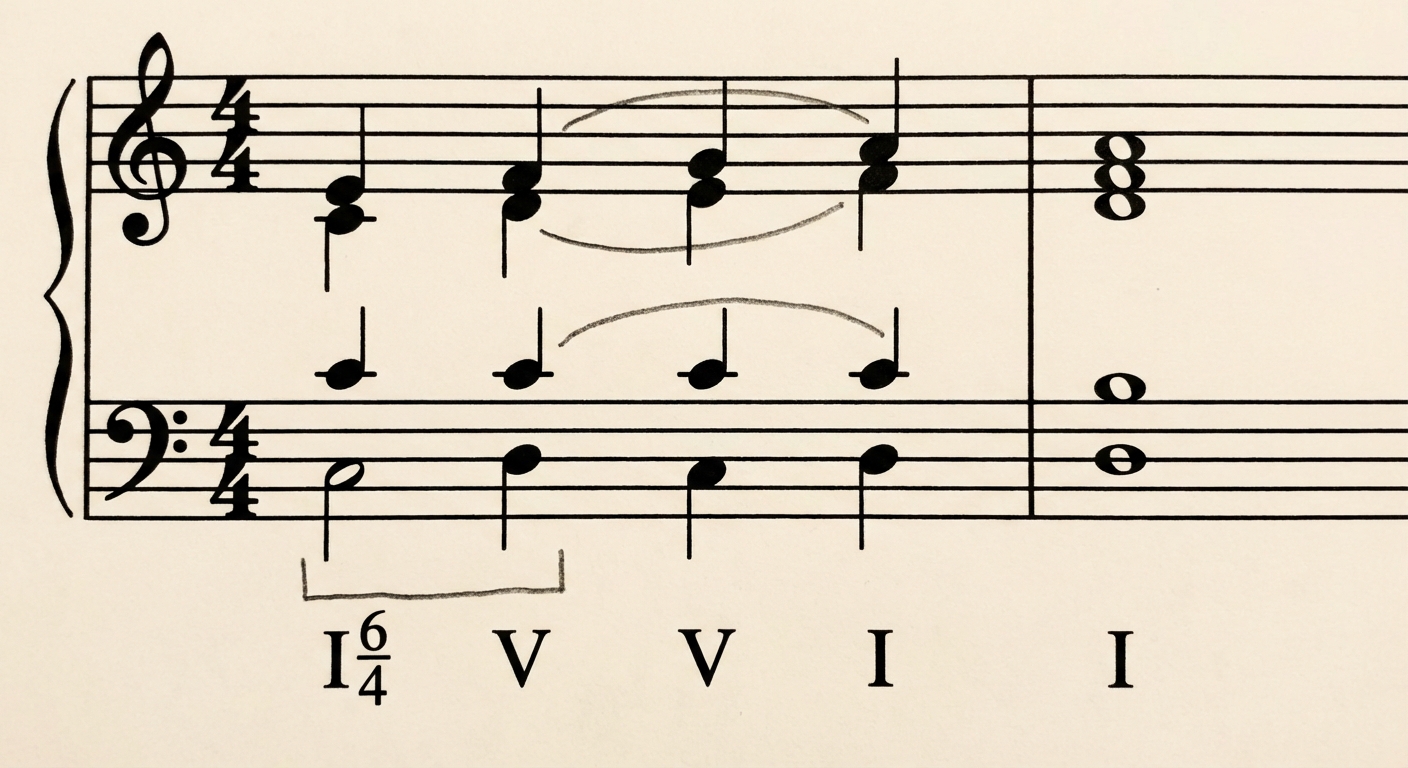
1. The Cadential Six-Four ($cad^6_4$)
This is the most common use. Despite looking like a Tonic chord ($I^6_4$), it functions as a Dominant preparation. It is essentially a $V$ chord with two non-chord tones (susensions/appoggiaturas) above it that usually resolve down by step.
Characteristics:
- Function: Dominant ($V$).
- Metrical Placement: Must occur on a strong beat.
- Resolution: The 6th above the bass resolves to the 5th ($8-7$ motion implies $3-2$ scale degrees) and the 4th resolves to the 3rd ($6-5$ implies $1-7$ scale degrees).
- Context: It precedes the $V$ chord at a cadence.
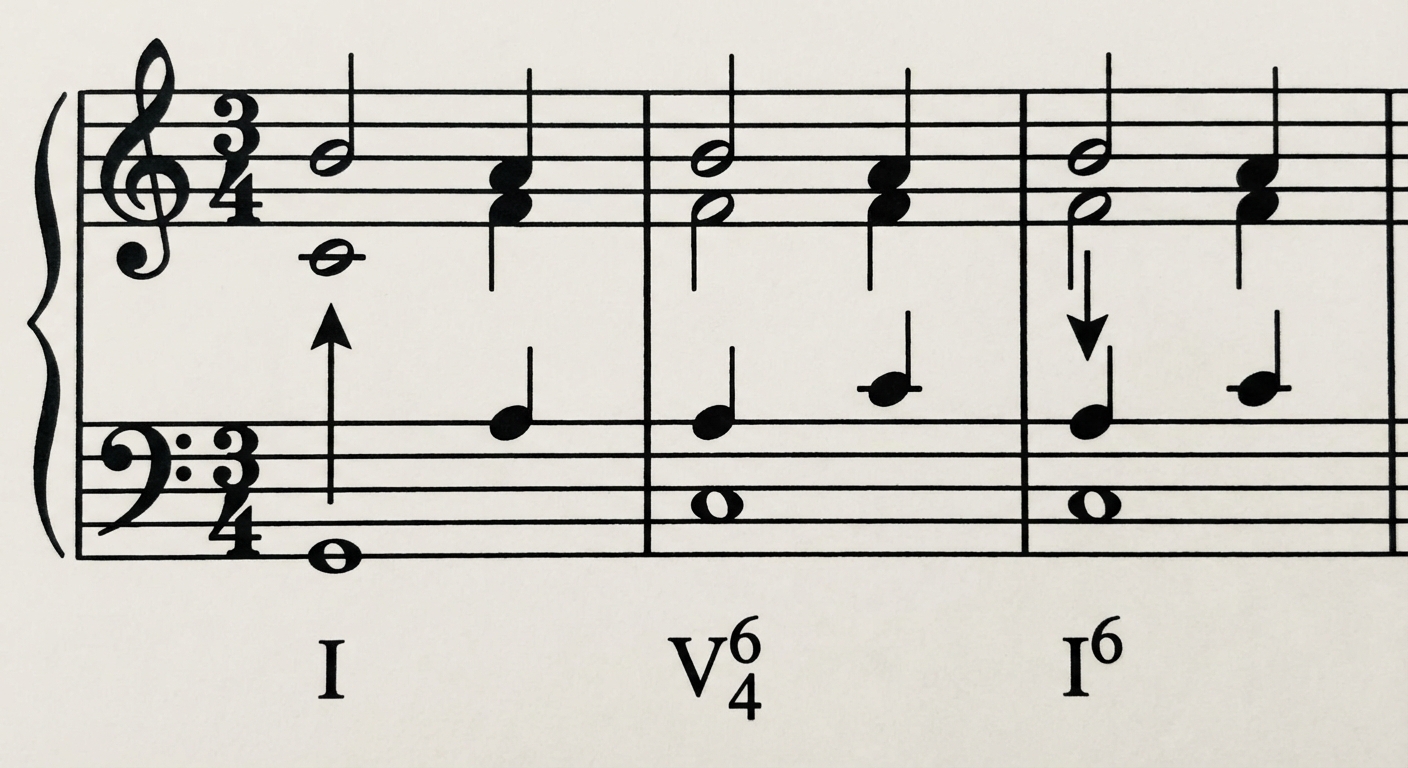
2. The Passing Six-Four
This chord connects a root position chord to a first inversion chord (or vice versa) via stepwise motion in the bass.
Characteristics:
- Function: Prolongation (expands the area of a single harmony).
- Metrical Placement: Weak beat.
- Voice Exchange: A voice exchange often occurs between the bass and the soprano (one goes $1-2-3$, the other goes $3-2-1$).
- Common Progression: $I \rightarrow V^6_4 \rightarrow I^6$ (Bass: Do-Re-Mi).
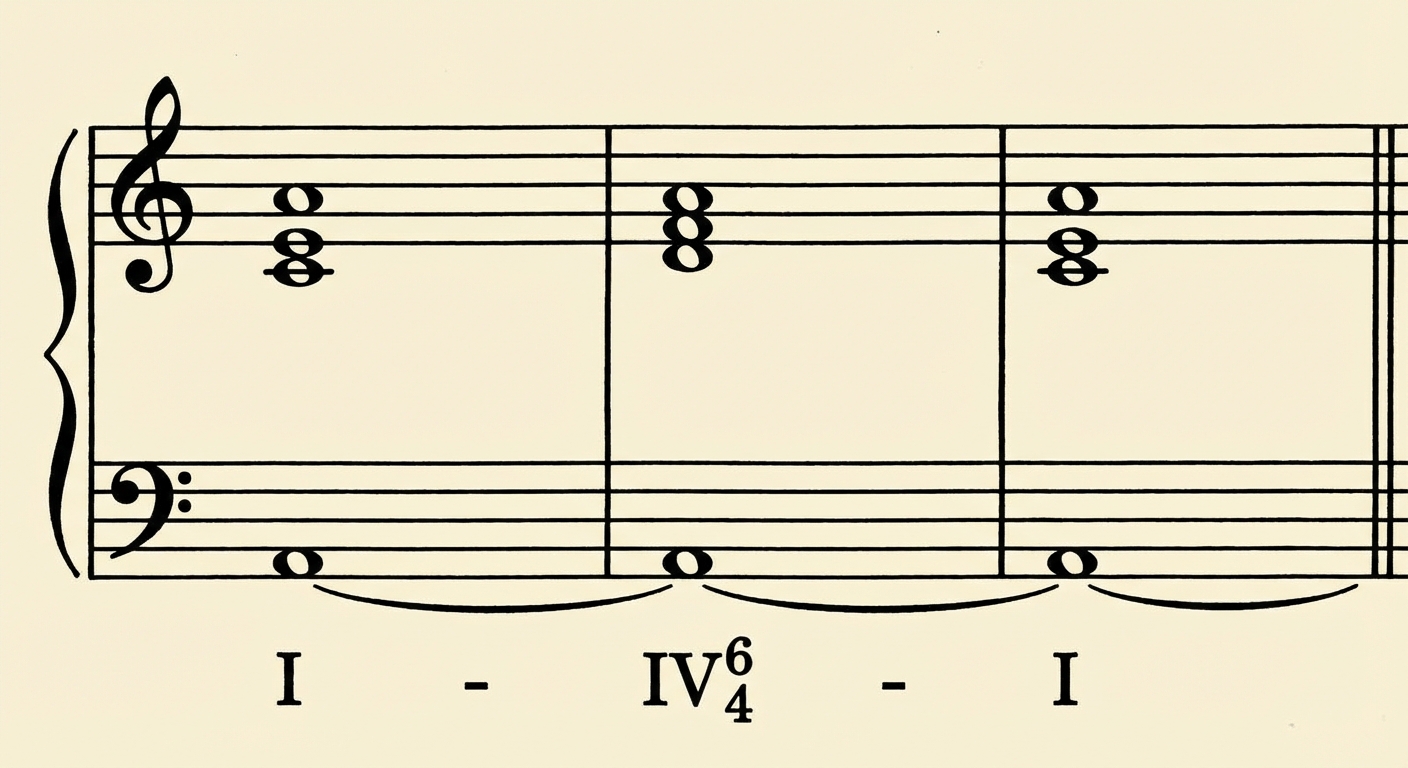
3. The Pedal (Neighboring) Six-Four
This occurs when the bass note stays stationary (a pedal point) while the upper voices move up to neighbors and back down.
Characteristics:
- Function: Prolongation (usually expanding the Tonic).
- Metrical Placement: Weak beat.
- Motion: The bass holds the root of the I chord. The 3rd and 5th of the I chord move up to the 4th and 6th (creating a $IV^6_4$) and return.
- Common Progression: $I \rightarrow IV^6_4 \rightarrow I$.
4. The Arpeggiated Six-Four
This occurs if the bass simply arpeggiates the same chord (e.g., Bass moves Low $C \rightarrow G \rightarrow High C$) while the harmony remains static. It is less "syntactical" and more common in waltz accompaniments or simple chord elaborations.
Memory Aids & Mnemonics
- "Six-Four, Double the Floor": When writing a $^6_4$ chord, always double the lowest note (the bass).
- "Cadential is Strong": The Cadential $6/4$ is the only one that happens on a strong beat (accented). Passing and Pedal are weak (unaccented).
- Sequence of Strength: $IV \rightarrow ii \rightarrow V$ (Get stronger as you approach the dominant). Think of $ii$ as the "Super" tonic—it's super at leading to $V$.
Common Mistakes & Pitfalls
1. Labeling the Cadential 6/4 as Tonic
- The Mistake: Analyzing a $I^6_4 - V - I$ progression as "Tonic - Dominant - Tonic."
- The Fix: In AP Theory, the $Cad^6_4$ is considered part of the Dominant function. Do not think of it as a Tonic chord. It is a decoration of $V$.
2. Incorrect Doubling in 6/4 chords
- The Mistake: Doubling the root (the name of the chord) in a second inversion triad.
- The Fix: Because the fourth above the bass is dissonant, we must double the static bass note (the 5th of the chord) to provide stability.
3. Parallel Octaves/Fifths with IV to V
- The Mistake: Moving all voices in the same direction when moving from $IV$ to $V$.
- The Fix: This is a danger zone because roots are separated by a step. Move the upper three voices in contrary motion to the bass line.
4. Retrogressions
- The Mistake: Writing $V \rightarrow IV$ or $V \rightarrow ii$.
- The Fix: Remember the flow: $PD \rightarrow D \rightarrow T$. Dominants resolve to Tonics (or deceptively to $vi$), not back to Predominants.