Comprehensive Guide to AP Comparative Government Unit 3
3.1 Civil Society
Defining Civil Society
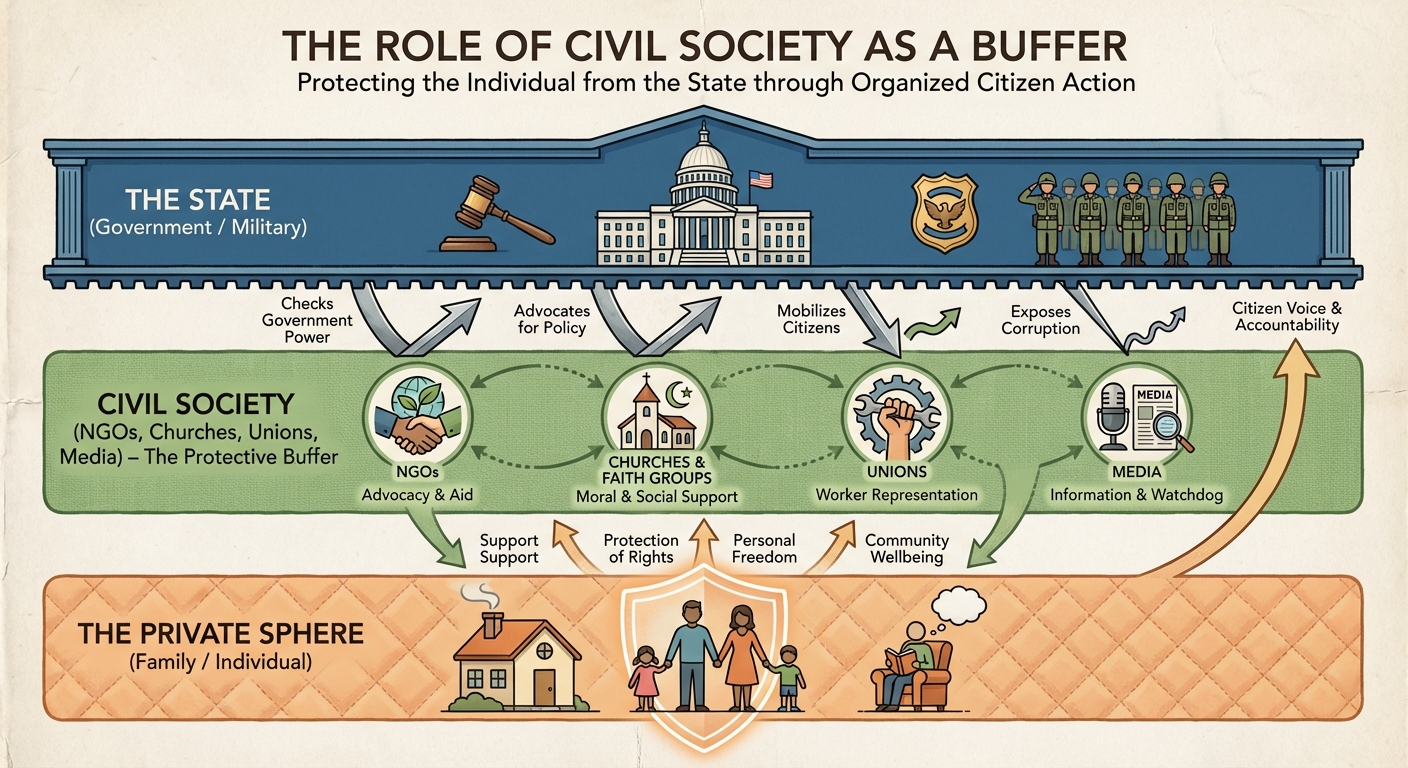
Civil Society refers to the diverse range of voluntary associations and organizations that operate independently of the government and the private (for-profit) market. It acts as a buffer zone between the state and the individual.
- Key Characteristics:
- Voluntary: Participation is not coerced.
- Autonomous: They operate self-sufficiently, distinct from state control.
- Public-oriented: While they may serve private interests (like a union), they operate in the public sphere to influence or check state power.
- Examples: Religious groups, labor unions, professional associations, NGOs (Non-Governmental Organizations), charities, and recreational clubs.
The Role of Civil Society in Different Regimes
In Democratic Regimes (e.g., UK, Mexico, Nigeria)
- Pluralism: Civil society acts as a check on government power (a watchdog).
- Articulation of Interests: It provides a vehicle for citizens to aggregate their needs and petition the government.
- Social Capital: It builds trust and cooperation among citizens.
In Authoritarian Regimes (e.g., China, Russia, Iran)
- Corporatism: The state may create or sanction only specific organizations (GONGOs - Government-Organized Non-Governmental Organizations) to monopolize representation.
- Monitoring: The state uses these organizations to spy on or control the population.
- Restriction: Independent groups are often harassed, required to register as “foreign agents” (Russia), or banned if they threaten state stability.
Country-Specific Examples
| Country | Civil Society Status | Specific Examples |
|---|---|---|
| UK | Robust & Pluralist | TUC (Trades Union Congress), CBI (Confederation of British Industry), Amnesty International. |
| Russia | Severely Restricted | Memorial (banned human rights group), “Foreign Agent” laws restrict funding for NGOs. |
| China | State-Controlled (Corporatist) | All-China Federation of Trade Unions (state-run), environmental NGOs are allowed if they don't criticize the Party. |
| Iran | Weak/Restricted | Green Movement (suppressed), religious foundations (Bonyads) are powerful but linked to the clerics, not independent civil society. |
| Mexico | Growing but threatened | Vibrant press and cartel-watch groups, but journalists/activists face violence from criminal organizations. |
| Nigeria | Active but Fragmented | Labor unions (NLC) often organize strikes; Boko Haram destroys civil society in the North; strong religious networks. |
Common Mistakes
- Mistake: Thinking “civil society” means a society that is polite or civilized.
- Correction: It refers to civilian organizations outside the government.
- Mistake: Assuming there is NO civil society in authoritarian regimes.
- Correction: It exists, but it is often underground, heavily regulated, or co-opted by the state (corporatism).
3.2 Political Culture
Political Culture is the collective history, values, beliefs, and attitudes that the citizenry holds about the legitimacy of the government and their role in the political system.
Categories of Political Culture (Almond & Verba)
- Parochial: Citizens feel distant from government and have no knowledge/interest (often in remote/tribal areas).
- Subject: Citizens accept government authority/laws but do not participate (common in authoritarianism).
- Participant: Citizens believe they can influence the system and actively participate (common in democracies).
Political Culture by Core Country
United Kingdom
- Gradualism: Belief in evolutionary rather than revolutionary change.
- Insularity: Feeling separate from the European continent (drove Brexit).
- Noblesse Oblige: Tradition where the wealthy/elite have a duty to look after the poor (roots of the Welfare State).
Russia
- Statism: A strong belief that the state should control conflicting social forces and the economy; citizens expect the state to be active in their lives.
- Desire for Order: Historically, Russians value stability and a “strong hand” leader over abstract civil liberties.
China
- Confucianism: Respect for hierarchy, authority, and social harmony.
- Maoism vs. Capitalism: A blend of communist ideology with pragmatic economic beliefs (“It doesn’t matter if a cat is black or white, so long as it catches mice”).
- Nationalism: Strong pride in regaining global status after the “Century of Humiliation.”
Mexico
- Patron-Clientelism (Camarillas): A system of exchanging political support for government jobs or favors.
- Machismo: Male dominance in political and social spheres (though changing with gender quotas).
- Transitional Trust: Growing trust in democratic institutions (INE) but distinct history of electoral fraud.
Nigeria
- Prebendalism: The belief that government officials have a right to use public office for personal gain to benefit their specific ethnic/tribal group.
- Fragmented: Low sense of national identity; loyalty lies with the ethnic group (Yoruba, Igbo, Hausa-Fulani) rather than the state.
Iran
- Religious vs. Secular: Deep divide between those supporting the Theocracy (Velayat-e Faqih) and those seeking republican/secular reforms.
- Anti-Imperialism: Distrust of the West (especially US/UK) due to historical interference (e.g., 1953 coup).
3.3 Political Socialization
Political Socialization is the lifelong process by which individuals acquire their political attitudes, views, and knowledge.
Agents of Socialization
- Family: The primary and most enduring influence.
- Schools: Curriculum often reinforces national values (e.g., “Patriotic Education” in China).
- Media:
- Free media acts as a watchdog in democracies.
- State media functions as a propaganda arm in authoritarian regimes (e.g., CCTV in China).
- Religious Institutions: Crucial in Iran (Mosques), Nigeria (Churches/Mosques), and Poland.
Comparison: Democratic vs. Authoritarian Socialization
| Feature | Democratic Regimes | Authoritarian Regimes |
|---|---|---|
| Goal | Build civic competence and participation. | Instill loyalty and obedience to the regime. |
| Curriculum | Critical thinking, civics, various viewpoints. | Ideological indoctrination, censorship of history (e.g., Tiananmen Square erasure). |
| Peer Groups | Open debate encouraged. | Self-censorship due to fear of reporting/surveillance. |
3.4 Political Ideologies
Political Ideologies are coherent sets of values regarding the fundamental goals of politics.
Major Ideologies in Comp Gov
- Individualism/Liberalism: Belief in individual civil liberties and freedom from government restriction (Dominant in UK).
- Neoliberalism: Economic ideology favoring free markets, privatization of state-owned enterprises (SOEs), and reduced government spending. (Thatcherism in UK, Austerity in Mexico under PRI/PAN, “Shock Therapy” in Russia).
- Communism: Belief in the abolition of private property with state control over economic resources (China, USSR historical).
- Socialism: Promoting social equality via government provision of welfare/services, whilst allowing some private ownership.
- Fascism: Extreme nationalist authoritarianism; the state is supreme over the individual.
- Populism: Us-vs-Them mentality (The “pure people” vs. the “corrupt elite”). Seen in Brexit (UK) and AMLO (Mexico).
- Theocracy: Rule by religious leaders based on religious law (Iran).
Common Mistakes
- Mistake: Confusing Neoliberalism with social liberalism.
- Correction: Neoliberalism is purely economic (pro-business, pro-trade, anti-regulation). It has nothing to do with social issues like gay marriage.
3.5 Political Participation
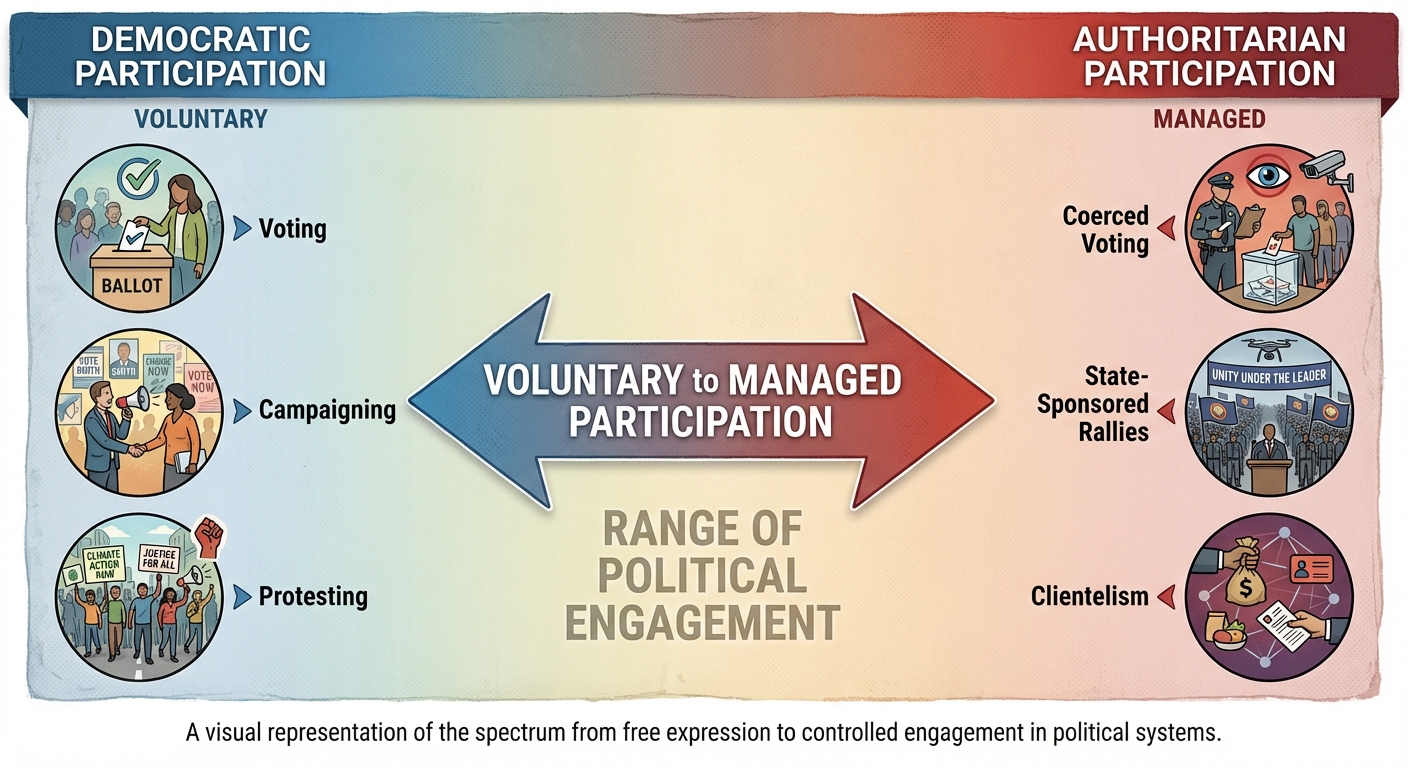
Political participation varies significantly based on the regime type. It can be Voluntary (Democratic) or Coerced/Managed (Authoritarian).
Forms of Participation
1. Voting
- Democracies: A way to choose policymakers. Turnout depends on efficacy.
- Authoritarian: A way to simulate legitimacy. High turnout (90%+) is distinct in authoritarian regimes because non-voting is seen as dissent.
2. Protest
- Civil Disobedience: Peaceful breaking of laws to protest injustice.
- Safety Valve Protests: Authoritarian regimes (like China) may allow small, local protests against local corruption to let people “vent,” preventing anger from targeting the central leadership.
3. Violence
- When institutional channels (elections) are blocked or illegitimate, participation turns violent.
- Examples: Boko Haram insurgents (Nigeria), Chechen separatists (Russia), Cartel violence against candidates (Mexico).
Linkage Institutions
Groups that connect the people to the government.
- Political Parties: Aggregate interests and run candidates.
- Interest Groups: Advocate for specific policy goals (e.g., NRA in US, TUC in UK).
- Media: Reports on government actions.
- Elections: The formal mechanism of choice.
3.6 Political and Social Cleavages
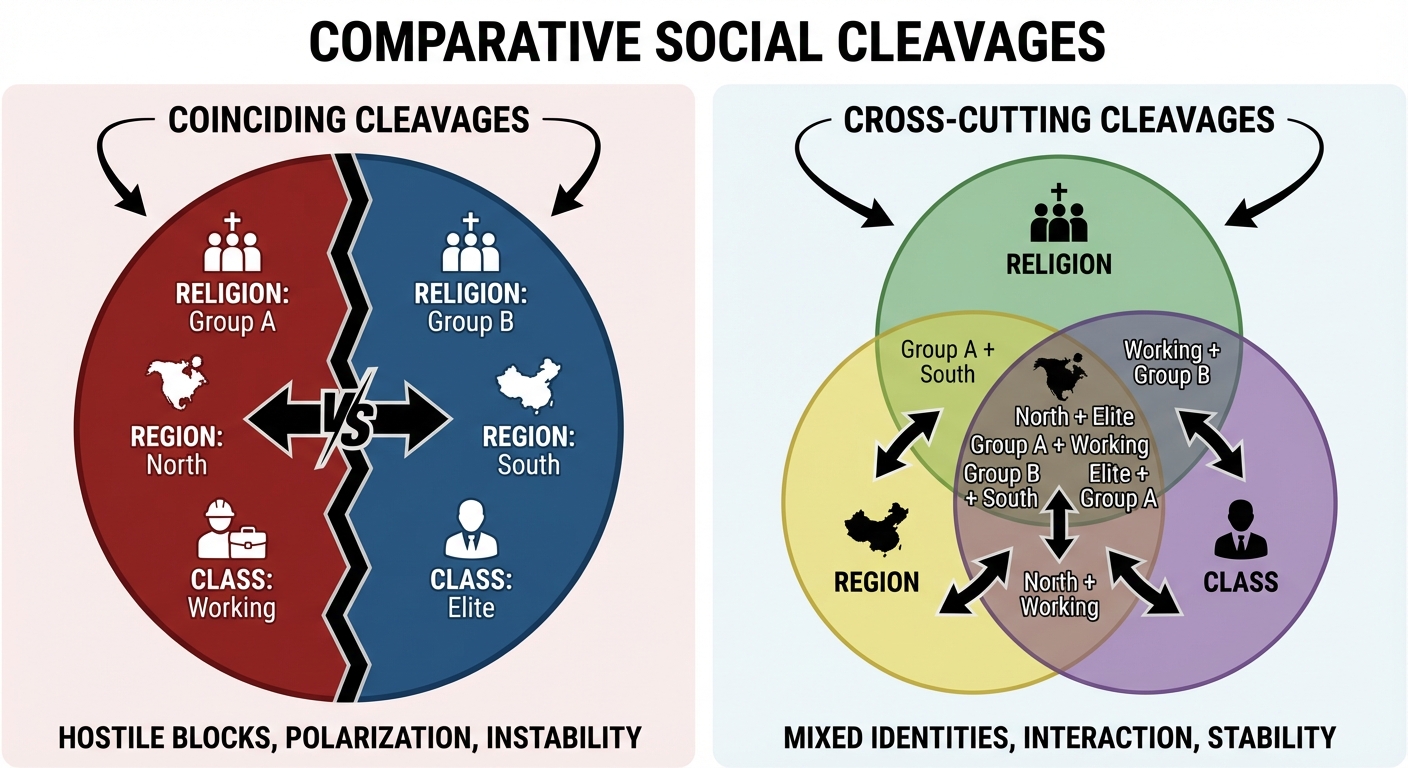
Cleavages are deep and internal divisions within a society based on ethnicity, religion, class, or territory.
Types of Cleavages (CRITICAL CONCEPT)
Coinciding (Reinforcing) Cleavages:
- When every dispute aligns the same groups against each other.
- Effect: Explosive. If you are Region A, you are also Religion A and Ethnicity A. It creates an "Us vs. Them" mentality.
- Example (Nigeria): The North is predominantly Hausa-Fulani, Muslim, and poorer. The South is Igbo/Yoruba, Christian, and wealthier. These divides stack on top of each other.
Cross-Cutting Cleavages:
- When divisions cut across different groups.
- Effect: Moderate conflict. You might disagree with someone on religion, but agree with them on class or region.
- Example (UK): You find wealthy Labour voters and poor Conservative voters; Scottish people can be Protestant or Catholic. This diffuses tension.
Cleavages in Core Countries
| Country | Primary Cleavages | Type | Impact |
|---|---|---|---|
| UK | Class (Historic), National Identity (Scottish/Irish), Urban vs. Rural (Brexit). | Mostly Cross-Cutting (becoming coinciding regarding Brexit) | Strains the Union (potential Scottish independence). |
| Russia | Ethnicity (Russian vs. Chechen/Tatar), Religion (Orthodox vs. Muslim). | Coinciding | Separatist violence in Chechnya. |
| China | Ethnicity (Han vs. Uighur/Tibetan), Urban vs. Rural (Hukou system). | Coinciding | Re-education camps in Xinjiang; massive wealth gap. |
| Iran | Religion (Shia vs. Sunni), Reformist vs. Conservative, Ethnicity (Persian vs. Kurd/Azeri). | Coinciding | Periodic massive protests met with state repression. |
| Mexico | Region (North-Industrial vs. South-Agricultural), Ethnicity (Mestizo vs. Amerindian). | Coinciding | Zapatista uprising in the South (Chiapas); North tends to vote PAN, South votes MORENA/PRD. |
| Nigeria | Ethnicity (250+ groups), Religion (Muslim North/Christian South), Region. | Strongly Coinciding | Constant instability, violence, and difficulty passing national legislation. |
Common Mistakes
- Mistake: Thinking all cleavages lead to war.
- Correction: Cross-cutting cleavages actually strengthen democracy by forcing compromise. Only coinciding cleavages threaten state disintegration.
3.7 Civil Rights vs. Civil Liberties
Though often used interchangeably, they have distinct meanings in political science.
Civil Liberties: Protection FROM the government. Basic freedoms the government cannot take away.
- Examples: Freedom of speech, press, assembly, religion.
- Status: Protected in UK/Mexico (mostly); restricted in Russia/China/Iran.
Civil Rights: Protection BY the government. Guarantees of equal treatment and protection against discrimination.
- Examples: Right to vote, equal employment opportunity, rights for minorities.
- Status: Often legally codified but poorly enforced in developing nations (e.g., Women’s rights in Nigeria).
Specific Issues
- United Kingdom: No written Bill of Rights (unwritten constitution), but follows the European Convention on Human Rights (ECHR).
- China: Constitution guarantees speech/assembly, but the "Four Cardinal Principles" (Party supremacy) override them. Rights are subordinated to the state interest.
- Russia: Crackdown on LGBTQ+ rights (Propaganda laws); decriminalization of some domestic violence.
Summary of Unit 3 Trends
- Modernization Theory: As countries economically develop (Mexico, China), citizens usually demand more political participation. China is the outlier (economic growth without democratization).
- Democratization: The transition from authoritarian to democratic regimes requires robust civil society and a shift from subject to participant political culture.
- Globalization: Has created new cleavages in all 6 countries (Winners of globalization vs. Losers/Nationalists).