AP Biology Unit 8: Ecosystem Energetics
Foundations of Ecosystem Energy
Energy is the currency of life. In AP Biology, understanding how energy enters, flows through, and exits biological systems is crucial. Unlike matter (carbon, nitrogen, water), which cycles within an ecosystem, energy flows linearly. It enters as sunlight (usually) and eventually exits as heat.
The Laws of Thermodynamics in Ecology
Biological systems obey the laws of physics. These laws dictate why food chains are short and how much life an ecosystem can support.
- First Law of Thermodynamics (Conservation of Energy): Energy cannot be created or destroyed, only transformed.
- Application: The total energy entering an ecosystem (solar radiation) must equal the total energy stored (biomass) plus the energy reflected or dissipated as heat.
- Second Law of Thermodynamics (Entropy): Every energy transfer increases the entropy (disorder) of the universe.
- Application: No energy transfer is 100% efficient. In every biological process (respiration, digestion), some energy is lost as metabolic heat. This heat helps maintain homeostasis in endotherms but is ultimately lost to the universe, meaning energy cannot be recycled.
Strategies for Energy Acquisition
Organisms are grouped by how they obtain high-energy organic compounds.
- Autotrophs (Producers): Capture energy from physical or chemical sources.
- Photosynthetic: Use solar energy to convert $CO2$ and $H2O$ into glucose and $O_2$ (e.g., plants, algae, cyanobacteria).
- Chemosynthetic: Capture energy from small inorganic molecules (like hydrogen sulfide, $H_2S$) in the absence of light (e.g., bacteria in deep-sea hydrothermal vents).
- Heterotrophs (Consumers): Capture energy present in carbon compounds produced by other organisms.
- They hydrolyze carbohydrates, lipids, and proteins via respiration to generate ATP.
Trophic Levels and Food Webs
To map energy flow, ecologists assign organisms to trophic levels based on their primary source of nutrition.
Trophic Hierarchy
| Trophic Level | Definition | Examples |
|---|---|---|
| Primary Producers | Autotrophs that support all other levels. | Grass, Phytoplankton, Cactus |
| Primary Consumers | Herbivores that eat producers. | Grasshopper, Zooplankton, Rabbit |
| Secondary Consumers | Carnivores/Omnivores that eat herbivores. | Mouse, Bluegill fish, Spider |
| Tertiary Consumers | Carnivores that eat other carnivores. | Snake, Hawk, Shark |
| Decomposers | Break down non-living organic matter (detritus), recycling nutrients back to the soil. | Fungi, Bacteria |
Food Chains vs. Food Webs
A food chain is a linear pathway showing a single line of energy transfer. A food web is a complex network of interconnected food chains.
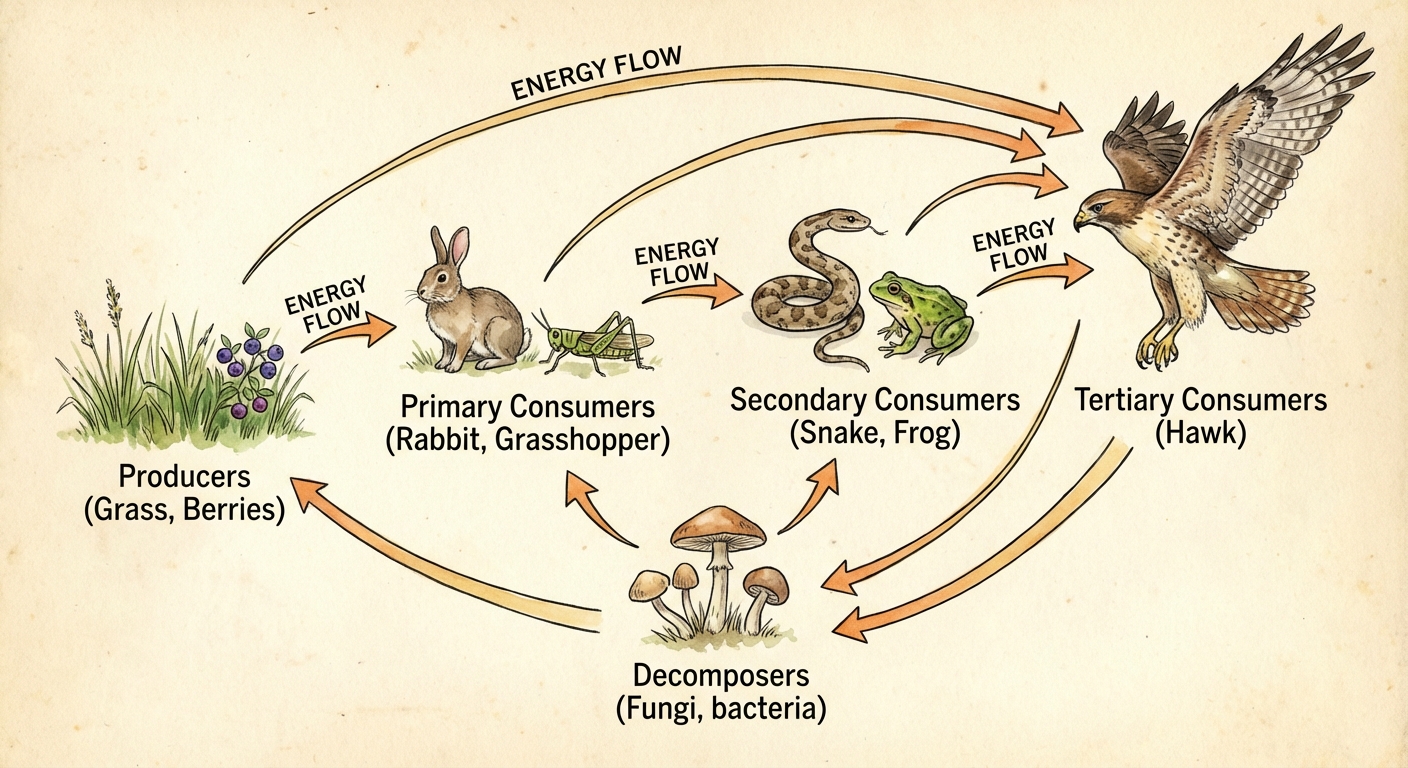
Critical Rule: The arrows in a food chain/web represent the direction of energy flow, not who fights whom. The arrow points from the organism being eaten to the organism that eats it.
Grass $\rightarrow$ Rabbit $\rightarrow$ Fox
Primary Productivity
This is one of the most math-heavy concepts in Unit 8. Primary productivity is the rate at which solar energy (or chemical energy) is converted into organic compounds by autotrophs over a specific time.
Gross vs. Net Primary Productivity
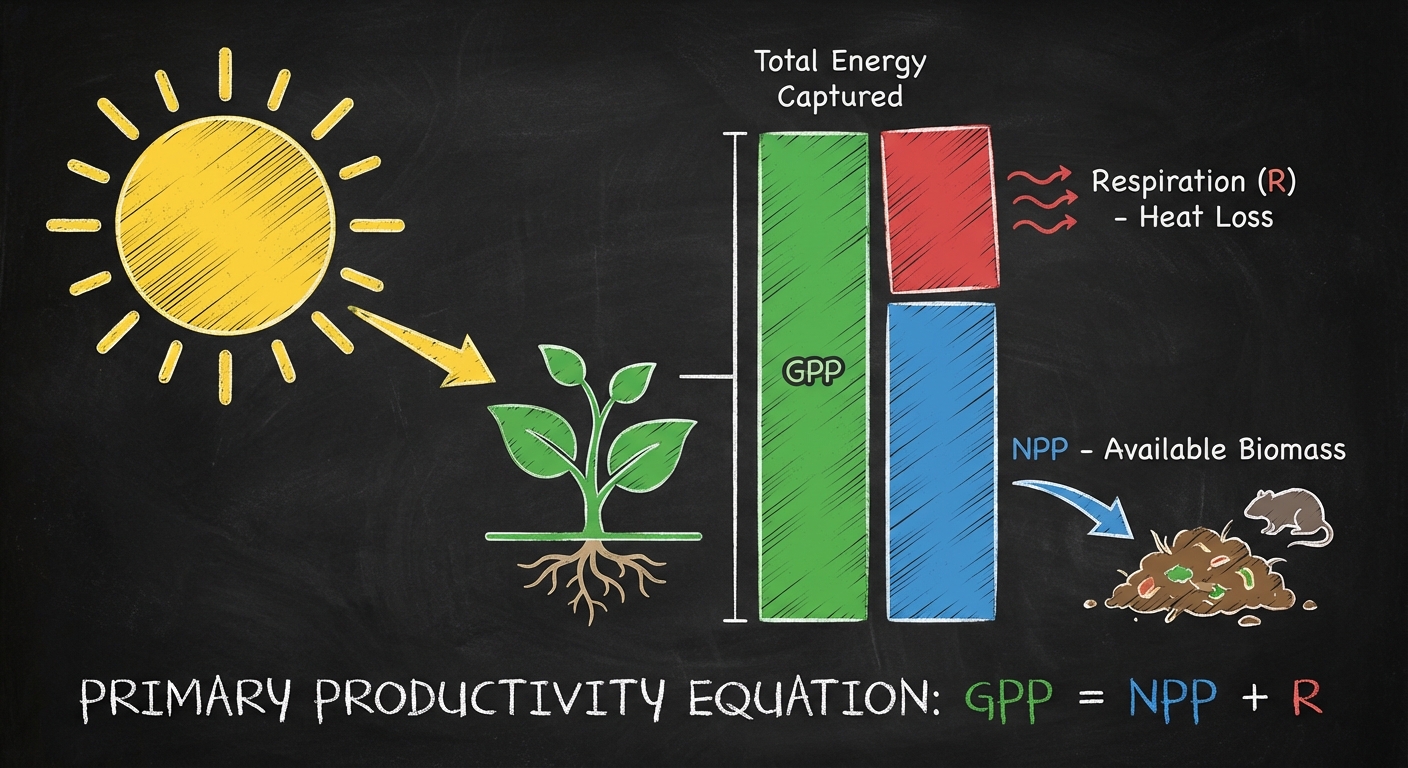
- Gross Primary Productivity (GPP): The total amount of energy captured by producers via photosynthesis per unit area per unit time.
- Net Primary Productivity (NPP): The organic material (biomass) that actually remains after the producers use some energy for their own cellular respiration.
The Golden Formula:
Where:
- $NPP$ = Energy available to consumers (biomass added)
- $GPP$ = Total energy captured
- $R$ = Energy lost due to respiration (metabolic cost)
The Paycheck Analogy:
- GPP is your Gross Salary (total money earned).
- R is Taxes/Bills (mandatory costs to stay alive).
- NPP is your Disposable Income (what is left over to save or spend… or for a predator to eat).
Measuring Productivity: The Light/Dark Bottle Method
A common AP lab scenario involves measuring dissolved oxygen in water samples containing algae.
- Light Bottle: Photosynthesis + Respiration occurs. ($NPP$ measurement)
- Dark Bottle: Only Respiration occurs. ($R$ measurement)
- Calculation: $Initial_DO - Dark_DO = Respiration$, and $(Light_DO - Initial_DO) + Respiration = GPP$.
Energy Efficiency and Pyramids
The 10% Rule of Ecological Efficiency
Only a fraction of the energy stored at one trophic level is transferred to the next. On average, ecological efficiency is about 10%.
Where does the other 90% go?
- Heat loss: A byproduct of cellular respiration (Second Law of Thermodynamics).
- Not Eaten: Bones, fur, wood, and roots may die and decompose rather than being consumed by the next level.
- Eaten but not assimilated: Egested waste (feces).
Ecological Pyramids
Ecologists use pyramids to visualize the diminishing returns across trophic levels.
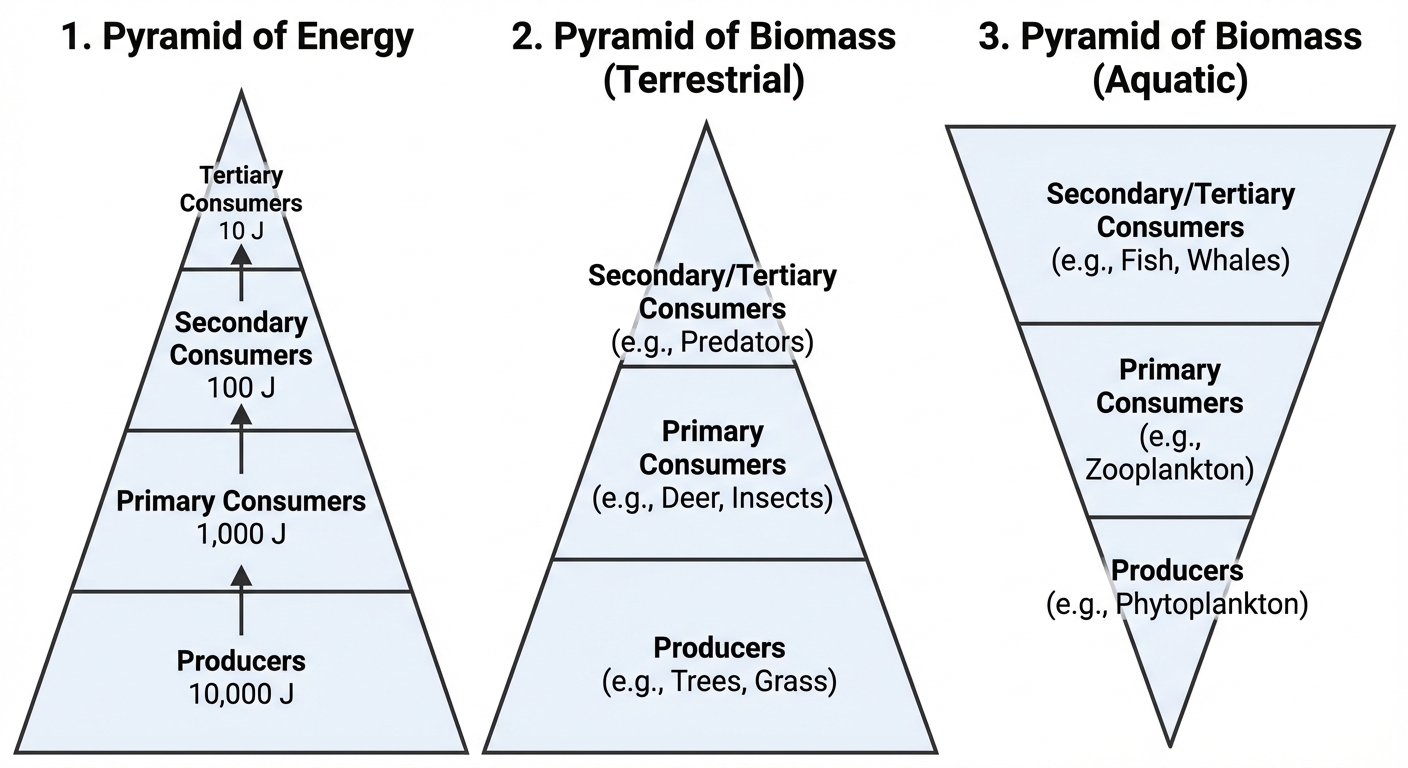
Pyramid of Energy:
- Shows the amount of energy (Joules or kcal) available at each level.
- Rule: MUST always be upright (wide base, narrow top). Energy laws prevent this from ever being inverted.
Pyramid of Biomass:
- Shows the dry weight of organic matter at each level.
- Usually Upright: e.g., A forest (lots of wood) $\rightarrow$ Insects $\rightarrow$ Birds.
- Exception (Inverted): In some aquatic ecosystems, the producers (phytoplankton) reproduce and are eaten so quickly that at any specific moment, their standing biomass is lower than the zooplankton. However, their turnover rate is high enough to support the web.
Pyramid of Numbers:
- Shows the count of individual organisms.
- Variable Shape: Can be inverted if the producer is very large (e.g., one Oak Tree supports thousands of insects).
Common Mistakes & Pitfalls
1. Energy Cycling vs. Matter Cycling
- Mistake: Saying "Energy recycles in an ecosystem."
- Correction: Energy flows. Sunlight enters, heat leaves. It never returns to the sun or the plants. Matter (Carbon, Nitrogen) cycles and is reused.
2. The Direction of the Arrows
- Mistake: Pointing the arrow from the predator to the prey (e.g., Fox $\rightarrow$ Rabbit).
- Correction: The arrow traces the path of the energy. The energy moves from the Rabbit into the Fox. Always point to the mouth of the eater.
3. Confusing GPP and NPP
- Mistake: Thinking herbivores consume GPP.
- Correction: Herbivores can only consume NPP (the plant biomass). GPP includes the energy the plant already burned to stay alive, which is gone as heat.
4. Endotherms vs. Ectotherms
- Mistake: Assuming endotherms (mammals/birds) are more efficient biomass producers than ectotherms (reptiles/insects).
- Correction: Endotherms use a huge portion of their energy to maintain body temperature (high $R$). Therefore, they have lower production efficiency outcomes (less biomass stored per unit of food eaten) compared to ectotherms, which don't burn energy for heat.