Mastering Polar Systems: Coordinates, Graphs, and Rates of Change
Polar Coordinates and Conversions
While the Cartesian (Rectangular) plane uses a grid of horizontal and vertical lines to locate points based on lateral distances ($x, y$), the Polar Coordinate System uses distance from a center point and an angle of rotation. This system is essential for modeling circular motion, periodic phenomena, and complex curves often found in physics and engineering.
Defining the System
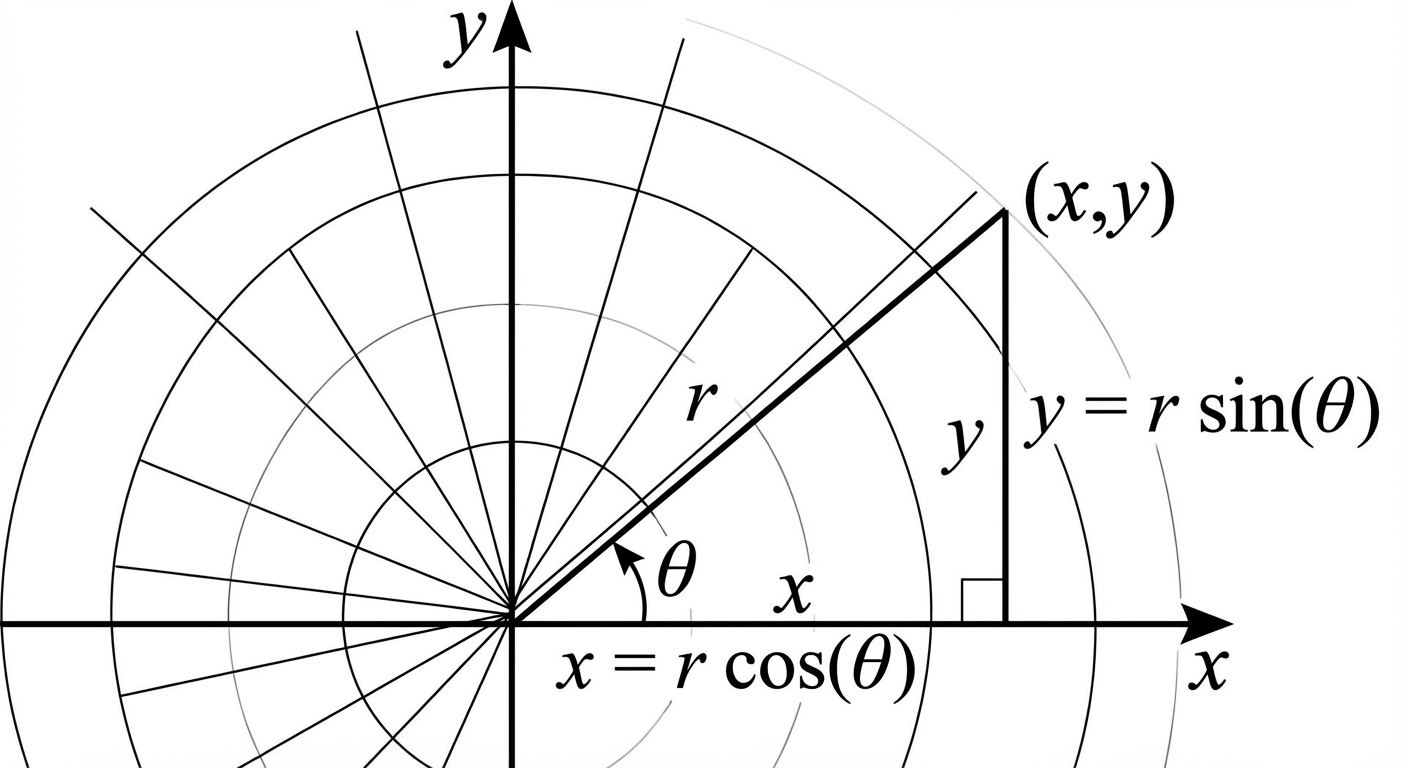
A point in the polar system is represented as an ordered pair $(r, \theta)$:
- $r$ (Radius/Modulus): The directed distance from the Pole (the origin, $(0,0)$).
- $\theta$ (Argument): The directed angle of rotation from the Polar Axis (the positive x-axis).
Non-Uniqueness of Polar Coordinates
Unlike rectangular coordinates, where one point has exactly one address $(x, y)$, a single location in the polar plane can be represented in infinitely many ways. This occurs due to coterminal angles and the nature of directed distance.
For any point $(r, \theta)$, the same location can be represented by:
- Adding full rotations: $(r, \theta + 2\pi n)$ where $n$ is an integer.
- Using a negative radius: $(-r, \theta + \pi + 2\pi n)$.
- Concept: A negative $r$ typically means "face direction $\theta$, then walk backwards $r$ units" (which is effectively the same as facing the opposite direction $\theta + \pi$ and walking forward).
Conversion Formulas
To translate between rectangular $(x, y)$ and polar $(r, \theta)$ forms, we utilize right triangle trigonometry (Pythagorean theorem and SOH CAH TOA).
Polar to Rectangular
If you know $r$ and $\theta$, use:
Rectangular to Polar
If you know $x$ and $y$, use:
Critical Note on $\theta$: When using $\theta = \arctan(\frac{y}{x})$, your calculator will result in an angle in Quadrant I or IV. You must verify the quadrant of the original point $(x,y)$ and add $\pi$ (or $180^\circ$) if the point lies in Quadrant II or III.
Graphs of Polar Functions
In AP Precalculus, you must recognize specific families of polar curves given by functions defined as $r = f(\theta)$. The behavior of trigonometry functions (amplitude, period) directly determines the shape of the graph.
1. Circles
The simplest polar graphs involving trigonometry are off-centered circles.
- Equation: $r = a \cos(\theta)$ or $r = a \sin(\theta)$
- Diameter: The diameter is equal to $|a|$.
- Orientation:
- $a \cos(\theta)$: Symmetric over the horizontal axis (lies on x-axis).
- $a \sin(\theta)$: Symmetric over the vertical axis (lies on y-axis).
2. Limaçons
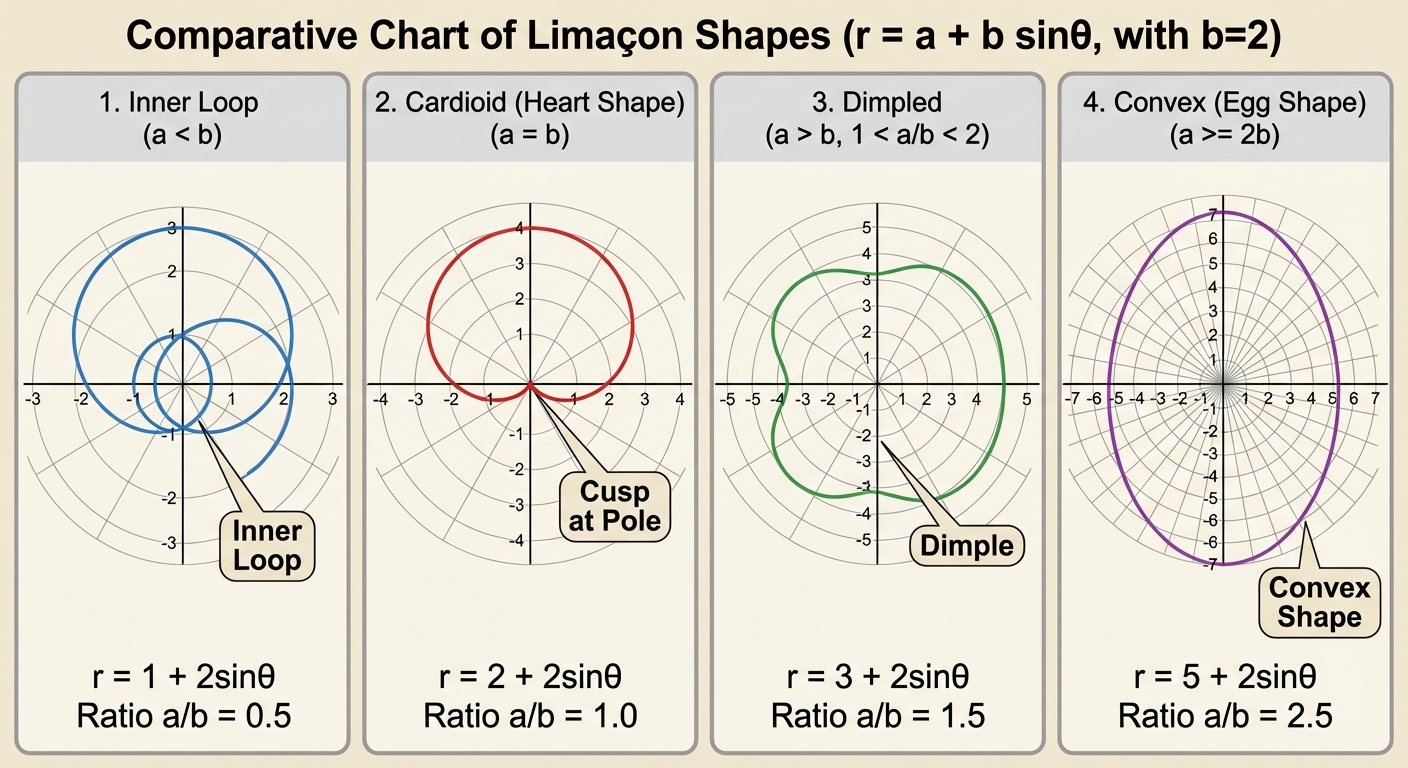
Limaçons are curves defined by the sum or difference of a constant and a trig function. They often look like beans, hearts, or loops.
- Equation: $r = a \pm b \cos(\theta)$ or $r = a \pm b \sin(\theta)$ (assume $a > 0, b > 0$)
- Key Ratio: The shape is determined by the ratio $\frac{a}{b}$.
| Ratio | Shape Name | Description |
|---|---|---|
| $\frac{a}{b} < 1$ | Limaçon with Inner Loop | The graph passes through the pole and creates a smaller inner loop. |
| $\frac{a}{b} = 1$ | Cardioid | Heart-shaped. Touches the pole exactly once (a sharp cusp). |
| $1 < \frac{a}{b} < 2$ | Dimpled Limaçon | "Dented" circle. Does not touch the pole. |
| $\frac{a}{b} \geq 2$ | Convex Limaçon | Looks like a flattened circle (oval-ish). No dent. |
3. Rose Curves
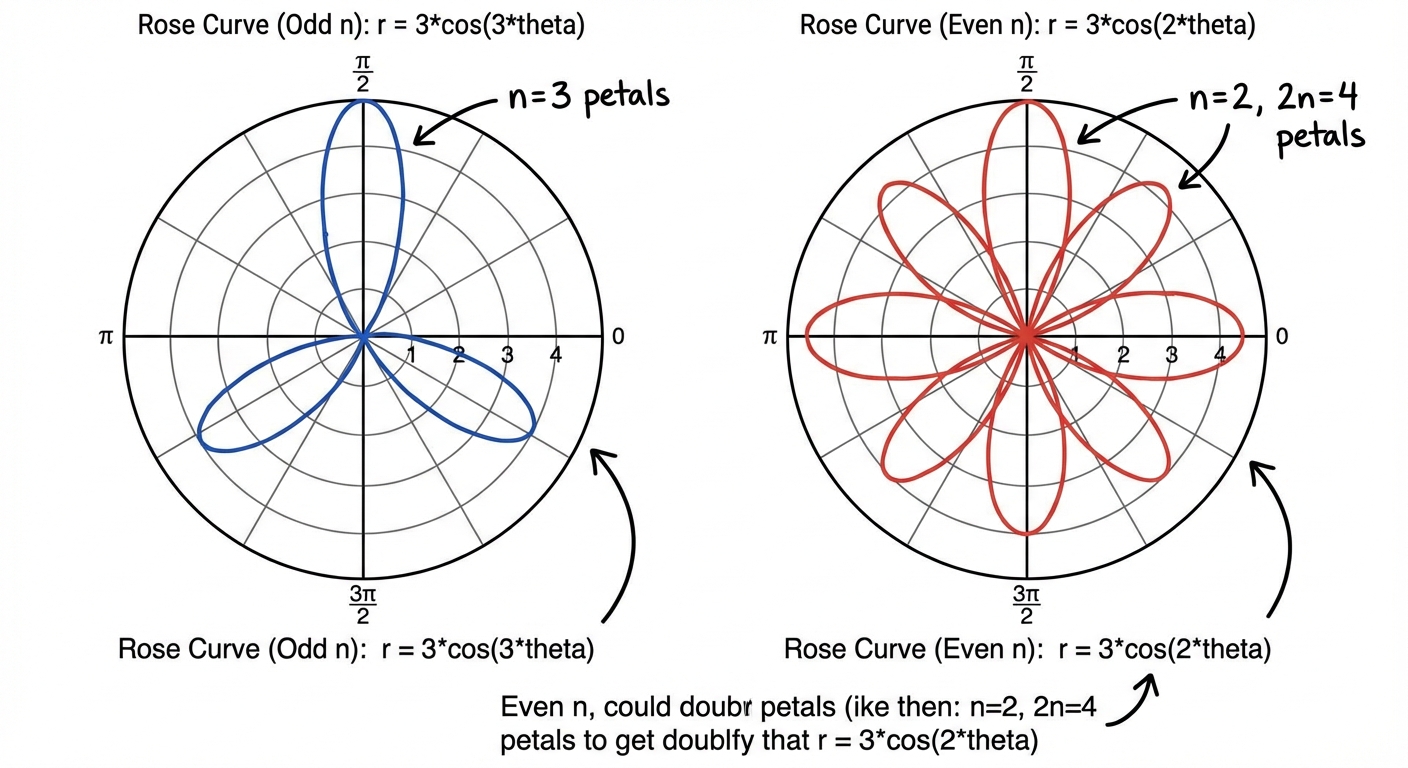
Rose curves are sinusoidal functions where the frequency is greater than 1, creating multiple loops (petals).
- Equation: $r = a \cos(n\theta)$ or $r = a \sin(n\theta)$ where $n \geq 2$ is an integer.
- Petal Length: The length of each petal is $|a|$.
- Number of Petals:
- If $n$ is ODD: The graph has $n$ petals.
- If $n$ is EVEN: The graph has $2n$ petals.
Example: $r = 4\cos(3\theta)$ has 3 petals of length 4. $r = 5\sin(2\theta)$ has 4 petals of length 5.
Rates of Change in Polar Functions
In polar functions, the dependent variable is $r$ and the independent variable is $\theta$. Therefore, the rate of change describes how the distance from the pole changes as the angle of rotation increases.
Average Rate of Change (AROC)
The average rate of change of $r$ with respect to $\theta$ over the interval $[\alpha, \beta]$ is:
Interpreting the Rate of Change
Analyzing the sign of the rate of change (slope of the $r$ vs $\theta$ graph in the Cartesian plane) tells us about the particle's movement relative to the origin.
- If $\frac{\Delta r}{\Delta \theta} > 0$ (or $r$ is increasing):
The point is moving further away from the pole as it rotates counter-clockwise. - If $\frac{\Delta r}{\Delta \theta} < 0$ (or $r$ is decreasing):
The point is moving closer to the pole as it rotates counter-clockwise. - If $r = 0$:
The graph passes through the pole.
Maximum and Minimum $r$ values:
To determine the maximum distance from the pole, look for the maximum value of $|r|$.
- For $r = 3 + 4\sin\theta$, the maximum $r$ is $3+4(1) = 7$. The minimum $r$ is $3+4(-1) = -1$, which corresponds to a distance of $|-1| = 1$.
Mnemonics & Memory Aids
- Coordinates: "X is Cross, Y is Sign"
- $x$ corresponds to Cos ($r\cos\theta$)
- $y$ corresponds to Sin ($r\sin\theta$).
- Limaçon Shapes: Remember the alphabet "I-C-D-C"
- Inner Loop ($<1$)
- Cardioid ($=1$)
- Dimpled ($1$ to $2$)
- Convex ($>2$)
- (Ratios increase from small to large).
- Rose Petals: "Odd is Odd, Even is Double"
- Odd coefficient $n$ = $n$ petals.
- Even coefficient $n$ = $2n$ petals.
Common Mistakes & Pitfalls
Quadrant Confusion (Inverse Tangent):
- Mistake: Evaluating $\theta = \tan^{-1}(-1)$ and writing $-45^\circ$ when the point is actually in Quadrant II $(-2, 2)$.
- Fix: Always plot the rectangular point $(x,y)$ first. If the calculator gives a Quadrant IV angle but your point is Quadrant II, add $180^\circ$ (or $\pi$).
Neglecting Negative Radius:
- Mistake: Assuming $r$ implies absolute distance only.
- Fix: Remember that if a function outputs a negative $r$ (e.g., in an inner loop of a Limaçon), the point plots in the quadrant opposite the angle $\theta$.
Rose Curve Petals:
- Mistake: Thinking $n$ always equals the number of petals.
- Fix: Check if $n$ is even! If $n=2$, there are 4 petals, not 2.
Distinguishing Rate of Change:
- Mistake: Confusing $\frac{\Delta r}{\Delta \theta}$ with the slope of the curve $\frac{dy}{dx}$ used in Calculus.
- Fix: In Precalc, we focus on radial change. If $r$ changes from 2 to 5, the particle moved 3 units further from the center, regardless of the "steepness" of the curve.