APES Unit 2: The Living World – Biodiversity & Services
Introduction to Biodiversity
Biodiversity is not just a count of how many animals you see in a forest; it is the variety of life across all levels of biological organization. In AP Environmental Science, understanding the nuance of biodiversity is critical because it directly correlates to ecosystem resilience—the ability of an ecosystem to recover after a disturbance.
The Three Levels of Biodiversity
Biodiversity is measured on three distinct scales. You must be able to differentiate between them on exams.
Genetic Diversity
- Definition: The measure of genetic variation among individuals in a population.
- Importance: High genetic diversity ensures that a population can respond to environmental stressors (disease, drought, climate change). If everyone has the exact same immune system genes, one virus kills everyone.
- The Bottleneck Effect: A drastic reduction in population size leading to a loss of genetic diversity. Even if the population recovers in numbers, the genetic diversity remains low, making them vulnerable.
Species Diversity
- Definition: The number of species in a region or in a particular type of habitat.
- Importance: Ecosystems with high species diversity are more productive and stable.
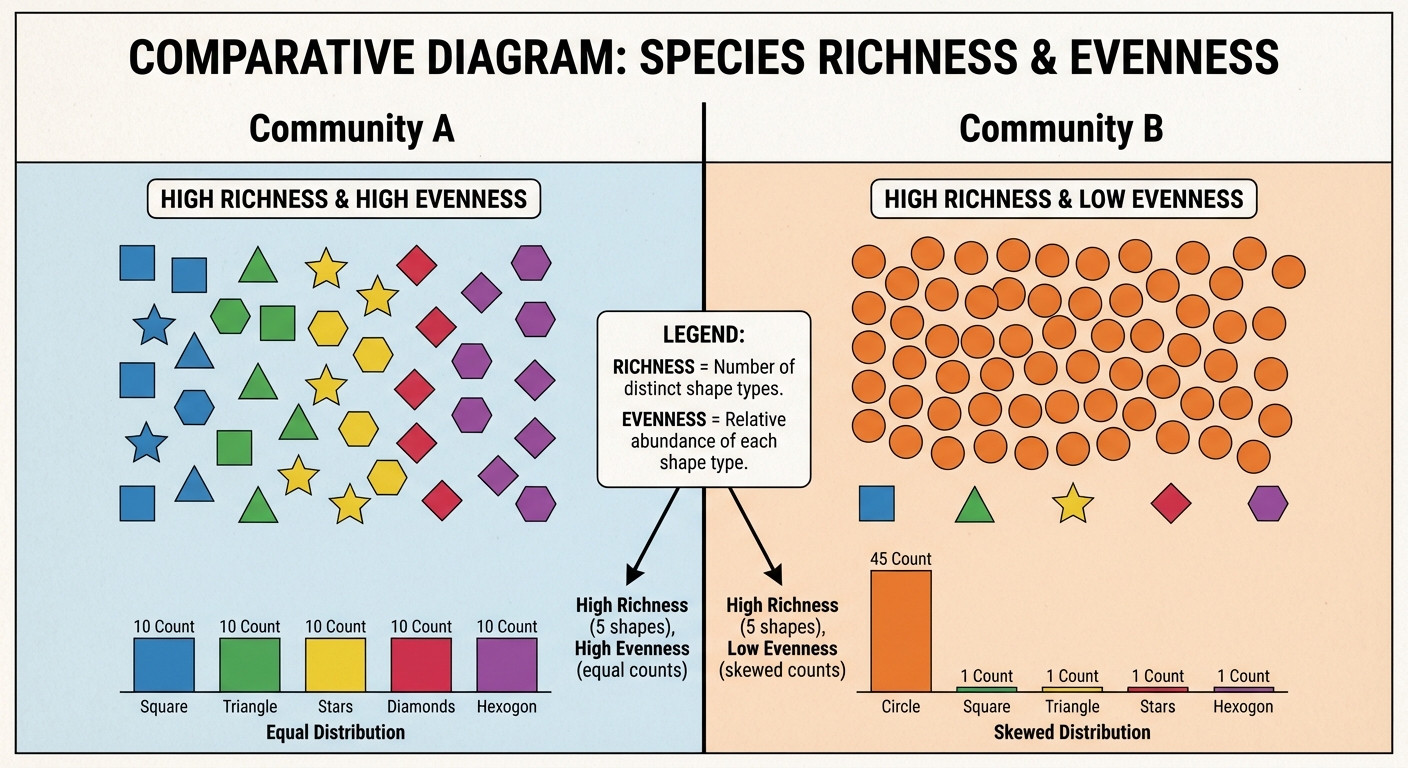
- Critical Distinction: You must distinguish between Species Richness and Species Evenness.
- Richness: The total number of different species ($R$).
- Evenness: The relative abundance of each species. Does one species dominate, or are they balanced?
- Ecosystem (Habitat) Diversity
- Definition: The variety of habitats that exist within a given region.
- Generalist vs. Specialist: High habitat diversity supports both specialist species (narrow niche, specific food requiring specific habitat) and generalist species (broad niche, adaptable).
- Impact: A loss of habitat diversity usually leads to a loss of specialist species first, followed by generalists.
Ecosystem Services
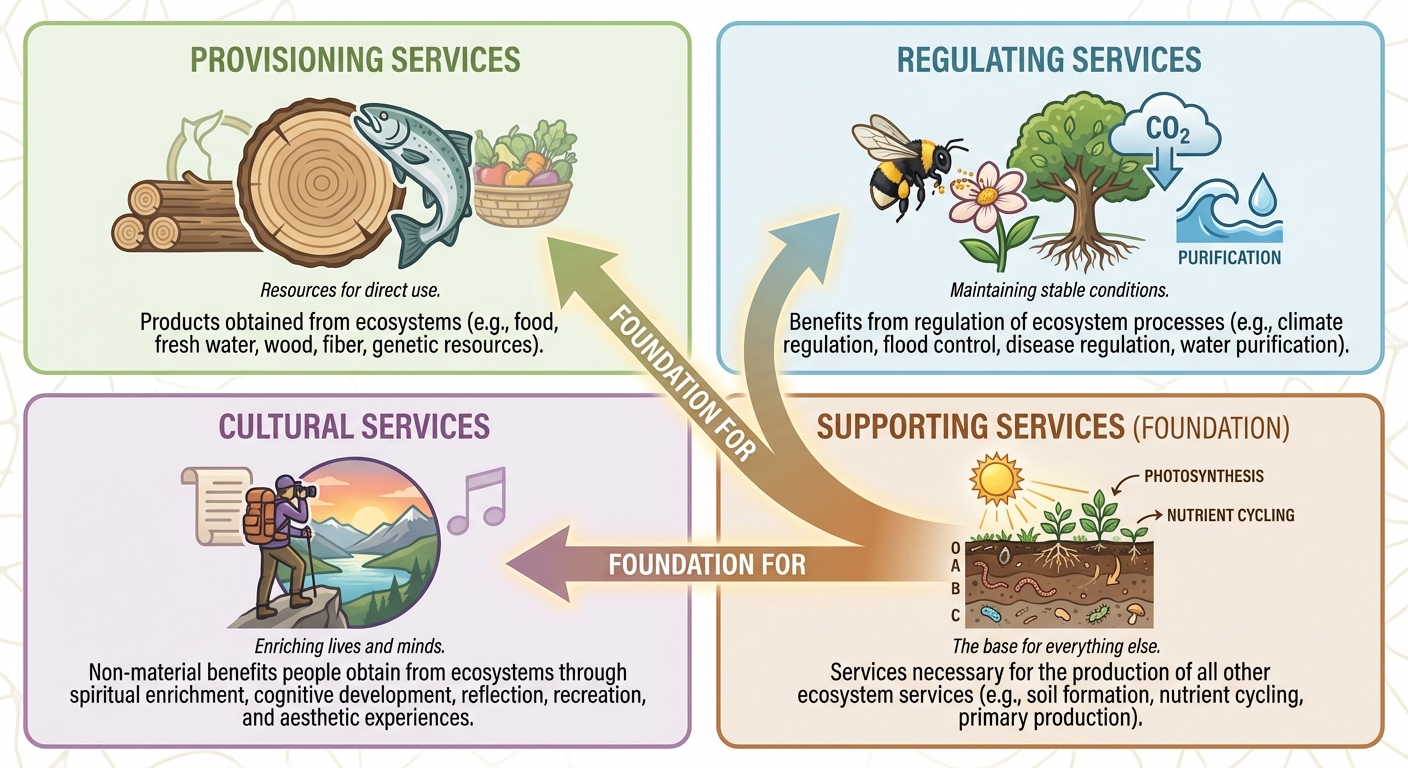
Nature provides benefits to humans. In APES, these benefits are categorized into four specific types of Ecosystem Services. You must memorize the category of a specific service (e.g., bees pollinating crops is a Regulating service).
1. Provisioning Services
These are the products mainly obtained from ecosystems—material goods that humans can harvest, sell, or use directly.
- Examples: Lumber (wood), fur, crop food, wild-caught fish, water (for drinking/irrigation), medicinal plants, rubber.
- Human Impact: Overharvesting and tragedy of the commons often deplete these services.
2. Regulating Services
These are benefits obtained from the regulation of ecosystem processes. They keep the world habitable and stable.
- Carbon Sequestration: Trees absorb $CO_2$, regulating climate.
- Pollination: Bees and bats pollinate crops (worth billions to the economy).
- Water Filtration: Wetlands remove toxins and excess nutrients from water.
- Flood Control: Tree roots hold soil and wetlands absorb storm surges.
3. Cultural Services
These are non-material benefits people obtain from ecosystems through spiritual enrichment, cognitive development, reflection, recreation, and aesthetic experiences.
- Examples: Tourism (ecotourism), hiking, national parks, aesthetic value (real estate price is higher with a view), spiritual significance of holy sites.
4. Supporting Services
These are services that are necessary for the production of all other ecosystem services. They are the background "infrastructure" of nature. Without these, the other three categories could not exist.
- Examples: Soil formation, photosynthesis (primary production), nutrient cycling (Nitrogen/Phosphorus cycles), habitat provision.
Anthropogenic Impacts on Services
Human activities disrupts these services, usually for economic gain.
- Example: Clearing a forest for lumber (Short-term Provisioning gain) results in the loss of carbon sequestration (Long-term Regulating loss) and soil formation (Supporting loss).
Island Biogeography
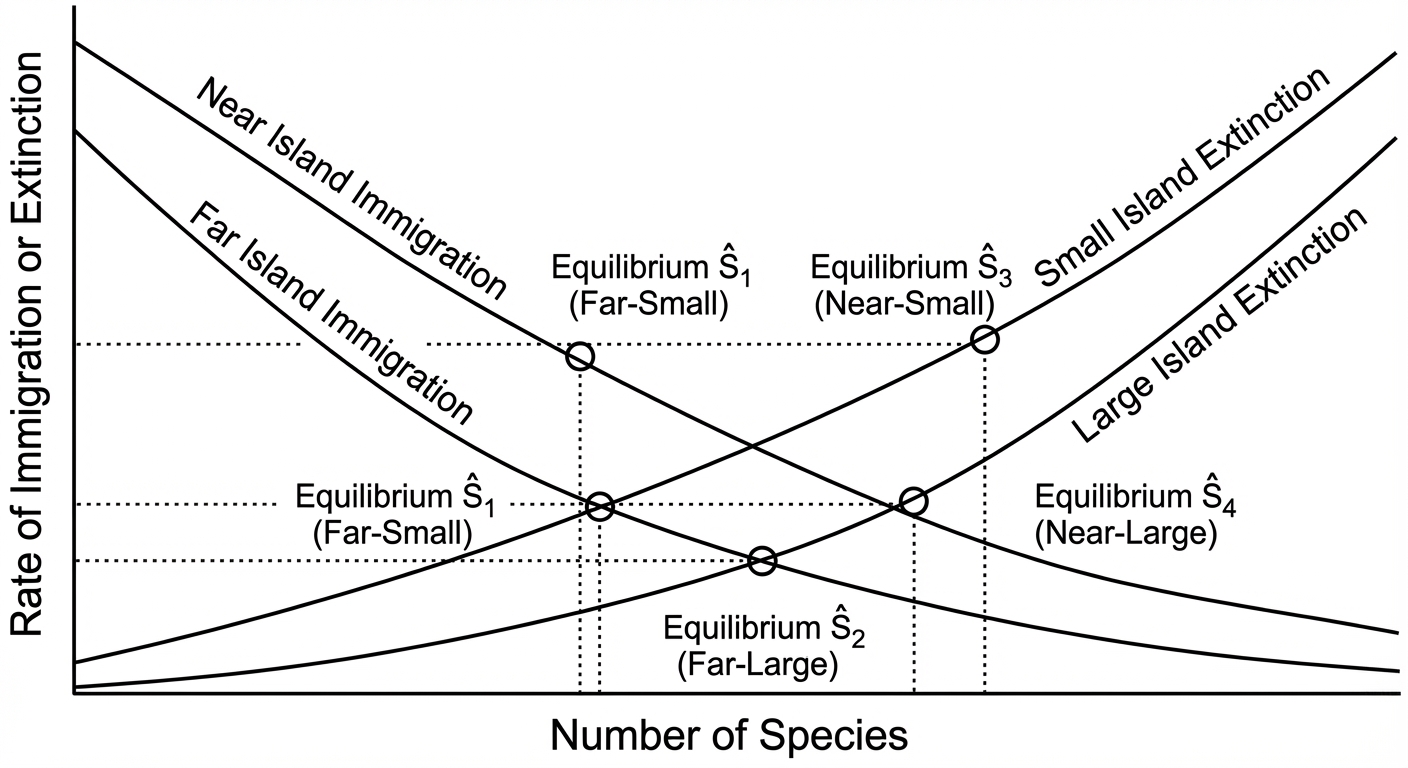
Theory of Island Biogeography: Proposed by MacArthur and Wilson, this theory predicts different rates of colonization and extinction on islands based on two specific variables: Size and Distance.
The Rules of the Theory
Distance from Mainland (The Immigration Factor)
- Islands closer to the mainland have higher immigration/colonization rates.
- Why? It is easier for organisms to disperse (fly, swim, float) a short distance than a long one.
- Islands farther away have lower species richness.
Size of the Island (The Extinction Factor)
- Larger islands have lower extinction rates and support more species.
- Why? Larger islands have more available niches (habitats) and larger resources to support larger populations (buffering against random extinction events).
- Smaller islands have higher extinction rates.
Evolution on Islands
Because islands are isolated, they are hotbeds for speciation.
- Adaptive Radiation: A single species evolves into many new species to fill available niches (e.g., Darwin's Finches on the Galapagos).
- Specialists: Island species often evolve to be specialists because of limited resources and lack of major predators. This makes them highly vulnerable to invasive species (which are usually generalists).
Application: "Islands" on Land
The theory implies that most habitat conservation acts as "islands." A patch of forest surrounded by concrete cities or farmland functions exactly like an island in the ocean.
- Conservation Strategy: Based on this theory, one large protected area is generally better than several small, fragmented areas (SLOSS debate: Single Large or Several Small).
Common Mistakes & Pitfalls
Mistake 1: Confusing Richness and Evenness.
- Correction: A lawn with 10,000 blades of grass and 1 dandelion has high abundance but very low richness (only 2 species) and very low evenness. A forest with 5 oaks, 5 maples, and 5 pines has higher richness (3 species) and perfect evenness. Richness is the count of types; Evenness is the balance.
Mistake 2: Mixing up Regulating and Supporting Services.
- Correction: If the service happens on a "human" timescale and fixes a problem (filtering water, pollinating this year's crop), it is usually Regulating. If it is a slow geological/biological process that allows life to exist at all (making soil, cycling nitrogen), it is Supporting.
Mistake 3: Thinking Island Biogeography only applies to water.
- Correction: In APES, a central park in New York City is an "island" of nature surrounded by a "sea" of urbanization. The rules of size and distance apply to habitat fragments on land.
Mistake 4: Assuming high biodiversity always equals high population numbers.
- Correction: You can have a high population of a single pest (low biodiversity). Healthy ecosystems usually balance populations across many species.