Unit 4 study notes: Contextual Applications of Differentiation
Contextual Applications of Differentiation
Interpreting the Derivative in Context
The fundamental application of the derivative in the real world is describing the instantaneous rate of change. In AP Calculus BC, you must be able to translate mathematical symbols into written sentences involving units and time.
Key Concepts
- Notation: Given a function $f(t)$,
- $f'(a)$ represents the rate at which $f$ is changing at time $t=a$.
- Units: If $y$ is measured in units of y and $x$ is measured in units of x, the derivative $\frac{dy}{dx}$ is measured in (units of y) per (unit of x).
- Verbal Descriptions: When asked to "interpret the meaning of $f'(3) = 5$" in an exam context, your answer must include:
- Instantaneous specification (at time $t=3$_, not over an interval).
- Direction (increasing/decreasing).
- Value (magnitude).
- Units.
Example: Temperature Interpretation
Scenario: The temperature of a cup of coffee is given by $T(m)$, where $T$ is degrees Celsius and $m$ is minutes since pouring.
Statement: $T'(5) = -2.2$
Interpretation: "At exactly 5 minutes after pouring, the temperature of the coffee is decreasing at a rate of 2.2 degrees Celsius per minute."
Straight-Line (Rectilinear) Motion
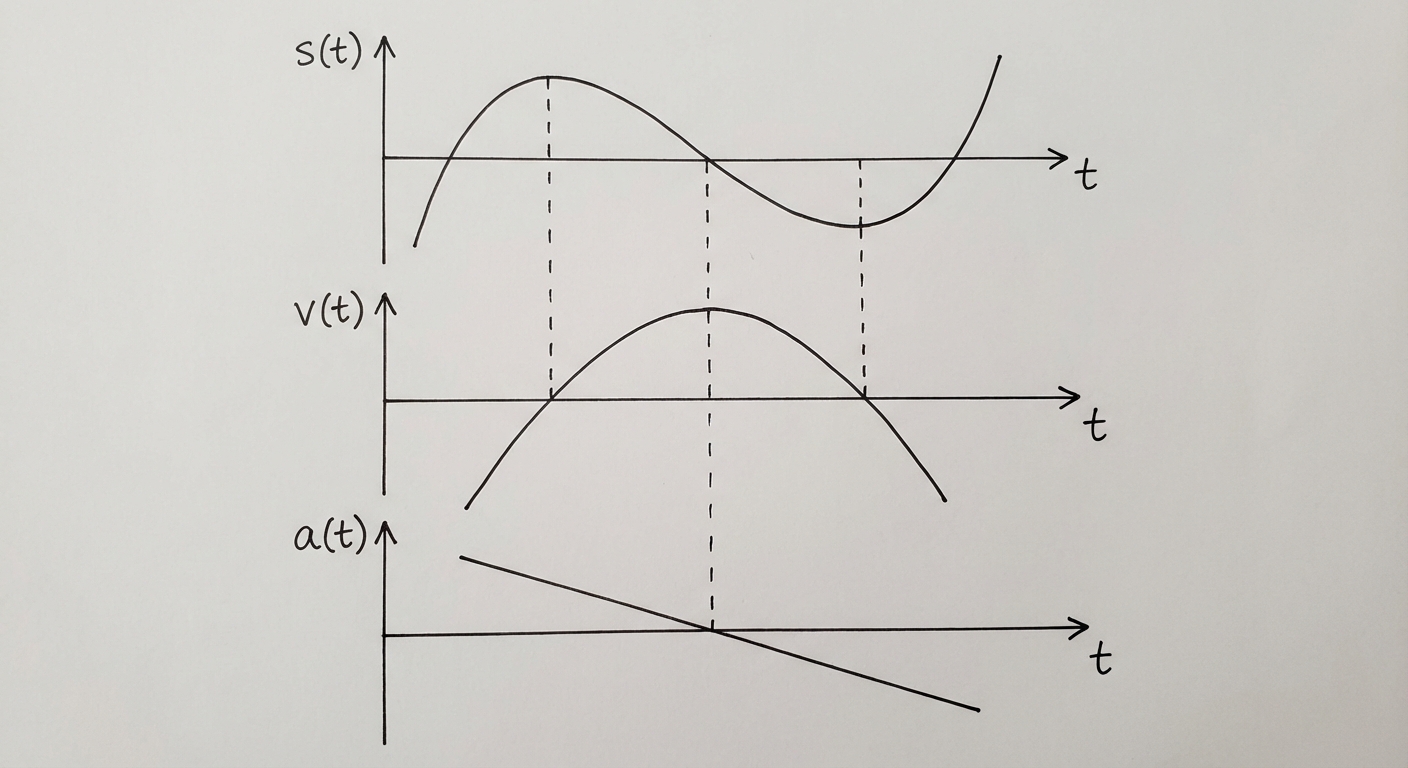
Motion along a line is the most frequent application of differentiation in Unit 4. We analyze the particle's behavior based on the relationships between position, velocity, and acceleration.
Definitions & Relationships
- Position ($x(t)$ or $s(t)$): The location of the particle relative to the origin.
- Units: meters, feet.
- Velocity ($v(t)$): The rate of change of position; indicates direction of motion.
- Units: m/s, ft/s.
- Positive Velocity: Moving right/up.
- Negative Velocity: Moving left/down.
- Acceleration ($a(t)$): The rate of change of velocity.
- Units: m/s$^2$, ft/s$^2$.
- Speed: The magnitude of velocity. Speed is a scalar (always non-negative).
Speeding Up vs. Slowing Down
This is a critical concept often tested on Multiple Choice.
- Speeding Up: Velocity and Acceleration have the SAME sign.
- $v(t) > 0$ and $a(t) > 0$ (Moving right, being pushed right)
- $v(t) < 0$ and $a(t) < 0$ (Moving left, being pushed left)
- Slowing Down: Velocity and Acceleration have OPPOSITE signs.
- $v(t) > 0$ and $a(t) < 0$ (Moving right, braking/pushed left)
- $v(t) < 0$ and $a(t) > 0$ (Moving left, braking/pushed right)
Worked Example: Particle Motion
Problem: A particle moves along the x-axis with velocity $v(t) = 3t^2 - 4t + 1$. Is the particle speeding up or slowing down at $t=1$?
Solution:
Find Velocity at $t=1$:
Since velocity is 0, the particle is momentarily stopped. Technically, it is neither speeding up nor slowing down at this exact instant, but let's check $t=0.5$ for better illustration.Revised Check at $t=0.5$:
Velocity is negative.Find Acceleration Function:
Find Acceleration at $t=0.5$:
Acceleration is negative.Compare Signs:
Since $v(0.5) < 0$ and $a(0.5) < 0$, the signs match.
Conclusion: The particle is speeding up at $t=0.5$.
Rates of Change in Applied Contexts (Non-Motion)
Differentiation applies to any quantity changing over time: volume, population, density, or cost.
General Strategy
- Identify whether the function represents the amount or the rate.
- If given amount $Q(t)$, calculate $Q'(t)$ to find the rate.
- If differentiation requires chain rule (e.g., $e^{-0.1t}$), proceed carefully.
Example: Fluid Volume
Problem: The volume of water in a tank is $V(t) = 8t^2 - 32t + 4$ gallons (for $t > 2$ hours). Find the rate at which water is entering/leaving the tank at $t=3$.
Solution:
Since $V'(3) > 0$, water is entering the tank at 16 gal/hr.
Related Rates
Related rates problems involve two or more variables that change with respect to time ($t$). Unlike standard differentiation, we differentiate implicitly with respect to $t$.
The 5-Step Process (D.R.E.D.S.)
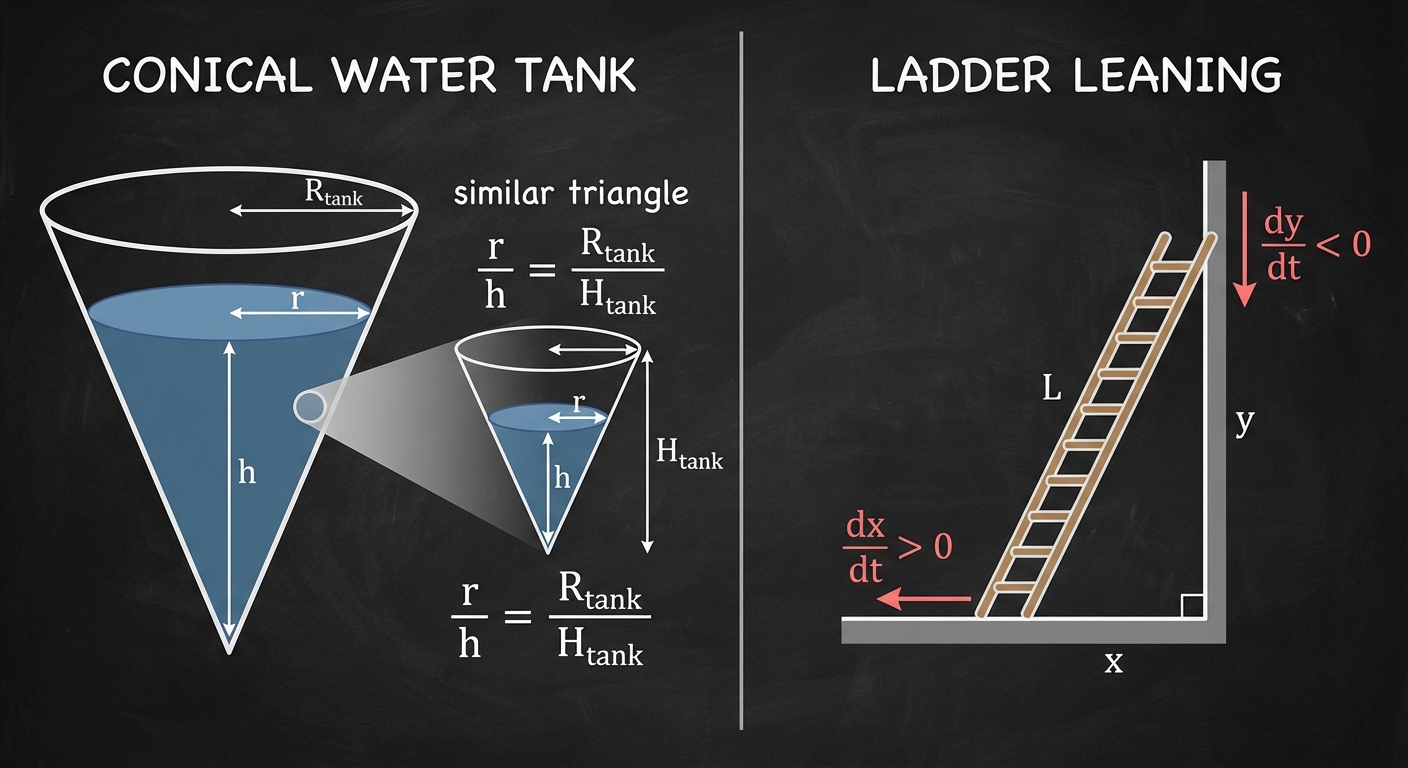
- Diagram: Draw and label the situation. Mark constants constant and changing values with variables.
- Rates: List what you know ($ rac{dx}{dt} = ext{?}$) and what you want to find.
- Equation: Write a static geometric equation relating variables (e.g., Pythagorean theorem, Volume formulae) before differentiation.
- Derivative: Differentiate both sides with respect to time $t$. Remember the Chain Rule: $ rac{d}{dt}(r^2) = 2r rac{dr}{dt}$.
- Substitute & Solve: Plug in the specific snapshot values given in the problem and solve.
Important Geometric Formulas to Memorize
| Shape | Formula |
|---|---|
| Circle Area | $A = \pi r^2$ |
| Sphere Volume | $V = \frac{4}{3}\pi r^3$ |
| Cone Volume | $V = \frac{1}{3}\pi r^2 h$ |
| Right Triangle | $a^2 + b^2 = c^2$ |
Worked Example: The Expanding Sphere
Problem: Helium is pumped into a spherical balloon at a rate of 10 in$^3$/sec. How fast is the radius increasing when the radius is 4 inches?
- Given: $\frac{dV}{dt} = 10$, radius $r = 4$.
- Find: $\frac{dr}{dt}$.
- Equation: $V = \frac{4}{3}\pi r^3$.
- Differentiate:
- Substitute:
Common Mistakes: Related Rates
- Freezing Variables: Plugging in $r=4$ into the volume equation before taking the derivative. Never substitute changing values before differentiation.
- Missing Chain Rule: Writing the derivative of $x^2$ as $2x$ instead of $2x \frac{dx}{dt}$.
- Cone Problems: Forgetting to use similar triangles to eliminate a variable ($r$ or $h$) when only one rate is known.
Local Linearity & Linearization
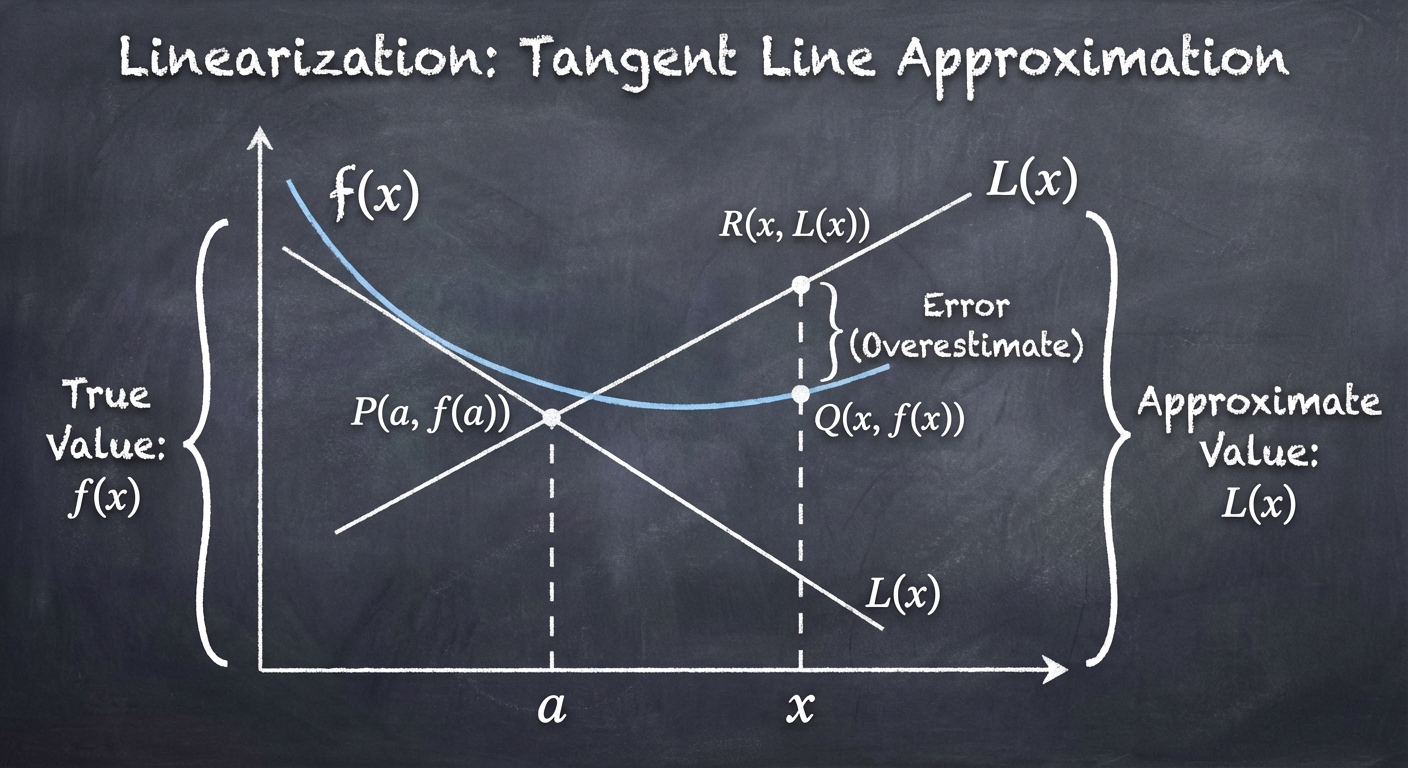
Curved functions behave like lines if you zoom in close enough. We use the Tangent Line Approximation (Linearization) to estimate complex function values.
The Formula
The linearization $L(x)$ of a function $f$ at a center point $x=a$ is:
This is simply the point-slope form of a line: $y - y1 = m(x - x1)$.
Approximation & Error (Concavity)
When we use $L(x)$ to approximate $f(x)$ nearby:
- Concave Up ($f''(a) > 0$): The graph bends upward, so the tangent line sits below the curve. The approximation is an underestimate.
- Concave Down ($f''(a) < 0$): The graph bends downward, so the tangent line sits above the curve. The approximation is an overestimate.
Worked Example
Problem: Approximate $\sqrt[4]{16.2}$ using linearization.
- Choose a center: Let $x = 16$ (a nice number near 16.2). Let $f(x) = x^{1/4}$.
- Point: $f(16) = \sqrt[4]{16} = 2$.
- Slope:
- Linearization Equation:
- Approximate:
L'Hospital's Rule
L'Hospital's Rule allows us to evaluate limits that result in indeterminate forms by using derivatives.
Conditions
To use L'Hospital's Rule for $\lim_{x \to c} \frac{f(x)}{g(x)}$, the limit must produce one of these two Indeterminate Forms:
- $\frac{0}{0}$
- $\frac{\pm \infty}{\pm \infty}$
The Rule
If the conditions are met:
Note: This is NOT the Quotient Rule. Differentiate the numerator and denominator separately.
Worked Example (Leading Coefficients doesn't work)
Problem: Evaluate $\lim_{x \to 0} \frac{e^{2x} - 1}{\sin(x)}$.
Test Substitution:
Top: $e^0 - 1 = 0$
Bottom: $\sin(0) = 0$
Result: $\frac{0}{0}$ (Indeterminate). L'Hospital's applies.Apply Rule:
Re-Evaluate Limit:
Common Mistakes: L'Hospital's
- Applying it blindly: Using the rule on a limit like $\lim_{x \to 1} \frac{x+2}{x+3}$. This yields $\frac{3}{4}$, but L'Hospital's would give $\frac{1}{1} = 1$, which is wrong.
- Stopping too soon: Sometimes the result after one application is still indeterminate. You may need to apply the rule a second time.
- Quotient Rule error: Do not perform $\frac{f'g - fg'}{g^2}$. It is simply $\frac{f'}{g'}$.