Study Notes: Unit 8 Area and Volume
Area Between Curves
calculus allows us to move beyond finding the area under a single curve to finding the area enclosed between two or more curves. This is the foundation of accumulation in a geometric context.
The Vertical Slicing Method (Integration with Respect to $x$)
When we integrate with respect to $x$, we are essentially summing an infinite number of vertical rectangles. The height of each rectangle is determined by the difference between the "top" function and the "bottom" function.
Definition: If $f$ and $g$ are continuous functions on $[a, b]$ and $f(x) \ge g(x)$ for all $x$ in $[a, b]$, the area $A$ of the region bounded by the graphs of $f$ and $g$ and the vertical lines $x=a$ and $x=b$ is:
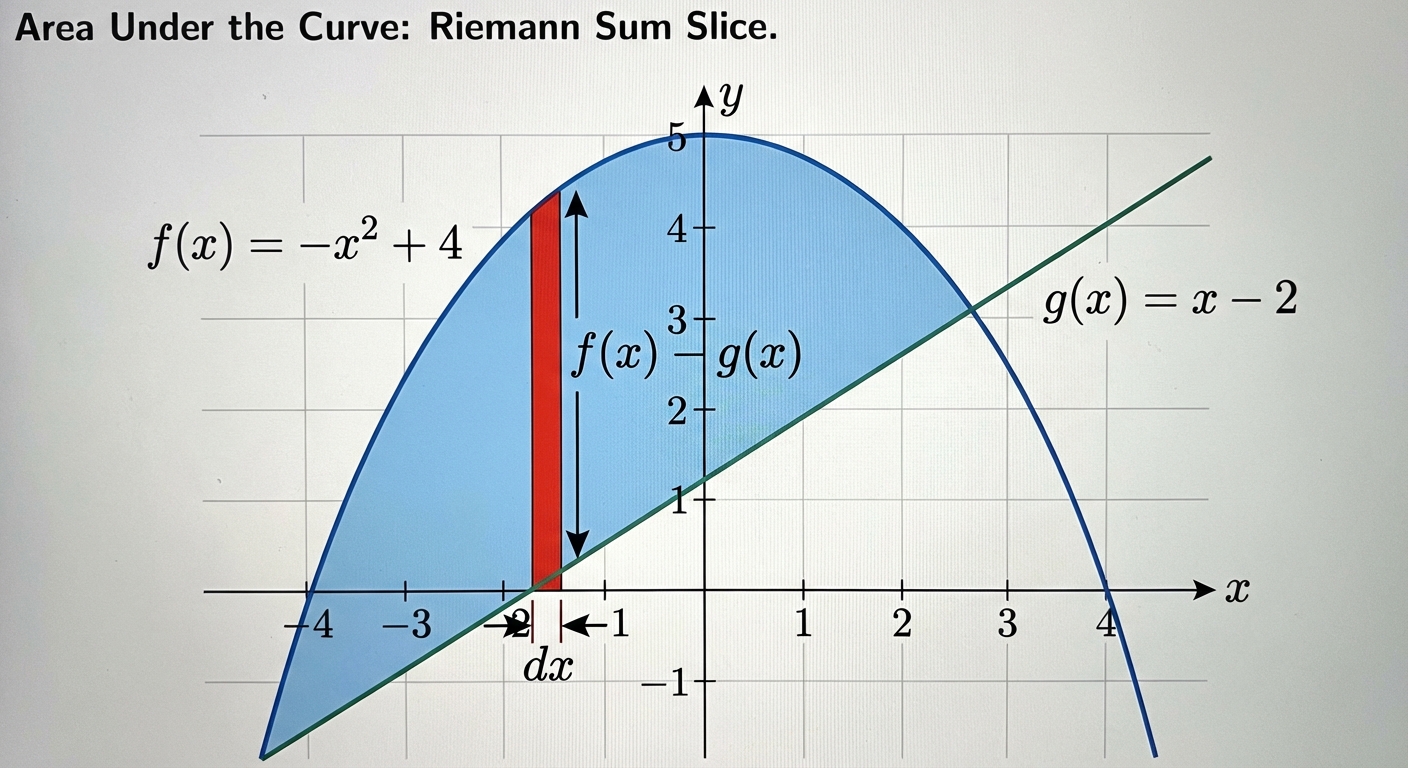
Key Steps to Solve:
- Sketch the geometric region. Identify which function is on top ($f(x)$) and which is on the bottom ($g(x)$).
- Find intersection points. If the limits $a$ and $b$ are not given, set $f(x) = g(x)$ and solve for $x$ to find boundaries.
- Set up the integral. Apply the formula $\text{Top} - \text{Bottom}$.
- Evaluate.
The Horizontal Slicing Method (Integration with Respect to $y$)
Sometimes, curves are defined as functions of $y$, or the geometry makes vertical slicing difficult (e.g., the "top" and "bottom" curves change midway through the region). In these cases, we slice horizontally.
Definition: If $x = f(y)$ (Right curve) and $x = g(y)$ (Left curve) are continuous on $[c, d]$, the area is:
Mnemonic:
- $dx$ integration: Top minus Bottom.
- $dy$ integration: Right minus Left.
Volumes with Cross Sections
In this topic, you calculate the volume of a solid whose base is a region in the $xy$-plane and whose cross-sections (slices) perpendicular to the $x$-axis (or $y$-axis) have a specific geometric shape.
Conceptual Approach
Imagine a loaf of bread. To find the volume, you can sum the volumes of all the individual slices. If each slice is infinitesimally thin ($dx$), the volume is the integral of the Area of the cross-section shape.
General Formula:
Where $A(x)$ is the area formula for the specific geometric shape of the cross-section.
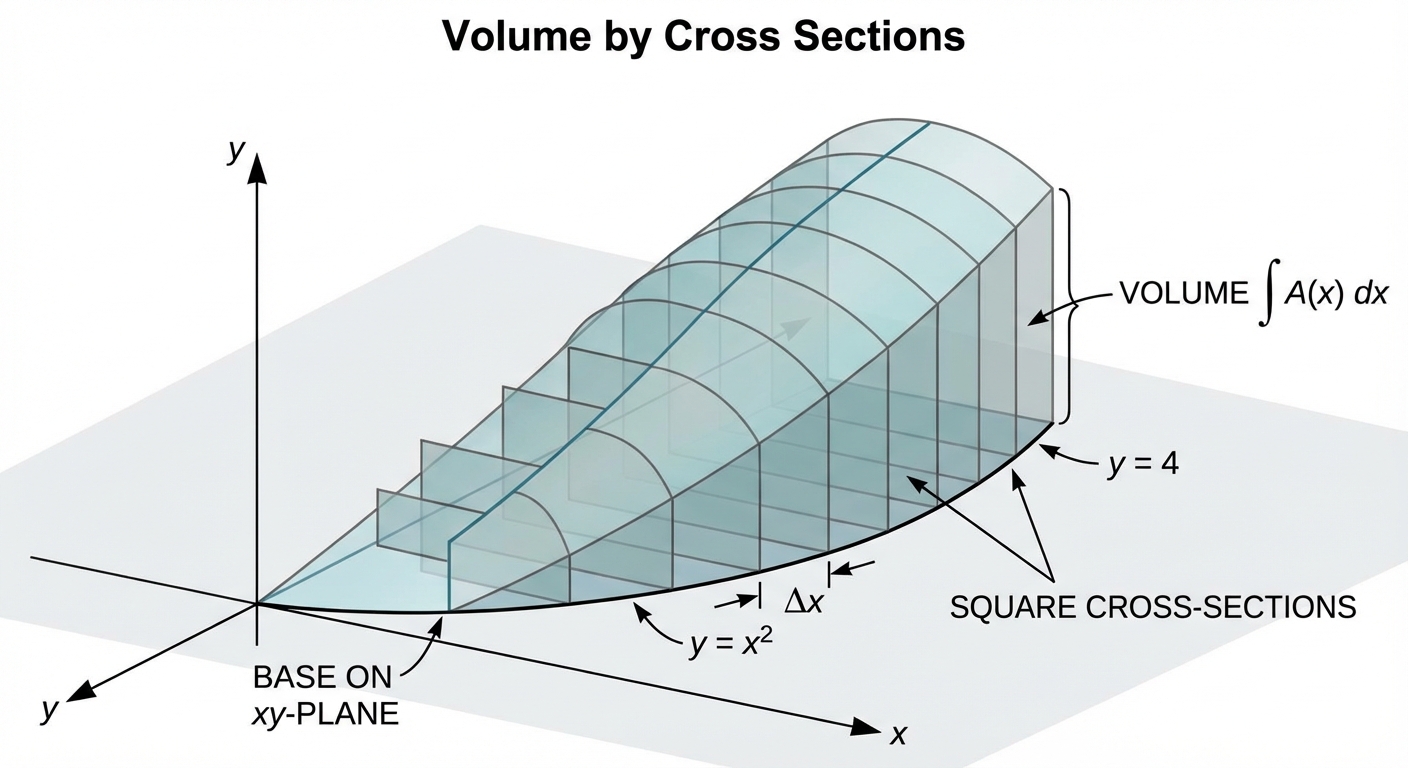
Common Cross-Section Formulas
Let $s$ be the length of the base of the cross-section (which is usually the distance between the two curves, e.g., $f(x) - g(x)$).
| Cross-Section Shape | Area Formula $A(s)$ |
|---|---|
| Square | $s^2$ |
| Semicircle | $\frac{\pi}{8}s^2$ |
| Equilateral Triangle | $\frac{\sqrt{3}}{4}s^2$ |
| Rectangle (height $h$) | $s \cdot h$ |
| Isosceles Rt. Triangle (leg on base) | $\frac{1}{2}s^2$ |
Worked Example: Square Cross Sections
Problem: Find the volume of the solid whose base is the region bounded by $y = \sqrt{x}$, $x=9$, and the x-axis. Cross-sections perpendicular to the x-axis are squares.
- Identify $s$: The slice is vertical. Top is $y=\sqrt{x}$, bottom is $y=0$. So, $s = \sqrt{x} - 0 = \sqrt{x}$.
- Identify Area: Shape is square, so $A(x) = s^2 = (\sqrt{x})^2 = x$.
- Integrate: Limits are $x=0$ to $x=9$.
Volumes with Disc and Washer Methods
These methods are specific applications of integration used to find the volume of Solids of Revolution—shapes created by rotating a 2D region around an axis.
The Disc Method
Use this method when the region being rotated is flush against the axis of rotation (there is no gap).
Concept: The cross-section is a solid circle (a disc). The area of a circle is $\pi r^2$.
Formula (Rotation about x-axis):
Where $R(x)$ is the radius function—the distance from the axis of rotation to the outer edge of the curve.
The Washer Method
Use this method when there is a gap between the region and the axis of rotation. The resulting solid has a hole in the middle.
Concept: The cross-section is a circle with a hole (a washer or ring). The area is $\pi(R{outer}^2 - r{inner}^2)$.
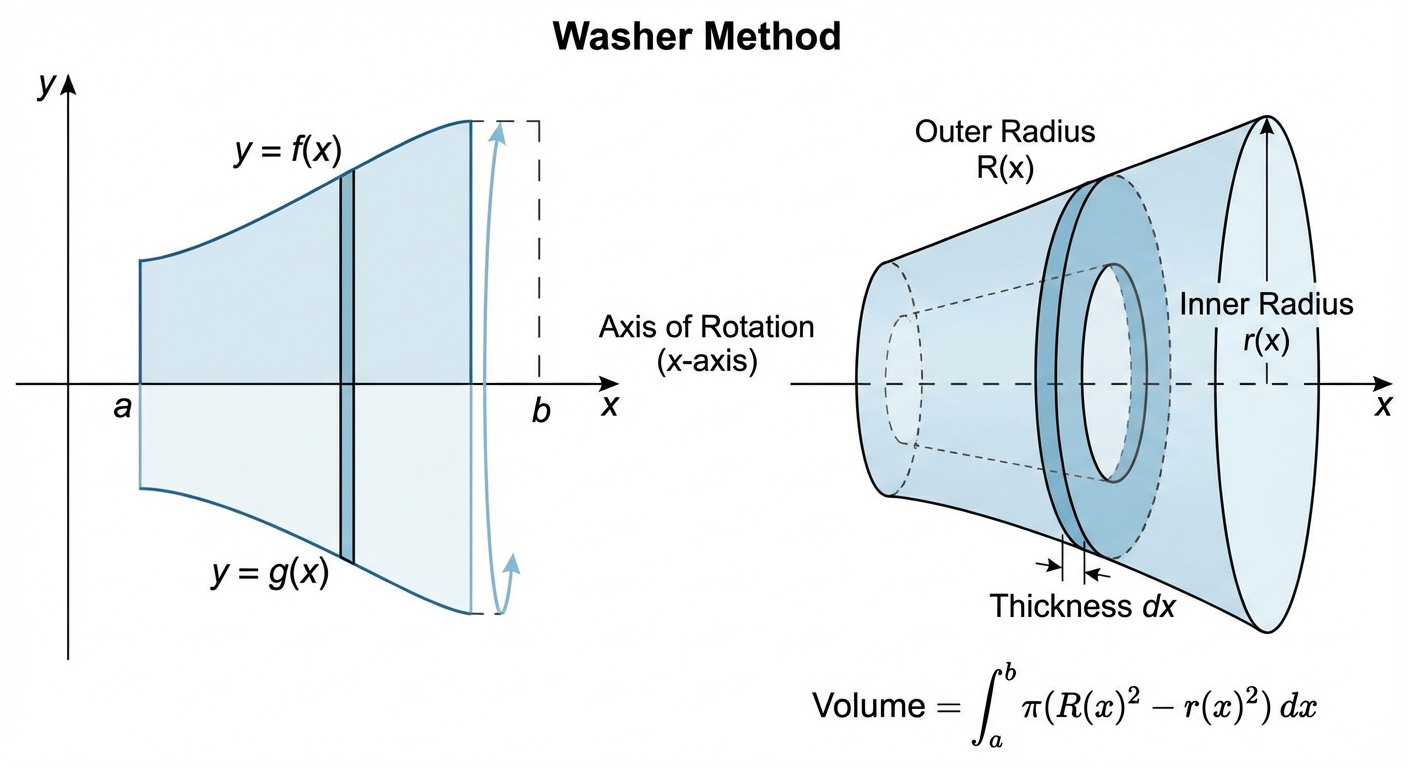
Formula:
- $R(x)$ (Outer Radius): Distance from axis of rotation to the far curve.
- $r(x)$ (Inner Radius): Distance from axis of rotation to the near curve.
Handling Rotations Around Shifted Axes
If you rotate around a line other than the x or y-axis (e.g., $y = -2$ or $x = 4$), you must adjust the radius calculation.
Radius Strategy: $\text{Radius} = |\text{Curve} - \text{Axis}|$
Example: Rotating the region bounded by $y=x^2$ and $y=4$ around the line $y = -2$.
- Outer Radius ($R$): From $y=-2$ (axis) to $y=4$ (far curve). $R = 4 - (-2) = 6$.
- Inner Radius ($r$): From $y=-2$ (axis) to $y=x^2$ (near curve). $r = x^2 - (-2) = x^2 + 2$.
Common Mistakes & Pitfalls
The Algebra Error of the Century:
- Mistake: Evaluating $\int (R - r)^2 \, dx$ for washers.
- Correction: It must be $\int (R^2 - r^2) \, dx$. You square the radii individually, then subtract. $(R-r)^2 \neq R^2 - r^2$.
Forgetting Pi:
- Mistake: Completing the integral perfectly but calculating $V = \int R^2$ instead of $V = \pi \int R^2$.
- Memory Aid: Area of a circle is $\pi r^2$. If you are making circles (discs/washers), you need the $\pi$.
Mixing Variables:
- Mistake: Using x-limits ($0$ to $5$) for a $dy$ integral or vice versa.
- Correction: If your integral ends in $dy$, every variable in the integrand and the limits of integration must be $y$-values.
Determining Boundaries:
- Mistake: Assuming the integration bounds are given in the problem without checking for intersection points.
- Correction: Always set $f(x) = g(x)$ to find where the curves cross unless the interval is explicitly bounded by vertical lines like $x=2$.