AP Spanish Literature: Unit 1 - La Época Medieval
Unit 1: La Época Medieval (The Medieval Period)
Unit Overview & Historical Context
Definition and Timeline
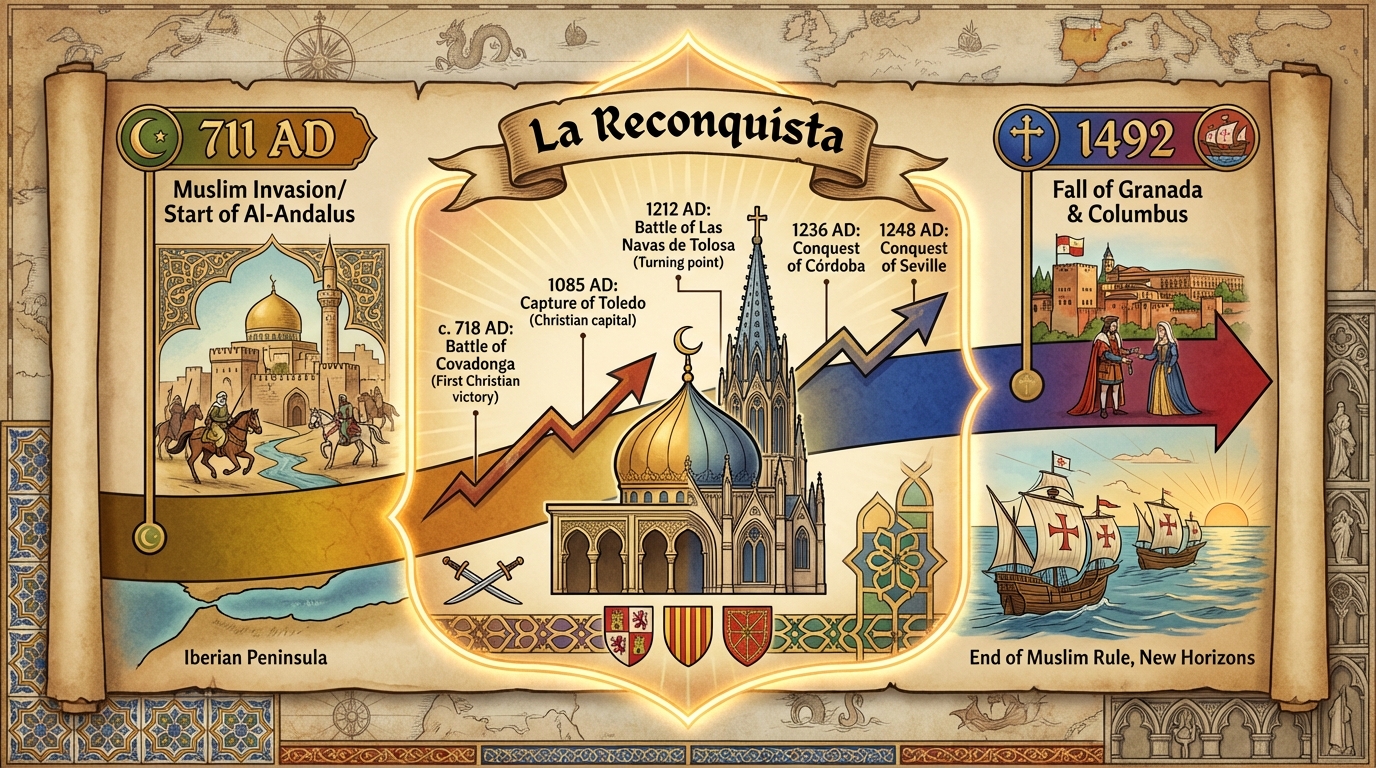
The Medieval Period in Spain is distinct from the rest of Europe due to the unique coexistence of three cultures (Christians, Muslims, and Jews) and the prolonged conflict known as the Reconquista.
- Timeline: Roughly 711 (Muslim invasion by the Moors) to 1492 (Fall of Granada, expulsion of Jews/Moors, arrival of Columbus in Americas, and Antonio de Nebrija’s first Grammar).
- The Reconquista: An 800-year struggle where Christian kingdoms in the north gradually reclaimed territory moving south against Muslim rule (Al-Andalus).
The "Three Cultures" (Las Tres Culturas)
Unlike the rigid feudalism of Northern Europe, Spain experienced a cultural fluidity.
- Convivencia: The coexistence (sometimes peaceful, sometimes hostile) of Christians, Muslims, and Jews. This led to a rich exchange in architecture, language, science, and literature.
- Language: Castilian (castellano) evolved from Vulgar Latin, enriched by roughly 4,000 words from Arabic (e.g., almohada, ojalá, azúcar).
Literary Traditions
- Mester de Juglaría (Art of the Minstrels): Oral tradition, popular, anonymous, irregular meter. Focus on epic heroes (e.g., El Cantar de Mio Cid).
- Mester de Clerecía (Art of the Clergy): Written by monks/scholars, didactic (meant to teach), religious themes, strict meter (cuaderna vía - 14 syllables). Author: Gonzalo de Berceo.
Required Reading 1: El Conde Lucanor
Full Title: El Conde Lucanor: "Exemplo XXXV" ("De lo que aconteció a un mozo que casó con una mujer muy fuerte y muy brava")
Author: Don Juan Manuel
Date: 1335 (14th Century)
Genre: Narrative Prose / Didactic Fiction
Summary
The Count (Conde Lucanor) faces a problem and asks his advisor, Patronio, for advice. To answer, Patronio tells a story (an example) about a young man (el mozo) who marries a rich but aggressive woman (mujer brava). On their wedding night, the young man kills various animals (dog, cat, horse) for disobeying his command to bring him water. Terrified, the bride becomes obedient. Patronio advises the Count to act similarly (decisively) at the beginning of a relationship/situation. The story ends with a rhyming couplet (pareado) summarizing the moral.
Narrative Structure: La Caja China
Don Juan Manuel uses a "story within a story" technique, also known as metafiction or a frame tale (caja china or mise-en-abyme).
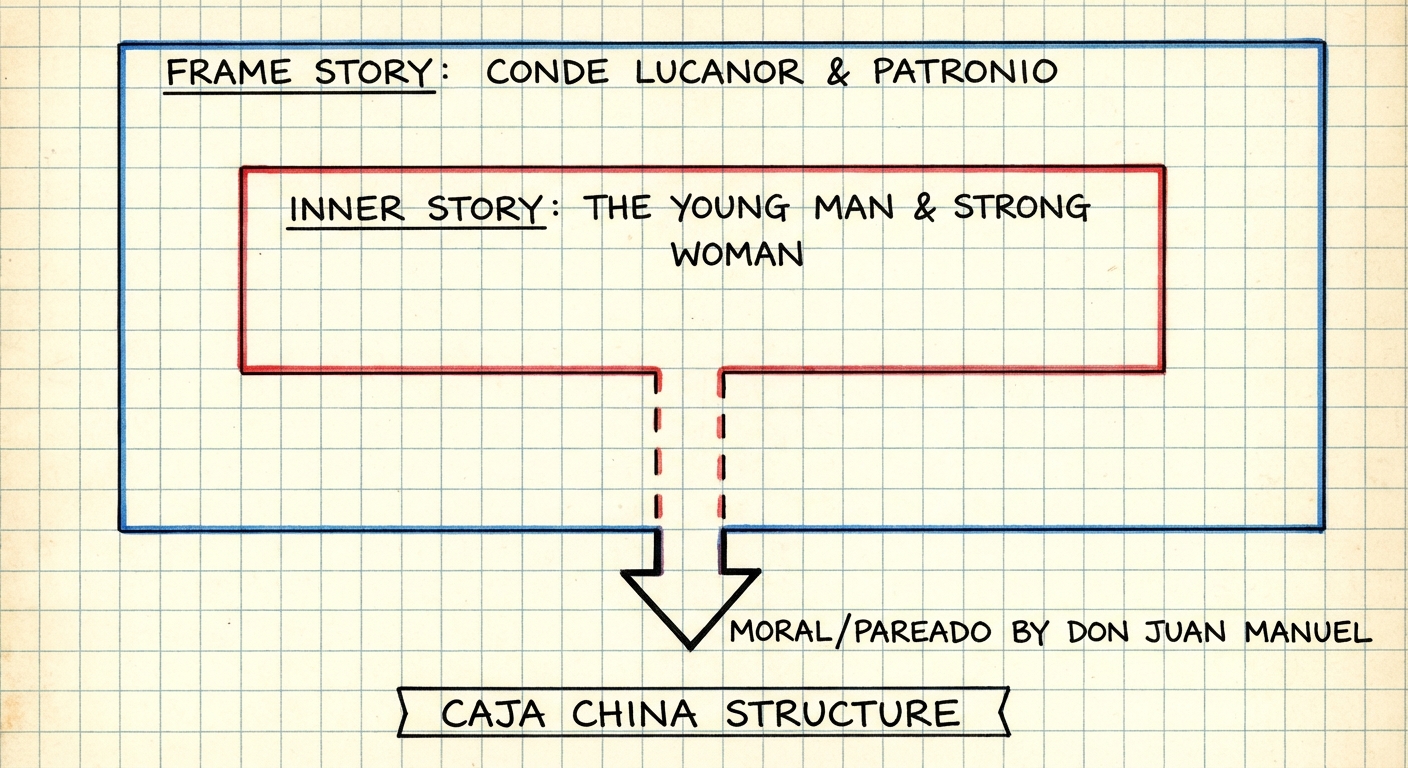
- Frame Level: Conde Lucanor asks Patronio for advice.
- Embedded Level: Patronio tells the story of the Mozo and the Mujer Brava.
- Frame Level (Return): Patronio applies the lesson to the Count's problem.
- Author Level: Don Juan Manuel enters the text as a character to approve the story and adds the moral (moraleja).
Key Literary Terms & Devices
- Apólogo: A short story designed to teach a moral lesson.
- Didáctico: Educational, teaching a lesson.
- Hipérbole: The violent exaggeration of killing the animals to instill fear.
- Moraleja: The explicit moral lesson at the end.
> "Si al comienzo no muestras quién eres, / nunca podrás después cuando quisieres."
AP Themes
- La construcción del género: Explores medieval expectations of masculinity (dominance) and femininity (submission).
- La creación literaria: The structure of the story reflects on the act of storytelling itself.
Required Reading 2: "Romance de la pérdida de Alhama"
Author: Anónimo
Date: Approx. 1482 (15th Century)
Genre: Romance Fronterizo (Ballad of the Frontier)
Historical Context
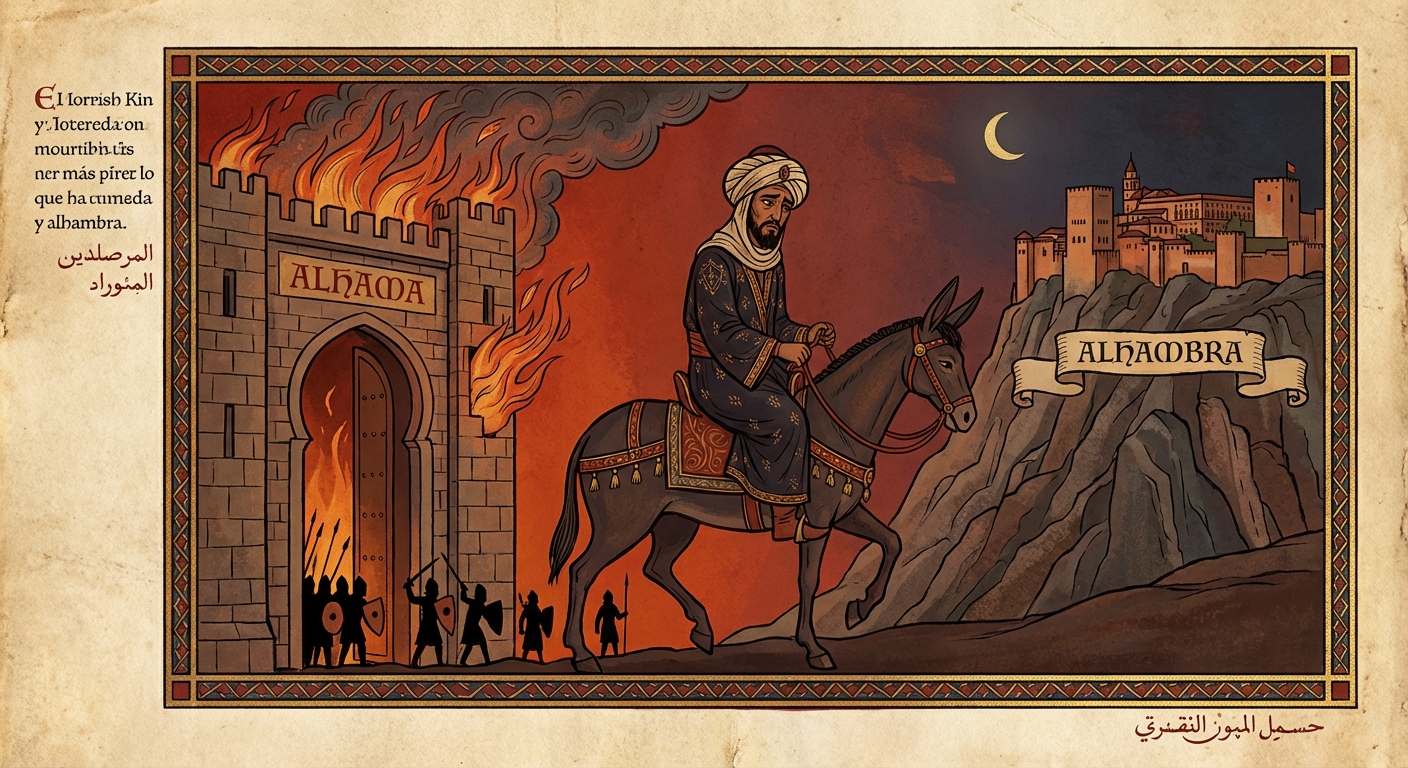
This poem was written during the final stages of the Reconquista, describing the Muslim King Boabdil losing the city of Alhama to Christians. It is unique because it is written in Spanish but from the perspective of the defeated Moors, reflecting the deep grief of loss.
Summary
The Muslim King of Granada receives news that Alhama has fallen. He throws the letter in the fire and kills the messenger. He rides a mule (sign of peace/slowness vs. a warhorse) to the Alhambra to call his troops. An Alfaquí (wise religious scholar) blames the King for the loss, citing the King's poor leadership and political betrayals (killing the Abencerrajes family). The poem ends without resolution, emphasizing doom.
Structure & Form
It follows the strict rules of a Romance:
- Octosyllabic (8 syllables per line).
- Rima Asonante in even-numbered lines (versos pares). (e.g., Grana/da, ganada, matara - assonance in a-a).
- Oral Tradition: Designed to be sung or recited.
Key Literary Terms & Devices
- Estribillo (Refrain): The repetition of "¡Ay de mi Alhama!" creates a mournful, unified tone (lament).
- In Medias Res: The poem starts in the middle of the action (receiving the letter) without introduction.
- Polifonía (Polyphony): Multiple voices speak in the poem without clear narrator transitions:
- The Narrator
- The King
- The Alfaquí (wise elder)
- The Chorus (the people)
- Sinalefa: Merging vowels across words to maintain the 8-syllable count (queal -> que_al).
AP Themes
- Las sociedades en contacto: Shows the conflict between Christians and Moors.
- El imperialismo: The expansion of Christian territory.
- Las relaciones de poder: The King's abuse of power (killing the messenger) vs. the Alfaquí's criticism.
Important Contextual Works
While not always the primary text for analysis questions, these are crucial for comparison and cultural understanding.
1. El Cantar de Mio Cid (Anonymous, c. 1200)
- Significance: The first great epic poem in Spanish.
- Theme: Honor. The hero, El Cid, loses his honor (exiled by the King) and fights to regain it (honra) through battle and loyalty.
- Style: Mester de Juglaría. Realism (unlike French fantasy epics).
2. Las Coplas por la muerte de su padre (Jorge Manrique, 1476)
- Genre: Elegy (poem of mourning).
- Key Concept: Ubi Sunt? (Where are they?). A meditation on the fleeting nature of life and power. Famous metaphor: "Our lives are the rivers that flow into the sea, which is death."
3. La Celestina (Fernando de Rojas, 1499)
- Significance: Marks the transition from the Middle Ages to the Renaissance.
- Genre: Tragicomedy / Dialogue Novel.
- Plot: Calisto loves Melibea. He uses a witch/procuress (Celestina) to get her. Everyone meets a tragic end due to greed and lust.
- Relevance: Breaks medieval archetypes; realistic, cynical view of humanity.
Comparative Table of Literary Schools
| Feature | Mester de Juglaría | Mester de Clerecía |
|---|---|---|
| Creator | Minstrels (Juglares) | Clergy/Scholars (Clérigos) |
| Purpose | Inform & Entertain the masses | Teach moral/religious dogmas |
| Transmission | Oral (recited/sung) | Written (manuscripts) |
| Metric Form | Irregular rhyme & meter | Cuaderna Vía (4 verses, 14 syllables, AAAA rhyme) |
| Example | El Cantar de Mio Cid | Milagros de Nuestra Señora (Berceo) |
Common Mistakes & Pitfalls
Confusing the "Author" with the "Narrator" in Conde Lucanor:
- Correction: Don Juan Manuel is the author. Patronio is a character acting as a narrator within the frame. Do not say "Don Juan Manuel tells the Count…" say "Patronio tells the Count…"
Misidentifying the perspective in Romance de la pérdida de Alhama:
- Correction: Students often assume a Spanish text implies a Christian perspective. This poem is written from the Moorish/Muslim perspective, even though it was likely written by a Christian imagining that grief.
Forgetting to mention Estribillo:
- Correction: Only citing "repetition" is weak. Specifically use the term estribillo when discussing the line "¡Ay de mi Alhama!".
Chronology of La Celestina:
- Correction: Avoid calling La Celestina purely medieval. It is a work of the transition (Prerrenacimiento). It lacks the theocentrism (God-centeredness) of the Middle Ages and focuses on human passion (Humanism).
"Romance" vs. "Romanticism":
- Correction: A Romance is a medieval ballad type. Romanticism is a 19th-century literary movement (Unit 5). Never confuse the two terms.