Unit 8 Comprehensive Study Guide: Solids of Revolution and Known Cross Sections
Foundations of Volume by Slicing
Before diving into specific methods like Discs or Washers, we must understand the fundamental geometric principle of finding volume using calculus. Just as area is found by accumulating (integrating) an infinite number of one-dimensional lines (Riemann sums), Volume is found by accumulating an infinite number of two-dimensional area slices.
The General Volume Formula
If a solid lies between $x=a$ and $x=b$, and the cross-sectional area of the solid perpendicular to the $x$-axis at any point $x$ is given by the function $A(x)$, then the volume $V$ is definitionally:
Alternatively, if the slices are perpendicular to the $y$-axis (horizontal slices), the volume is defined by integrating with respect to $y$:
Key Concept: The integral sums up the areas of infinitely thin slices ($dx$ or $dy$) to create a total volume.
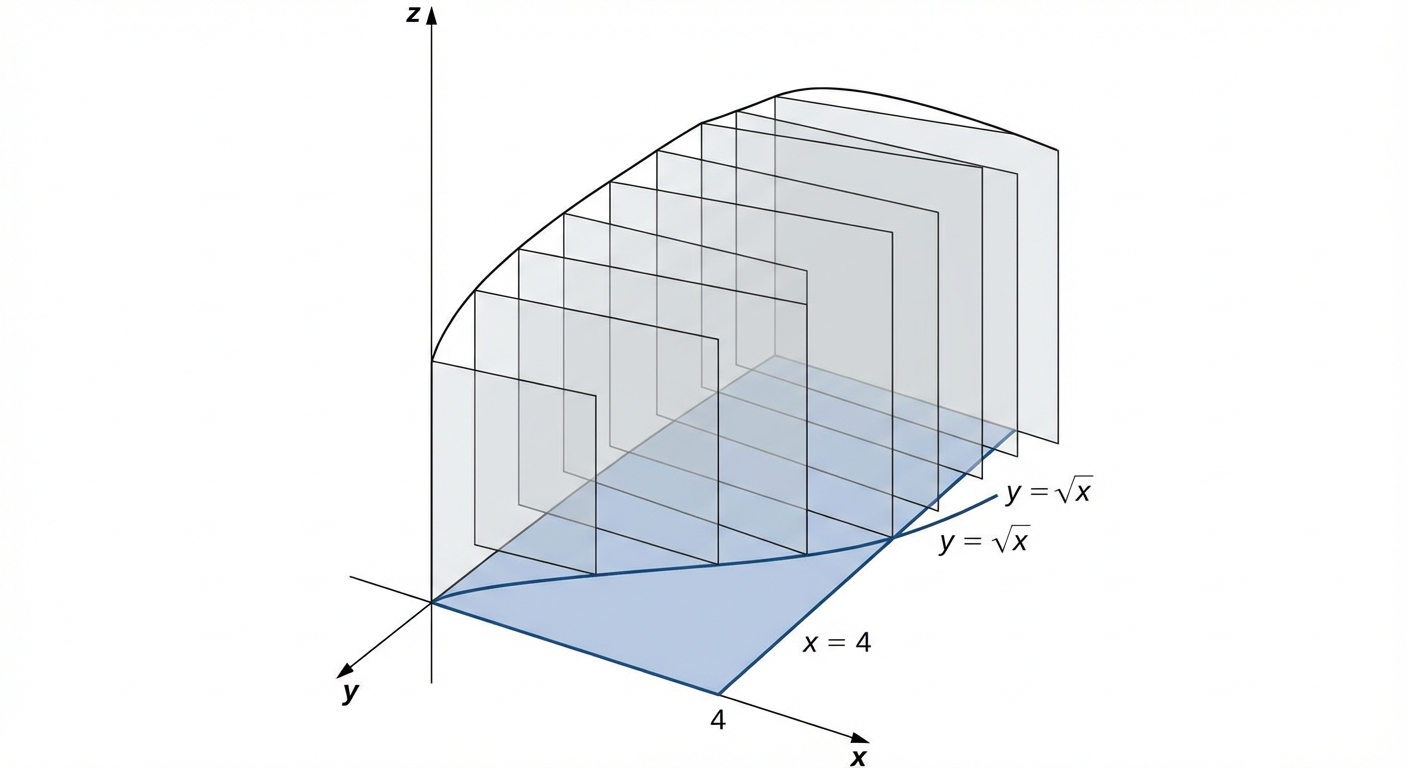
Volumes with Known Cross Sections
In these problems, you are not rotating anything. Instead, you are building a 3D shape on top of a 2D base. The base is a region in the $xy$-plane bounded by functions, and geometric shapes (squares, triangles, semicircles) project perpendicularly out of the page.
Determining the "Slice" Length ($s$)
The critical step is determining the length of the base of the cross-section, denoted here as $s$.
- Perpendicular to x-axis: $s = \text{Top Function} - \text{Bottom Function}$ ($y{top} - y{bottom}$)
- Perpendicular to y-axis: $s = \text{Right Function} - \text{Left Function}$ ($x{right} - x{left}$)
Squares and Rectangles
Once you have determined the expression for $s$, you plug it into the geometric area formula for that shape inside the integral.
| Shape | Relationship to Base ($s$) | Area Formula ($A$) |
|---|---|---|
| Square | Base of square = $s$ | |
| Rectangle | Height $h$ is usually given as a multiple of $s$ (e.g., $h=3s$) |
Worked Example: Square Cross Sections
Problem: Find the volume of a solid whose base is the region bounded by $y = \sqrt{x}$, $y=0$, and $x=4$, with cross sections perpendicular to the x-axis that are squares.
- Identify the Slice ($s$): Since slices are perpendicular to the x-axis, $s = \text{Top} - \text{Bottom}$.
- Area Formula: For a square, $A(x) = s^2$.
- Integrate:
Triangles and Semicircles
These shapes often cause calculation errors because students forget the constants ($ rac{1}{2}, rac{\pi}{8}$, etc.).
| Shape of Cross Section | Area Formula ($A(x)$) | Notes |
|---|---|---|
| Semicircle | Diameter $= s$, so radius $r = s/2$. Area is $\frac{1}{2}\pi (s/2)^2$. | |
| Equilateral Triangle | Memorize this pre-derived formula to save time. | |
| Isosceles Rt. Triangle (Leg on base) | Base $= s$, Height $= s$. | |
| Isosceles Rt. Triangle (Hypotenuse on base) | Requires geometry to derive height from hypotenuse. |
Volumes with Disc Method
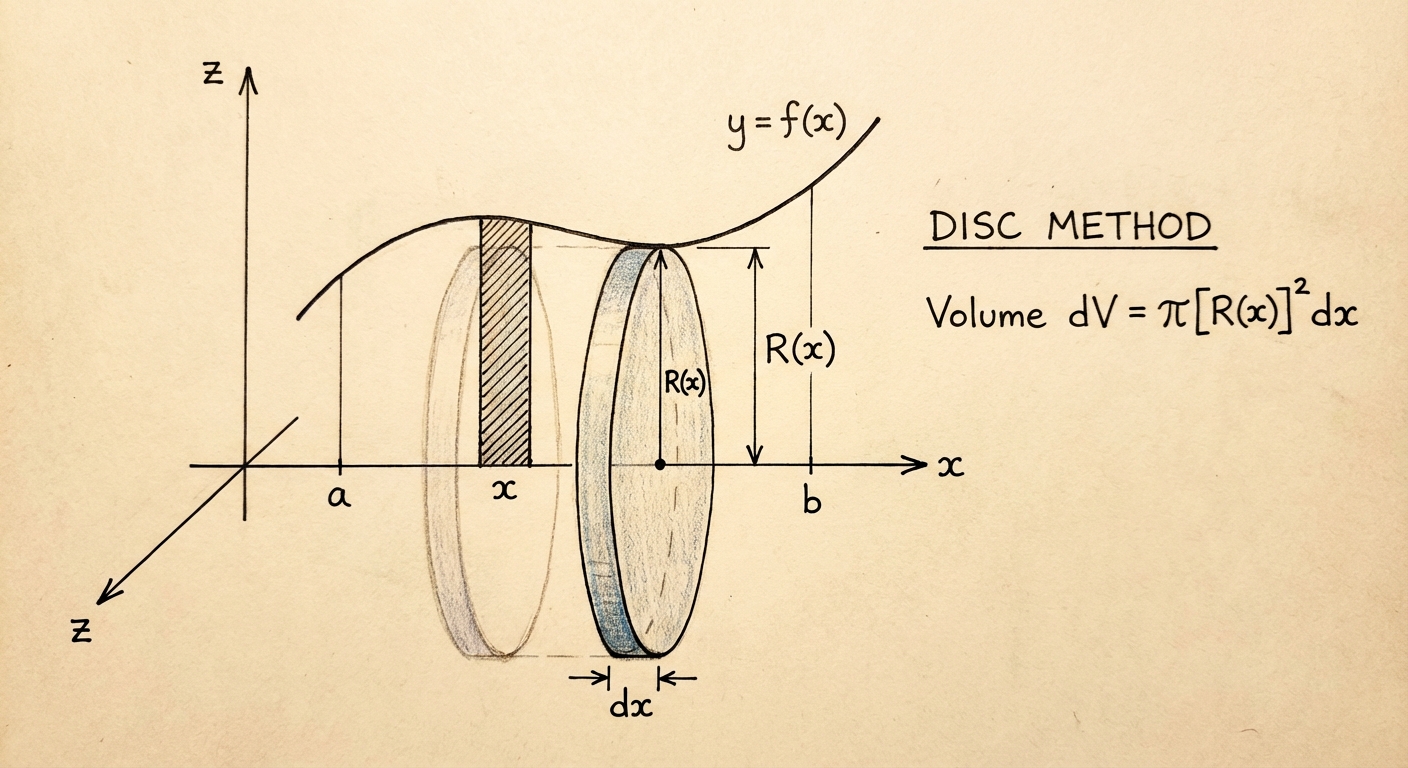
Use the Disc Method when a region is rotated around an axis, and the region is flush against the axis of rotation (no gap).
The Concept
When a rectangle touching the axis is rotated 360 degrees, it forms a cylinder (a disc). The volume of a cylinder is $V = \pi r^2 h$. In calculus:
- The radius $r$ is the function value $R(x)$.
- The height $h$ is the infinitesimal width $dx$.
The Formula
- $R(x)$: The distance from the axis of rotation to the outer edge of the curve.
- Don't forget the $\pi$ outside the integral!
Example: Rotation about the X-axis
Problem: Find the volume of the solid generated by revolving the region bounded by $y = x^2$ and $y=0$ from $x=0$ to $x=2$ about the x-axis.
- Identify Radius ($R$): The distance from axis ($y=0$) to curve ($y=x^2$) is $x^2$.
- Setup Integral:
- Solve:
Volumes with Washer Method
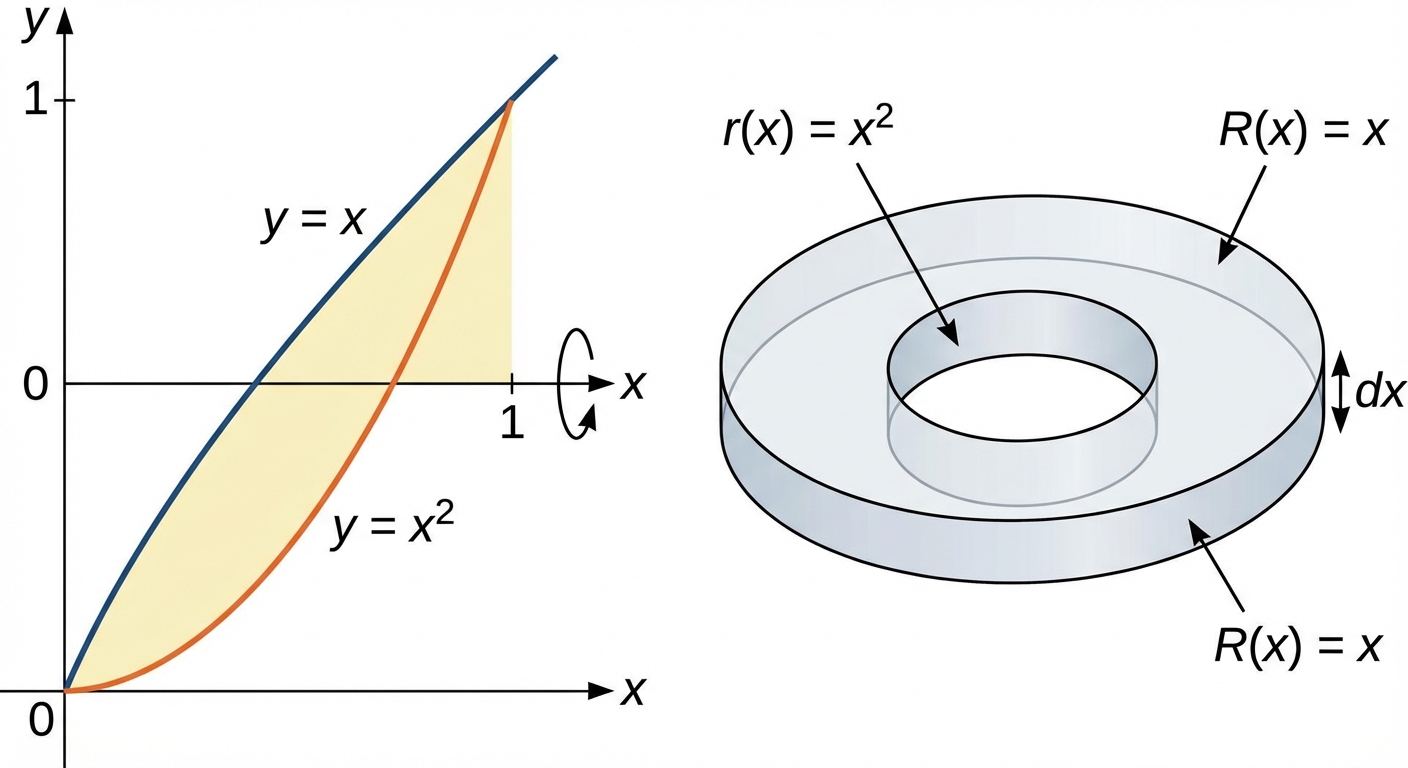
Use the Washer Method when the region being rotated is not flush against the axis of rotation, creating a solid with a hole (or cavity) in the middle.
The Concept
A "washer" is a disc with a smaller disc removed from the center. To find the area of the face of a washer, you calculate the Area of the Outer Circle minus the Area of the Inner Circle.
The Formula
- $R(x)$ (Outer Radius): Distance from axis of rotation to the furthest curve.
- $r(x)$ (Inner Radius): Distance from axis of rotation to the closest curve (the boundary of the empty space).
IMPORTANT: Axis of Rotation Shift
If calculating rotation around a line other than the x or y-axis (e.g., $y = -2$), the radii change length.
- Formula for Radius: $| \text{Function} - \text{Axis} |$
- Example: If rotating $y=x^2$ around $y=-2$, the radius is $x^2 - (-2) = x^2 + 2$.
Mnemonics & Memory Aids
- "Outer minus Inner": Always establish which function is physically farther from the axis line. Draw an arrow from the axis through the region. The first curve you hit is $r$ (inner); the second is $R$ (outer).
- "Pi is Pie": Circles (Discs/Washers) involve $\pi$. Squares and Triangles (Cross Sections) usually do not involve $\pi$ (unless the shape is a semicircle).
- The "Square Separately" Rule:
- Correct: $R^2 - r^2$ (Washer)
- Incorrect: $(R - r)^2$ (Algebraic Sin)
Common Mistakes & Pitfalls
1. The Algebra Trap: $(R-r)^2$
The Mistake: Students often write the integrand for the washer method as $(R(x) - r(x))^2$.
The Correction: You are subtracting volumes, not radii. You must square the radii first, then subtract. The correct form is $R(x)^2 - r(x)^2$.
2. Variable Confusion ($dx$ vs $dy$)
The Mistake: Rotating around the y-axis (vertical) but integrating with respect to $x$.
The Correction:
- Rotation around Horizontal Axis ($y=0, y=5$) $\rightarrow$ $dx$ (Functions must be $y=…$)
- Rotation around Vertical Axis ($x=0, x=-1$) $\rightarrow$ $dy$ (Functions must be $x=…$)
3. Semicircle Coefficient Area
The Mistake: Using $\frac{1}{2}\pi s^2$ for semicircle cross-sections.
The Correction: If $s$ describes the base (diameter) on the graph, the radius is $\frac{s}{2}$. Squaring that gives $\frac{s^2}{4}$. Multiplied by $\frac{1}{2}\pi$, the correct coefficient is $\frac{\pi}{8}$.
4. Forgetting the Shift
The Mistake: When rotating around $y=2$, using just $f(x)$ as the radius.
The Correction: The radius is the distance from the curve to the axis. If the axis is $y=2$ and the curve is $y=x^2$ (below the axis), the radius is $2 - x^2$.