APUSH Unit 9: Challenges and Changes in Contemporary America (1990s–Present)
Post-Cold War Politics: The Clinton Era (1993–2001)
Following the end of the Cold War, the United States navigated a new geopolitical landscape while grappling with internal partisan divides. The presidency of Bill Clinton marked a shift toward the center for the Democratic Party.
The "New Democrat" and Domestic Policy
Clinton campaigned as a New Democrat, a centrist faction moving away from traditional liberal reliance on big government and toward market-based policies. This strategy, often called triangulation, allowed him to co-opt Republican issues.
- North American Free Trade Agreement (NAFTA): Ratified in 1993, this agreement eliminated trade barriers between the U.S., Canada, and Mexico. While it boosted trade volume and corporate profits, critics argued it accelerated the outsourcing of American manufacturing jobs.
- Welfare Reform (1996): Clinton signed the Personal Responsibility and Work Opportunity Reconciliation Act, which ended the guarantee of federal aid to the poor and established the Temporary Assistance for Needy Families (TANF) program, imposing time limits on benefits.
- Budget Surplus: A combination of tax increases on the wealthy and spending cuts led to the first federal budget surpluses in decades by the late 1990s.
The Republican Resurgence
In the 1994 midterm elections, Republicans led by Newt Gingrich instituted the Contract with America, a manifesto promising tax cuts, term limits, and balanced budgets. This resulted in a Republican takeover of both houses of Congress for the first time in 40 years, intensifying political polarization.
Impeachment
Clinton’s presidency was marred by scandals, culminating in his impeachment in 1998 for perjury and obstruction of justice regarding his relationship with intern Monica Lewinsky. While the House voted to impeach, the Senate failed to reach the two-thirds majority required for conviction/removal. This event highlighted the deepening partisan vitriol in Washington.
The Bush Presidency and the War on Terror (2001–2009)
The trajectory of the 21st century was irrevocably altered by the contested election of 2000 and the terrorist attacks of September 11.
The Election of 2000
The contest between Vice President Al Gore and Texas Governor George W. Bush was one of the closest in history. Results hinged on Florida's electoral votes.
- The dispute reached the Supreme Court in Bush v. Gore, where the Court ruled 5-4 to stop the manual recount in Florida, effectively handing the presidency to Bush.
- This outcome reinforced political polarization and raised questions about the electoral college system.
September 11 and the Bush Doctrine
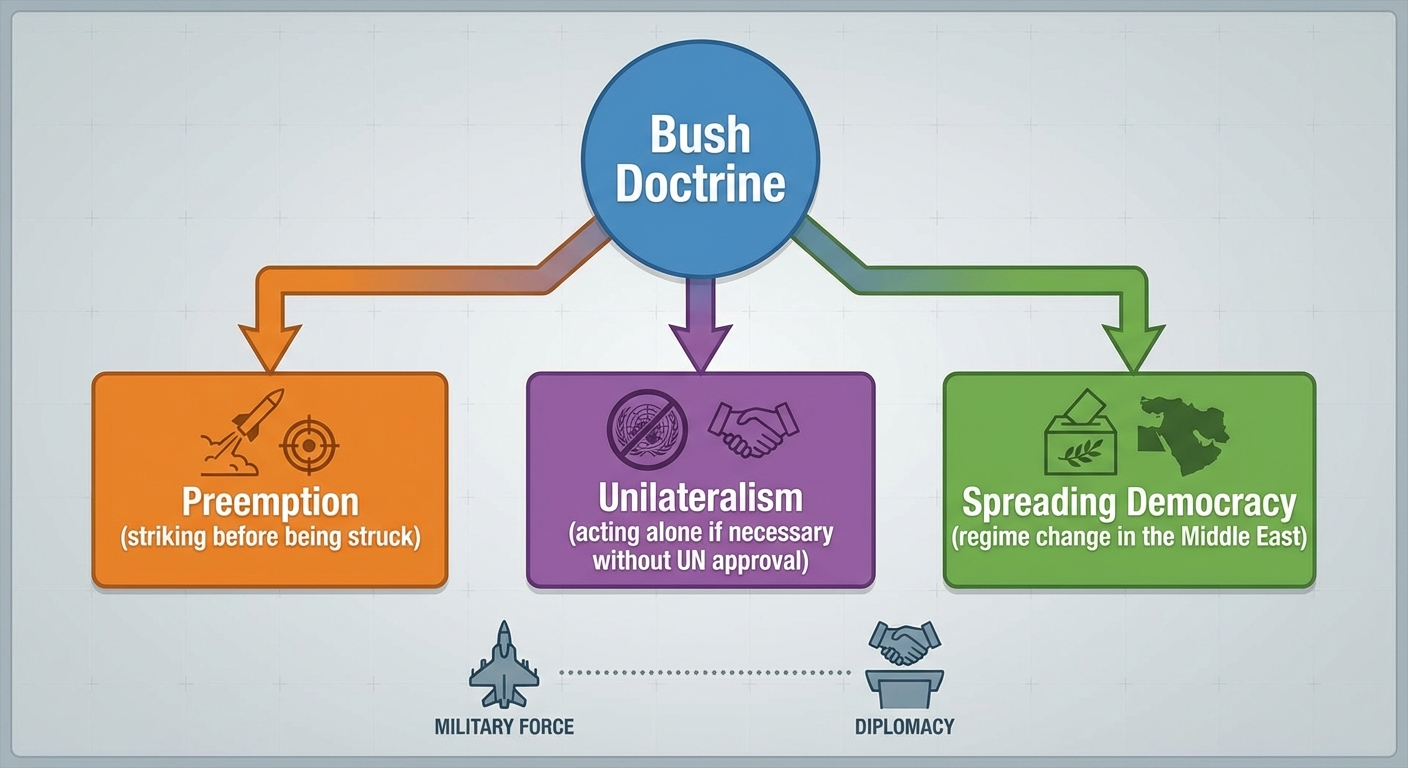
On September 11, 2001, Al-Qaeda terrorists hijacked four planes, striking the World Trade Center in NYC and the Pentagon in DC. This event shifted U.S. foreign policy from containment to aggressive interventionism.
- The War in Afghanistan: In October 2001, the U.S. invaded Afghanistan to overthrow the Taliban government, which had provided sanctuary to Osama bin Laden and Al-Qaeda.
- The Bush Doctrine: This policy asserted the U.S. right to launch preemptive strikes against nations perceived as threats, even if an attack was not imminent. It moved the U.S. toward unilateralism.
- The War in Iraq: In 2003, the U.S. invaded Iraq based on intelligence (later proven flawed) that dictator Saddam Hussein possessed Weapons of Mass Destruction (WMDs) and had links to terrorism. The war toppled Hussein but led to a prolonged, unstable occupation.
Civil Liberties vs. National Security
The War on Terror prompted significant domestic legal changes:
- USA PATRIOT Act (2001): Expanded the government's power to conduct surveillance on citizens (wiretaps, email monitoring) to prevent terrorism.
- Department of Homeland Security: Created in 2002 to coordinate national security efforts.
- Guantanamo Bay: Established as a detention camp for "enemy combatants," sparking intense debate over habeas corpus and the treatment of prisoners.
21st-Century Political and Social Developments
The late 2000s saw major economic upheaval and historic political shifts with the election of the first African American president.
The Great Recession and The Obama Presidency (2009–2017)
George W. Bush's term ended amid the Great Recession (2007–2009), triggered by the collapse of a housing bubble and risky financial practices.
- Election of 2008: Barack Obama defeated John McCain, mobilizing a coalition of minorities, young voters, and college-educated whites.
- Economic Stimulus: The American Recovery and Reinvestment Act aimed to save jobs and bail out the auto industry.
- The Affordable Care Act (Obamacare): Passed in 2010, this was the most significant overhaul of the U.S. healthcare system since the 1960s. It mandated health insurance coverage and prohibited insurers from denying coverage based on pre-existing conditions.
Modern Economy and Changing Demographics
The U.S. economy continued its transition from manufacturing to a service and technology-based economy.
- Globalization: Advances in the internet and logistics deeply integrated the U.S. into the global market. While this lowered consumer prices, it contributed to wage stagnation for manual laborers and the decline of the "Rust Belt."
- Income Inequality: The wealth gap between the top 1% and the rest of the population widened significantly, leading to social movements like Occupy Wall Street.
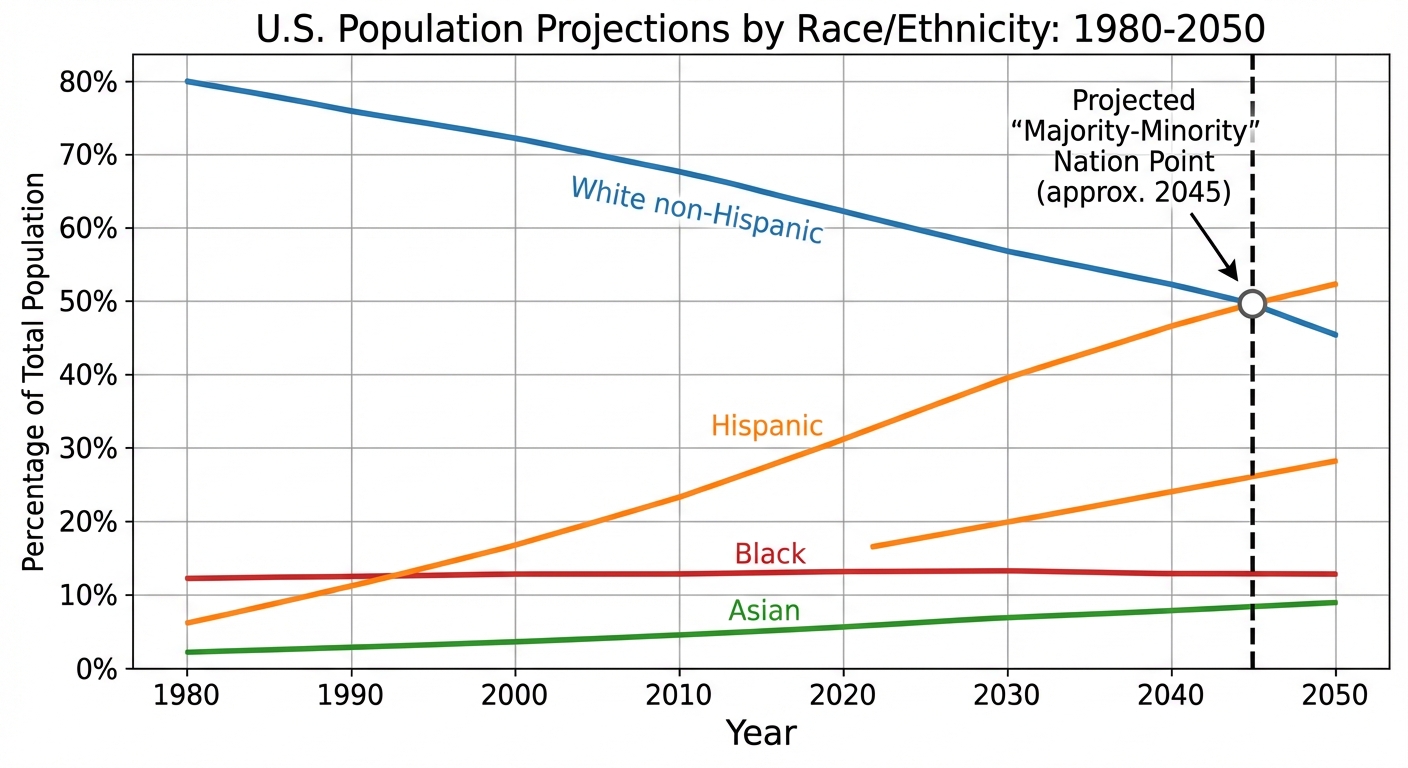
- Immigration: Post-1980 immigration has been dominated by individuals from Latin America and Asia. This demographic shift has altered the political landscape, particularly in the Sun Belt, and sparked fierce debates over immigration reform and border security.
- The Environment: Concerns over climate change and global warming became central political issues. While the U.S. joined international agreements (like the Paris Agreement under Obama), participation has fluctuated with changing administrations.
Summary of Key Trends
| Era | Domestic Focus | Foreign Policy Focus |
|---|---|---|
| 1990s (Clinton) | Economic boom, Welfare Reform, Internet rise | Post-Cold War peace, Free Trade (NAFTA), Humanitarian interventions (Balkans) |
| 2000s (Bush) | Tax cuts, No Child Left Behind | War on Terror, Preemptive War (Iraq/Afghanistan), Unilateralism |
| 2010s (Obama/Trump) | Healthcare (ACA), Great Recession recovery | Pivot to Asia, withdrawing from Middle East wars, Trade protectionism (late 2010s) |
Common Mistakes & Pitfalls
Confusing the Gulf War (1991) with the War in Iraq (2003):
- Correction: The Gulf War (Operation Desert Storm) was under George H.W. Bush to liberate Kuwait. The War in Iraq was under George W. Bush to find WMDs and remove Saddam Hussein.
Misunderstanding the Election of 2000:
- Correction: Students often think the Supreme Court decided who won. Technically, the Supreme Court stopped the recount in Florida (Bush v. Gore), which left Bush ahead in the certified vote tally, giving him the Electoral College victory despite losing the national popular vote.
Oversimplifying the Causes of the 2008 Crash:
- Correction: It wasn't just "stock market fluctuation." It was specifically tied to subprime mortgages (giving loans to people who couldn't pay them back) and the bundling of these toxic loans by banks.
Chronology of Technology:
- Correction: The personal computer revolution began in the 80s, but the World Wide Web and widespread internet usage redefined the economy starting in the mid-to-late 1990s (the Dot-com boom).