Unit 2: The Influence of Language and Culture on Identity
Language and Personal Identity (La lengua y la identidad personal)
In the AP Spanish Language and Culture curriculum, language is not merely a tool for communication; it is the primary vehicle for culture and a fundamental component of self-perception. How we speak determines not only how others view us but how we view ourselves.
The Link Between Language and Culture
Identity (La identidad) is a composite of values, beliefs, language, and traditions. Language shapes our reality (the Sapir-Whorf hypothesis) and connects individuals to their heritage.
- Language as Heritage: For many, speaking a "heritage language" (lengua de herencia) is an act of resistance against losing their roots.
- Dialects and Accents: Variations in Spanish (e.g., voseo in Argentina/Central America vs. tuteo in Mexico/Spain) are regional identity markers. They signal belonging to specific geographic communities.

Co-official Languages and Indigenous Influence
A critical concept for the AP exam is understanding that the Spanish-speaking world is multilingual.
1. Linguistic Diversity in Spain
Spain recognizes several co-official languages (lenguas cooficiales) alongside Castilian Spanish (castellano). This diversity often leads to strong regional identities.
- El catalán: Spoken in Cataluña (Catalonia). Associated with strong growing movements relative to autonomy.
- El euskera (Basque): Spoken in Euskadi (Basque Country). A pre-Roman language unrelated to Latin.
- El gallego: Spoken in Galicia. Historically linked closely to Portuguese.
2. Indigenous Languages in Latin America
Indigenous languages profoundly influence Spanish vocabulary and identity in the Americas.
- El guaraní: Uniquely, Paraguay is a truly bilingual nation where non-indigenous people also speak Guaraní, giving Paraguayans a distinct collective identity.
- El quechua/El aimara: Widely spoken in the Andean region (Peru, Bolivia, Ecuador).
- El náhuatl: The language of the Aztecs (Mexico), lending words like chocolate, tomate, and aguacate.
Code-Switching and Spanglish
Code-switching (La alternancia de códigos)—shifting between languages in a single conversation—is a marker of bicultural identity, particularly in the United States. It creates a sense of solidarity among bilinguals.
- Misconception: Spanglish is often viewed negatively by purists as "broken Spanish," but linguists and AP themes frame it as a valid dialectical evolution and an expression of a dual identity (identidad doble).
Cultural Beliefs and Values (Creencias y valores personales)
This section deals with the invisible software of the mind—the values that dictate behavior within Hispanic cultures.
Collective vs. Individual Identity
While Western cultures (like the U.S.) often prize individualism, many Hispanic cultures lean toward Collectivism (El colectivismo). Identity is defined by one's relationship to the group.
- Individualism: "I am distinct from my family."
- Collectivism: "I am a reflection of my family."
Key Cultural Values
When writing cultural comparisons, reference these specific concepts:
- El Familismo: The loyalty, dedication, and attachment to the nuclear and extended family. Grandparents (los abuelos) often live in the home or play a central role in child-rearing.
- El Respeto: A hierarchical value. It is not just "respect" in the English sense but involves recognizing power distance based on age, social position, or gender. Using usted is a linguistic manifestation of this value.
- El Personalismo: The preference for personal relationships over formal or institutional procedures. Who you know is often as important as what you know.
- El Fatalismo: The belief that destiny is predetermined (often expressed as "Si Dios quiere" - God willing), which can influence attitudes toward planning and the future.
Education and Identity
In many Spanish-speaking countries, academic titles (Licenciado, Doctor, Ingeniero) are used as part of a person's name. This reflects the high value placed on education as a status symbol and a pillar of public identity (identidad pública).
Multiculturalism and Assimilation (Multiculturalismo y asimilación)
Globalization and migration have made identity fluid. This topic explores what happens when cultures collide.
Models of Acculturation
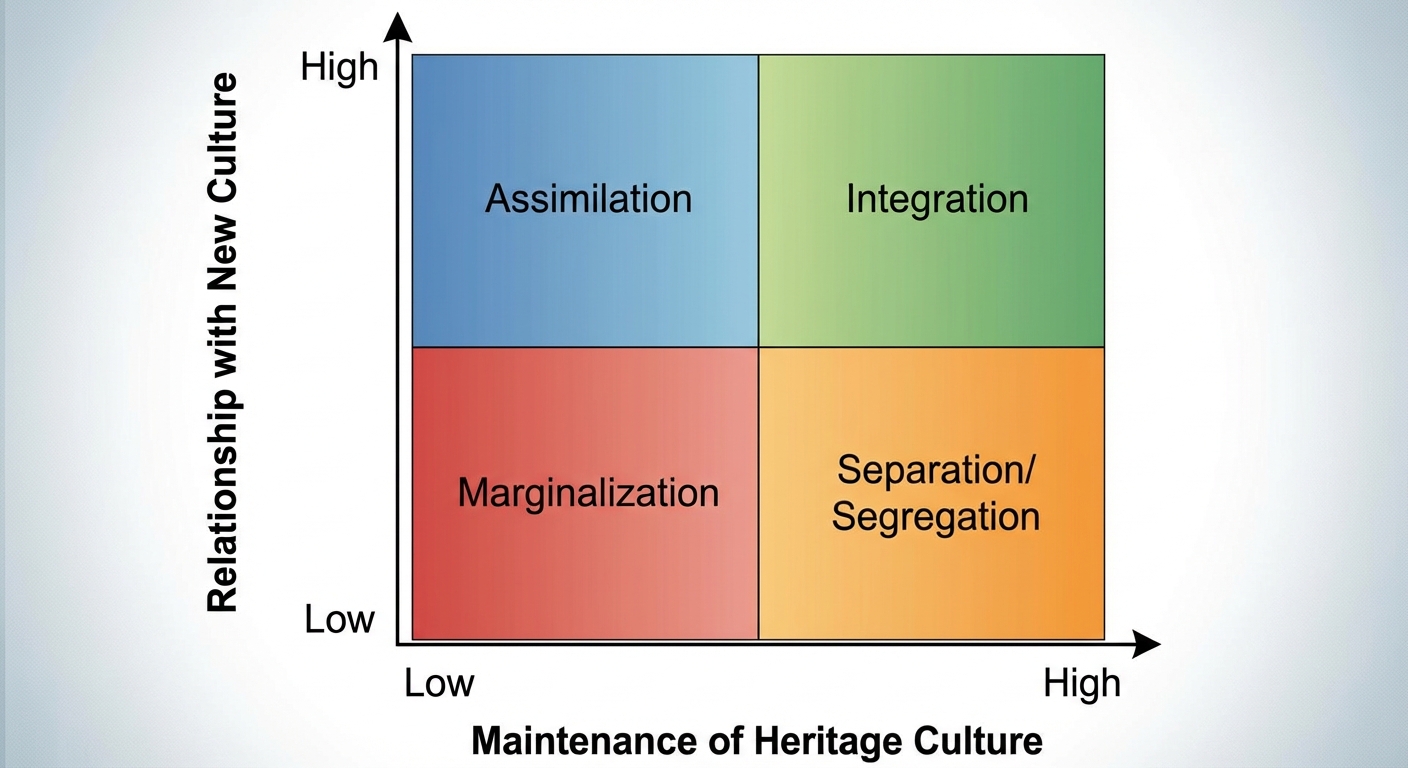
When an immigrant arrives in a new culture, they undergo Acculturation (Aculturación)—the process of adapting to a new culture. This can result in distinct outcomes:
| Term (Español) | Definition | Outcome |
|---|---|---|
| Asimilación | The individual abandons their original culture to fully adopt the new one. | Loss of heritage language/traditions. |
| Integración | Maintaining original culture while participating in the new society. | Bi-culturalism/Bilingualism. |
| Enajenación (Alienation) | Rejection by the dominant culture and loss of connection to the home culture. | Isolation, feeling "ni de aquí, ni de allá" (neither from here nor there). |
The Immigrant Experience
Migration forces a re-evaluation of identity.
- Remittances (Las remesas): Money sent home connects the migrant to their origin, maintaining their role as a provider even from a distance.
- Transnationalism: Living with one foot in each country (physically in the US, culturally/digitally in the home country).
Heroes and Historical Figures
Identity is often anchored by national heroes who represent cultural values.
- Simón Bolívar / José de San Martín: Represents independence and unit.
- Rigoberta Menchú: Represents indigenous rights and resistance.
- Sor Juana Inés de la Cruz: Represents feminism and intellectualism.
Mnemonics & Exam Tips
The "3 P's" of Culture
The AP exam defines culture through the interaction of these three elements. Use this framework for your Cultural Comparison presentation.
- Product (Producto): Literature, food, monuments, laws.
- Practice (Práctica): Social interactions, rites of passage, table manners.
- Perspective (Perspectiva): Values, attitudes, beliefs (e.g., Catholicism, familismo).
Acronym: PPP (Producto reflects Práctica which reflects Perspectiva).
AP Connecting Words
When discussing identity in essays, use high-level connectors:
- Por consiguiente (Therefore)
- No obstante (However/Nevertheless)
- En lo que se refiere a (With regards to)
- Hacer hincapié en (To emphasize)
Common Mistakes & Pitfalls
Confusing "Asimilación" with "Integración":
- Mistake: Using asimilación as a positive term for fitting in.
- Correction: In AP contexts, asimilación usually implies a loss of original identity. Integración is the positive balance of both cultures.
Stereotyping (Generalizaciones):
- Mistake: "All Hispanics are Catholic" or "All Spanish speakers love soccer."
- Correction: Always use qualifiers like generalmente, en muchas comunidades, or es común que.
Linguistic Errors with Identity Terms:
- Mistake: "El individualismo es bueno por la sociedad."
- Correction: "…es bueno para la sociedad." (Objective/Goal).
- Mistake: "La gente son…"
- Correction: "La gente es…" (Collective nouns are singular in Spanish).