Unit 3 Overview: Understanding Japanese Esthetics and Artistic Traditions
Arts and Aesthetics in Japan
Welcome to your deep dive into Unit 3: Influences of Beauty and Art. In the AP Japanese Language and Culture curriculum, this section is crucial not just for reading and listening comprehension, but specifically for the Cultural Perspective Presentation (Free Response Question). You must be able to discuss how Japanese art reflects its environment, history, and social structure, and compare it to your own culture.
Visual and Performing Arts (Shikaku Geijutsu to Butai Geijutsu)
Japanese arts are rarely just about "decoration"; they usually contain deep spiritual or philosophical meanings, often rooted in Zen Buddhism or Shintoism.
Traditional Performing Arts
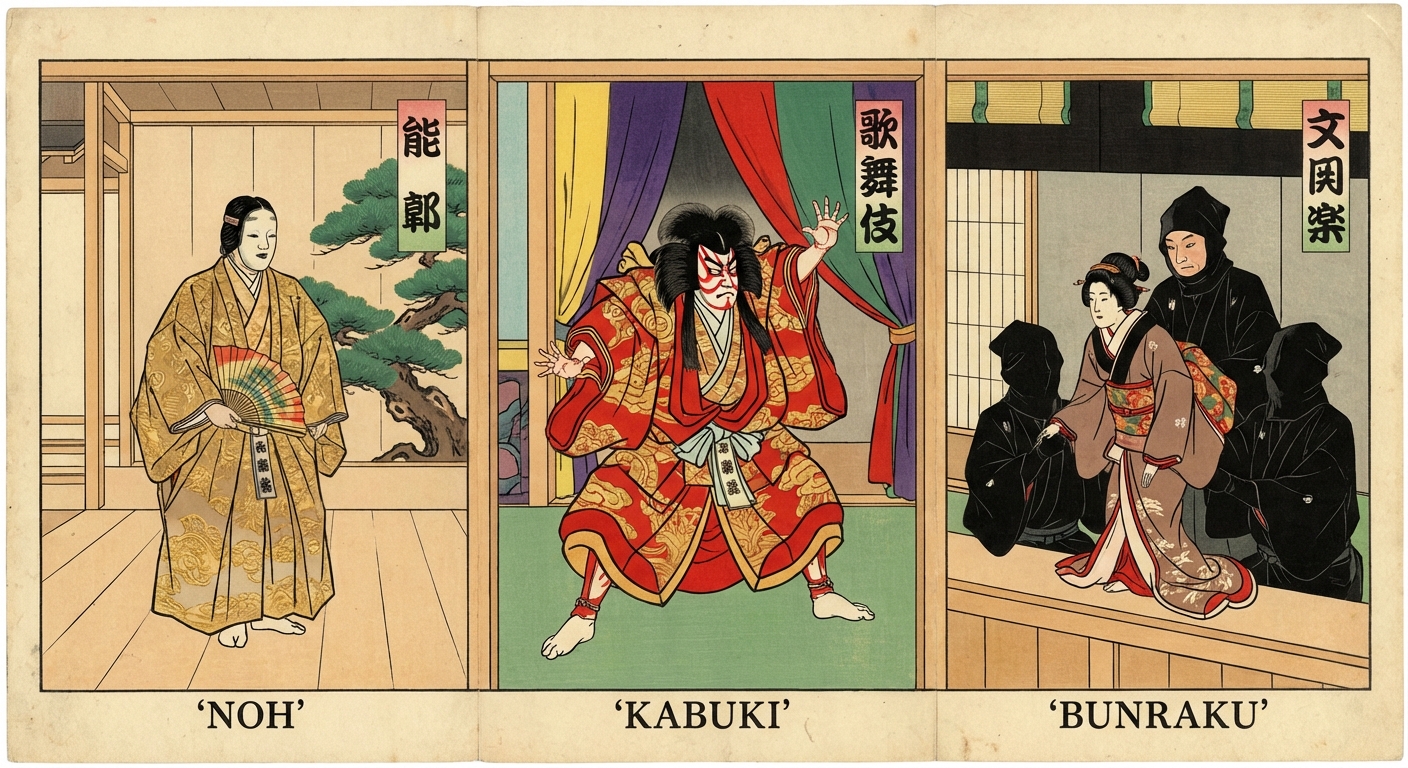
The "Big Three" of traditional Japanese theater are frequently tested. You must know the differences between them to avoid confusion during the listening section.
| Feature | Noh (能) | Kabuki (歌舞伎) | Bunraku (文楽) |
|---|---|---|---|
| Origin | 14th Century (Samurai class) | 17th Century (Merchant/Townspeople) | 17th Century (Merchant/Townspeople) |
| Performance Style | Slow, spiritual, highly stylized movements. | Dynamic, exaggerated, loud, acrobatic. | Complex puppetry with chanted narration. |
| Visuals | Masks (Omote) signify roles. Minimalist stage. | Kumadori (distinctive face makeup). Elaborate, rotating stages. | Nearly life-sized puppets manipulated by 3 people. |
| Key Term | Yugen (profound, mysterious beauty) | Mie (striking a pose to show emotion) | Tayu (the narrator/chanter) |
Note: Another important form is Rakugo (落語), a comic storytelling art performed by a single person sitting on a cushion (zabuton). They use only a fan (sensu) and a hand towel (tenugui) as props to tell funny dialogue-driven stories.
Visual Arts and Architecture
Ukiyo-e (Woodblock Prints)
- Definition: Meaning "pictures of the floating world," this art form flourished in the Edo period. It depicts landscapes, tales from history, and theater scenes.
- Key Artists: Hokusai (famous for The Great Wave) and Hiroshige.
- Influence: Heavily influenced Western Impressionists (Van Gogh, Monet) in a movement called Japonisme.
Calligraphy (Shodo)
- More than just writing, Shodo is an art of mental discipline. The flow of the brush (fude) reflects the state of the writer's mind.
- Kanji/Kana: Works often feature poetry or Zen maxims.
Garden Design and Architecture
- Kare-sansui (Dry Landscape Garden): Often found in Zen temples (like Ryoan-ji). Uses rocks and raked gravel to represent islands and water. It aids in meditation.
- Architecture: Traditional wooden structures rely on joinery (interlocking wood) rather than nails. The Tatami room, with distinct Shoji (sliding paper doors) and Fusuma (opaque sliding doors), creates flexible living spaces.
Literature and Literary Movements (Bungaku)
Japanese literature spans over a millennium, focusing heavily on nature, seasons, and human emotion.
Classical Literature
- The Tale of Genji (Genji Monogatari): Written by Murasaki Shikibu (a lady-in-waiting) in the early 11th century. It is widely considered the world's first novel. It depicts the lifestyles, romances, and intrigues of the Heian court.
Poetry Forms
Understanding the structure of Japanese poetry is essential for the reading section.
- Haiku:
- Structure: 5-7-5 syllables.
- Rule: Must include a Kigo (season word) like "frog" (spring) or "snow" (winter).
- Master: Matsuo Basho is the most famous haiku poet.
- Tanka:
- Structure: 5-7-5-7-7 syllables.
- Older than Haiku, often focuses on love and strong emotions.
Modern Literature
- Natsume Soseki: The most famous modern novelist (Meiji era). Works like Kokoro and I Am a Cat explore the isolation of the modern individual during Japan's rapid Westernization.
- Haruki Murakami: Contemporary writer famous globally for surreal, magical realism (e.g., Kafka on the Shore).
Ideals of Beauty Across Cultures (Bi no Ishiki)
This is the conceptual core of Unit 3. When asked to compare Japanese aesthetics to another culture, focus on these specific Japanese terms.
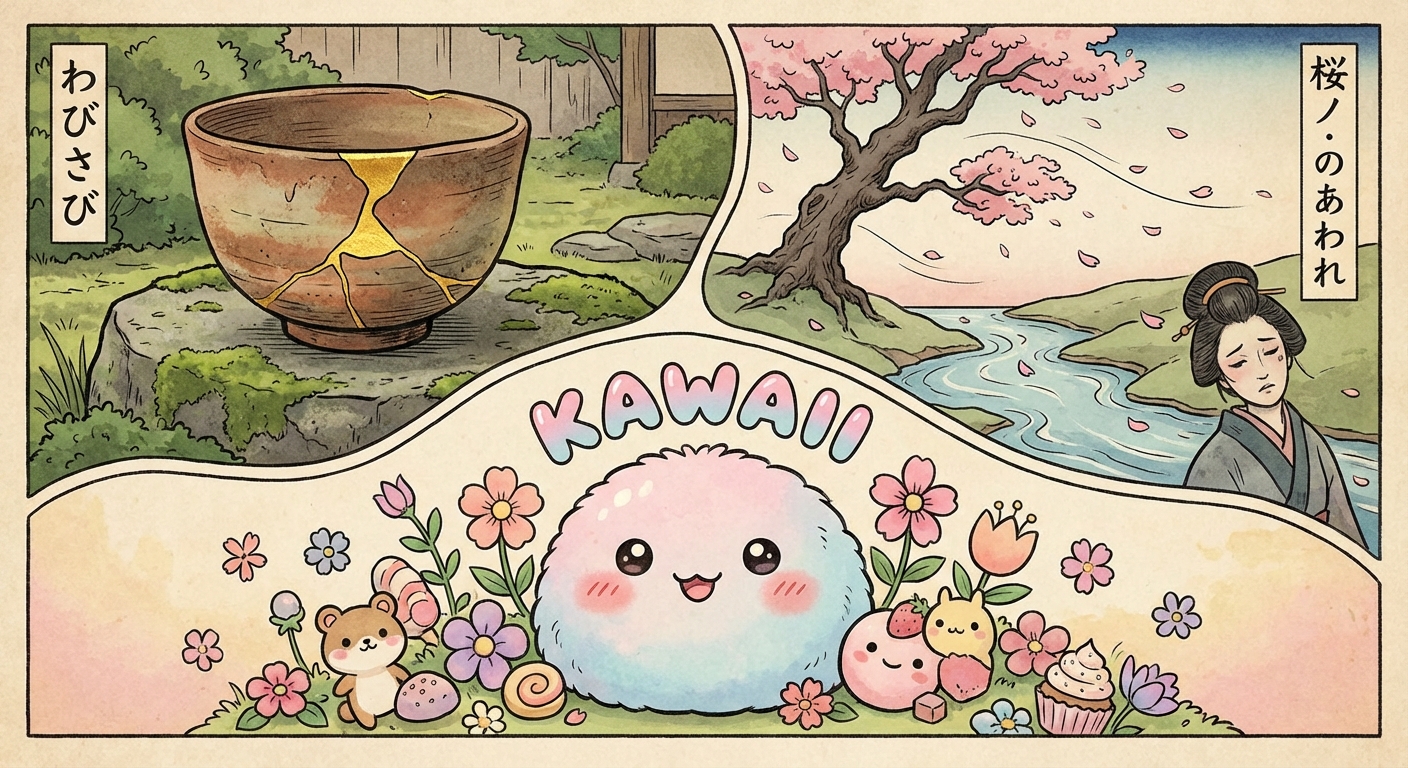
1. Wabi-Sabi (侘寂)
- Definition: The appreciation of beauty that is imperfect, impermanent, and incomplete.
- Characteristics: Asymmetry, roughness, simplicity, modesty, intimacy, and the appreciation of natural objects.
- Example: A tea bowl that is slightly misshapen or has a rustic texture is considered more beautiful than a perfectly symmetrical, machine-made bowl.
2. Mono no Aware (物の哀れ)
- Definition: The pathos of things; a gentle sadness or awareness of the transience of life.
- Primary Symbol: Cherry Blossoms (Sakura). They bloom brilliantly for a week and then fall. Their beauty lies specifically in the fact that they do not last. This contrasts with the Western ideal of the "eternal rose."
3. Miyabi (雅)
- Definition: Courtly elegance, refinement, and sophistication.
- Context: Associated with the Heian period and The Tale of Genji. It rejects the rustic and prefers the polished and aristocratic.
4. Kawaii (可爱)
- Definition: "Cute" culture.
- Modern Application: Originating in the 1970s (Hello Kitty), Kawaii has become a global aesthetic. It values vulnerability, childlike innocence, and round soft shapes.
- Cultural Function: Some sociologists argue Kawaii culture provides an escape from the immense pressure of Japanese work and academic life.
Common Mistakes & Pitfalls
Confusing Haiku and Tanka counts:
- Mistake: Thinking Tanka is just a long Haiku without rules.
- Correction: Remember the ending 7-7 for Tanka. Also, Haiku strictly requires a kigo (season word), while Tanka does not necessarily require one.
Misidentifying Theater Forms:
- Mistake: Describing Kabuki as "quiet and masked."
- Correction: Connect Kabuki with CRAZY (loud, colorful, makeup). Connect Noh with NO (No expression, masks, stillness).
Oversimplifying Kawaii:
- Mistake: Treating Kawaii only as a marketing tool.
- Correction: In the Cultural Perspective Presentation, acknowledge it as a mindset and a specific aesthetic standard that influences fashion, handwriting, and even government mascot communication (Yuru-chara).
Neglecting the "Why":
- Mistake: Listing art forms without distinct explanations.
- Correction: Always connect the art to the culture. Why do they like paper doors? (Connection to nature). Why do they like rock gardens? (Zen Buddhism/Meditation).