Unit 7 Study Guide: Secondary Functions and Chromatic Harmony
Introduction to Secondary Function
In functional tonal harmony, chords usually relate directly to the tonic (I). However, composers often wish to emphasize or "highlight" a chord other than the tonic to create forward momentum and harmonic interest. This process is called tonicization.
To achieved this, we use Secondary Functions: chords that act as Dominant ($V$) or Leading-Tone ($vii^\circ$) chords for a diaper tone other than the main tonic. These chords are chromatic—they require accidentals outside the key signature.
Key Concepts
- Tonicization: The process of treating a chord other than the tonic as a temporary center of gravity.
- Secondary Tonic: The chord being tonicized (the "target" chord).
- Chromaticism: Using notes outside the diatonic scale.
Secondary Dominant Chords ($V/x$)
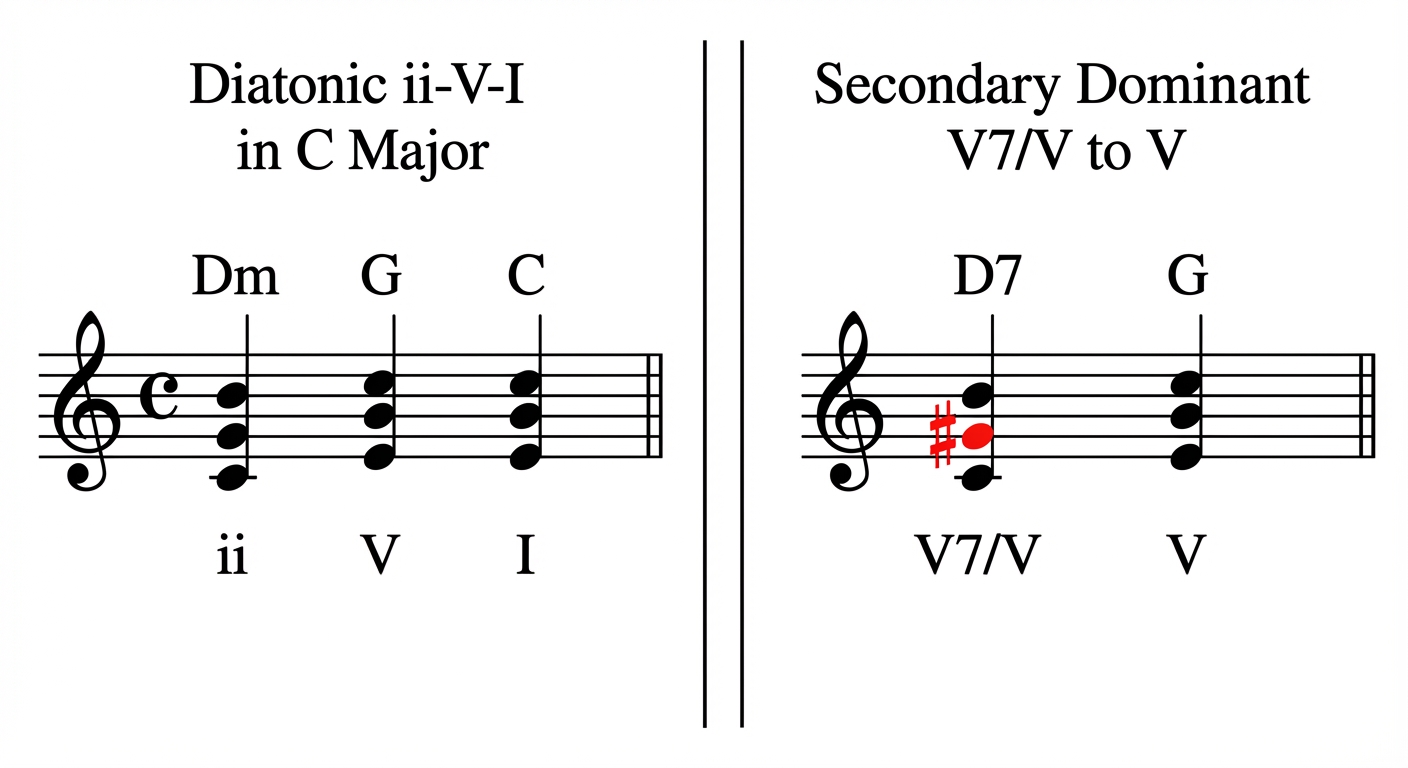
A Secondary Dominant is a Major triad or Dominant Seventh chord that precedes a diatonic major or minor triad. It functions exactly like a standard $V-I$ progression, but shifted to a new, temporary key.
Construction Rules
- Root: The root of the secondary dominant is a Perfect 5th above (or Perfect 4th below) the root of the target chord.
- Quality:
- A secondary dominant triad ($V/x$) is Major.
- A secondary dominant seventh ($V^7/x$) is a Major-Minor 7th (Mm7) chord (Major triad + Minor 7th).
- Accidentals: You generally must alter the third of the secondary dominant to create a temporary leading tone (a half-step below the target root).
The "X of Y" Notation
We analyze these chords using slash notation: Function / Target.
- $V/V$ (pronounced "Five of Five") resolves to the Dominant ($V$).
- $V/ii$ resolves to the Supertonic ($ii$).
- $V^7/IV$ resolves to the Subdominant ($IV$).
Valid Targets
The target chord (the denominator of the fraction) must be a Major or Minor triad.
- You cannot tonicize a diminished chord (like $vii^\circ$ in Major or $ii^\circ$ in Minor) because a diminished chord cannot act as a stable tonic.
- You generally do not write $V/I$ (this is just $V$).
Detailed Analysis Table: Common Secondary Dominants in C Major
| Function | Target in C | Calculation (P5 above target) | Resulting Notes | Required Accidentals |
|---|---|---|---|---|
| $V/ii$ | D minor | A is P5 above D | A - C# - E | Raise C to C# |
| $V/V$ | G Major | D is P5 above G | D - F# - A | Raise F to F# |
| $V/vi$ | A minor | E is P5 above A | E - G# - B | Raise G to G# |
| $V^7/IV$ | F Major | C is P5 above F | C - E - G - Bb | Lower B to Bb (creates dom 7th) |
Note: $V^7/IV$ is unique because to make a C-E-G triad into a Dominant 7th (Mm7), you must add a minor seventh interval (Bb). In C Major, this requires adding a flat, whereas most secondary dominants require adding sharps.
Secondary Leading-Tone Chords ($vii^\circ/x$)
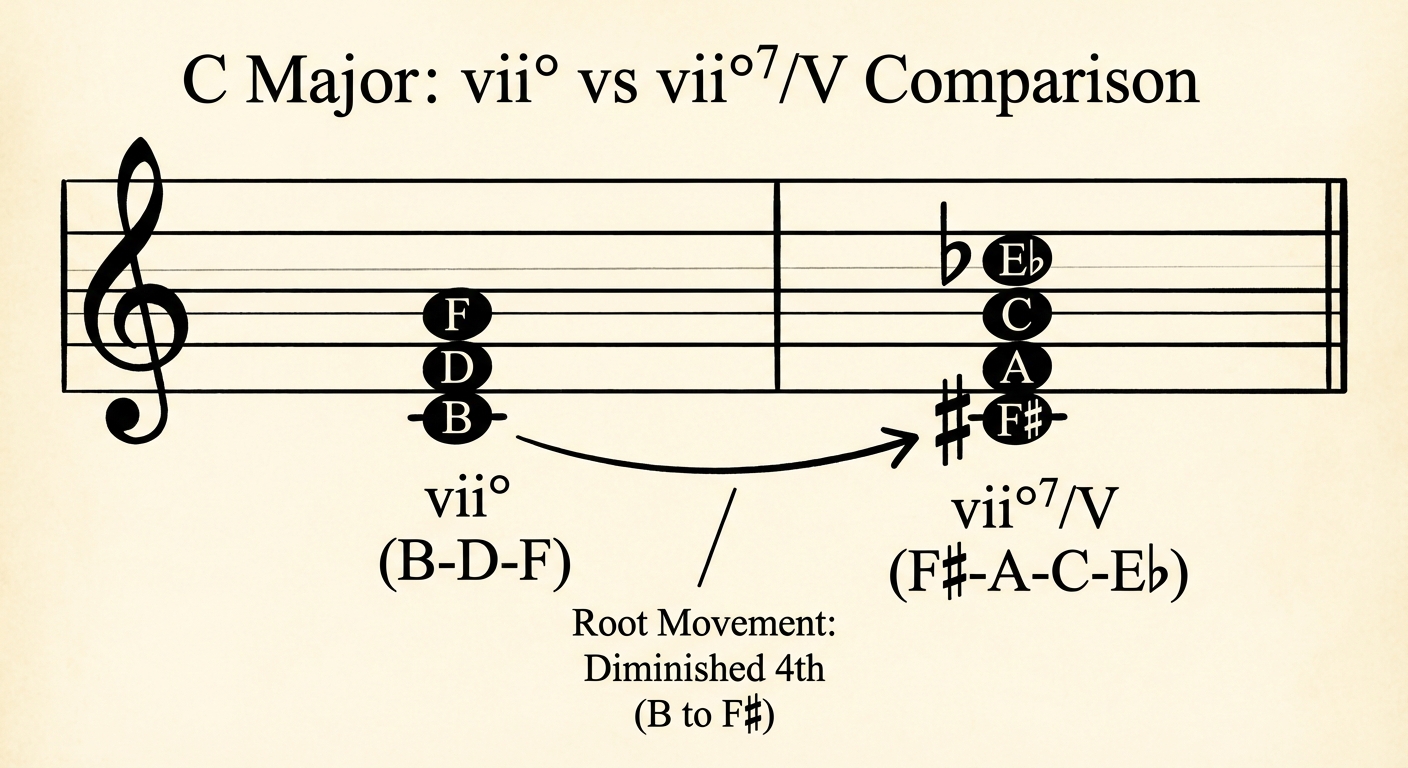
Just as we can have a "Five of x," we can have a "Seven of x." These are diminished chords built on the temporary leading tone of the target chord.
Construction Rules
- Root: The root of the secondary leading-tone chord is a minor 2nd (half step) below the root of the target chord.
- Quality:
- Triads: Always diminished ($vii^\circ/x$).
- Seventh Chords: usually Fully Diminished ($vii^{\circ 7}/x$).
- Exception: In Major keys, if the target is Major (like V or IV), you occasionally see a Half-Diminished ($vii^{\phi 7}/x$), but fully diminished is standard on the AP exam for its strong pull.
Example Calculation
Find the $vii^{\circ 7}/ii$ in C Major:
- Identify Target: $ii$ is D minor.
- Find Root: half step below D is C#.
- Build Fully Diminished 7th: C# - E - G - Bb.
- Check Accidentals: C# is accidental. Bb is accidental.
Voice Leading and Resolution
Correct voice leading is critical for the Free Response Questions (FRQs) on the AP exam. Secondary functions follow standard SATB rules, but with specific attention to chromaticism.
1. The Temporary Leading Tone
The third of a secondary dominant (or the root of a secondary leading-tone chord) acts as the leading tone to the target.
- Rule: The temporary leading tone MUST resolve UP by a half step to the root of the target chord.
2. The Chromatic Note
- Because secondary functions introduce accidentals, adhere to the principle of chromatic direction:
- If a note is raised (e.g., F to F#), it wants to continue up.
- If a note is lowered (e.g., B to Bb in $V^7/IV$), it wants to continue down.
3. The Seventh Factor
- If using a $V^7/x$ or $vii^{\circ 7}/x$, the seventh of the chord resolves DOWN by step.
4. Spacing and Doubling
- Never double the temporary leading tone (the raised accidental).
- In $V/x$ triads, double the Root.
Tonicization vs. Modulation
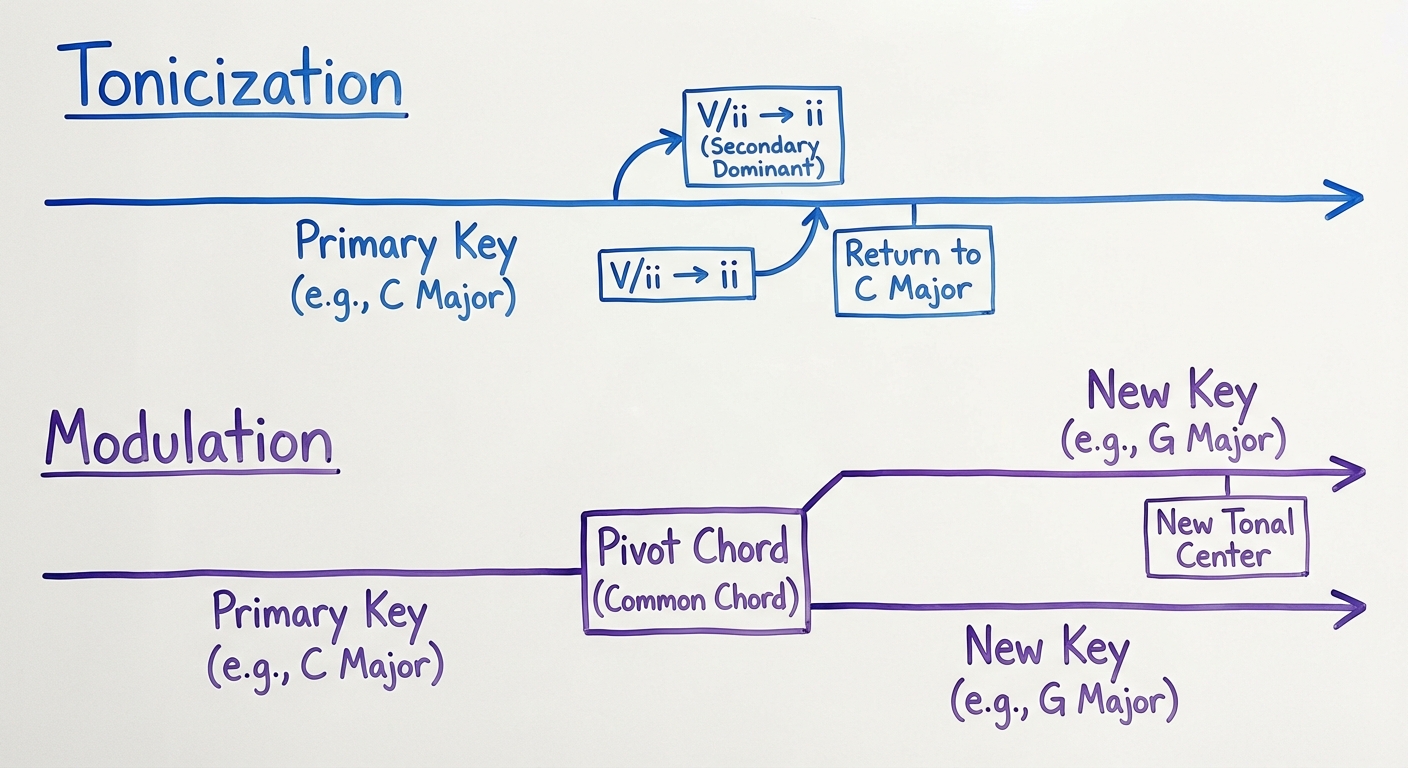
It is vital to distinguish between a fleeting secondary function and a full key change.
Tonicization
- Duration: Very short (usually just two chords: $V/x \to x$).
- Effect: Temporarily highlights a chord.
- Cadence: Does NOT conclude with a strong cadence in the new key.
- Notation: Analyzed with slash notation within the original key.
Modulation
- Duration: Longer; the music continues in the new key.
- Effect: Establishes a new tonal center.
- Cadence: CONFIRMED by a cadence (PAC) in the new key.
- Notation: Usually typically indicated by a specific pivot chord and a change in Roman numeral analysis layers.
Common Mistakes & Pitfalls
Confusing V/IV with I:
In C Major, a C Major triad is $I$. However, a C Dominant 7th (C-E-G-Bb) is $V^7/IV$. If you see a tonic triad with a minor 7th added, it is almost always a secondary dominant to the subdominant.Forgetting the "Temporary Leading Tone" Resolution:
Student often identify the chord correctly but create parallel octaves or frustrated leading tones in part-writing. Always circle the accidental and draw an arrow to the note a half-step above it.Misidentifying the Target:
Example: In F Major, a student sees an A major triad (A-C#-E). They think "A is iii in F." But iii must be minor. A Major is $V$ of D ($vi$). Therefore, A Major is $V/vi$, not a diatonic $iii$ with an accidental.Tonicizing Diminished Chords:
You cannot have $V/vii^\circ$ or $V/ii^\circ$ (in minor). Dominants resolve to stable sonorities. If you calculate a slash chord pointing to a diminished triad, check your math again.
Summary Check
To master this section, ask yourself:
- Can I spell the $V^7/V$ in any key?
- Do I know the difference between a diatonic chord and a secondary function?
- Can I part-write the resolution of a secondary $vii^{\circ 7}$ resolving to its target without writing consecutive 5ths?