Evolutionary Biology: Mechanisms, Evidence, and History
The Mechanics of Natural Selection
Core Definitions
- Evolution: A change in the genetic make-up (allele frequencies) of a population over time. It is not fundamentally about individuals changing, but populations shifting.
- Natural Selection: The process by which organisms with specific phenotypes that are better adapted to their environment survive and reproduce at higher rates than organisms without those phenotypes.
Darwin’s Postulates
Much of modern evolutionary theory rests on the foundations laid by Charles Darwin in On the Origin of Species. For natural selection to occur, four conditions must be met:
- Variation: Individuals within a population exhibit differences in traits (phenotypic variation).
- Overproduction: Populations produce more offspring than the environment can support (carrying capacity).
- Competition: Because resources are limited, offspring must compete for survival (struggle for existence).
- Differential Reproductive Success: Individuals with more favorable traits (adaptations) are more likely to survive and reproduce, passing those traits to the next generation.
Evolutionary Fitness
Students often misconstrue "survival of the fittest" as "survival of the strongest." In biology, Fitness is strictly defined by reproductive success.
- It is measured by the number of fertile offspring an organism contributes to the next generation.
- Traits that increase fitness are those that improve survival and reproduction in a specific local environment.
- Trade-offs: A trait that increases mating success (e.g., bright feathers in peacocks) might decrease survival chances (easier for predators to spot). Selection balances these pressures.
Historical Context: Lamarck vs. Darwin
Before Darwin, Jean-Baptiste Lamarck proposed the theory of Inheritance of Acquired Characteristics (e.g., giraffes stretched their necks to reach leaves, and passed longer necks to offspring). We now know this is incorrect because somatic changes (body changes during life) do not alter the DNA passed in gametes.
Artificial Selection
Artificial Selection occurs when humans, rather than the environment, determine which individuals reproduce. This demonstrates that selection can result in dramatic changes over short periods.
- Mechanism: Humans select parents with desirable traits (e.g., sweetness in corn, docility in dogs) to breed.
- Significance: Darwin used artificial selection (breeding pigeons) as a model to explain how natural selection could work over longer timescales.
- Unintended Consequences: Overuse of antibiotics selects for resistant bacteria (MRSA); overuse of pesticides selects for resistant crop pests.
Population Genetics: Hardy-Weinberg Equilibrium
To determine if a population is evolving, scientists look at allele frequencies. If they change, evolution is happening. If they remain constant, the population is in Hardy-Weinberg Equilibrium.
The Formulas
There are two key formulas you must memorize. $p$ usually represents the dominant allele and $q$ the recessive allele.
- Allele Frequencies:
- Genotype Frequencies:
| Variable | Represents |
|---|---|
| $p$ | Frequency of the dominant allele ($A$) |
| $q$ | Frequency of the recessive allele ($a$) |
| $p^2$ | Frequency of homozygous dominant genotype ($AA$) |
| $2pq$ | Frequency of heterozygous genotype ($Aa$) |
| $q^2$ | Frequency of homozygous recessive genotype ($aa$) |
Five Conditions for Equilibrium
A population is NOT evolving (is in equilibrium) only if ALL five conditions are met:
- No Mutation: No changes in the DNA sequence.
- Random Mating: No sexual selection; organisms do not choose partners based on genotypes.
- No Natural Selection: All genotypes share the same survival/reproductive success.
- Extremely Large Population Size: No genetic drift.
- No Gene Flow: No immigration or emigration.
Worked Example
Problem: In a population of sheep, wool color is determined by a single gene. White wool ($W$) is dominant to black wool ($w$). You observe that 16% of the sheep have black wool.
Solution:
- Identify the known variable: Black wool is recessive ($ww$), so the frequency of the genotype $q^2 = 0.16$.
- Solve for $q$:
- Solve for $p$: Since $p + q = 1$, then $p = 1 - 0.4 = 0.6$.
- Calculate heterozygous frequency ($2pq$):
Answer: 48% of the sheep are heterozygous.
Mechanisms of Evolution (Causes)
Since the conditions for Hardy-Weinberg are rarely met in nature, evolution is constantly occurring. The main drivers are:
1. Natural Selection (Adaptive Evolution)
This is the only mechanism that consistently improves the match between organisms and their environment. It can manifest in three patterns: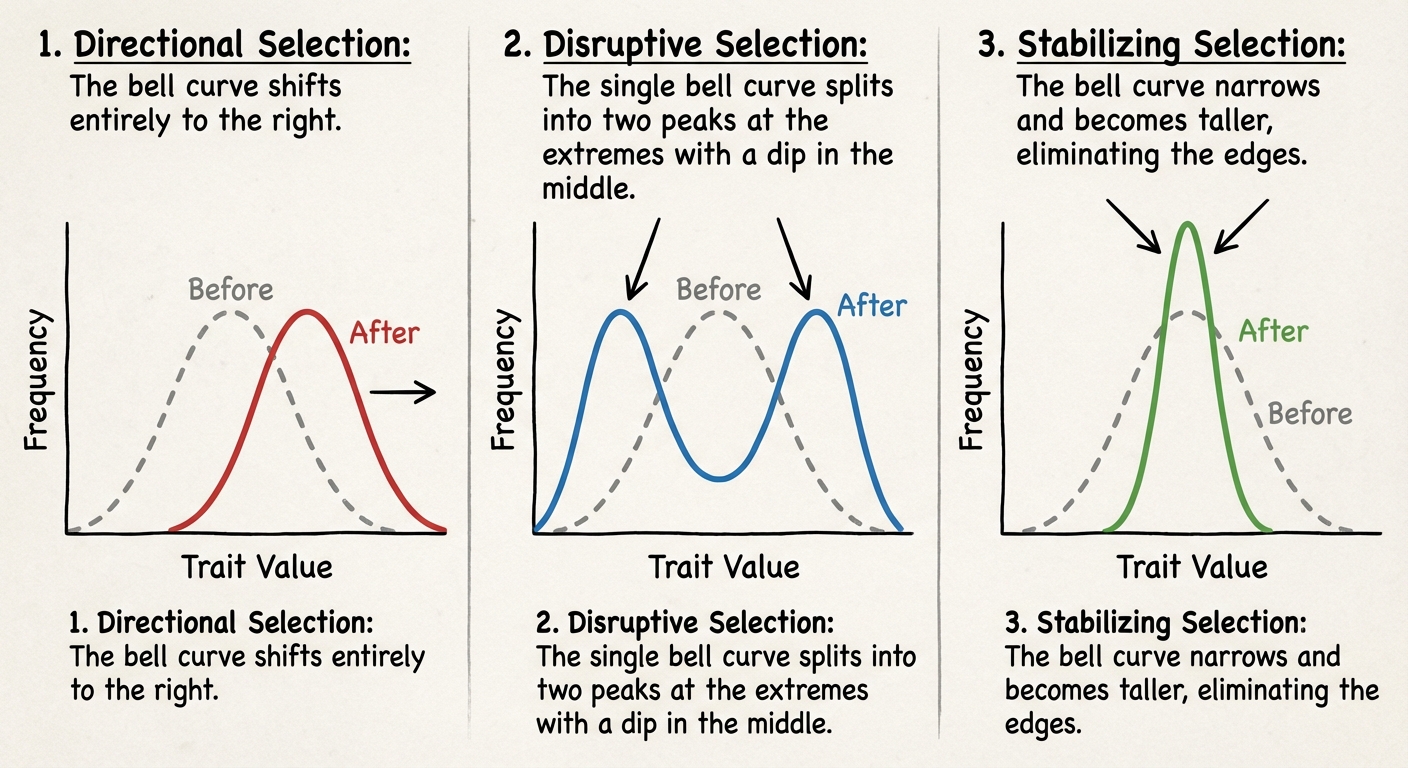
- Directional Selection: Conditions favor individuals at one extreme of a phenotypic range (e.g., The Peppered Moth shifting from light to dark due to industrial soot).
- Disruptive Selection: Conditions favor individuals at both extremes of a phenotypic range over intermediate variants (e.g., finches with small beaks for soft seeds and large beaks for hard seeds, but no medium beaks).
- Stabilizing Selection: Natural selection acts against extreme phenotypes and favors intermediate variants (e.g., human birth weights).
2. Genetic Drift
Random changes in allele frequencies, most significant in small populations. It minimizes genetic variation.
- Bottleneck Effect: A sudden event (fire, flood, hunting) drastically reduces population size. The survivors' gene pool may not reflect the original population (e.g., Cheetahs).
- Founder Effect: A few individuals become isolated from a larger population and establish a new population with a different gene pool (e.g., Polydactyly in Amish communities).
3. Gene Flow
The transfer of alleles into or out of a population due to the movement of fertile individuals or gametes (migration). It tends to reduce genetic differences between populations.
Evidence for Evolution
1. Evidence from Organisms
- Morphological Homologies: Structures in different species that are similar because of common ancestry.
- Example: The forelimbs of humans, cats, whales, and bats share the same skeletal structure despite different functions.
- Vestigial Structures: Remnants of features that served a function in the organism's ancestors (e.g., pelvic bones in whales, wisdom teeth in humans).
- Analogous Structures: Features with similar function but different structure and origin (e.g., wings of a bee vs. wings of a bird). These represent Convergent Evolution, not common ancestry.
- Embryology: Similar developmental stages (e.g., pharyngeal pouches/gill slits) in vertebrates indicate common ancestry.
2. Molecular Evidence (The Strongest Proof)
- All life shares Conserved Core Processes: DNA/RNA as genetic carriers, the universal genetic code, and metabolic pathways (glycolysis).
- Sequence Comparison: The more similar the amino acid or DNA sequence between two species, the more recently they likely shared a common ancestor.
3. The Fossil Record
- Paleontology: Shows the progression of life forms.
- Dating Methods:
- Relative Dating: Using distinct rock layers (stratigraphy).
- Radiometric Dating: Using the decay rate of isotopes (Half-life). Example: Carbon-14 for recent remains, Uranium-238 for older rocks.
Phylogeny and Cladistics
Biologists use Phylogenetic Trees and Cladograms to visualize evolutionary relationships.
- Clade: A group of species that includes an ancestral species and all its descendants (monophyletic group).
- Node: Represents the most recent common ancestor of the lineages branching from it.
- Sister Taxa: Groups that share an immediate common ancestor.
- Outgroup: A species or group strictly related to the group being studied (the ingroup), used as a reference to determine ancestral vs. derived traits.
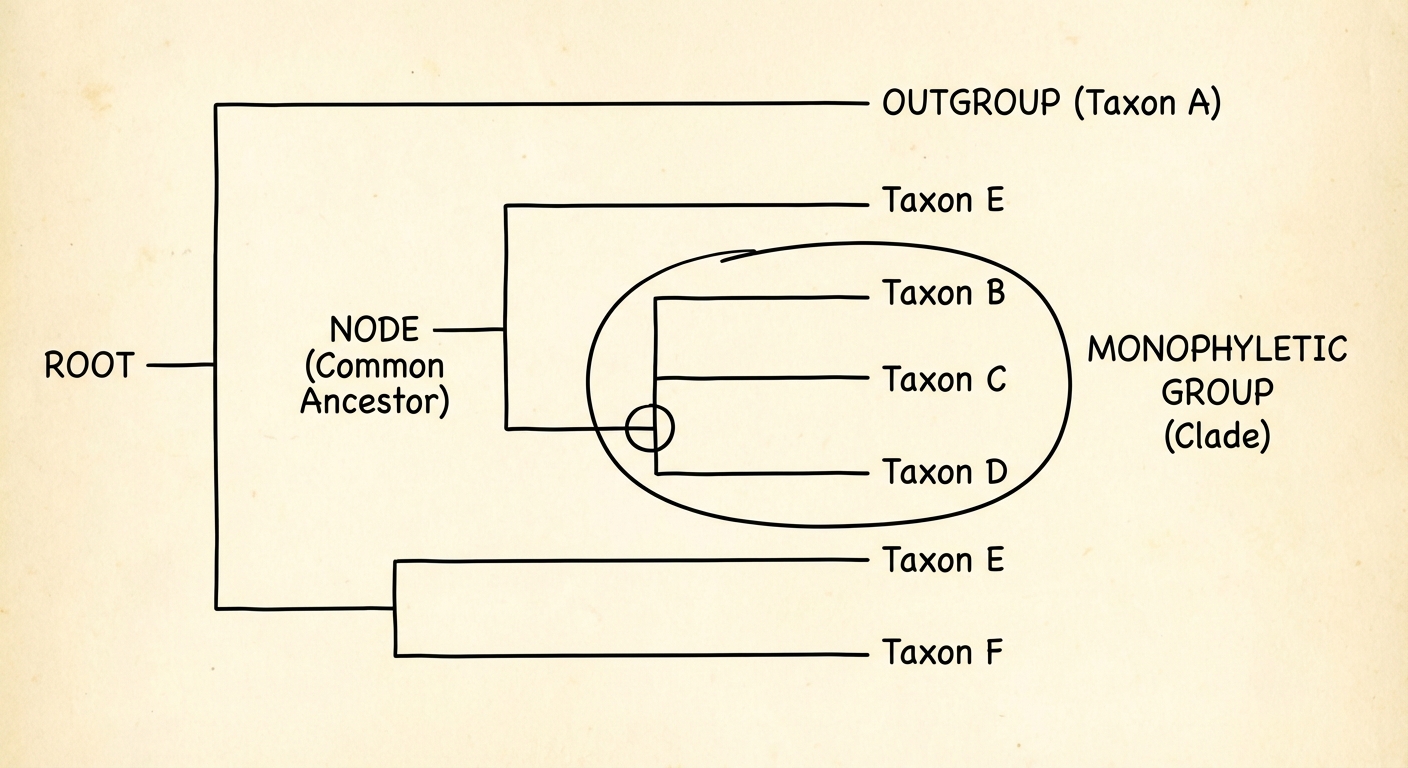
Key Rule: Rotation around a node does not change the relationships. $A$ next to $B$ implies relationship only if they share a recent node.
Speciation
Speciation is the process by which one species splits into two or more species. A biological species is defined by the ability to interbreed and produce viable, fertile offspring.
Reproductive Barriers
barriers that prevent gene flow between populations.
- Pre-zygotic Barriers (Prevent mating/fertilization):
- Habitat Isolation: Live in different areas.
- Temporal Isolation: Breed at different times of day/year.
- Behavioral Isolation: Unique courtship rituals.
- Mechanical Isolation: Morphological differences start mating.
- Gametic Isolation: Sperm cannot fertilize the egg.
- Post-zygotic Barriers (Prevent hybrid success):
- Reduced Hybrid Viability: Offspring do not survive.
- Reduced Hybrid Fertility: Offspring are sterile (e.g., Mule).
Modes of Speciation
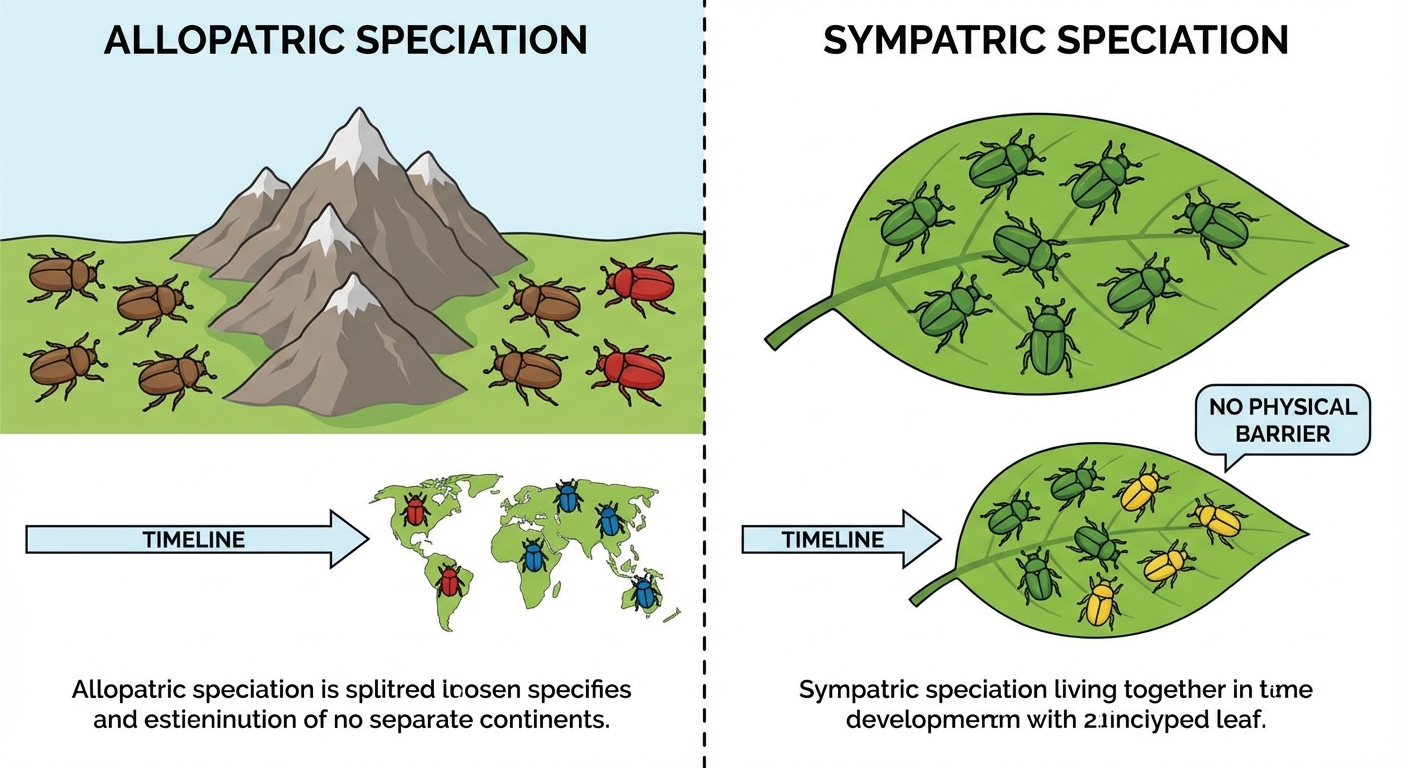
- Allopatric Speciation ("Other Country"): Gene flow is interrupted when a population is divided into structurally geographically isolated subpopulations (e.g., a river changes course, a canyon forms).
- Sympatric Speciation ("Same Country"): Speciation occurs in populations that live in the same geographic area. (Driven by polyploidy in plants, or sexual selection/habitat differentiation in animals).
Pace of Evolution
- Gradualism: Selection and variation happen gradually over long periods.
- Punctuated Equilibrium: Species appear suddenly, persist essentially unchanged for some time (stasis), and then apparently disappear. Often associated with rapid environmental change.
Origins of Life
The Primitive Atmosphere
Based on the Oparin-Haldane hypothesis, early Earth encouraged abiotic synthesis of organic molecules.
- Atmosphere: Water vapor, Nitrogen, CO2, Methane ($CH4$), Ammonia ($NH3$), Hydrogen ($H_2$).
- Missing Component: Almost NO free Oxygen ($O_2$). This was crucial because oxygen is reactive and would have broken down forming molecules.
Miller-Urey Experiment
Stanley Miller and Harold Urey simulated early Earth conditions (gases + sparks for lightning). They successfully produced amino acids, proving that organic molecules can form from inorganic precursors.
RNA World Hypothesis
It is believed that RNA was the first genetic material, not DNA.
- RNA can store genetic information.
- RNA (ribozymes) can act as a catalyst (enzyme) to self-replicate.
Common Mistakes & Pitfalls
- "Individuals Evolve": NEVER say this. Individuals survive or die; Populations evolve.
- "Evolution has a goal": Evolution does not create "perfect" organisms. It selects for whatever variations happen to exist that work best in the current environment. If the environment changes, the "best" trait changes.
- Lamarckian Language: Avoid saying organisms "needed" a trait or "tried" to adapt. Organisms either have the specific allele or they don't. Use phrases like "Individuals with mutation X had a survival advantage…"
- Hardy-Weinberg Calculations: Remember the difference between allele frequency ($p, q$) and genotype frequency ($p^2, 2pq, q^2$). Read the question carefully: does it give you the number of individuals (genotype) or the frequency of the gene?
- Dominant = Common: A dominant allele is not necessarily the most common one in a population (e.g., polydactyly is dominant but rare).